
Fact Check: Does Ranked Choice Voting Actually Fix Political Polarization?
As more jurisdictions adopt ranked-choice voting, advocates promise it will reduce extremism, boost turnout, and end negative campaigning. A review of recent academic evidence reveals a more complicated reality: while it successfully reduces primary-to-runoff drop-off and encourages civility in some races, its impact on broader polarization remains fiercely debated.
By Factlen Editorial Team
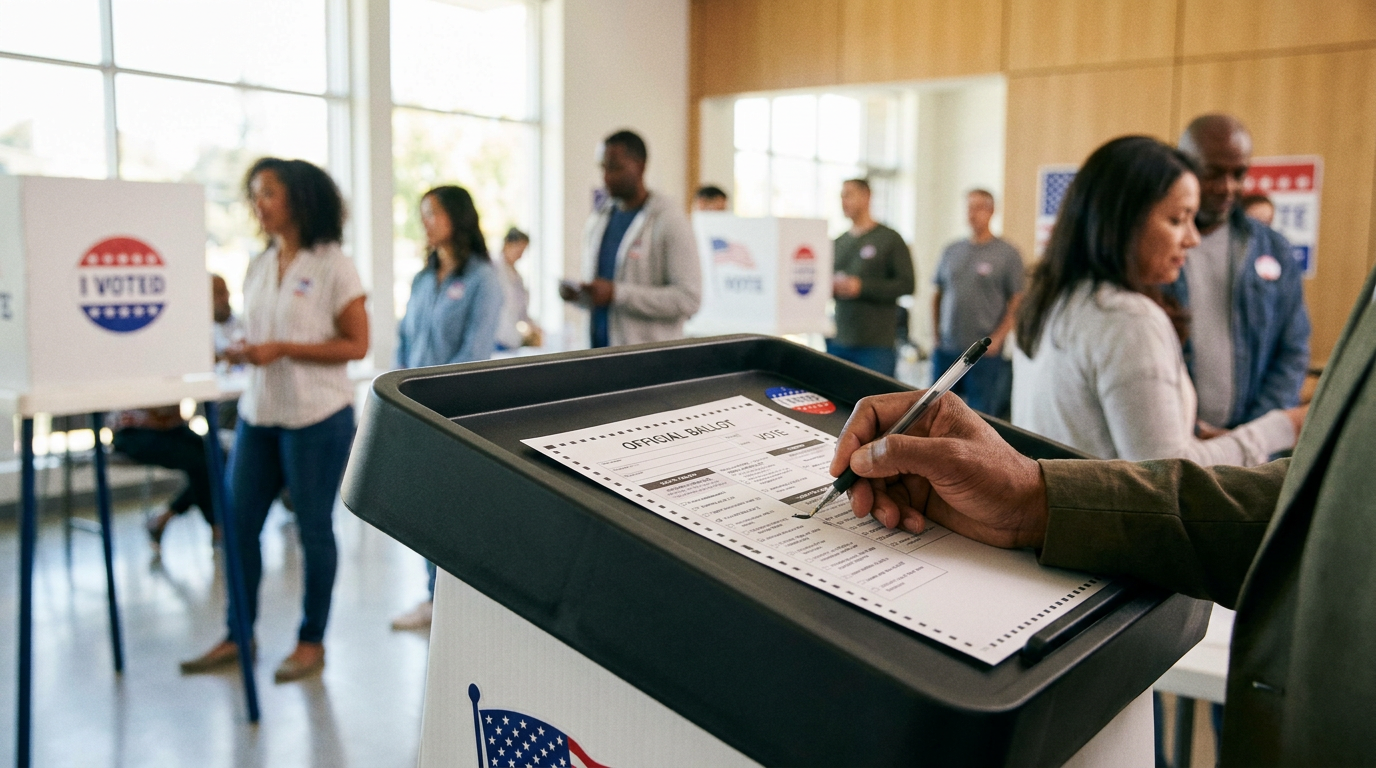
- Electoral Reform Advocates
- Argue that RCV disincentivizes hyperpartisanship, rewards broad consensus, and eliminates the 'spoiler effect' of third-party candidates.
- Skeptical Political Scientists
- Point to data showing RCV can sometimes elect more ideologically divergent candidates and highlight the learning curve for voters.
- Civic Engagement Researchers
- Focus on the mechanics of turnout, noting RCV successfully combines primary and runoff elections but requires voter education to prevent ballot errors.
What's not represented
- · Local election administrators managing the logistical transition
- · Third-party candidates who run in RCV systems
Why this matters
With over 50 jurisdictions currently using ranked-choice voting and several states considering ballot measures to adopt it, understanding the actual data behind this electoral reform is crucial. Voters need to know whether changing the mechanics of the ballot box genuinely improves democratic outcomes or simply shifts the strategic landscape.
Key points
- Ranked Choice Voting (RCV) requires candidates to secure a majority of votes through multiple rounds of tabulation.
- A Harvard study found RCV reduced rhetorical extremism among candidates in Maine by over 20%.
- Other models suggest RCV can occasionally elect more ideologically divergent candidates in highly polarized states.
- RCV successfully eliminates the severe drop in voter turnout that occurs between primary and runoff elections.
- Voters in RCV jurisdictions consistently report experiencing less negative campaigning and higher satisfaction with the election process.
For over a century, the vast majority of American elections have operated on a simple premise: the candidate with the most votes wins, even if they fall short of a majority. But in recent years, a rapidly growing movement has championed Ranked Choice Voting (RCV) as a structural cure for the nation's democratic ailments. Proponents argue that allowing voters to rank their preferences rather than picking a single candidate will lower the temperature in politics, increase voter turnout, and disincentivize toxic campaigning [5][7].[5][7]
The mechanics of RCV, specifically the Instant Runoff Voting (IRV) variant used in places like Maine and Alaska, are straightforward. If no candidate wins an outright majority of first-choice votes, the candidate with the fewest votes is eliminated. The ballots cast for that eliminated candidate are then redistributed to those voters' second choices. This process repeats until one candidate secures a majority [4][7].[4][7]

The central promise of RCV is that it reduces political polarization. Because candidates need second- and third-choice votes to survive multiple rounds of tabulation, the theory suggests they must appeal to a broader swath of the electorate rather than simply firing up a narrow, extreme base [5].[5]
Some academic evidence supports this moderating effect. A 2025 study out of Harvard University analyzed the campaign platforms of congressional candidates in Maine before and after the state adopted RCV in 2018. Utilizing text-based analysis, the researchers found that RCV led to a 20.5% decrease in the rhetorical extremism of candidate platforms. The data suggests that the mechanical need to secure broader voter appeal genuinely contributed to a more moderate political environment in that state [1].[1]

However, other political scientists warn that RCV is not a universal antidote to polarization. A comprehensive 2024 analysis published in the University of Illinois Law Review modeled the prospective effects of adopting Instant Runoff Voting nationwide. The researchers found that in highly polarized states, IRV can actually produce winning candidates who are more ideologically divergent from the median voter than traditional plurality systems [2].[2]
The researchers noted that while RCV successfully combated extremist tendencies in specific races—such as Alaska's 2022 congressional elections—the mathematical formulas used to redistribute votes do not always yield moderate consensus winners when the electorate itself is deeply divided [2]. This suggests that RCV's ability to moderate politics depends heavily on the existing political geography of the state [2][7].[2][7]
Beyond polarization, advocates frequently claim that RCV boosts voter turnout and engagement. The evidence here is robust, but highly specific. A landmark study by researchers at the University of Missouri-St. Louis compared cities using RCV with demographically similar cities using plurality voting. They found that RCV does not necessarily cause a massive surge in baseline municipal turnout [3].[3]
Beyond polarization, advocates frequently claim that RCV boosts voter turnout and engagement.
Where RCV undeniably succeeds is in eliminating the severe drop-off in voter participation that plagues traditional runoff elections. Because RCV combines the primary and the runoff into a single "instant" event, it ensures that the final decisive round of counting features the maximum number of participating voters, rather than the fraction who typically return to the polls weeks later for a runoff [3][7].[3][7]

There is also evidence that RCV changes how campaigns interact with voters, which can indirectly boost engagement. Studies have shown that candidates in RCV cities are more likely to reach out to voters in person, leading to a measurable 9-point increase in youth voter turnout in certain jurisdictions. The necessity of asking for a "second choice" vote forces campaigns to knock on doors they might otherwise ignore [7].[7]
Yet, civic researchers also point to a persistent challenge known as "ballot exhaustion." If a voter only ranks one or two candidates, and those candidates are eliminated early in the tally, that voter's ballot is "exhausted" and does not factor into the final round that determines the winner. Data from recent elections in New York City and Alaska indicates that electorates with heavy concentrations of ethnic and racial minorities sometimes experience higher rates of ballot exhaustion, raising questions about the need for extensive voter education [3][7].[3][7]
The third major claim tested by researchers is whether RCV reduces negative campaigning. The logic is intuitive: a candidate is less likely to launch a vicious attack ad against a rival if they need that rival's supporters to rank them second [5].[5]
Survey data largely backs this up. A study comparing voters in RCV cities to those in plurality cities found that respondents in RCV jurisdictions perceived significantly less candidate criticism and negative campaigning. They were also measurably more satisfied with the conduct of the local campaigns [4][7].[4][7]
This dynamic was vividly illustrated in a 2022 study by the Center for Campaign Innovation, which analyzed two Republican congressional primaries in Virginia. One district used a traditional plurality vote, while the other used an RCV "firehouse primary." In the RCV district, 84% of voters said the candidates ran a positive campaign, compared to just 59% in the plurality district. Furthermore, the winning candidate in the RCV district emerged with a significantly higher net favorability rating [6].[6]

Despite these benefits, the transition to RCV requires a learning curve. A University of Chicago review noted that in survey experiments, US voters initially preferred the simplicity of casting a single vote over filling out a ranked ballot. However, this preference weakened among respondents who had actual experience using ranked ballots in real elections [4].[4]
Ultimately, the academic consensus suggests that Ranked Choice Voting is a powerful mechanical shift, but not a magic wand. It successfully eliminates the spoiler effect, solves the problem of runoff drop-off, and demonstrably encourages more civil campaigning. But as an antidote to deep-seated national polarization, the evidence remains mixed, proving that no ballot design can entirely engineer away a divided electorate [2][7].[2][7]
How we got here
2004
San Francisco implements Ranked Choice Voting for its municipal elections, becoming a major early adopter.
2018
Maine becomes the first state to use RCV for federal congressional elections.
2020
Alaska voters approve a ballot measure establishing a top-four open primary followed by an RCV general election.
2024
Multiple states feature ballot initiatives to either adopt or ban Ranked Choice Voting, reflecting growing national debate.
Viewpoints in depth
Electoral Reform Advocates
Argue that RCV is a necessary structural change to fix broken campaign incentives.
Advocacy groups like FairVote view the plurality voting system as the root cause of toxic polarization and the 'spoiler effect.' They argue that when candidates only need 35% or 40% of the vote to win a crowded primary, they are incentivized to cater exclusively to their most extreme base and attack their rivals. By requiring candidates to build a coalition that reaches 50%, RCV forces politicians to engage with voters outside their core demographic and campaign on issues rather than insults.
Skeptical Political Scientists
Caution that mathematical voting models do not always produce moderate outcomes in the real world.
Researchers analyzing the mathematical properties of Instant Runoff Voting point out that it is not immune to electing polarizing figures. In highly divided electorates, the sequence of candidate elimination can sometimes result in a moderate candidate being knocked out early, leaving voters to choose between two extremes in the final rounds. These scholars emphasize that while RCV solves specific problems like the spoiler effect, it cannot magically manufacture a moderate consensus in a state where the voters themselves are deeply polarized.
Civic Engagement Researchers
Focus on the practical impacts of RCV on voter turnout, ballot completion, and campaign contact.
For researchers studying voter behavior, the most significant benefit of RCV is its ability to consolidate elections. By eliminating the need for a separate runoff election weeks later, RCV ensures that the final decision is made when turnout is at its peak. However, these researchers also highlight the critical need for voter education. If voters do not understand that they can rank multiple candidates, their ballots may become 'exhausted' early in the tally, effectively removing their voice from the final, decisive round of counting.
What we don't know
- Whether the moderating effects seen in states like Maine will replicate in larger, more diverse states.
- The long-term impact of RCV on the viability and growth of third-party political movements.
- How quickly the rate of 'ballot exhaustion' decreases as voters become more accustomed to ranking candidates over multiple election cycles.
Key terms
- Ranked Choice Voting (RCV)
- An electoral system where voters rank candidates by preference on their ballots, rather than selecting just one.
- Instant Runoff Voting (IRV)
- The most common form of RCV in the US, where the lowest-polling candidates are sequentially eliminated and their votes transferred until one candidate reaches a majority.
- Plurality Voting
- The traditional US electoral system where the candidate with the most votes wins, even if they do not secure a majority (over 50%) of the total votes cast.
- Spoiler Effect
- A phenomenon in plurality voting where a minor candidate draws votes away from a major candidate with similar politics, inadvertently helping a candidate from the opposing side win.
Frequently asked
What is ballot exhaustion?
Ballot exhaustion occurs when a voter only ranks a few candidates, and all of those chosen candidates are eliminated early in the counting process. Because the voter did not rank the remaining candidates, their ballot does not factor into the final round that determines the winner.
Does Ranked Choice Voting favor one political party?
Academic research indicates that RCV does not inherently favor Democrats or Republicans. Instead, it tends to favor candidates who can build broad coalitions and secure second-choice votes from their opponents' supporters, regardless of their party affiliation.
How does RCV affect third-party candidates?
RCV eliminates the 'spoiler effect,' allowing voters to rank a third-party candidate first without fear of wasting their vote. If the third-party candidate is eliminated, the voter's ballot simply transfers to their second choice, which is often a major-party candidate.
Sources
Source coverage
7 outlets
3 viewpoints surfaced







[1]Harvard UniversityCivic Engagement Researchers
More Choices, Less Extremism: The Effect of Ranked-Choice Voting on Political Extremism in Maine
Read on Harvard University →[2]University of Illinois Law ReviewSkeptical Political Scientists
Beyond the Spoiler Effect: Can Ranked-Choice Voting Solve the Problem of Political Polarization?
Read on University of Illinois Law Review →[3]University of Missouri-St. LouisCivic Engagement Researchers
Voter Participation with Ranked Choice Voting in the United States
Read on University of Missouri-St. Louis →[4]University of ChicagoSkeptical Political Scientists
Promise of the Reform: Ranked-Choice Voting
Read on University of Chicago →[5]FairVoteElectoral Reform Advocates
Ranked choice voting lowers polarization in politics
Read on FairVote →[6]Center for Campaign InnovationCivic Engagement Researchers
Ranked Choice Voting Resulted In A More Positive Campaign
Read on Center for Campaign Innovation →[7]Factlen Editorial Team
Synthesis by Factlen editorial team
Read on Factlen Editorial Team →


Every angle. Every day.
Get news politics stories with full source coverage and perspective breakdowns delivered to your inbox.