
The Science of VO2 Max: Why Cardiorespiratory Fitness is the Ultimate Longevity Metric
Extensive clinical data reveals that cardiorespiratory fitness, specifically measured by VO2 max, is a stronger predictor of lifespan than smoking, diabetes, or heart disease.
By Factlen Editorial Team
- Clinical Cardiologists
- Focus on VO2 max as a vital sign for disease prevention and stratifying patient mortality risk.
- Exercise Physiologists
- Focus on the mechanics of training zones, mitochondrial adaptations, and maximizing human performance.
- Preventive Gerontologists
- Focus on how aerobic capacity delays frailty, preserves brain volume, and extends independent healthspan.
- Synthesis Analysts
- Evaluate the aggregate data to provide actionable longevity protocols for the general public.
What's not represented
- · Primary Care Physicians facing systemic barriers to prescribing exercise
- · Health Insurance Providers evaluating fitness metrics for premium adjustments
Why this matters
Understanding and improving your VO2 max offers one of the few scientifically proven pathways to not just live longer, but to dramatically extend the years you spend healthy, active, and independent. Unlike genetic factors, cardiorespiratory fitness is highly modifiable at any age.
Key points
- VO2 max is the single strongest predictor of human lifespan, outperforming traditional metrics like smoking or diabetes.
- Moving from the lowest to the highest quartile of fitness reduces all-cause mortality risk by nearly 500%.
- Aerobic exercise combats aging at the cellular level by forcing the body to build new, efficient mitochondria.
- A polarized training model—combining steady Zone 2 cardio with intense Zone 5 intervals—yields the best results.
- Cardiorespiratory fitness is highly modifiable, and significant improvements can be made at any age.
The modern pursuit of longevity is often clouded by expensive supplements, unproven biohacking trends, and complex dietary restrictions. Yet, the most robust, scientifically validated predictor of a long, healthy life requires no prescription and is accessible to almost everyone. According to decades of clinical data, cardiorespiratory fitness stands alone as the single greatest biomarker for human lifespan.[6]
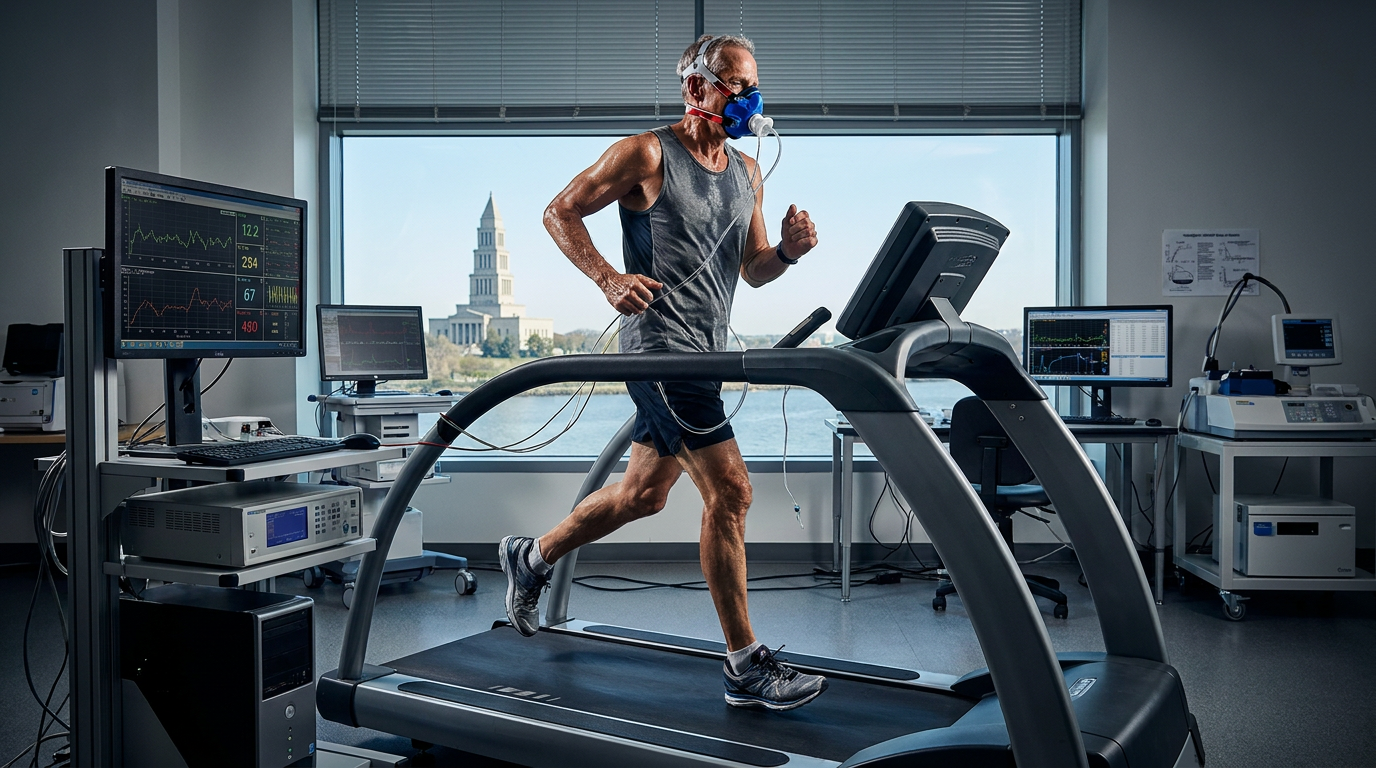
This metric is most accurately quantified by VO2 max, which measures the maximum amount of oxygen your body can utilize during intense exercise. It is the ultimate test of your heart, lungs, blood vessels, and muscle cells working in unison to produce energy. When this system is highly efficient, the entire body operates with a profound biological advantage.[1][2]
To understand the magnitude of its impact, researchers have compared low cardiorespiratory fitness to traditional health risks. The results are consistently staggering. The American Heart Association has formally urged the medical community to adopt cardiorespiratory fitness as a standard clinical vital sign, noting that its predictive power for mortality is unparalleled.[1]
A landmark study published in the Journal of the American College of Cardiology analyzed over 120,000 patients who underwent exercise treadmill testing. The researchers found that moving from the lowest quartile of fitness to the highest quartile reduces all-cause mortality risk by nearly 500 percent. The survival curves between the least fit and most fit individuals diverge so sharply that researchers noted there is almost no upper limit to the benefits of aerobic fitness.[3]
To put that in perspective, having a low VO2 max is a significantly greater risk factor for death than being a current smoker, having type 2 diabetes, or suffering from coronary artery disease. While modern medicine heavily medicates the latter conditions, the former is often ignored in standard annual physicals.[1][3]

The mechanism behind this protective effect lies deep within our cells, specifically in the mitochondria. These microscopic organelles are the powerhouses responsible for converting oxygen and nutrients into usable cellular energy, a process known as cellular respiration.[2][4]
As we age, mitochondrial function naturally declines. They become less efficient, produce more oxidative stress, and die off. This cellular decay is a primary driver of the physical frailty, metabolic syndrome, and cognitive decline that we associate with getting older.[4]
However, rigorous aerobic exercise directly combats this decay. It stimulates a process called mitochondrial biogenesis, effectively forcing the body to build new, more efficient energy factories while clearing out the old, dysfunctional ones. This keeps the cellular machinery operating at a youthful capacity.[2]

Exercise physiologists divide cardiovascular training into distinct intensity zones to target different physiological adaptations. The foundation of mitochondrial health is built in what is commonly referred to as "Zone 2"—a steady, moderate intensity where you can still hold a conversation, but with noticeable effort.[5][6]
Exercise physiologists divide cardiovascular training into distinct intensity zones to target different physiological adaptations.
Spending 150 to 200 minutes a week in Zone 2 trains the body to efficiently burn fat for fuel and clears metabolic waste. This creates a massive base of cellular health and durability, allowing the heart to pump more blood with less effort over time.[2][5]
But while Zone 2 builds the foundation, raising your actual VO2 max ceiling requires pushing the cardiovascular system to its absolute limit. This is where high-intensity interval training, often referred to as Zone 5, becomes essential.[3][6]
Zone 5 involves short, grueling bursts of maximum effort—such as four-minute sprints followed by four minutes of recovery—that force the heart to pump maximal blood volumes. This sheer mechanical stress triggers the heart muscle to become stronger and more elastic.[5]
The combination of high-volume Zone 2 and low-volume Zone 5 creates a polarized training model that yields the highest improvements in cardiorespiratory fitness. This dual approach ensures both cellular efficiency and maximum cardiac output.[2][6]

The benefits of a high VO2 max extend far beyond the heart. Because the brain is a highly metabolic organ that requires massive amounts of oxygen, robust cardiorespiratory fitness is strongly correlated with preserved brain volume and a significantly lower risk of neurodegenerative diseases like Alzheimer's.[4]
Despite the overwhelming evidence, the medical community has been slow to adopt VO2 max testing as a standard practice. The equipment is expensive, the test requires the patient to exercise to exhaustion, and physicians are rarely reimbursed for administering it outside of specialized sports cardiology clinics.[1][6]
Transparent uncertainty also remains regarding the absolute upper limits of benefit. While moving from "poor" to "above average" fitness yields massive mortality reductions, the marginal benefit of moving from "elite" to "Olympic level" is less clear, and extreme endurance exercise carries its own rare risks, such as atrial fibrillation.[3][5]
Furthermore, genetics play an undeniable role in an individual's absolute ceiling. Some individuals are "high responders" to aerobic training, seeing rapid increases in their VO2 max, while others must work twice as hard for modest physiological gains.[4]
Nevertheless, the physiological truth remains universal: everyone, regardless of their genetic baseline or starting age, can improve their cardiorespiratory fitness. Studies on septuagenarians have shown that initiating a structured aerobic program can reverse decades of cardiac stiffening.[5]

For those without access to a laboratory, proxy measurements like the 12-minute Cooper run test or modern smartwatch estimates provide a highly useful baseline to track progress over time.[1][6]
In the complex and often contradictory landscape of longevity science, VO2 max offers a rare beacon of clarity. It is a measurable, modifiable metric that directly dictates the length and quality of our lives, proving that the fountain of youth is built through sustained, deliberate effort.[6]
How we got here
1923
British physiologist A.V. Hill first introduces the concept of maximal oxygen uptake (VO2 max) in human performance.
1968
Dr. Kenneth Cooper publishes 'Aerobics', popularizing the concept of cardiorespiratory fitness for the general public.
2016
The American Heart Association publishes a scientific statement urging the medical community to adopt cardiorespiratory fitness as a clinical vital sign.
2018
The Journal of the American College of Cardiology publishes a massive 120,000-patient study proving the unparalleled mortality benefits of high fitness.
2020s
Advances in wearable technology make continuous VO2 max estimation accessible to millions outside of clinical laboratories.
Viewpoints in depth
Clinical Cardiologists
Focus on VO2 max as a vital sign for disease prevention and stratifying patient mortality risk.
For clinical cardiologists and epidemiologists, the data surrounding VO2 max is viewed primarily through the lens of risk reduction. They argue that the medical establishment's hyper-focus on pharmaceutical interventions for cholesterol and blood pressure misses the forest for the trees. By treating low cardiorespiratory fitness as a primary disease state rather than an afterthought, they believe millions of premature deaths from heart disease and metabolic syndrome could be prevented. Their push is for standardized, reimbursed fitness testing in annual physicals.
Exercise Physiologists
Focus on the mechanics of training zones, mitochondrial adaptations, and maximizing human performance.
Exercise physiologists look past the mortality statistics and focus on the cellular mechanics of how to actually move the needle. This camp emphasizes the necessity of polarized training—specifically the strict adherence to Zone 2 heart rates to build mitochondrial density, paired with the agonizing effort of Zone 5 intervals to increase cardiac stroke volume. They frequently caution against the 'junk miles' of moderate-intensity exercise, arguing that most people exercise too hard on their easy days and too easy on their hard days to elicit true physiological adaptation.
Preventive Gerontologists
Focus on how aerobic capacity delays frailty, preserves brain volume, and extends independent healthspan.
Gerontologists view VO2 max not just as a heart metric, but as a proxy for total-body resilience against the decay of aging. They highlight that a high VO2 max correlates strongly with preserved muscle mass, bone density, and neurological health. For this camp, the goal isn't necessarily athletic performance, but 'healthspan'—ensuring that an 80-year-old has the physical capacity to carry groceries, climb stairs, and recover from a fall. They view aerobic exercise as the most potent, pleiotropic anti-aging drug currently known to science.
What we don't know
- The exact point of diminishing returns where extreme endurance exercise no longer provides additional longevity benefits.
- The precise genetic mechanisms that make some individuals 'high responders' to aerobic training while others see slower progress.
- How to effectively integrate comprehensive VO2 max testing into standard, insurance-reimbursed primary care.
Key terms
- VO2 Max
- The maximum rate at which the heart, lungs, and muscles can effectively use oxygen during exercise, used as the primary indicator of cardiorespiratory fitness.
- Mitochondria
- Organelles within cells that generate most of the chemical energy needed to power the cell's biochemical reactions.
- Healthspan
- The period of a person's life during which they are generally healthy and free from serious or chronic illness, as opposed to just lifespan (total years alive).
- All-cause mortality
- The death rate from all causes of death for a population in a given time period, used in research to measure overall survival benefits.
- Polarized Training
- An exercise regimen where the vast majority of training is done at a low intensity (Zone 2), with a small fraction done at very high intensity (Zone 5), avoiding the moderate 'gray zone'.
Frequently asked
Can I improve my VO2 max if I am over 60?
Yes. Clinical studies show that older adults can significantly improve their VO2 max and reverse age-related cardiac stiffening through structured aerobic training.
Do I need to go to a lab to test my VO2 max?
While a laboratory test with a mask is the most accurate, field tests like the 12-minute Cooper run or estimates from high-end smartwatches provide a reliable baseline for tracking your progress.
Is walking enough to improve my fitness?
Walking is excellent for general health, but significantly raising your VO2 max requires pushing your heart rate higher into Zone 2 (moderate effort) and occasionally Zone 5 (maximum effort).
What is Zone 2 cardio?
Zone 2 is a steady-state cardiovascular exercise intensity where you are working but can still comfortably hold a conversation, typically around 60-70% of your maximum heart rate.
Sources
Source coverage
6 outlets
4 viewpoints surfaced






[1]American Heart AssociationClinical Cardiologists
Importance of Assessing Cardiorespiratory Fitness in Clinical Practice: A Case for Fitness as a Clinical Vital Sign
Read on American Heart Association →[2]National Institutes of HealthExercise Physiologists
Mitochondrial Biogenesis and Exercise: Mechanisms and Implications for Healthspan
Read on National Institutes of Health →[3]Journal of the American College of CardiologyClinical Cardiologists
Association of Cardiorespiratory Fitness With Long-term Mortality Among Adults Undergoing Exercise Treadmill Testing
Read on Journal of the American College of Cardiology →[4]Nature AgingPreventive Gerontologists
The hallmarks of aging and the protective effects of rigorous aerobic exercise
Read on Nature Aging →[5]The Lancet Healthy LongevityPreventive Gerontologists
Dose-response associations between aerobic training zones and all-cause mortality in older adults
Read on The Lancet Healthy Longevity →[6]Factlen Editorial TeamSynthesis Analysts
Synthesis by Factlen editorial team
Read on Factlen Editorial Team →
Every angle. Every day.
Get health stories with full source coverage and perspective breakdowns delivered to your inbox.