
The Science of Emulsification: How to Build Perfectly Stable Sauces at Home
Mastering vinaigrettes, mayonnaise, and pan sauces comes down to a single chemical trick: forcing oil and water to coexist. Understanding the mechanics of emulsifiers and shear force can permanently elevate your home cooking.
By Factlen Editorial Team
- Food Scientists
- Emulsions are thermodynamically unstable systems that require precise control of droplet size and interfacial tension.
- Culinary Traditionalists
- Perfect emulsions rely on classical technique, patience, and sensory feedback during the cooking process.
- Modern Home Cooks
- Science and modern tools should be leveraged to make classic techniques foolproof and accessible.
What's not represented
- · Commercial Food Manufacturers
- · Vegan Recipe Developers
Why this matters
Mastering emulsification shifts a home cook from blindly following recipes to understanding the underlying mechanics of flavor delivery. A properly emulsified sauce ensures that acids, fats, and seasonings are distributed evenly across every bite, rather than pooling into a greasy, separated mess.
Key points
- Emulsification is the chemical process of forcing oil and water to mix, forming the basis of mayonnaise, vinaigrettes, and pan sauces.
- Emulsifiers like egg yolks and mustard contain molecules with both water-loving and fat-loving ends, acting as a bridge between the liquids.
- Mechanical shear force, such as whisking or blending, is required to break the dispersed liquid into microscopic droplets.
- High-speed blending of extra-virgin olive oil can strip fatty acids from polyphenols, resulting in a bitter-tasting sauce.
- A broken emulsion can be rescued by slowly whisking the separated mixture into a fresh stabilizer like a new egg yolk or mustard.
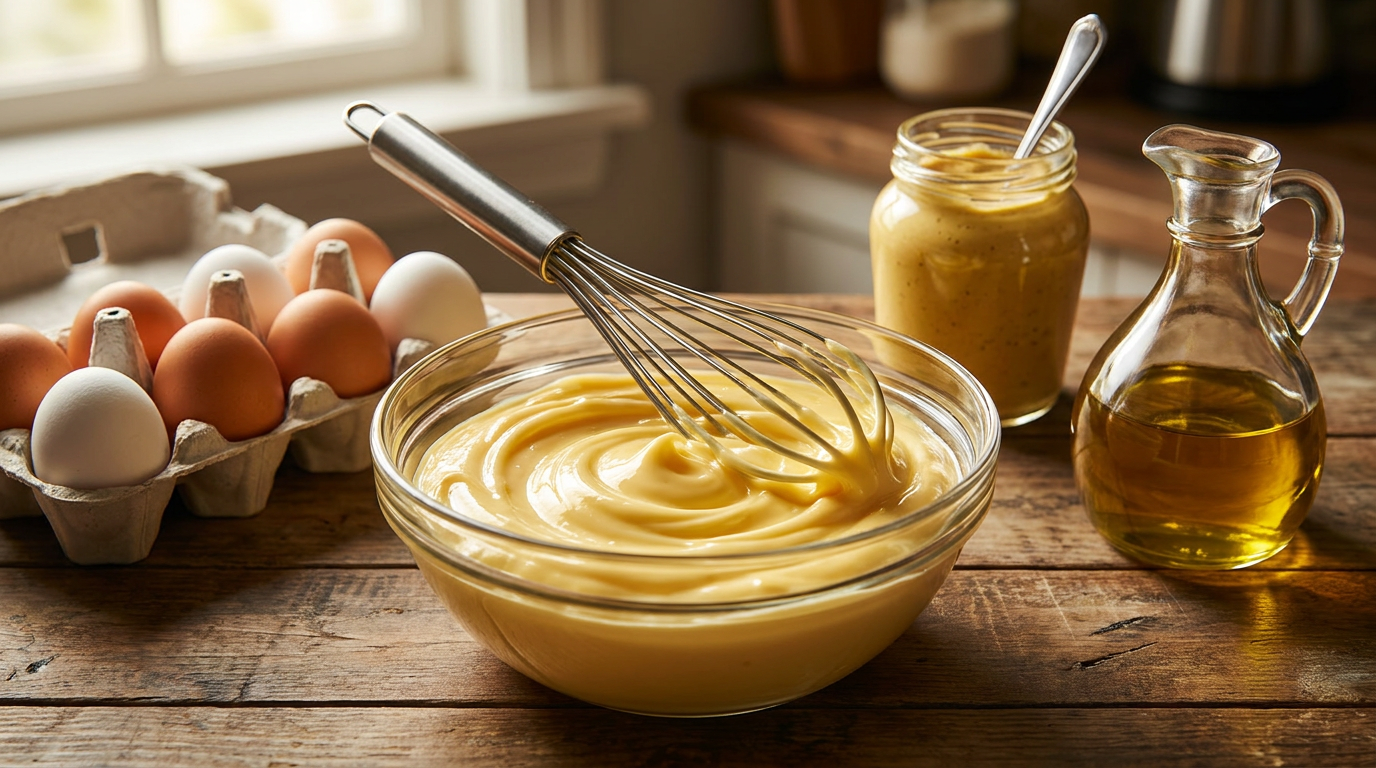
Cooking is often romanticized as an art form, but at the stovetop, it is fundamentally an exercise in chemistry and physics. One of the most essential magic tricks a cook can perform is forcing two natural enemies—fat and water—to peacefully coexist in a single, cohesive liquid. This process, known as emulsification, is the invisible architecture behind the world's greatest condiments and dressings. It is the mechanism that transforms raw egg yolks and oil into thick, creamy mayonnaise, turns butter and wine into a glossy pan sauce, and creates vinaigrettes that cling perfectly to delicate salad greens rather than pooling sadly at the bottom of the bowl. Understanding how to build and maintain these structures separates intuitive cooks from those who merely follow recipes.[1][5]
Left to their own devices, aqueous solutions—like vinegar, lemon juice, or wine—and lipids—like olive oil or melted butter—will violently reject one another. This is due to their molecular structures. Water molecules are polar, meaning they carry a slight electrical charge that makes them highly attracted to each other. Oil molecules, on the other hand, are non-polar and hydrophobic. When the two are mixed, the water molecules actively squeeze the oil out of the way to bond with one another. Without intervention, the mixture will rapidly separate into distinct, unappetizing layers, leaving a greasy film on the palate and uneven flavor distribution.[3][4]
To bridge this chemical divide, cooks must rely on specialized molecules known as emulsifiers. These molecules—often proteins or complex carbohydrates—possess a unique split personality. One end of the molecule is hydrophilic, meaning it is strongly attracted to water, while the opposite end is lipophilic, meaning it readily binds to fat. When introduced into a hostile mixture of oil and water, emulsifiers act as chemical diplomats. They embed their fat-loving tails into microscopic oil droplets while their water-loving heads face outward into the liquid. This effectively coats the fat, creating a protective barrier that prevents the oil droplets from fusing back together.[1][3][6]

Fortunately, the standard home kitchen is already stocked with powerful natural emulsifiers. The most famous is lecithin, a phospholipid found abundantly in egg yolks, which serves as the heavy lifter behind mayonnaise, aioli, and hollandaise sauce. For vinaigrettes, the mucilage present in the outer coating of mustard seeds makes Dijon mustard an exceptional and flavorful stabilizer. Other common pantry staples, including honey, garlic paste, and concentrated tomato paste, can also provide enough structural interference to keep a temporary emulsion from breaking during a meal, even if they lack the sheer binding power of egg yolks.[1][2]
In food science, these mixtures are categorized by their structural phases. An emulsion always consists of a "continuous phase" and a "dispersed phase." In mayonnaise and vinaigrettes, water is the continuous phase, and the oil is dispersed throughout it in microscopic droplets, creating an oil-in-water emulsion. Conversely, butter and heavy cream are water-in-oil emulsions, where tiny water droplets are trapped within a continuous matrix of dairy fat. Understanding which phase you are building dictates the order of operations; you must always start with the continuous phase and slowly introduce the dispersed phase to avoid overwhelming the system.[3][4]
In food science, these mixtures are categorized by their structural phases.
However, chemical emulsifiers cannot do the job alone; they require the application of mechanical violence. In culinary terms, this is known as shear force. Whether a cook is whisking vigorously by hand in a copper bowl, shaking a tightly sealed mason jar, or firing up a high-speed blender, the physical goal remains the same: to smash the dispersed phase into millions of microscopic droplets. The smaller and more uniform these droplets become, the more viscous, creamy, and stable the resulting sauce will be. Without sufficient shear force, the emulsifiers cannot adequately coat the fat, and the sauce will remain thin and greasy.[1][4]
Modern kitchen tools have revolutionized the application of shear force, making notoriously difficult emulsions nearly foolproof. While traditional mayonnaise requires a slow, agonizing drop-by-drop addition of oil into egg yolks while whisking frantically, an immersion blender can accomplish the exact same task in under a minute. By placing the heavy liquids—the egg, mustard, and acid—at the bottom of a tight-fitting jar and pouring the oil directly on top, the spinning blade creates a powerful vortex. This vortex gradually pulls the oil downward, shearing it into perfect microscopic suspension with zero risk of human error.[1][5]

Even the most perfectly executed emulsions are thermodynamically unstable systems that will eventually succumb to entropy. Food scientists categorize this structural breakdown into several specific mechanisms. The most common are flocculation, where oil droplets clump together without losing their individual protective membranes, and coalescence, where the droplets fully merge back into large, visible pools of oil. When this happens in the kitchen, the sauce is referred to as "broken" or "split," transforming from a smooth, opaque cream into a curdled, unappetizing soup of separated fat and liquid.[3][6]
Temperature control plays a critical role in maintaining the kinetic stability of these delicate systems. Heat increases the kinetic energy of the molecules, causing them to move rapidly and collide with much greater force. If a pan sauce or a hollandaise gets too hot, the emulsifier proteins can actually denature—essentially cooking—and lose their chemical binding ability. Once the proteins seize, the fat droplets instantly coalesce. This is precisely why cold butter must be whisked into a pan sauce off the direct heat, and why classic hollandaise requires the gentle, indirect warmth of a double boiler.[4][5]
There is also a distinct chemical trap when applying high shear force to certain premium ingredients. Extra-virgin olive oil, for instance, contains bitter-tasting polyphenols that are naturally coated in fatty acids. When subjected to the extreme mechanical blades of a food processor or blender, these protective fatty acids are violently stripped away. This releases the raw polyphenols directly into the aqueous environment, turning the entire batch of mayonnaise or vinaigrette unpalatably bitter. For blended emulsions, neutral oils like canola, grapeseed, or standard refined olive oil are far safer bets.[2]

Fortunately, a broken emulsion is rarely a lost cause. Because the ingredients have not fundamentally changed their chemical composition, the suspension simply needs to be rebuilt from scratch. The most reliable culinary fix is to place a fresh stabilizer—such as a single egg yolk, a splash of heavy cream, or a teaspoon of mustard—into a clean bowl. By slowly whisking the broken, oily sauce drop-by-drop into the new stabilizer, the shear force and fresh emulsifiers will re-suspend the fat droplets, restoring the sauce to its glossy, cohesive glory without wasting the original ingredients.[2][5]
Ultimately, mastering the science of emulsification shifts a home cook from blindly following instructions to truly understanding the underlying mechanics of flavor delivery. A properly emulsified sauce does not just look more professional; it ensures that acids, fats, and seasonings are distributed perfectly evenly across every single bite. Whether dressing a simple weeknight salad or finishing a complex pan reduction for a seared steak, controlling the interaction between oil and water is the foundational skill that elevates everyday cooking into culinary craftsmanship.[1][5]
Viewpoints in depth
The Food Scientist's view
Emulsions are thermodynamically unstable systems that require precise control of droplet size and interfacial tension.
From a biochemical perspective, creating a stable emulsion is a battle against entropy. Food scientists focus on the rheology of the continuous phase and the kinetic energy of the system. They measure stability by how well emulsifiers—like proteins or polysaccharides—reduce the interfacial tension between oil and water. For industrial applications, achieving a microscopic, uniform droplet size through high-pressure homogenization is critical to preventing flocculation and extending shelf life.
The Traditional Chef's view
Perfect emulsions rely on classical technique, patience, and sensory feedback during the cooking process.
Classical culinary training treats emulsification as a foundational physical skill. Traditionalists argue that relying on immersion blenders or artificial stabilizers bypasses the essential sensory feedback of cooking. A chef learns to watch the viscosity of mayonnaise change with each drop of oil, or feels the exact moment a beurre blanc thickens in the pan. For this camp, a broken sauce is a failure of patience—usually the result of rushing the oil addition or failing to control the heat.
The Modern Home Cook's view
Science and modern tools should be leveraged to make classic techniques foolproof and accessible.
Modern culinary advocates, heavily influenced by food-science communicators, prioritize reliable results over traditional romance. If an immersion blender can create a perfectly stable, tightly sheared mayonnaise in 60 seconds without the risk of a sore arm or a broken sauce, it is the superior method. This camp embraces the strategic use of stabilizers—like adding a dash of mayonnaise to a vinaigrette to keep it emulsified for days—to make weeknight cooking highly efficient.
What we don't know
- Whether emerging plant-based emulsifiers can perfectly replicate the specific kinetic stability and mouthfeel of egg-yolk lecithin in commercial applications.
- How varying micro-climates and ambient humidity levels in home kitchens precisely alter the stability of delicate warm emulsions like hollandaise.
Key terms
- Emulsion
- A colloidal dispersion of two immiscible liquids, such as oil and water, where one is suspended as microscopic droplets within the other.
- Emulsifier
- A molecule with both water-loving and fat-loving properties that coats droplets in an emulsion, preventing them from merging.
- Hydrophilic
- Having a chemical attraction to water; the 'water-loving' end of an emulsifier molecule.
- Hydrophobic
- Repelling water; the 'water-fearing' or 'fat-loving' end of an emulsifier molecule.
- Shear force
- The mechanical energy—such as whisking or blending—required to break a liquid into microscopic droplets.
- Coalescence
- The process by which small droplets in an emulsion merge back together to form larger, visible pools of liquid, causing the sauce to break.
Frequently asked
Why did my blender mayonnaise turn out bitter?
Extra-virgin olive oil contains bitter polyphenols coated in fatty acids. High-speed blending strips away these fatty acids, releasing the bitter flavor. Use neutral oils for blended emulsions.
Can I make a vinaigrette without mustard?
Yes, but it will be a temporary emulsion. You will need to shake or whisk it vigorously right before serving, as the oil and vinegar will separate quickly without a chemical stabilizer.
How do I fix a broken hollandaise or mayonnaise?
Start with a fresh egg yolk or a teaspoon of mustard in a clean bowl, then slowly whisk the broken, separated sauce into the new base drop-by-drop until it re-emulsifies.
Why is my pan sauce greasy?
A greasy pan sauce has 'broken,' meaning the fat has separated from the liquid. This usually happens if the sauce gets too hot or if the butter is added too quickly without enough mechanical whisking.
Sources
Source coverage
6 outlets
3 viewpoints surfaced






[1]Serious EatsModern Home Cooks
The Food Lab: Emulsions
Read on Serious Eats →[2]Cook's IllustratedCulinary Traditionalists
The Science of Emulsions and Vinaigrettes
Read on Cook's Illustrated →[3]ResearchGateFood Scientists
Advances in emulsion stability: A review on mechanisms and role of emulsifiers
Read on ResearchGate →[4]Encyclopedia of Life Support SystemsFood Scientists
Structure of Food Emulsions
Read on Encyclopedia of Life Support Systems →[5]Factlen Editorial TeamModern Home Cooks
Synthesis by Factlen editorial team
Read on Factlen Editorial Team →[6]National Center for Biotechnology InformationFood Scientists
Physical Chemistry of Food Emulsions
Read on National Center for Biotechnology Information →
Every angle. Every day.
Get food drink stories with full source coverage and perspective breakdowns delivered to your inbox.