
Ice Baths vs. Saunas: The Science of Temperature Manipulation for Muscle Recovery
While cold water immersion is highly effective for immediate pain relief, recent meta-analyses reveal it can actually blunt muscle growth. Understanding the physiological differences between hot and cold therapy allows athletes to match their recovery protocols to their specific fitness goals.
By Factlen Editorial Team
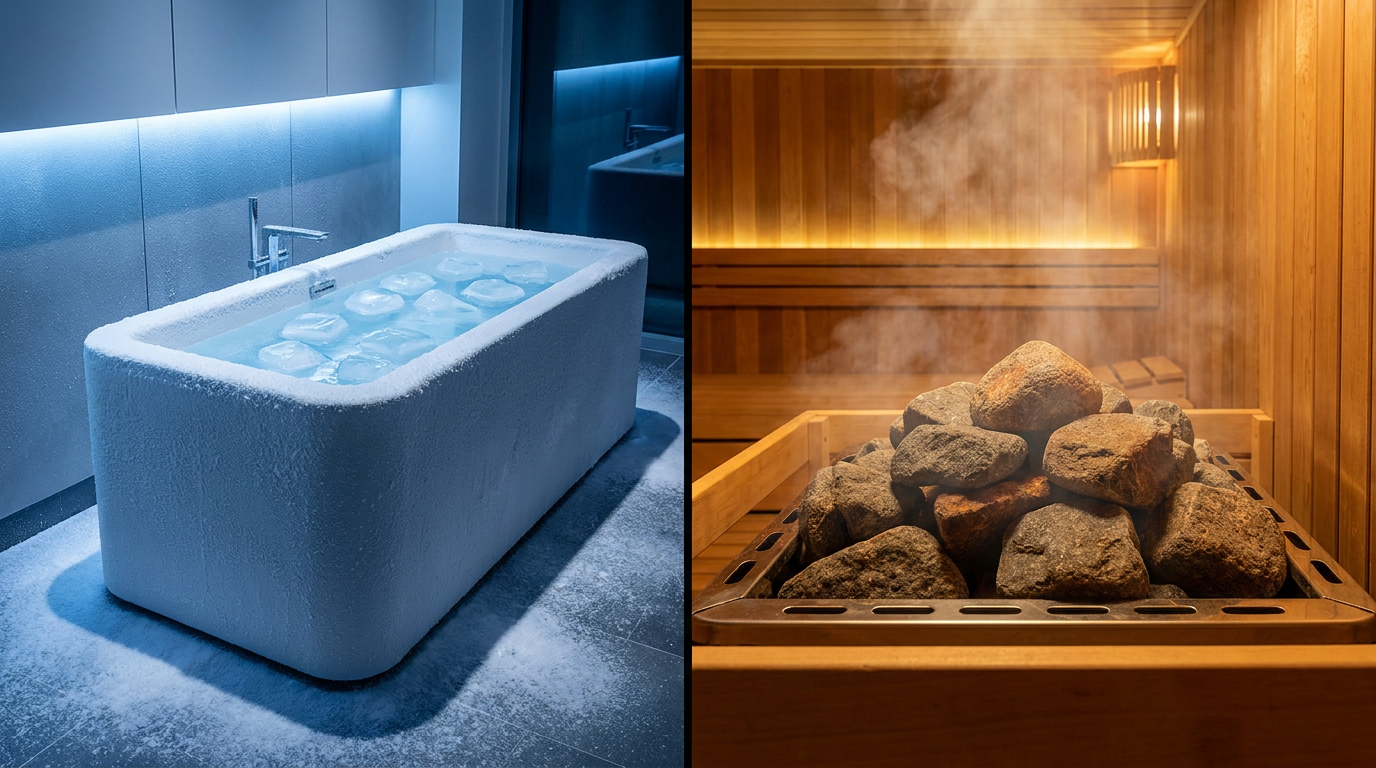
- Hypertrophy & Strength Athletes
- Prioritizing muscle growth and long-term strength adaptations over immediate pain relief.
- Endurance & Tournament Athletes
- Focusing on rapid fatigue clearance and pain reduction to perform repeatedly.
- Longevity & Wellness Advocates
- Viewing temperature therapy as a tool for systemic health and cellular resilience.
What's not represented
- · Casual gym-goers who lack access to specialized recovery equipment
- · Physical therapists treating clinical injuries rather than sports fatigue
Why this matters
Millions of gym-goers use ice baths to recover faster, but they may be accidentally sabotaging their muscle gains. By understanding how temperature affects cellular inflammation, you can strategically use hot and cold therapies to maximize either immediate performance or long-term strength.
Key points
- Cold water immersion effectively reduces Delayed Onset Muscle Soreness (DOMS) by constricting blood vessels and flushing out metabolic waste.
- Meta-analyses show that using ice baths immediately after resistance training blunts satellite cell activation and attenuates muscle growth.
- Heat therapy, such as sauna use, promotes vasodilation, increasing blood flow to damaged muscles by up to 400%.
- Saunas stimulate the release of Heat Shock Proteins (HSPs), which help repair cellular damage without interrupting the body's anabolic signaling.
The modern fitness landscape has embraced extreme temperatures as the ultimate recovery hack. Scroll through any social media feed, and you will inevitably see athletes, celebrities, and weekend warriors plunging into tubs of floating ice or sweating profusely in cedar-lined saunas. Recovery, once an afterthought consisting of a light jog and a few half-hearted stretches, has evolved into a multi-billion-dollar industry centered on physiological optimization.[6]
At the heart of this trend is the premise that manipulating the body's core temperature can accelerate the repair of damaged tissues. When we subject ourselves to intense physical stress, our muscles sustain micro-tears, triggering an inflammatory response that leaves us feeling stiff and sore. Temperature therapy aims to intervene in this process, either by slamming the brakes on inflammation with cold or hitting the accelerator on blood flow with heat.[6]
Cold water immersion (CWI)—commonly known as the ice bath—has become the gold standard for immediate relief. The standard protocol involves submerging the body up to the chest in water chilled between 5°C and 15°C for roughly 10 to 15 minutes. This intense thermal shock triggers an immediate survival response, forcing the body to rapidly adapt to the freezing environment.[3]
The primary mechanism behind cold water immersion is vasoconstriction. As the freezing water hits the skin, blood vessels rapidly narrow to preserve core body heat. This aggressive constriction acts like a physiological sponge, squeezing metabolic waste products—such as lactic acid—out of the extremities and reducing the swelling associated with acute tissue damage. Furthermore, the cold numbs nerve endings, providing immediate, localized pain relief.[4]

For reducing Delayed Onset Muscle Soreness (DOMS), the science is overwhelmingly in favor of the ice bath. Multiple meta-analyses have confirmed that athletes who utilize cold water immersion report significantly less pain and stiffness in the 24 to 48 hours following strenuous exercise compared to those who rely on passive rest. If the sole objective is to feel better tomorrow, the ice bath delivers.[2][3]
However, a growing body of evidence has revealed a significant hypertrophy paradox: feeling better does not necessarily equate to growing stronger. While cold water immersion is excellent at blunting inflammation, researchers have discovered that this very inflammation is a critical prerequisite for muscle growth. By artificially suppressing the body's natural inflammatory response, athletes may be inadvertently sabotaging their own gains.[1][6]
When you lift heavy weights, the resulting micro-trauma signals the immune system to dispatch inflammatory cells to the damaged site. This acute inflammation is not a bug in the system; it is a vital feature. The inflammatory cascade clears away cellular debris and signals the body to begin the rebuilding process, ensuring that the muscle fibers grow back thicker and more resilient than before.[1]
Cold water immersion interrupts this delicate cellular signaling. Studies have shown that submerging muscles in cold water immediately after resistance training significantly blunts the activation of satellite cells—the precursor cells responsible for repairing and building new muscle fibers. Furthermore, the cold environment reduces the rate of muscle protein synthesis for up to two days post-workout, fundamentally starving the muscle of its growth phase.[1]
Cold water immersion interrupts this delicate cellular signaling.
The long-term consequences of this blunted signaling are measurable. In controlled 12-week studies comparing cold water immersion to active recovery, participants who took ice baths after their strength sessions saw significantly attenuated gains in both muscle mass and overall strength. The cold water effectively muted the body's adaptive response to the heavy lifting.[1]

This does not mean ice baths are useless; it simply means their application must be highly contextual. For endurance runners, CrossFit competitors in the middle of a multi-day tournament, or professional fighters, maximizing muscle mass is secondary to immediate performance recovery. When an athlete needs to clear fatigue and perform again at a high level within hours, the anti-inflammatory benefits of cold water immersion are unmatched.[2][6]
For those whose primary goal is building muscle, the pendulum is swinging toward the opposite end of the thermometer: heat therapy. Traditional dry saunas and modern infrared saunas are increasingly being recognized not just for relaxation, but as potent tools for post-workout physiological repair that do not interfere with the body's anabolic signaling.[6]
The physiological response to heat is the exact inverse of cold exposure. When you step into a sauna, your body undergoes massive vasodilation. Blood vessels widen, and heart rate elevates, mimicking the cardiovascular demands of light aerobic exercise. This response can increase blood flow to the skin and muscles by up to 400%, creating a superhighway for nutrient delivery.[5][6]
This surge in oxygen-rich blood is exactly what damaged muscles need to rebuild. Instead of flushing blood away from the extremities, heat therapy drives it directly into the micro-tears created during a workout. This accelerated circulation helps clear metabolic byproducts while simultaneously delivering the amino acids required for muscle protein synthesis, effectively speeding up the repair process without blunting the necessary inflammatory signals.[5]
At the cellular level, heat therapy triggers the release of Heat Shock Proteins (HSPs). These specialized molecular chaperones are deployed in response to thermal stress. Their primary job is to seek out damaged or misfolded proteins within the cells and repair them. By elevating core temperature, sauna use artificially stimulates the production of HSPs, providing a massive boost to the body's internal repair mechanisms.[5]

Like cold water, heat therapy is also highly effective at reducing Delayed Onset Muscle Soreness. The deep, penetrating warmth relaxes tight connective tissues, increases the elasticity of muscle fibers, and soothes joint stiffness. However, because heat promotes rather than suppresses blood flow, it achieves this pain relief while actively supporting the hypertrophy process.[5]
Beyond acute muscle recovery, regular sauna use offers profound systemic benefits. Long-term studies have linked frequent heat exposure to significant improvements in cardiovascular health, lowered blood pressure, and a reduced risk of cardiovascular disease. The controlled thermal stress conditions the heart and vascular system, providing a longevity benefit that complements a rigorous fitness routine.[5]

The key to optimizing temperature therapy lies in the timing. If you are committed to the mental and systemic benefits of cold plunging, experts recommend separating your ice bath from your resistance training by at least four to six hours, or reserving cold exposure entirely for rest days. This allows the acute inflammatory response to peak and initiate muscle repair before the cold shuts it down.[6]
Ultimately, the choice between hot and cold comes down to matching the temperature to the specific physiological goal. If you need to survive a grueling tournament weekend and bounce back tomorrow, embrace the ice. But if your goal is to build strength, increase muscle mass, and support long-term cardiovascular health, skipping the plunge and heading straight for the sauna might be the smartest move you can make.[6]
Viewpoints in depth
Hypertrophy & Strength Athletes
Prioritizing muscle growth and long-term strength adaptations over immediate pain relief.
For bodybuilders, powerlifters, and casual lifters focused on building mass, the acute inflammation that follows a heavy workout is a necessary signal for growth. This camp argues that artificially blunting this response with cold water immersion starves the muscle of its adaptive phase. Instead, they favor passive rest, active recovery, or heat therapy, which promotes blood flow and nutrient delivery without interrupting the cellular signaling required for protein synthesis.
Endurance & Tournament Athletes
Focusing on rapid fatigue clearance and pain reduction to perform repeatedly.
Athletes engaged in multi-day tournaments, CrossFit competitions, or high-mileage endurance running face a different physiological math. For them, maximizing muscle mass is secondary to clearing metabolic waste and reducing joint stiffness so they can compete again in a few hours. This camp relies heavily on cold water immersion because its vasoconstrictive properties offer unmatched, immediate relief from Delayed Onset Muscle Soreness (DOMS), allowing for sustained peak performance.
Longevity & Wellness Advocates
Viewing temperature therapy as a tool for systemic health and cellular resilience.
Beyond the gym, a growing community views hot and cold exposure through the lens of longevity. This perspective emphasizes the systemic benefits of temperature stress, such as the cardiovascular conditioning provided by saunas and the brown fat activation triggered by cold plunges. For these advocates, the debate over muscle hypertrophy is less important than the production of Heat Shock Proteins, improved metabolic flexibility, and the mental resilience forged by enduring extreme temperatures.
What we don't know
- The exact temperature threshold at which cold water immersion begins to significantly blunt muscle protein synthesis.
- Whether alternating hot and cold therapies (contrast water therapy) provides a middle ground that reduces soreness without sacrificing hypertrophy.
- The long-term effects of daily infrared sauna use on muscle mass compared to traditional dry saunas.
Key terms
- Hypertrophy
- The enlargement of an organ or tissue from the increase in size of its cells; in fitness, this refers to the growth of muscle mass.
- Vasoconstriction
- The narrowing of blood vessels, which reduces blood flow and helps limit acute inflammation and swelling.
- Vasodilation
- The widening of blood vessels, which increases blood flow, oxygen, and nutrient delivery to damaged tissues.
- Delayed Onset Muscle Soreness (DOMS)
- The muscle pain and stiffness that typically peaks 24 to 72 hours after intense or unfamiliar exercise.
- Satellite Cells
- Precursor cells in skeletal muscle that activate and fuse with muscle fibers to facilitate repair and growth after heavy lifting.
- Heat Shock Proteins (HSPs)
- A family of proteins produced by cells in response to thermal stress, which help repair and protect other cellular proteins from damage.
Frequently asked
Does taking a cold shower after a workout kill my gains?
A brief cold shower is unlikely to lower deep muscle temperature enough to significantly blunt hypertrophy. The negative effects on muscle growth are primarily associated with prolonged 10-15 minute submersions in ice baths.
When is the best time to take an ice bath?
If your goal is muscle growth, it is best to take an ice bath on rest days or at least four to six hours away from your resistance training session to avoid interrupting the initial inflammatory repair phase.
Should I use the sauna before or after my workout?
Using the sauna after a workout is highly recommended to take advantage of increased blood flow for muscle repair, though a brief 5-minute session beforehand can help warm up stiff joints.
How hot should a sauna be for recovery benefits?
Traditional dry saunas are typically set between 150°F and 195°F (65°C to 90°C), while infrared saunas operate at lower temperatures but use light to penetrate tissues more deeply.
Sources
Source coverage
6 outlets
3 viewpoints surfaced






[1]The Journal of PhysiologyHypertrophy & Strength Athletes
Cold water immersion attenuates anabolic signalling and skeletal muscle hypertrophy
Read on The Journal of Physiology →[2]Sports MedicineEndurance & Tournament Athletes
Effects of Cold-Water Immersion Compared with Other Recovery Modalities
Read on Sports Medicine →[3]Frontiers in PhysiologyHypertrophy & Strength Athletes
Network meta-analysis of cold water immersion protocols on exercise-induced muscle damage
Read on Frontiers in Physiology →[4]MDPI HealthcareEndurance & Tournament Athletes
Effects of Cold-Water Immersion Combined with Other Therapies in Post-Exercise Fatigue Recovery
Read on MDPI Healthcare →[5]National Institutes of HealthLongevity & Wellness Advocates
Clinical Effects of Regular Dry Sauna Bathing: A Systematic Review
Read on National Institutes of Health →[6]Factlen Editorial TeamLongevity & Wellness Advocates
Synthesis by Factlen editorial team
Read on Factlen Editorial Team →

Every angle. Every day.
Get fitness stories with full source coverage and perspective breakdowns delivered to your inbox.