
Steam Deck OLED vs. ROG Ally X: Choosing the Right Premium Handheld in 2026
The handheld PC gaming market has matured into a two-horse race between Valve's seamless OLED efficiency and Asus's raw Windows-powered performance. Choosing between them comes down to whether you prioritize a console-like experience or high-end graphical power.
By Factlen Editorial Team
- Console Purists
- Gamers who prioritize a seamless, frictionless user experience over raw graphical fidelity.
- Power Seekers
- Enthusiasts who want desktop-class performance and flexibility in a portable form factor.
- Windows Ecosystem Users
- Players heavily invested in Game Pass and third-party launchers who need native Windows.
What's not represented
- · Budget Gamers
- · Game Developers
Why this matters
Spending $500 to $1,000 on a handheld gaming PC is a major investment. Understanding the fundamental trade-offs between battery efficiency, operating system friction, and raw processing power ensures you buy the device that actually fits your daily gaming habits.
Key points
- The Steam Deck OLED starts at $549, offering a console-like SteamOS experience and a vibrant HDR OLED display.
- Asus's ROG Ally X costs $799, providing significantly more processing power, 24GB of RAM, and native Windows 11.
- The Ally X features a massive 80Wh battery to support its high-power chip, while the Deck uses a 50Wh battery optimized for extreme efficiency.
- SteamOS prevents many multiplayer games with anti-cheat from running, making the Windows-based Ally X better for competitive shooters.
- The Steam Deck OLED is ideal for frictionless indie gaming, while the Ally X is built for demanding AAA titles and Game Pass.
The handheld PC gaming market has matured from a niche experiment into a highly competitive two-horse race. The novelty of playing full desktop games on a subway commute has worn off; today, consumers demand refinement, reliability, and power. Two devices currently stand at the absolute top of the premium tier: Valve's Steam Deck OLED and Asus's ROG Ally X. While they look similar at a glance, they represent entirely different engineering philosophies. Choosing between them is not simply a matter of picking the "best" device, but rather understanding which set of trade-offs aligns with your personal gaming habits.[7]
The core philosophical difference between the two machines dictates every aspect of their user experience. Valve approached the market by building a dedicated console that just happens to play PC games, creating a tightly controlled ecosystem. Asus, on the other hand, built a remarkably powerful Windows laptop and crammed it into a handheld chassis, prioritizing maximum compatibility and raw performance over streamlined simplicity. This fundamental divergence means that buyers must weigh the comfort of a frictionless interface against the freedom of an open operating system.[7]
The case for the Steam Deck OLED rests entirely on its frictionless software and hardware synergy. Priced starting at $549, it utilizes Valve's custom Linux-based SteamOS to deliver an experience where games simply work out of the box. Users do not have to worry about driver updates, background Windows processes, or clunky launcher interfaces. The device wakes from sleep instantly, suspends gameplay flawlessly, and features a user interface that feels as polished and intuitive as a dedicated home console like the Nintendo Switch.[1][6]
The evidence supporting the Steam Deck's superiority lies in its breathtaking display and low-wattage efficiency. The 7.4-inch HDR OLED screen delivers perfect, inky blacks and vibrant colors that traditional LCD panels simply cannot match. Games with dark, atmospheric environments look fundamentally better on Valve's hardware. Furthermore, the OLED panel is paired with a highly efficient custom AMD Zen 2 processor that sips power when running less demanding titles, allowing the device to run quietly and coolly under moderate loads.[1][6]

This efficiency translates directly into unmatched longevity for specific types of gaming. Equipped with a 50Wh battery, the Steam Deck OLED can stretch its runtime up to an astonishing 12 hours on lightweight indie titles or older classic games. For travelers on long-haul flights or commuters who prefer to leave their chargers at home, this endurance makes it the ultimate travel companion. It is a machine perfectly optimized for clearing out a backlog of acclaimed, less graphically intense games.[1][6]
However, the case against the Steam Deck OLED centers on its strict performance ceiling and software walls. Its custom APU is aging, meaning the newest, most demanding AAA blockbusters often struggle to maintain a stable 30 frames per second, even on the lowest graphical settings. Players looking to experience the bleeding edge of modern gaming graphics will find Valve's handheld lacking the necessary horsepower to keep up with the latest industry releases, forcing them to rely on heavy upscaling that degrades image quality.[3]
Additionally, because the Steam Deck runs on a Linux architecture, games with aggressive kernel-level anti-cheat software—like many popular competitive multiplayer shooters—simply will not boot. If a game is not available directly on the Steam storefront, installing it requires dropping into a desktop mode and tinkering with complex compatibility layers. For gamers heavily invested in outside ecosystems, this walled garden approach can quickly become a frustrating barrier to entry, requiring technical workarounds just to play titles they already own on other platforms.[1][3]
The case for the Asus ROG Ally X is built on raw, uncompromised power and total platform freedom. Priced at a premium $799, it is designed for players who refuse to sacrifice frame rates. It utilizes the much more powerful AMD Ryzen Z1 Extreme processor (and newer Z2 variants), paired with a massive 24GB of high-speed RAM. This hardware configuration allows the device to muscle through complex textures and demanding physics engines that would bring lesser handhelds to a grinding halt.[2][5]
The case for the Asus ROG Ally X is built on raw, uncompromised power and total platform freedom.
The evidence for the Ally X's dominance is quantified in its benchmarks and its display capabilities. When pushed to its 25W or 30W turbo modes, it smoothly runs modern titles at a crisp 1080p resolution, taking full advantage of its 120Hz variable refresh rate display. This variable refresh rate technology ensures that even when frame rates fluctuate during intense action sequences, the gameplay remains incredibly smooth and free of jarring screen tearing, providing a distinctly premium PC gaming feel.[2][4]

Asus also addressed the biggest historical flaw of high-power handhelds by cramming an unprecedented 80Wh battery into the Ally X. While its processor is undeniably power-hungry, this massive capacity means the device can still deliver over two hours of heavy AAA gaming at high settings. When dialed back to lower wattages for medium-intensity titles, the sheer size of the battery allows it to easily outlast the Steam Deck, proving that brute-force engineering can effectively solve efficiency deficits.[2][5]
The case against the ROG Ally X is almost entirely about the friction of the Windows 11 operating system. While Microsoft has made strides with a unified Xbox dashboard, navigating a full desktop operating system on a 7-inch touchscreen remains inherently clunky. Users must contend with standard PC annoyances, including unexpected background updates, driver conflicts, and a user interface that was fundamentally designed for a mouse and keyboard rather than a pair of analog sticks. It demands patience and a willingness to troubleshoot.[3][4]
Furthermore, the Windows sleep mode is notoriously unreliable compared to the Steam Deck's instant suspend-and-resume feature. Putting the Ally X to sleep mid-game often results in crashed software, audio glitches, or a completely drained battery upon waking. Additionally, while the Ally X's LCD screen is sharp and incredibly fast, it lacks the breathtaking contrast and perfect black levels of Valve's OLED panel, making cinematic, story-driven games look slightly washed out by comparison when played in a dark room.[3]
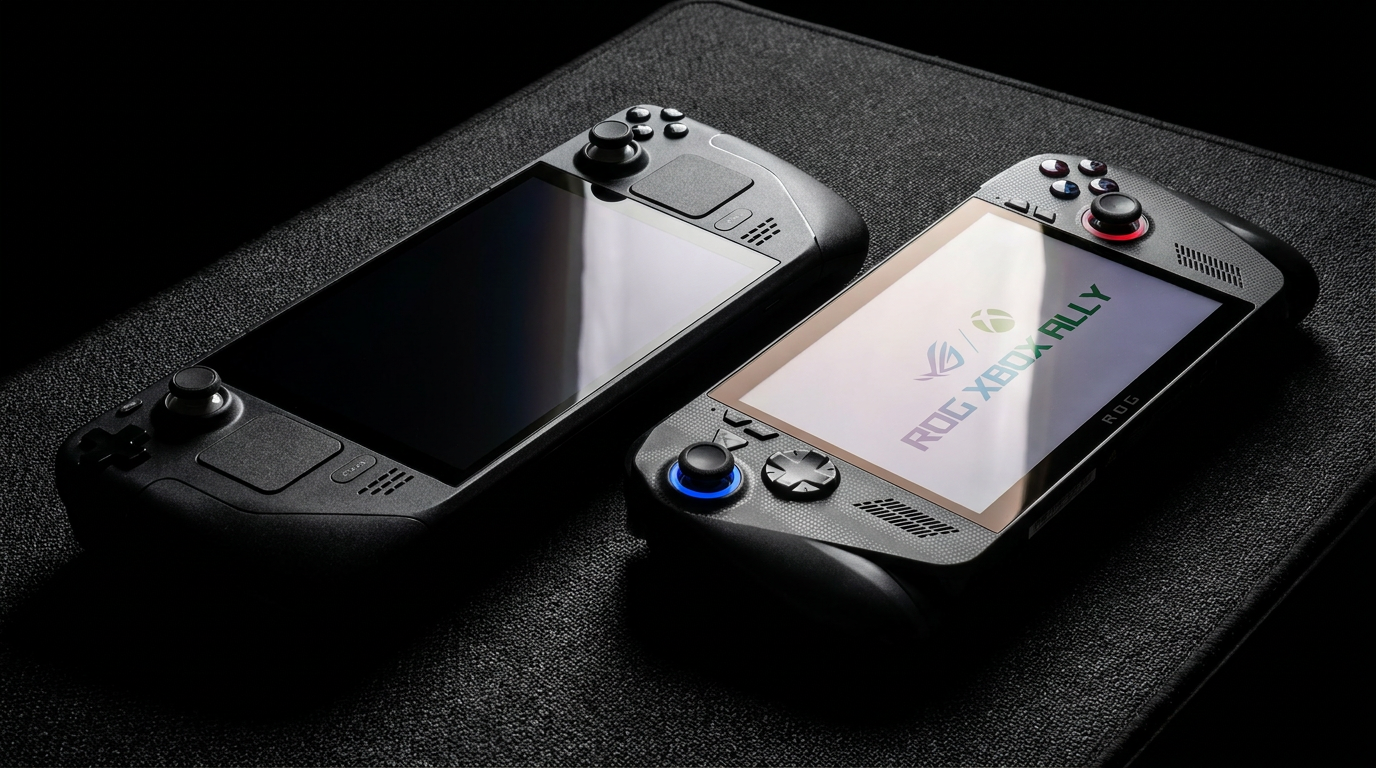
Comparing the ergonomics and build quality reveals two distinct approaches to comfort. The Steam Deck OLED is wider and features dual trackpads, making it excellent for playing strategy games, city builders, or classic PC titles that require precise cursor control. The Ally X, conversely, features a more traditional, Xbox-style asymmetrical layout with deeper, highly textured grips that many users find significantly more comfortable for fast-paced action games and extended dual-stick shooter sessions, though it lacks the versatile trackpads entirely.[2][3]
Storage and connectivity also present a meaningful trade-off for prospective buyers. The Ally X comes standard with a massive 1TB drive and dual USB-C ports—including a high-speed USB4 port that supports external desktop graphics cards—catering heavily to power users who want to dock the device. The Steam Deck offers 512GB at its base OLED tier, keeping the entry price accessible, but limiting the number of massive modern games you can install simultaneously without purchasing a secondary MicroSD card.[2][5]

Ultimately, the Steam Deck OLED fits well when you want a frictionless, console-like experience, prioritize battery life for indie games, and value the visual punch of an OLED screen. It is the device that gets out of its own way, allowing you to focus entirely on the game rather than the hardware running it. For players who want their handheld to feel like a dedicated entertainment appliance rather than a miniature computer, Valve's offering remains completely unmatched in the current market.[1][3]
However, the Steam Deck OLED does not fit when your library consists heavily of PC Game Pass titles, competitive multiplayer shooters equipped with strict anti-cheat software, or the absolute latest graphical showcases. If your gaming diet relies on pushing the boundaries of modern rendering techniques, the aging processor inside the Deck will quickly become a source of frustration, forcing you to compromise heavily on visual fidelity and resolution just to maintain a consistently playable frame rate.[3]
Conversely, the ROG Ally X fits well when you want the ultimate portable powerhouse, need native Windows compatibility for multiple game launchers, and are willing to pay a premium for high frame rates and extra memory. It is the definitive choice for enthusiasts who want to carry their entire desktop ecosystem—including Xbox Game Pass, the Epic Games Store, and heavily modded titles—in their backpack without worrying about Linux compatibility layers or storefront restrictions. It truly shines as a mobile desktop.[2][5]
The ROG Ally X does not fit when you have a low tolerance for software troubleshooting, demand instant-resume functionality for quick gaming bursts, or prefer the absolute lightest device for extended, casual play sessions. If you view tweaking settings, updating drivers, and navigating a desktop environment as a chore rather than a feature, the sheer power of the Ally X will not be enough to overcome the inherent clunkiness of its Windows foundation. In those cases, simplicity wins.[3][4]
How we got here
February 2022
Valve launches the original Steam Deck, proving the viability of the premium handheld PC market.
June 2023
Asus releases the first ROG Ally, introducing high-refresh-rate Windows gaming to the form factor.
November 2023
Valve releases the Steam Deck OLED, drastically improving the screen, battery life, and thermals.
July 2024
Asus launches the ROG Ally X, doubling the battery capacity and increasing RAM to fix the original model's flaws.
Mid-2026
The Ally X and Steam Deck OLED remain the definitive premium choices, representing the peak of their respective design philosophies.
Viewpoints in depth
Console Purists
Gamers who prioritize a seamless, frictionless user experience over raw graphical fidelity.
This camp overwhelmingly favors the Steam Deck OLED. They argue that a handheld device should behave like a Nintendo Switch—waking from sleep instantly, managing updates invisibly, and providing a unified interface. For these users, the visual benefits of the HDR OLED screen and the extreme battery efficiency at low wattages far outweigh the inability to play the most demanding new releases at maximum settings.
Power Seekers
Enthusiasts who want desktop-class performance and flexibility in a portable form factor.
Power seekers gravitate toward the ROG Ally X. They view the handheld not as a closed console, but as a miniaturized PC. This group values the 24GB of RAM and the Z1 Extreme processor, which allow for 1080p gaming at high frame rates. They are willing to tolerate the occasional clunkiness of Windows 11 because it grants them unrestricted access to game mods, third-party launchers, and competitive multiplayer titles that block Linux.
Game Pass Subscribers
Players heavily invested in Microsoft's subscription ecosystem.
For this demographic, the operating system is the deciding factor. Because the ROG Ally X runs native Windows 11, it can download and play PC Game Pass titles locally without any workarounds. While Steam Deck users can stream Game Pass via the cloud or endure complex dual-boot installations, subscribers argue that the Ally X's native support makes it the only logical choice for maximizing their monthly membership.
What we don't know
- How Valve's eventual 'Steam Deck 2' will bridge the current performance gap with Asus's hardware.
- Whether Microsoft will release a truly handheld-optimized version of Windows to fix the Ally X's software friction.
Key terms
- APU (Accelerated Processing Unit)
- A single chip that combines both the central processor (CPU) and graphics processor (GPU), used in both the Steam Deck and ROG Ally X to save space.
- OLED (Organic Light-Emitting Diode)
- A display technology where each pixel provides its own light, allowing for perfect blacks and infinite contrast.
- TDP (Thermal Design Power)
- A measure of how much power a chip consumes and the heat it generates; higher TDP means better performance but faster battery drain.
- Variable Refresh Rate (VRR)
- A display feature on the ROG Ally X that syncs the screen's refresh rate with the game's frame rate, eliminating screen tearing and stuttering.
Frequently asked
Can the Steam Deck OLED play Xbox Game Pass games?
Not natively out of the box. You can stream Game Pass titles via Xbox Cloud Gaming through a browser, but downloading them locally requires installing Windows, which removes the seamless SteamOS experience.
Does the ROG Ally X have an OLED screen?
No, the ROG Ally X uses a 7-inch 1080p IPS LCD screen. While it is sharp and supports a 120Hz refresh rate, it lacks the deep blacks and vibrant colors of the Steam Deck's OLED panel.
Which handheld has better battery life?
It depends on the game. The Steam Deck OLED is more efficient for lightweight indie games, lasting up to 12 hours. However, for heavy AAA games, the ROG Ally X's massive 80Wh battery allows it to outlast the Deck.
Sources
Source coverage
7 outlets
3 viewpoints surfaced







[1]IGNConsole Purists
Steam Deck OLED Review
Read on IGN →[2]PCMagPower Seekers
Asus ROG Ally X Review
Read on PCMag →[3]Pocket-lintWindows Ecosystem Users
ROG Ally X vs Steam Deck OLED: Which handheld is right for you?
Read on Pocket-lint →[4]Rock Paper ShotgunWindows Ecosystem Users
ASUS ROG Xbox Ally X Review
Read on Rock Paper Shotgun →[5]TechPowerUpPower Seekers
ASUS ROG Ally X Review - The Best Handheld Gaming PC
Read on TechPowerUp →[6]ValveConsole Purists
Steam Deck OLED Tech Specs
Read on Valve →[7]Factlen Editorial TeamWindows Ecosystem Users
Synthesis by Factlen editorial team
Read on Factlen Editorial Team →
Every angle. Every day.
Get gaming esports stories with full source coverage and perspective breakdowns delivered to your inbox.