
The AI That Fits in a Pocket: How Offline Small Language Models Are Transforming Remote Healthcare
A new generation of compact, offline AI models is bringing advanced medical diagnostics to off-grid clinics, ensuring patient privacy and eliminating the need for cloud connectivity.
By Factlen Editorial Team
- Global Health Advocates
- Argue that SLMs are the key to health equity by bringing expert-level diagnostic support to the last mile of healthcare.
- Privacy & Security Experts
- Emphasize the data protection benefits of zero-egress architectures that eliminate cloud transmission risks.
- AI Developers
- Focus on the computational elegance and cost-effectiveness of fine-tuning smaller models for specific tasks.
What's not represented
- · Cloud Infrastructure Providers
- · Regulatory Bodies
Why this matters
By severing the tether to the cloud, offline AI democratizes access to expert-level medical support. It allows field medics in the most remote or disaster-stricken areas to diagnose patients accurately while keeping sensitive health data strictly on the device.
Key points
- Small Language Models (SLMs) can run entirely offline on standard smartphones and tablets.
- These compact models are being deployed in remote clinics to assist with medical diagnostics and translation.
- A 'zero-egress' architecture ensures that sensitive patient data never leaves the local device, solving major privacy concerns.
- SLMs require significantly less power than cloud-based AI, making them compatible with solar-powered mobile health units.
The artificial intelligence revolution has a fundamental connectivity problem. While large language models (LLMs) like GPT-4 require massive server farms and constant, high-bandwidth internet access to function, billions of people live in off-grid or low-connectivity environments. For remote medical clinics, humanitarian deployments, and rural outposts, a cloud-dependent AI is virtually useless. When a patient arrives at a field hospital with complex symptoms, a doctor cannot wait for a satellite connection to stabilize just to consult a diagnostic algorithm. This infrastructure gap has historically kept the most advanced digital health tools locked within well-funded, urban medical centers, leaving the world's most vulnerable populations behind.[1]
Enter the Small Language Model (SLM). Over the past year, AI developers have achieved a major breakthrough in compressing neural networks, creating highly capable models that can run entirely offline on standard smartphones, tablets, or low-power edge devices. By stripping away the bloat of general-purpose models, researchers have proven that AI does not need to be massive to be intelligent. This shift from centralized cloud computing to decentralized edge inference represents a fundamental reimagining of how artificial intelligence is deployed in the real world.[3][4]
SLMs typically contain between 1 billion and 8 billion parameters—a fraction of the hundreds of billions found in their larger counterparts. Despite their significantly smaller size, they are trained on highly curated, domain-specific datasets. Instead of learning to write poetry or code in Python, a healthcare-focused SLM is trained exclusively on medical literature, clinical guidelines, and diagnostic case studies. This intense specialization allows these compact models to punch far above their weight, matching the accuracy of massive cloud models in specific clinical tasks while requiring a fraction of the computational overhead.[3]

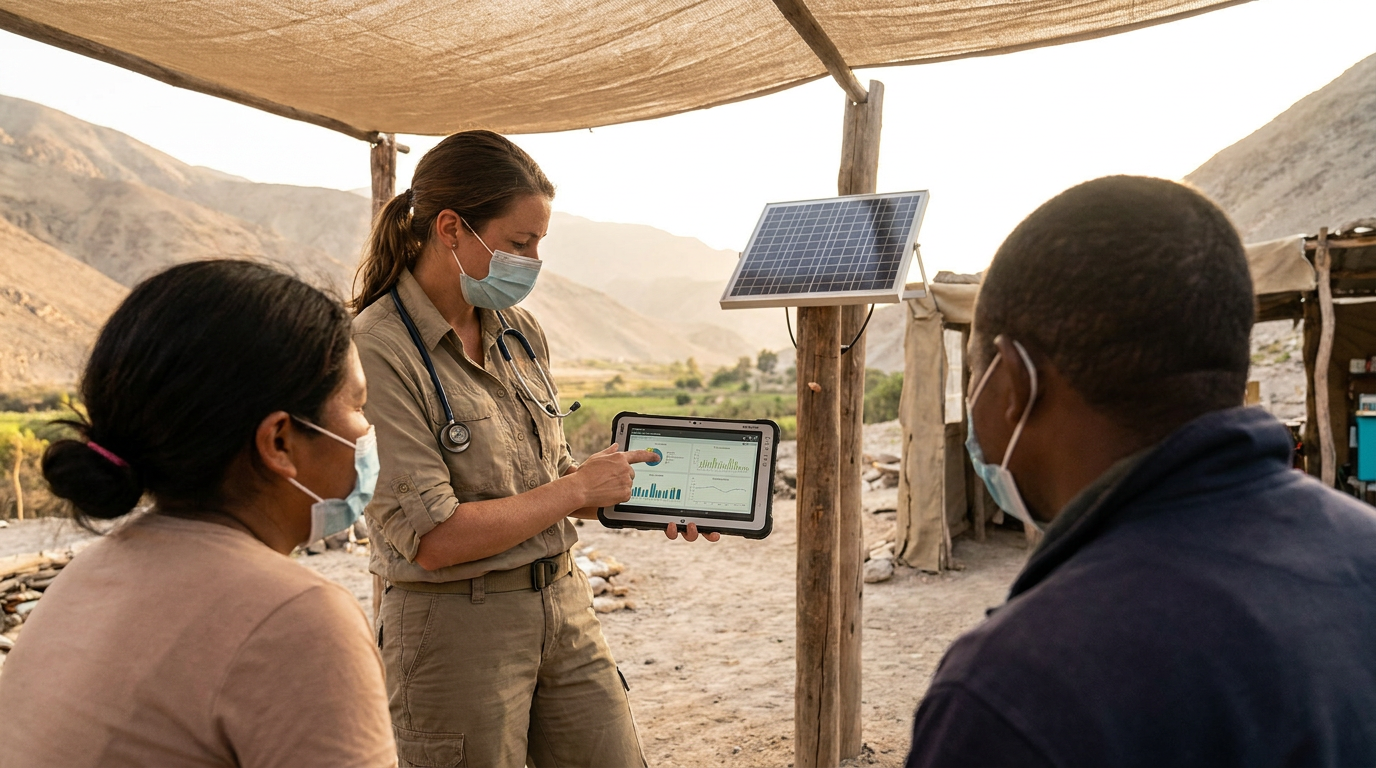
In rural clinics, mobile health units, and refugee camps, these offline models are now being actively deployed to assist healthcare workers. A recent 2026 study highlighted how SLMs can process patient symptoms, analyze electronic medical records, and suggest differential diagnoses without ever sending a single byte of data to the cloud. Field medics can input a patient's vitals and symptoms into a tablet, and the local AI instantly cross-references the data against thousands of medical conditions, providing immediate, evidence-based recommendations even in the middle of a connectivity blackout.[2][5]
This 'zero-egress' architecture solves one of the biggest hurdles in healthcare AI: patient privacy. Because the inference happens entirely on-device, sensitive medical data never leaves the examination room. In traditional cloud-based AI systems, patient information must be transmitted to external servers, processed, and sent back—a process that introduces significant cybersecurity vulnerabilities and regulatory headaches. By keeping all data localized, SLMs eliminate the risk of interception during transmission, ensuring that a patient's most intimate health details remain strictly between them and their attending physician, secured within the physical hardware of the clinic.[6]
This localized processing ensures seamless compliance with strict data residency laws, such as HIPAA in the United States and the GDPR in Europe. As a result, SLMs are becoming highly attractive not just to humanitarian NGOs operating in austere environments, but also to major hospital networks. Large healthcare systems are increasingly adopting local SLMs as 'sidecar containers' within their internal software, allowing them to leverage the power of generative AI for clinical documentation and decision support without risking the catastrophic legal and financial consequences of a third-party data breach.[2][4]
Power constraints are another major factor driving the adoption of edge AI in remote regions. Running a complex query on a massive cloud-based LLM requires significant energy, relying on data centers that consume megawatts of power and a stable electrical grid to maintain the connection. SLMs, however, are specifically designed to operate efficiently on battery-powered edge devices. Their optimized architecture minimizes CPU and memory usage, allowing them to run complex algorithms without draining a device's battery in a matter of minutes.[2][7]
Power constraints are another major factor driving the adoption of edge AI in remote regions.
This exceptionally low energy footprint makes SLMs perfectly compatible with solar-powered mobile health units. Field medics can run sophisticated diagnostic algorithms on a standard tablet powered by a portable, foldable solar panel. This energy independence ensures continuous operation even in disaster response scenarios where the local power grid has been completely destroyed by hurricanes or earthquakes. By severing the reliance on both the internet and the electrical grid, SLMs provide a truly autonomous medical support system for the world's most challenging environments, ensuring care never stops.[2]

Beyond pure diagnostics, offline SLMs are breaking down critical language barriers in global health. Specialized AI tools are using compressed models to provide real-time, culturally aware translation between patients and doctors in areas where human translators are entirely unavailable. In refugee camps or diverse urban clinics, a doctor can speak into a device, and the SLM instantly translates the complex medical terminology into the patient's native dialect, operating flawlessly without any network connection. This ensures that informed consent and accurate symptom reporting are never compromised by a language gap.[5][7]
These localized translation models go far beyond simple word-for-word conversion. They are fine-tuned to capture emotional tone, subtle pain indicators, and urgency. When a patient describes their symptoms, the AI reformulates the input into a structured, medically accurate clinical summary for the attending physician. If a patient expresses severe distress or uses colloquial terms for pain, the SLM flags the sentiment, ensuring that the doctor understands the true severity of the condition even across a profound linguistic divide.[5]
Major technology companies are aggressively fueling this shift toward edge computing. Microsoft's Phi-3 and Phi-4 series, alongside IBM's Granite models and Google's Gemma, have definitively proven that compact AI can reason through complex medical texts just as effectively as massive models. These tech giants are open-sourcing many of their SLM weights, allowing developers and medical researchers around the world to freely download the models, fine-tune them for specific regional diseases, and deploy them locally without paying ongoing API fees. This open-source approach is rapidly accelerating global health innovation.[3][4]
These models are increasingly being integrated directly into clinical decision support applications as embedded features. By running the AI locally, software developers can build robust, offline-first medical applications that provide instantaneous, sub-100-millisecond response times. There is no network latency, no waiting for a remote server to process the request, and no unexpected service outages. For a doctor in a chaotic emergency room or a medic in a remote field tent, this predictable, instantaneous performance can literally be the difference between life and death for a critical patient.[4]

However, SLMs are not a complete replacement for their massive cloud-based counterparts. Because they operate with significantly fewer parameters, they inherently lack the broad, encyclopedic knowledge of larger models. While an SLM excels at its specific trained task—such as diagnosing common respiratory illnesses or translating a specific regional dialect—it can struggle with highly complex, multi-disciplinary medical edge cases that require drawing obscure connections across vastly different fields of medicine. They are highly specialized tools, not artificial general intelligence.[3][5]
Consequently, they are designed to serve as specialized assistants rather than omniscient oracles. When an offline SLM encounters a rare condition or an anomaly outside its specific training data, it is programmed to recognize its own uncertainty. It will flag the case for human review or queue the data to be analyzed by a cloud-based LLM once the device eventually reconnects to a stable network. This hybrid approach ensures that patients receive immediate care for common issues while reserving heavy computational power for the most difficult cases.[1][5]
As hardware accelerators for mobile devices continue to improve, the gap between cloud and edge AI will narrow even further. Future smartphones will carry dedicated neural processing units capable of running even more sophisticated models with zero battery drain. For the global health community, the democratization of artificial intelligence means that the most advanced diagnostic tools in human history are no longer confined to well-funded urban hospitals. They can now fit seamlessly into the pocket of a field medic anywhere in the world.[1][2]
How we got here
2023-2024
Large Language Models dominate the AI landscape, but their reliance on massive cloud servers limits their use in sensitive or remote environments.
Late 2024
Tech giants release the first highly capable Small Language Models (SLMs), proving that compact AI can reason effectively.
2025
Researchers begin fine-tuning SLMs specifically for medical diagnostics and deploying them on mobile devices.
Early 2026
Zero-egress offline AI platforms are successfully deployed in rural clinics and humanitarian missions, providing real-time diagnostic support without internet access.
Viewpoints in depth
Global Health Advocates
Argue that SLMs are the key to health equity.
By removing the need for internet infrastructure, these models bring expert-level diagnostic support to the 'last mile' of healthcare. Advocates emphasize that empowering local medics with offline AI reduces misdiagnoses in underserved regions and ensures that the benefits of the AI revolution are not restricted to wealthy, highly connected nations.
Privacy & Security Experts
Emphasize the data protection benefits of offline processing.
Because SLMs run entirely on-device, they eliminate the risk of intercepting sensitive medical records during cloud transmission. Security experts argue that this zero-egress architecture solves major compliance hurdles for hospitals and military deployments, making AI usable in environments where data leaks carry catastrophic consequences.
AI Developers
Focus on the computational elegance of SLMs.
Developers argue that throwing massive computing power at every problem is unsustainable. They point out that fine-tuning smaller models for specific tasks provides a much better balance of latency, cost, and accuracy, allowing software engineers to build robust applications without relying on expensive and fragile API calls to remote servers.
What we don't know
- How regulatory bodies like the FDA will standardize the approval process for autonomous, offline diagnostic models.
- The long-term cost of maintaining and updating fleets of offline edge devices in harsh, remote environments.
- Whether SLMs will eventually be able to handle highly complex, multi-disciplinary medical edge cases without deferring to the cloud.
Key terms
- Small Language Model (SLM)
- A compact AI model designed to run efficiently on local devices with fewer computational resources than large cloud-based models.
- Zero-egress architecture
- A system design where data is processed entirely on the local device and never transmitted to external servers.
- Edge inference
- The process of running AI algorithms locally on a hardware device, such as a smartphone or tablet, rather than in a centralized cloud data center.
- Parameter
- The internal variables, such as weights and biases, that an AI model learns during training, which determine its complexity and capabilities.
Frequently asked
Can an offline AI model be as accurate as ChatGPT?
For highly specific, domain-trained tasks like medical diagnostics, SLMs can match or exceed the performance of general-purpose large models, though they lack broad general knowledge.
How does the AI get updated if it operates offline?
The models are updated periodically when the device connects to a secure network, downloading new weights and medical guidelines before returning to the field.
Does running AI drain a smartphone's battery quickly?
While AI inference is computationally intensive, SLMs are specifically optimized for mobile processors, allowing them to run efficiently on standard batteries or portable solar setups.
Sources
Source coverage
7 outlets
3 viewpoints surfaced







[1]Factlen Editorial TeamAI Developers
Synthesis by Factlen editorial team
Read on Factlen Editorial Team →[2]ResearchGateGlobal Health Advocates
Small Language Models (SLMs) are emerging as transformative tools in healthcare AI
Read on ResearchGate →[3]IBMAI Developers
What are small language models?
Read on IBM →[4]MicrosoftPrivacy & Security Experts
Deploy a web app with a local small language model (SLM)
Read on Microsoft →[5]The Medical FuturistGlobal Health Advocates
Using ChatGPT Offline: How Small Language Models Can Aid Healthcare Professionals
Read on The Medical Futurist →[6]arXivPrivacy & Security Experts
Zero-egress psychiatric AI architecture: fully on-device inference
Read on arXiv →[7]ISGAI Developers
The Big Benefits of Small Language Models in AI Development
Read on ISG →

Every angle. Every day.
Get ai stories with full source coverage and perspective breakdowns delivered to your inbox.