
2026 Rivian R2 vs. Tesla Model Y: The Ultimate Midsize EV SUV Comparison
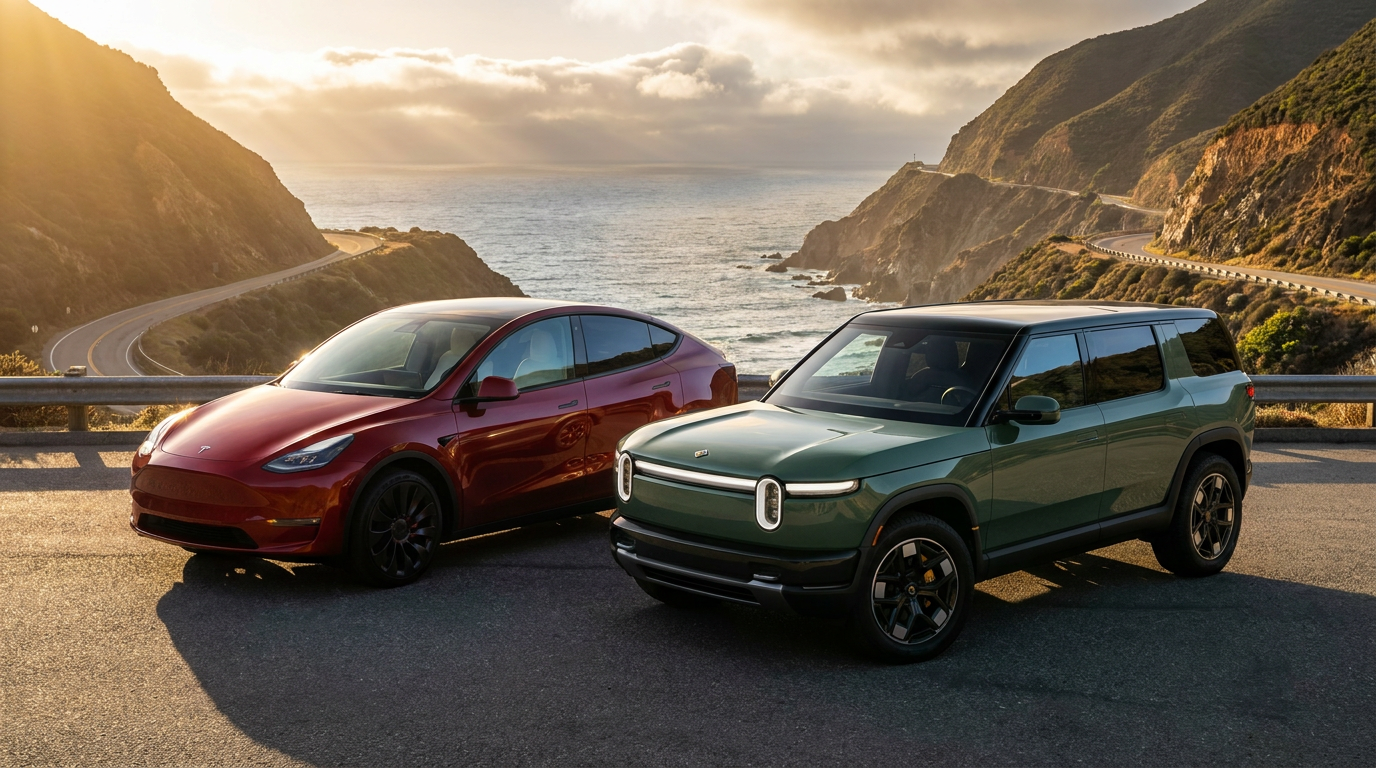
The highly anticipated Rivian R2 has arrived to challenge the refreshed Tesla Model Y, offering buyers a choice between rugged outdoor utility and aerodynamic commuter efficiency.
By Factlen Editorial Team
- Value & Efficiency Advocates
- Focusing on aerodynamic design, software maturity, and cost-to-own metrics.
- Adventure & Utility Enthusiasts
- Prioritizing cargo flexibility, off-road capability, and rugged aesthetics.
- Neutral Automotive Analysts
- Evaluating the vehicles strictly on engineering achievements and market positioning.
What's not represented
- · Traditional Automakers (Ford/GM) losing market share
- · Budget-constrained buyers waiting for $30k EVs
Why this matters
For the first time, buyers in the world's most popular vehicle segment—midsize SUVs—do not have to compromise between electric efficiency and rugged utility. This head-to-head competition forces both automakers to deliver better features, longer range, and more versatile designs, directly benefiting consumers looking for their next family vehicle.
Key points
- The 2026 Rivian R2 and refreshed Tesla Model Y represent two distinct EV philosophies: rugged utility versus aerodynamic efficiency.
- At the top of their ranges, both performance models cost roughly $57,500 and share an identical 105 MPGe efficiency rating.
- The Rivian R2 offers superior cargo space (90.1 cu-ft), flat-folding seats, and genuine off-road capability.
- The Tesla Model Y retains a massive advantage for budget buyers, with its base model starting at $39,990 today.
- Both vehicles utilize native NACS ports, granting them seamless access to the Tesla Supercharger network.
The midsize electric SUV segment has reached a golden era in 2026. For years, the Tesla Model Y has dominated the global sales charts, serving as the default recommendation for buyers seeking a practical, tech-forward EV. But the landscape shifted this summer with the arrival of the Rivian R2. Designed as a smaller, more accessible sibling to the R1S, the R2 brings rugged outdoor utility to a segment defined by aerodynamic teardrops. With Tesla simultaneously rolling out its heavily updated "Juniper" refresh for the Model Y, consumers are now presented with two exceptional, domestically built options that represent entirely different philosophies of what an electric crossover should be.[1][4]
The comparison between these two vehicles is no longer theoretical, as the first R2 Performance models are now reaching customer driveways. At the top of their respective lineups, the vehicles are priced within a few hundred dollars of each other, with the Model Y Performance starting at roughly $57,490 and the launch-edition R2 Performance at $57,990. This price parity forces a genuine trade-off analysis for buyers. One vehicle is tuned for on-road refinement and aerodynamic efficiency, while the other is built for versatility, off-road capability, and maximum cargo volume.[3][5]
However, for buyers shopping strictly on a budget in 2026, the Tesla Model Y retains a massive immediate advantage. The refreshed Model Y lineup starts at just $39,990 for the base rear-wheel-drive version, making it highly accessible today. Rivian’s more affordable R2 trims—including a $48,490 Standard Long Range and a $45,000 base model—are not scheduled to arrive until 2027. Therefore, the current head-to-head battle is strictly a heavyweight fight between their flagship, dual-motor performance variants.[2][5]
The most surprising revelation in this matchup is the efficiency data. The Rivian R2 is a boxy, upright SUV that weighs approximately 5,250 pounds—nearly 800 pounds heavier than the Model Y. Yet, according to recent EPA filings, the R2 Performance on 21-inch all-season tires perfectly matches the Model Y Performance with a combined rating of 105 MPGe. By utilizing a slightly larger 86.8-kilowatt-hour battery pack compared to Tesla’s 84-kilowatt-hour unit, the Rivian actually edges out the Tesla in total range, offering 330 miles against the Model Y's 306 miles.[3][4]

When it comes to raw acceleration and powertrain dynamics, both vehicles deliver the kind of instant torque that converts traditional combustion drivers into EV advocates. The R2 Performance boasts a staggering 656 horsepower and 609 pound-feet of torque from its dual-motor setup. Despite this massive output, the lighter and more aerodynamic Model Y remains a hair quicker in a straight line, sprinting from zero to 60 miles per hour in 3.3 seconds compared to the Rivian’s 3.6 seconds. Both SUVs offer blistering speed, but the Tesla feels slightly more nimble and planted on winding backroads.[1][6]
Inside the cabin, Tesla’s 2026 "Juniper" refresh has directly addressed years of consumer feedback. The updated Model Y features significantly richer interior materials, extensive sound deadening for a quieter ride, and the long-awaited addition of ventilated front seats. A new 8-inch rear passenger display allows backseat riders to control climate and entertainment, mirroring the popular updates first seen on the Model 3. The aesthetic remains fiercely minimalist, centered around a 15.4-inch touchscreen that now handles gear selection predictively, eliminating physical stalks entirely.[1][2]
Inside the cabin, Tesla’s 2026 "Juniper" refresh has directly addressed years of consumer feedback.
Rivian takes a decidedly more utilitarian and tactile approach to its interior packaging. The R2 features a 15.6-inch central display paired with a dedicated digital instrument cluster behind the steering wheel—a feature Tesla omits. The R2 is designed for adventure logistics, offering two gloveboxes, massive pop-out cup holders, and a power-rolling rear window that enhances the open-air feel. Most notably, all of the R2's seats fold completely flat, transforming the cabin into a cavernous space capable of accommodating an air mattress for car camping.[4][6]

Cargo capacity highlights the physical differences between the teardrop and the box. The Rivian R2 swallows up to 90.1 cubic feet of gear with the seats folded flat, comfortably beating the Model Y’s 76.0 cubic feet. The R2 also features a larger 5.2-cubic-foot front trunk, compared to Tesla’s 4.1-cubic-foot frunk, and includes a factory spare tire option. However, the Model Y fights back with power-folding rear seats that can be dropped directly from the trunk area, adding a layer of everyday convenience for grocery runs and school drop-offs.[4][5]
Ride quality and off-road capability present the starkest divergence between the two platforms. The refreshed Model Y features improved suspension tuning that irons out the harshness of previous generations, making it an incredibly comfortable and quiet highway cruiser. Conversely, the Rivian R2 is a genuine off-roader, boasting 9.6 inches of ground clearance, 32-inch tires, and a sophisticated torque-vectoring system designed for mud, sand, and steep inclines. While the R2 is remarkably refined on the pavement, it cannot completely hide its taller center of gravity in tight corners.[4][6]
Historically, charging infrastructure was the ultimate trump card for any Tesla comparison, but that moat has evaporated in 2026. The Rivian R2 is built natively with the North American Charging Standard (NACS) port, granting it seamless, adapter-free access to the vast Tesla Supercharger network. While the Model Y still charges slightly faster—completing a 10-to-80 percent fast charge in roughly 24 minutes compared to the Rivian’s 29 minutes—both vehicles offer a frictionless road-trip experience that cures range anxiety.[3][5]

In a side-by-side trade-off analysis, the argument for the Tesla Model Y centers on its unmatched value at the entry level, its sports-sedan handling, and its aerodynamic efficiency. The evidence lies in its lower starting price, its 3.3-second sprint time, and its proven track record of software optimization. The argument against the Model Y focuses on its polarizing stalkless steering column, its lack of a driver-facing instrument cluster, and its ubiquitous, blending-in-with-traffic exterior design.[2][5]
Conversely, the argument for the Rivian R2 is rooted in its exceptional utility, distinctive rugged design, and superior cargo packaging. The evidence is found in its 90.1 cubic feet of storage, its flat-folding seats, and its 330-mile range that defies its boxy aerodynamics. The argument against the R2 is its current high barrier to entry—with only the $57,990 Performance trim available in 2026—along with a slightly slower fast-charging curve and a taller stance that sacrifices some on-road agility.[3][4]
Ultimately, the 2026 Tesla Model Y fits perfectly when a buyer prioritizes immediate affordability, sporty on-road driving dynamics, and a sleek, minimalist tech ecosystem. It is the ideal choice for urban commuters, growing families who rarely leave the pavement, and anyone looking for the most established, frictionless EV ownership experience available today. It does not fit well for buyers who require genuine off-road capability, maximum boxy cargo space, or physical driving controls.[2][6]

The 2026 Rivian R2 fits perfectly when a buyer views their vehicle as a basecamp for outdoor hobbies, values a commanding SUV seating position, and needs the versatility of a massive, flat-folding cargo area. It is the ultimate choice for weekend adventurers who want zero-emission capability without sacrificing the ruggedness of a traditional utility vehicle. It does not fit well for buyers on a strict $40,000 budget this year, or those who prefer the low-slung, carving-canyons feel of a performance sedan.[4][5]
How we got here
2020
Tesla introduces the Model Y, which quickly scales to become the best-selling vehicle of any kind globally.
March 2024
Rivian officially unveils the R2 platform, targeting a smaller footprint and lower price point than its flagship R1S.
Early 2026
Tesla rolls out the heavily updated 'Juniper' refresh for the Model Y, improving ride quality and interior materials.
May 2026
EPA ratings confirm the Rivian R2 matches the Model Y in efficiency while beating it in total range.
June 2026
The first Rivian R2 Performance models begin reaching customer driveways, initiating the head-to-head market battle.
Viewpoints in depth
Value & Efficiency Advocates
Focusing on aerodynamic design, software maturity, and cost-to-own metrics.
This camp, often represented by daily commuters and tech-focused reviewers, argues that the Tesla Model Y remains the undisputed king of the segment because it excels at the fundamentals. They point to the Model Y's lower entry price of $39,990, its superior fast-charging curve, and its proven aerodynamic teardrop shape that maximizes highway range. From this perspective, the Rivian R2's boxy design and heavy curb weight are unnecessary penalties for drivers who spend 99% of their time on paved roads.
Adventure & Utility Enthusiasts
Prioritizing cargo flexibility, off-road capability, and rugged aesthetics.
Outdoor enthusiasts and lifestyle buyers argue that the Rivian R2 finally brings true SUV utility to the midsize electric market. They emphasize that the R2's 90.1 cubic feet of cargo space, completely flat-folding seats, and 9.6 inches of ground clearance make it a vastly superior tool for camping, hauling gear, and tackling rough terrain. For this camp, the Model Y is essentially a tall hatchback, whereas the R2 is a genuine utility vehicle that doesn't compromise on EV efficiency.
Neutral Automotive Analysts
Evaluating the vehicles strictly on engineering achievements and market positioning.
Industry analysts view the convergence of these two vehicles as a massive win for consumers. They highlight the engineering marvel of Rivian matching Tesla's 105 MPGe efficiency despite a much heavier, boxier chassis. At the same time, they praise Tesla's 'Juniper' refresh for addressing long-standing complaints about ride harshness and cabin noise. To this camp, the choice isn't about which vehicle is objectively better, but rather which design philosophy—the aerodynamic commuter or the rugged basecamp—better fits the buyer's lifestyle.
What we don't know
- How the Rivian R2's real-world long-term reliability will compare to the highly mature Model Y platform.
- Whether Rivian can successfully scale production to meet the massive demand for the $45,000 base R2 in 2027.
- How the integration of Rivian vehicles into the Tesla Supercharger network will affect wait times at popular charging stations during peak holiday travel.
Key terms
- MPGe
- Miles Per Gallon Equivalent, a metric used by the EPA to compare the energy efficiency of electric vehicles to traditional gas-powered cars.
- NACS
- North American Charging Standard, the charging plug design originally developed by Tesla that has now been adopted by nearly all major EV manufacturers.
- Torque Vectoring
- A technology that allows a vehicle to independently control the power sent to each wheel, improving grip and handling on slippery or uneven terrain.
- Frunk
- A portmanteau of 'front trunk,' referring to the enclosed storage space located under the hood of an electric vehicle where a gas engine would traditionally sit.
Frequently asked
Can the Rivian R2 use Tesla Superchargers?
Yes. The 2026 Rivian R2 is built natively with a North American Charging Standard (NACS) port, allowing adapter-free access to Tesla Superchargers.
Which SUV is faster from 0 to 60 mph?
The Tesla Model Y Performance is slightly quicker, hitting 60 mph in 3.3 seconds compared to the Rivian R2 Performance's 3.6 seconds.
Is the $45,000 Rivian R2 available to buy right now?
No. Only the $57,990 Performance trim is available in 2026. The more affordable Standard and Long Range trims are scheduled to launch in 2027.
Do the seats fold completely flat in both vehicles?
The Rivian R2's seats fold completely flat to create a level surface for camping, while the Model Y's seats fold down but retain a slight incline.
Sources
Source coverage
6 outlets
3 viewpoints surfaced






[1]Car and DriverNeutral Automotive Analysts
2026 Tesla Model Y Juniper Refresh Brings Much-Needed Refinement
Read on Car and Driver →[2]EdmundsValue & Efficiency Advocates
2026 Tesla Model Y Review, Pricing, and Specs
Read on Edmunds →[3]ElectrekAdventure & Utility Enthusiasts
Rivian R2 Performance EPA ratings match Model Y efficiency, beat it on range
Read on Electrek →[4]CarBuzzAdventure & Utility Enthusiasts
Rivian R2 vs Tesla Model Y: How The New SUV Beats The Benchmark
Read on CarBuzz →[5]RoadEthosValue & Efficiency Advocates
Tesla Model Y vs Rivian R2: An Honest Comparison For 2026 Buyers
Read on RoadEthos →[6]carwowNeutral Automotive Analysts
Rivian R2 vs Tesla Model Y: which electric SUV is better?
Read on carwow →
More in automotive
See all 6 stories →Hydrail Tech
How Hydrogen Trains Are Quietly Decarbonizing Rural Railways
8 sources
Air Taxis
The Electric Air Taxi Era Is Finally Here: How eVTOLs Are Clearing the FAA's Final Hurdles in 2026
8 sources
Marine Tech
How Hydrofoiling is Making Electric Boats Mainstream
8 sources
Synthetic Fuels
How Synthetic E-Fuels Are Keeping the Supercar Combustion Engine Alive
7 sources
Every angle. Every day.
Get automotive stories with full source coverage and perspective breakdowns delivered to your inbox.