
How Hydrofoiling is Making Electric Boats Mainstream
By combining underwater wings with aerospace-grade flight controllers, a new generation of electric boats is solving the marine industry's massive energy problem.
By Factlen Editorial Team
- Marine Innovators
- Engineers focused on the software and physics breakthroughs enabling zero-emission travel.
- Commercial Operators
- Transit authorities prioritizing the massive reduction in operating costs and CO2 emissions.
- Traditional Boating Enthusiasts
- Consumers balancing the incredible ride quality against the high upfront costs and maintenance.
What's not represented
- · Traditional marine mechanics who will need to retrain to service high-voltage systems and aerospace sensors.
- · Marine wildlife conservationists studying the impact of silent, high-speed underwater foils on marine animals.
Why this matters
The maritime industry is a massive contributor to global carbon emissions, largely because pushing water requires immense amounts of fossil fuels. By solving the physics of drag, hydrofoiling makes zero-emission water travel commercially viable for both commuters and recreational boaters.
Key points
- Hydrofoils lift a boat's hull out of the water, reducing hydrodynamic drag by up to 95%.
- This massive efficiency gain allows heavy electric batteries to deliver long ranges and high speeds.
- Onboard flight controllers adjust the underwater wings 100 times per second to ensure a perfectly stable ride.
- Electric foiling ferries can reduce CO2 emissions from 32kg per mile to just 112g compared to diesel.
- The technology eliminates wake, allowing high-speed travel in sensitive urban waterways.
- High upfront costs and complex maintenance remain the primary barriers to mainstream consumer adoption.
For decades, the marine industry has faced a fundamental physics problem: water is roughly 800 times denser than air. Pushing a traditional boat hull through it requires a staggering amount of energy. When engineers first attempted to electrify boats, they ran into a wall. The heavy lithium-ion batteries required to push a conventional hull through the water severely limited both speed and range, often restricting early electric boats to slow, short-distance trips.[8]
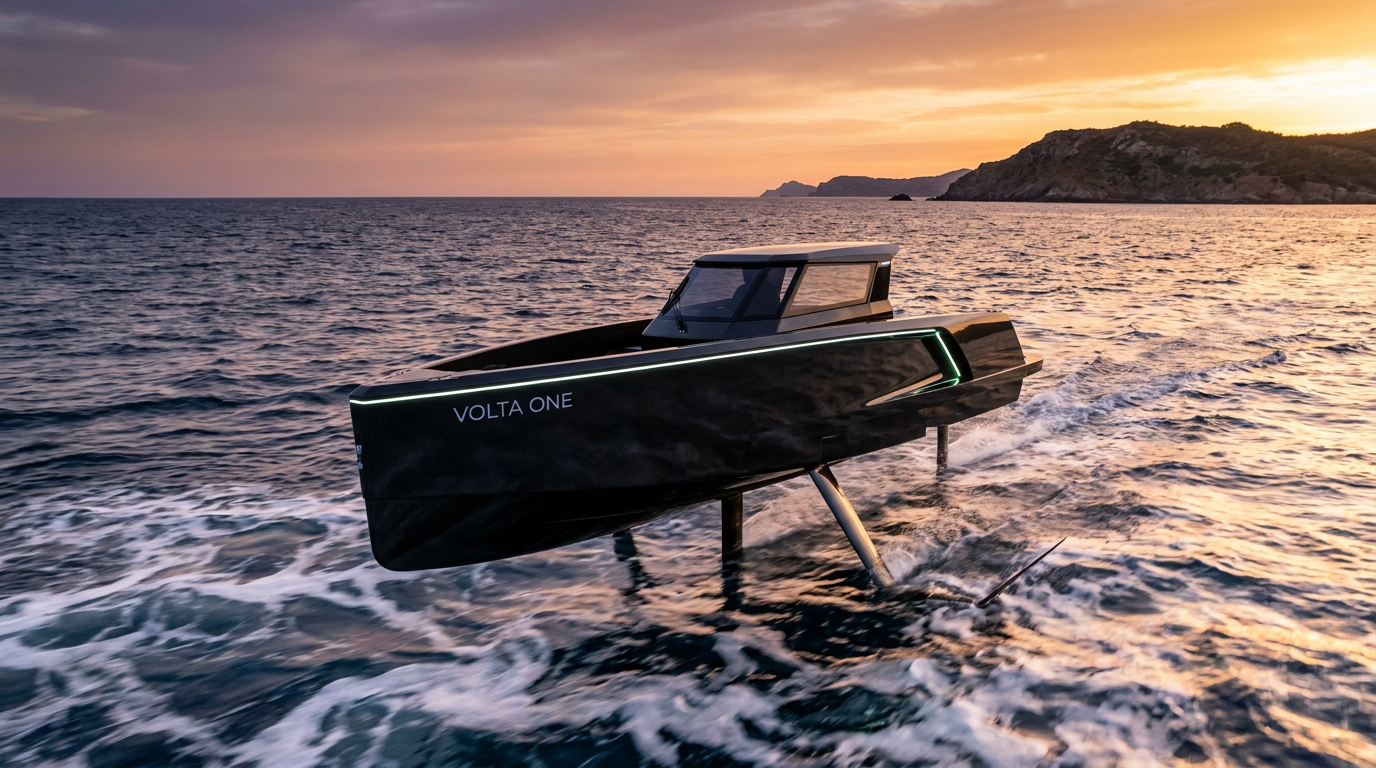
The solution to this energy deficit wasn't just better batteries; it was changing how the boat interacts with the water. Enter the hydrofoil. While the concept of underwater wings dates back over a century, modern materials and software have transformed it into the key that unlocks marine electrification. As a hydrofoil boat accelerates, water flows over its submerged carbon-fiber wings, generating upward lift.[5][8]
Once the vessel reaches a specific takeoff speed, the entire hull rises completely out of the water. The results are mathematically profound. By flying above the surface, hydrodynamic drag is reduced by 80 to 95 percent. Suddenly, the energy required to maintain cruising speed plummets, allowing electric propulsion to match and even exceed the range of traditional fossil-fuel boats.[1][2]

But physical wings are only half the equation. A boat flying on hydrofoils is inherently unstable—much like trying to balance a pencil on the tip of your finger. What makes modern electric hydrofoils possible is the "brain" of the vessel: the flight controller. This onboard computer system acts as an aerospace-grade autopilot.[5]
Using a suite of ultrasonic sensors, gyroscopes, and accelerometers, the flight controller reads wave heights, pitch, and roll in real-time. It then commands electric actuators to adjust the angle of attack on the submerged foils up to 100 times per second. This constant micro-adjustment keeps the boat perfectly level, slicing through chop and swell without the passengers feeling a thing.[4][5]
The Swedish manufacturer Candela has been at the forefront of this recreational revolution. Their flagship C-8 daycruiser utilizes a 69-kilowatt-hour battery—the same pack found in a Polestar 2 electric car—to deliver a range of 57 nautical miles at a cruising speed of 22 knots. Because the hull never touches the water while foiling, the ride is eerily silent and completely devoid of the jarring "hull slap" associated with traditional speedboats.[4]

The Swedish manufacturer Candela has been at the forefront of this recreational revolution.
Across the Atlantic, Silicon Valley-based Navier is pushing the envelope further. Founded by MIT engineers and utilizing technology derived from America's Cup racing yachts, the Navier N30 boasts a 75-mile range. The company has also integrated advanced autonomous features, allowing the vessel to dock itself and navigate complex waterways with minimal human intervention.[2][6]
While luxury dayboats capture the public's imagination, the most significant environmental impact of hydrofoiling lies in commercial transit. Traditional diesel-powered high-speed ferries are notorious polluters, burning massive amounts of fuel to push heavy passenger loads through the water at speed.[7]
The math heavily favors electrification in the commercial sector. A conventional diesel express ferry emits approximately 32 kilograms of carbon dioxide per nautical mile. In stark contrast, an electric hydrofoil ferry operating on a moderately clean grid emits just 112 grams of CO2 over the same distance. Furthermore, because the foiling vessels create virtually no wake, they can travel at high speeds through sensitive urban waterways without eroding shorelines or damaging moored vessels.[1][7]

This has led to rapid adoption by transit authorities. Candela's P-12 electric shuttle is already entering commuter service in Stockholm, with further deployments scheduled for the UK, Saudi Arabia, and New Zealand. Meanwhile, Artemis Technologies is preparing to launch its 150-passenger EF-24 foiling ferry in the UK, signaling that the technology can scale to handle mass transit.[3][7]
The economic argument for commercial operators is equally compelling. Electricity is significantly cheaper than marine diesel, and the 80 percent reduction in energy consumption means the cost per mile drops precipitously. Navier estimates that its vessels can operate for as little as $0.38 per nautical mile, a fraction of the cost of running a comparable gas-powered boat.[2]
Despite the clear advantages, the transition to foiling is not without friction. The upfront cost remains a significant barrier for recreational buyers. A fully equipped carbon-fiber hydrofoil dayboat often starts well north of $350,000. The complex integration of aerospace sensors, electric actuators, and high-voltage battery systems also requires specialized maintenance that traditional marinas are not yet equipped to handle.[4][8]
There is also the persistent fear of submerged debris. Striking a submerged log at 25 knots while suspended on carbon-fiber struts is a daunting prospect. Manufacturers have addressed this by engineering the foils to retract or break away safely upon heavy impact, protecting the hull's integrity, but a replacement foil is an expensive repair.[8]
Nevertheless, the trajectory of the marine industry is clear. Market analysts project the electric hydrofoil sector will grow to $4.6 billion by 2034. As battery densities continue to improve and manufacturing scales up, the cost of these "flying boats" is expected to drop, making silent, wake-free, zero-emission water travel the new standard rather than a luxury exception.[3]

How we got here
2014
Candela is founded in Sweden with the goal of applying hydrofoil technology to electric boats.
2021
Silicon Valley startup Navier is founded, bringing America's Cup foiling expertise to the consumer market.
2024
Candela's C-8 model proves the commercial viability of the tech, delivering a 57-nautical-mile range.
2025
Navier delivers its first production N30 vessels, featuring advanced autonomous docking capabilities.
2026
Electric foiling ferries, including the Candela P-12 and Artemis EF-24, begin entering scheduled commuter service globally.
Viewpoints in depth
Marine Innovators
Engineers argue that the true breakthrough is the software, not just the physical wings.
For companies like Candela and Navier, the physical hydrofoil is only a small piece of the puzzle. They emphasize that unassisted foiling is inherently unstable in unpredictable ocean conditions. The real revolution is the "flight controller"—the aerospace-grade software that reads wave data and adjusts the foils 100 times per second. This software layer transforms a bumpy, dangerous ride into a smooth, automated experience, effectively bringing fighter-jet technology to consumer boating.
Commercial Transit Authorities
Public transport operators view foiling as the key to decarbonizing mass transit on the water.
While luxury dayboats grab headlines, transit authorities are focused on the math of moving people. Traditional diesel ferries are among the worst polluters per passenger-mile in public transit. By adopting electric hydrofoils, cities can cut emissions from 32 kilograms of CO2 per mile down to just 112 grams. Furthermore, because foiling boats create no wake, they can travel at high speeds through inner-city waterways without damaging infrastructure, drastically cutting commute times.
Traditional Boating Enthusiasts
Veteran boaters praise the ride quality but remain cautious about the high costs and complexity.
In reviews across boating magazines, traditionalists are universally stunned by the "magic carpet" ride and the eerie silence of electric foiling. However, they are quick to point out the practical hurdles. The starting price of over $350,000 for a 28-foot dayboat puts it out of reach for most consumers. Additionally, there is anxiety about striking submerged debris at 25 knots and the specialized maintenance required for the complex electric actuators and sensors.
What we don't know
- How well the complex carbon-fiber foils and electric actuators will hold up to decades of saltwater corrosion.
- Whether the cost of the aerospace-grade flight controllers will drop enough to make foiling viable for entry-level boats.
- How quickly traditional marinas will upgrade their infrastructure to support high-voltage DC fast charging.
Key terms
- Hydrofoil
- An underwater wing that generates lift as a boat accelerates, raising the hull completely out of the water to reduce drag.
- Flight Controller
- The onboard computer system that uses sensors to read wave conditions and automatically adjusts the foils to keep the boat stable.
- Actuator
- A mechanical device controlled by the boat's computer that physically changes the angle of the hydrofoils in real-time.
- Nautical Mile
- A unit of measurement used in marine navigation, equal to exactly 1,852 meters (about 1.15 land miles).
- Hull Slap
- The jarring impact and noise caused by a traditional boat's hull repeatedly hitting the waves at high speeds.
Frequently asked
What happens if a hydrofoil boat hits a log?
Most modern foiling boats are engineered so that the foils will safely break away or retract upon a heavy impact, protecting the main hull from catastrophic damage.
Can hydrofoil boats operate in rough seas?
Yes. The flight controller adjusts the foils to slice through moderate waves (often up to 3 or 4 feet), providing a smoother ride than a traditional boat. In extreme weather, the foils can be retracted to drive it like a normal boat.
How long does it take to charge an electric boat?
When connected to a DC fast charger, models like the Candela C-8 can charge from 10% to 80% in under 45 minutes.
Why don't all boats use hydrofoils?
Foiling requires complex, expensive software and sensors to remain stable. Until recently, the technology was too costly and difficult to implement for consumer vessels.
Sources
Source coverage
8 outlets
3 viewpoints surfaced







[1]CandelaMarine Innovators
Electric Ferries: Range & Sustainability, Explained
Read on Candela →[2]NavierMarine Innovators
Navier - The Boat of the Future
Read on Navier →[3]Market InteloCommercial Operators
Electric Hydrofoil Boat Market Research Report 2034
Read on Market Intelo →[4]Boating MagTraditional Boating Enthusiasts
2024 Candela C-8 Open Daycruiser Boat Test, Pricing, Specs
Read on Boating Mag →[5]EV PoweredMarine Innovators
Candela: The secret behind the flying electric speed boats
Read on EV Powered →[6]WallpaperTraditional Boating Enthusiasts
11 new electric boats for 2025: hydrofoils to speedboats
Read on Wallpaper →[7]Norwegian SciTech NewsCommercial Operators
An autonomous "flying" boat
Read on Norwegian SciTech News →[8]Factlen Editorial Team
Synthesis by Factlen editorial team
Read on Factlen Editorial Team →
Every angle. Every day.
Get automotive stories with full source coverage and perspective breakdowns delivered to your inbox.