
How Bidirectional Charging is Turning EVs into Mobile Power Plants
Vehicle-to-grid (V2G) technology is crossing the threshold from pilot programs to commercial reality in 2026, allowing electric vehicles to power homes and stabilize the electrical grid.
By Factlen Editorial Team
- Grid Operators and Utilities
- View electric vehicles as essential, dispatchable energy storage needed to stabilize the grid and integrate intermittent renewable energy sources.
- Automakers and Tech Providers
- Focus on standardizing communication protocols and unlocking bidirectional features to add distinct value to their electric vehicle platforms.
- Consumer Advocates
- Emphasize the need for affordable bidirectional hardware, clear battery warranties, and fair compensation for drivers exporting power.
What's not represented
- · Independent repair shops
- · Fossil fuel grid operators
Why this matters
Electric vehicles are evolving from simple consumers of electricity into decentralized energy assets. For homeowners, this means the ability to keep the lights on during multi-day blackouts, lower daily energy bills, and even earn passive income by selling power back to the grid.
Key points
- Bidirectional charging allows EVs to power homes (V2H) or export energy to the grid (V2G).
- An average EV battery holds enough energy to power a standard home for three to five days.
- Regulatory shifts in 2026, such as Germany removing double grid fees, are making V2G economically viable.
- Drivers participating in utility grid programs can earn an estimated $420 to $780 annually.
- High hardware costs ($5,000+) and battery degradation concerns remain the primary hurdles to mass adoption.
For over a century, a car's primary job was to move people from point A to point B. When parked, it was an inert block of metal. But in 2026, the electric vehicle is undergoing a profound identity shift. It is no longer just transportation; it is a mobile power plant capable of fundamentally altering how society manages electricity.[6]
The math behind this transition is staggering. The average passenger vehicle sits parked for 90 to 95 percent of its life. Meanwhile, modern EVs carry battery packs ranging from 60 to 100 kilowatt-hours. To put that in perspective, a single fully charged EV can power an average residential home for three to five days without requiring the driver to compromise their daily commute.[1]
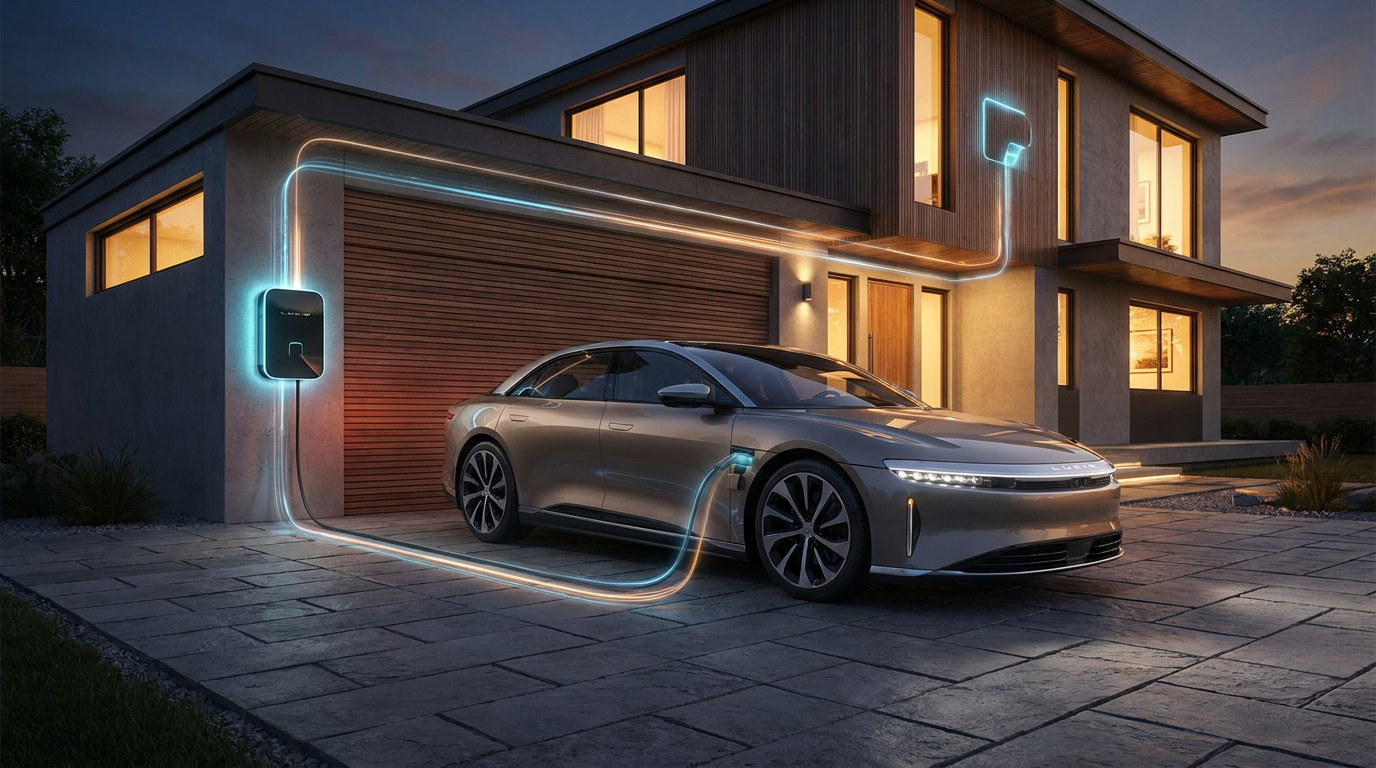
Unlocking this dormant energy is the promise of bidirectional charging. While traditional EV chargers are one-way streets, pushing alternating current (AC) from the grid into the car's direct current (DC) battery, bidirectional systems add a return lane. They allow the vehicle to discharge its stored energy back out into the world.[5]
This technology is broadly categorized into three tiers, collectively known as V2X (Vehicle-to-Everything). The simplest is Vehicle-to-Load (V2L), which allows drivers to plug standard 120V appliances—like a refrigerator during a blackout, a laptop at a job site, or power tools at a campsite—directly into the car's built-in outlets.[5]

The next step up is Vehicle-to-Home (V2H). In this setup, the EV connects to the home's electrical panel via a specialized wall charger and a transfer switch. During a power outage or peak pricing hours, the house draws its electricity entirely from the driveway, effectively turning the car into a massive, whole-home backup battery.[5]
The ultimate realization of this technology, however, is Vehicle-to-Grid (V2G). This allows the EV to export its stored energy back into the broader utility network. When multiplied across millions of vehicles, V2G creates a massive, decentralized energy reserve that utilities can tap into when renewable generation drops or demand spikes.[2]
For years, V2G has been trapped in "pilot purgatory," hindered by regulatory hurdles and hardware costs. But 2026 is emerging as the inflection point. A major catalyst occurred in Germany, where regulators finally removed the "double charging" of grid fees and electricity taxes for stored electricity fed back into the grid.[4]
For years, V2G has been trapped in "pilot purgatory," hindered by regulatory hurdles and hardware costs.
By treating EVs as mobile storage units rather than end consumers, this regulatory shift transforms a financial penalty into a revenue opportunity. Simultaneously, the European Union and the UK have moved from encouraging smart charging to mandating it, requiring new public chargers to support the ISO 15118-20 protocol.[4]
This standard is the digital handshake required for bidirectional communication. Automakers are responding aggressively to the new landscape. Volkswagen, for instance, has begun unlocking V2H capabilities for its ID. models equipped with 77 kWh batteries via a free over-the-air software update, instantly turning tens of thousands of cars into grid assets.[4][5]
Utility companies are also launching large-scale commercial pilots to test the waters. In the Netherlands and Sweden, energy provider Vattenfall has partnered with Kia and Hyundai to deploy bidirectional charging points to households, testing how EVs can automatically respond to electricity demand spikes between 4:00 PM and 9:00 PM.[3]
The economic incentives for drivers are becoming clearer. By participating in Virtual Power Plant (VPP) programs, where utilities aggregate thousands of EVs to dispatch energy collectively, owners can earn an estimated $420 to $780 annually in grid services revenue, simply by leaving their cars plugged in.[1][2]

However, significant barriers remain before V2G becomes ubiquitous. The most immediate is the upfront cost. A bidirectional EVSE (Electric Vehicle Supply Equipment) and the necessary home transfer switch can cost between $5,000 and $15,000 to install, a steep premium over standard Level 2 chargers.[1]
The hardware is expensive because the inversion process—converting the car's DC power back to the AC power used by homes and grids—typically happens inside the wall-mounted charger rather than the vehicle itself. This requires heavy, specialized power electronics.[1]
There is also lingering consumer anxiety regarding battery health. EV batteries degrade over time, and participating in V2G means subjecting the battery to additional "micro-cycles" of charging and discharging, which some fear could accelerate wear and tear.[1]

How we got here
Early 2020s
Automakers introduce V2L (Vehicle-to-Load), allowing drivers to plug standard appliances directly into their cars.
2024
Early V2H (Vehicle-to-Home) systems launch, primarily marketed as premium backup power solutions for luxury trucks and SUVs.
January 2026
Germany officially removes double grid fees for stored electricity, removing a major financial penalty for V2G participation.
Mid 2026
Major utilities across Europe and the US launch commercial Virtual Power Plant pilots utilizing aggregated EV fleets.
2027
EU mandate requires all newly installed public chargers to support the ISO 15118-20 bidirectional communication standard.
Viewpoints in depth
Grid Operators and Utilities
View electric vehicles as essential, dispatchable energy storage needed to stabilize the grid.
For utility companies, the transition to renewable energy presents a massive storage problem: the sun doesn't always shine, and the wind doesn't always blow. Instead of spending billions on utility-scale battery farms, grid operators view the millions of parked electric vehicles as a decentralized, ready-made solution. By networking these vehicles into Virtual Power Plants (VPPs), utilities can draw micro-amounts of power from thousands of cars simultaneously to smooth out demand spikes, effectively using consumer driveways to balance the grid.
Automakers and Tech Providers
Focus on standardizing communication protocols and unlocking bidirectional features to add value.
Automakers see bidirectional charging as a key differentiator that transforms a vehicle from a depreciating asset into a revenue-generating home appliance. By pushing over-the-air updates to unlock V2H and V2G capabilities, companies like Volkswagen and Ford are integrating their products deeper into consumers' daily lives. However, they are also racing to standardize the underlying software—specifically the ISO 15118 protocol—to ensure their vehicles can communicate seamlessly with chargers and utility networks across different global markets.
Consumer Advocates
Emphasize the need for affordable bidirectional hardware, clear battery warranties, and fair compensation.
While the prospect of earning passive income is appealing, consumer advocates caution that the economics don't yet make sense for everyone. The upfront cost of installing a bidirectional charger and transfer switch can easily exceed $10,000. Furthermore, advocates are pressing automakers for ironclad warranty protections, ensuring that the "micro-cycling" required to feed power back to the grid won't prematurely degrade the vehicle's expensive battery pack or leave the owner footing the bill for a replacement.
What we don't know
- How quickly the cost of bidirectional home chargers will fall to match standard Level 2 chargers.
- The exact long-term impact of daily V2G micro-cycling on the lifespan of various EV battery chemistries.
- Whether consumers will broadly consent to utility companies controlling their vehicle's charge state.
Key terms
- Bidirectional Charging
- Technology that allows an electric vehicle to both receive energy from the grid and discharge energy back into it or a home.
- V2G (Vehicle-to-Grid)
- A system where electric vehicles communicate with the power grid to sell demand response services by returning electricity to the network.
- V2H (Vehicle-to-Home)
- Using an electric vehicle's battery to provide backup power directly to a residential home during an outage or peak pricing period.
- ISO 15118
- The international communication standard that enables 'Plug & Charge' and bidirectional energy transfer between vehicles and chargers.
- Virtual Power Plant (VPP)
- A cloud-based network of decentralized power generating units, such as EVs and home batteries, that can be dispatched together to stabilize the grid.
Frequently asked
Will bidirectional charging degrade my EV battery?
Frequent micro-cycling can add wear, but modern battery management systems and utility limits are designed to minimize degradation. Many automakers are now updating warranties to explicitly cover V2G use.
Do I need a special charger for V2H or V2G?
Yes. You need a bidirectional EVSE (charger) that contains an inverter to convert the car's DC power back to AC, plus a transfer switch installed in your home.
Can any electric vehicle feed power back to the grid?
Not yet. While V2L (powering appliances) is common, full V2G/V2H requires specific onboard hardware and software. Models like the Ford F-150 Lightning, Nissan Leaf, and newer VW ID. series currently support it.
Sources
Source coverage
6 outlets
3 viewpoints surfaced






[1]Energy Solutions IntelligenceConsumer Advocates
Bidirectional EV Charging 2026: Which Cars Can Power Your Home and the Grid?
Read on Energy Solutions Intelligence →[2]V2G NewsGrid Operators and Utilities
2026 Outlook: The Year V2G Becomes a Mainstream Grid Resource
Read on V2G News →[3]VattenfallGrid Operators and Utilities
Vattenfall Netherlands launches V2G pilot with Kia and Hyundai
Read on Vattenfall →[4]Env.vcAutomakers and Tech Providers
V2G in 2026: The Barriers That Remain After the Regulatory Breakthrough
Read on Env.vc →[5]ElectroverseAutomakers and Tech Providers
Everything you need to know about bidirectional charging: V2G, V2H, and V2L explained
Read on Electroverse →[6]Factlen Editorial TeamConsumer Advocates
Synthesis by Factlen editorial team
Read on Factlen Editorial Team →
Every angle. Every day.
Get automotive stories with full source coverage and perspective breakdowns delivered to your inbox.