
How Cities and Neighborhoods Are Rebuilding 'Third Places' to Combat Isolation
Urban planners and community groups are revitalizing public libraries, parks, and cooperative housing models to restore the informal gathering spaces essential for civic life and mental well-being.
By Factlen Editorial Team
- Community Sociologists
- Emphasize the civic and democratic function of third places, arguing they are where people learn pluralism and build societal trust.
- Urban Planners and Municipalities
- View social spaces as critical infrastructure, akin to transit or utilities, requiring public funding to improve population mental health.
- Cohousing Advocates
- Argue that true community resilience requires integrating shared spaces and cooperative governance directly into residential housing models.
What's not represented
- · Commercial Real Estate Developers
- · Rural Residents lacking physical infrastructure
Why this matters
As loneliness reaches epidemic levels, the physical spaces where we live and gather are being redesigned to engineer connection back into daily life, offering a blueprint for healthier, more resilient communities.
Key points
- The U.S. Surgeon General has equated the health risks of chronic loneliness to smoking 15 cigarettes a day.
- "Third places"—informal public gathering spots like cafes and libraries—are critical for fostering community ties and civic engagement.
- Recent surveys show a steep decline in the use of shared spaces, with half of Americans rarely visiting parks.
- Municipalities are increasingly treating social spaces as essential public health infrastructure.
- Cohousing models are gaining traction by permanently integrating shared community spaces into residential neighborhoods.
The modern world has engineered friction out of daily life, but in doing so, it has also engineered out connection. As remote work normalizes and digital convenience replaces physical errands, millions of people find themselves oscillating exclusively between their homes and their workplaces—or, increasingly, just different rooms within their homes. This binary existence has fueled a well-documented crisis of isolation. Yet, in response to this growing epidemic of loneliness, a quiet but powerful architectural and social revival is taking root across neighborhoods worldwide: the intentional rebuilding of "third places."[1][6]
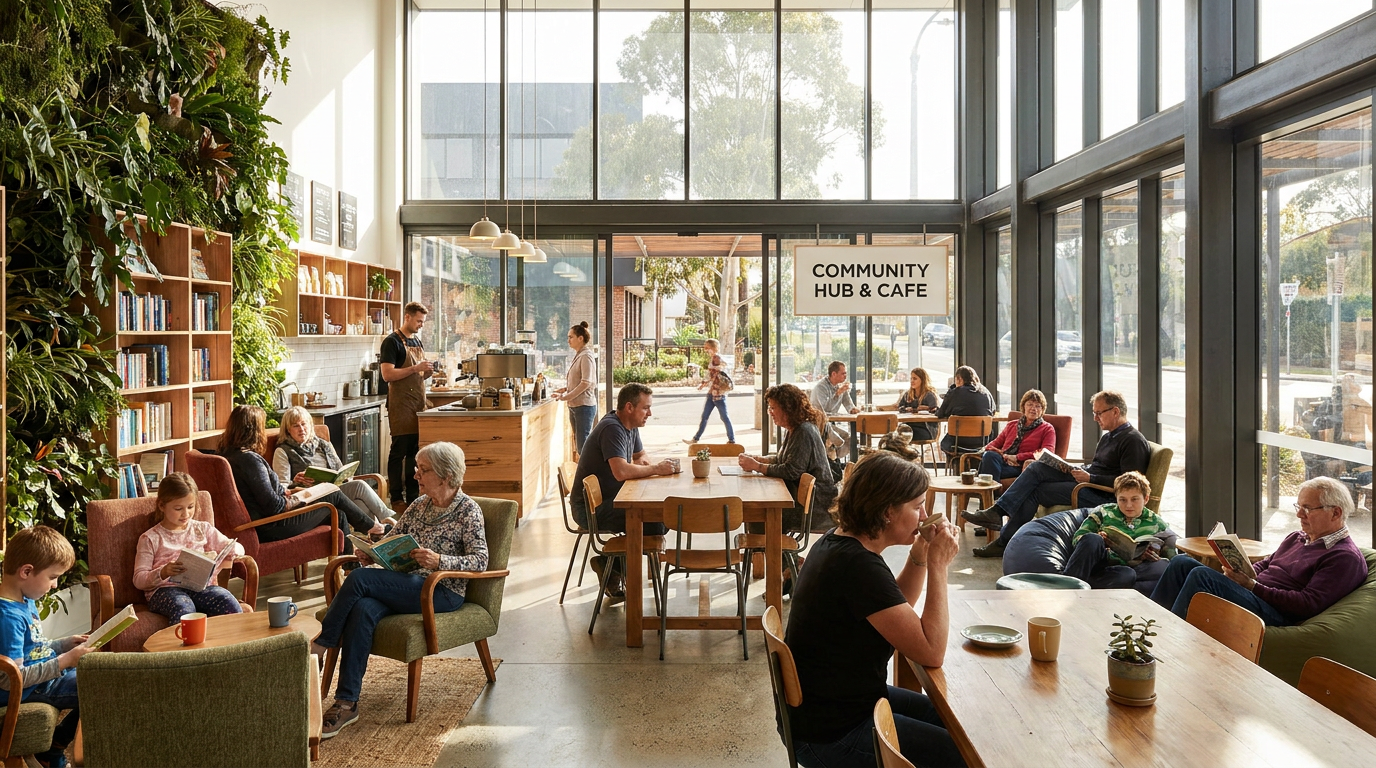
The concept of the "third place" was coined by sociologist Ray Oldenburg in his influential 1989 book The Great Good Place. If the home is considered the "first place" and the workplace is the "second," the third place serves as the informal, neutral public gathering spot. It is the local diner, the neighborhood barbershop, the public library, the community garden, or the church basement. These spaces are characterized by their high accessibility, their lack of formal hierarchy, and their unique ability to foster casual, low-stakes interactions among strangers and acquaintances alike.[2][3]
For decades, these spaces served as the vital bedrock of civic life and local social capital. They were the crucibles where neighbors organically became friends, where local gossip and news circulated, and where citizens learned the everyday practice of pluralism. However, the late twentieth and early twenty-first centuries saw a steady, quiet erosion of this critical social infrastructure. Suburban sprawl, the privatization of leisure time, and the relentless creep of commercialization began to systematically squeeze out accessible, affordable gathering spots from the modern urban landscape.[2][3]
The COVID-19 pandemic dramatically accelerated this decline. Lockdowns forced the closure of countless cafes, community centers, and recreational venues. Even as society reopened, the economic fallout and the entrenchment of hybrid work meant that many traditional third places never recovered. A recent American Social Capital Survey revealed a stark reality regarding our relationship with shared spaces: half of Americans reported never or seldom visiting a park in the previous year, and 63 percent said the exact same thing about their local public libraries.[2]

The human cost of this vanishing social infrastructure is profound and increasingly measurable. Public health officials and sociologists now universally recognize that the absence of community spaces is not merely a lifestyle shift; it is a severe public health crisis. The U.S. Surgeon General has explicitly labeled loneliness a national epidemic, noting that the physical and mental health risks of chronic social disconnection are comparable to smoking fifteen cigarettes a day, significantly raising the risk of cardiovascular disease and cognitive decline.[4]
Without third places, the casual "weak ties" that bind a community together begin to fray. Clinical researchers note that these informal interactions—chatting with a barista, nodding to a regular at the dog park, or sharing a table at a crowded library—are vital for emotional regulation and a sense of belonging. When these opportunities dry up, rates of anxiety, depression, and substance abuse predictably rise, particularly among young adults and the elderly who often lack the built-in social networks of a traditional workplace or school environment.[1][4]
Recognizing the severity of this isolation, urban planners, municipal governments, and community organizers are now actively treating social infrastructure with the same urgency as physical infrastructure like roads and bridges. The revival of third places is moving beyond nostalgia, becoming a deliberate strategy for public health and civic resilience. Cities are beginning to reimagine underutilized civic buildings, funding neighborhood-driven programming, and redesigning public parks to be more inclusive and welcoming to diverse populations.[4][6]

The revival of third places is moving beyond nostalgia, becoming a deliberate strategy for public health and civic resilience.
Modern third places are adapting to contemporary needs. Public libraries, long the champions of free, accessible space, are evolving far beyond traditional book repositories. They are transforming into vibrant community hubs that host everything from tool-lending programs and maker spaces to language classes and casual social events. By offering a safe, non-commercial environment open to everyone regardless of income or background, libraries are successfully filling the void left by vanishing neighborhood haunts.[1][2]
Commercial spaces are also shifting their models to better serve as community anchors. Independent coffee shops and bookstores are increasingly designing their layouts to encourage lingering and interaction, hosting open mic nights, community board meetings, and local art showcases. However, sociologists caution that true third places must remain financially accessible; a cafe where a cup of coffee costs seven dollars inherently excludes a significant portion of the community, undermining the egalitarian nature of Oldenburg's original vision for shared public life.[1][3]
To counter the growing risks of over-commercialization and gentrification, grass-roots movements are actively reclaiming public space for the people. Community gardens, neighborhood plazas, and cooperative tool-sharing spaces are being established through collective citizen effort rather than corporate investment. These citizen-led initiatives ensure that the spaces accurately reflect the specific cultural and social needs of the local residents, fostering a much deeper sense of ownership, pride, and long-term stewardship over the neighborhood's shared environment. By removing the financial barrier to entry, these projects guarantee that everyone has a place to belong.[3][4]

For some, the desire for connection is driving an even more profound shift in how we live: the rise of cohousing and intentional communities. If third places provide a temporary escape from isolation, cohousing seeks to permanently integrate community into the fabric of daily life. Originating in Denmark in the 1970s, this model blends the autonomy of private homeownership with the intentionality of collective living, creating a hybrid environment that naturally facilitates daily social interaction.[5][6]
In a typical cohousing development, individual private homes are clustered around extensive shared spaces, most notably a "common house" featuring a large dining room, kitchen, and recreational areas. Residents actively participate in the design and governance of the neighborhood, sharing resources, responsibilities, and, crucially, regular communal meals. This structure effectively builds a robust, inescapable third place directly into the residential environment, ensuring that social connection is a default state rather than an effortful errand.[5]

The cohousing model is gaining particular traction among older adults who are actively seeking a vibrant alternative to traditional institutional care. Senior cohousing communities promote aging-in-place by fostering an environment of mutual support, shared resources, and daily interdependence. Residents maintain their complete independence and privacy in their own homes while benefiting from a built-in social network that actively guards against the profound, debilitating isolation that all too often accompanies later life in conventional housing arrangements. This proactive approach to community living drastically reduces the cognitive and physical decline associated with loneliness.[5]
While cohousing represents the most immersive end of the spectrum, the broader push to revitalize third places shares the exact same fundamental goal: engineering connection back into the human experience. Whether it is a multi-generational housing cooperative, a bustling municipal library, or a simple neighborhood park with shaded seating and a chessboard, these spaces are absolutely essential for a healthy, functioning society.[1][5]
The success of this revival will depend on sustained investment and a cultural shift in how we value shared space. It requires zoning laws that encourage mixed-use development, municipal budgets that prioritize public amenities, and a collective willingness to step out of our private bubbles. By actively participating in and advocating for our local third places, we can begin to rebuild the social wealth that sustains both individual well-being and the everyday practice of democratic life.[2][4][6]
How we got here
1989
Sociologist Ray Oldenburg publishes 'The Great Good Place', coining the term 'third place'.
2000
Robert Putnam's 'Bowling Alone' documents the steep decline of civic engagement and shared social spaces in America.
2020
The COVID-19 pandemic forces the closure of traditional gathering spots, drastically accelerating social isolation.
2023
The U.S. Surgeon General issues an advisory declaring loneliness and isolation a public health epidemic.
2026
Municipalities increasingly integrate 'social infrastructure' investments into city budgets to combat the mental health crisis.
Viewpoints in depth
Urban Planners and Municipalities
Viewing social spaces as critical infrastructure, akin to transit or utilities, requiring public funding.
Urban planners argue that combating the loneliness epidemic requires treating parks, libraries, and community centers as essential public health infrastructure. They advocate for municipal budgets that prioritize the design and maintenance of these spaces, ensuring they remain accessible, inclusive, and free from the pressures of commercialization. By investing in social infrastructure, cities can proactively reduce the downstream healthcare costs associated with chronic isolation.
Community Sociologists
Emphasizing the civic and democratic function of third places for societal trust.
Sociologists emphasize that informal gathering spots are the bedrock of a functioning democracy. They argue that third places provide a low-stakes environment where citizens learn to interact with diverse groups, practice pluralism, and build the 'weak ties' that bridge socioeconomic divides. Without these spaces, society fractures into insular, polarized bubbles, severely damaging community resilience and mutual trust.
Cohousing Advocates
Integrating shared spaces and cooperative governance directly into residential housing models.
Advocates for intentional communities argue that relying on external commercial or public spaces is insufficient for true connection. They champion cohousing models that permanently weave shared resources, communal meals, and cooperative governance into the daily residential experience. This approach is viewed as particularly vital for aging populations, offering a sustainable alternative to institutional care by building a reliable support network right outside the front door.
What we don't know
- How municipalities will secure long-term funding to maintain free, non-commercial public spaces in high-rent urban areas.
- Whether the shift toward hybrid and remote work will permanently alter the geographic distribution of successful third places.
- How to effectively scale cohousing models without making them prohibitively expensive for lower-income residents.
Key terms
- Third Place
- An informal public gathering space separate from the home (first place) and the workplace (second place).
- Social Infrastructure
- The physical places and organizations, such as libraries and parks, that shape the way people interact and build community.
- Cohousing
- An intentional community of private homes clustered around shared space, designed to foster regular social interaction and mutual support.
- Weak Ties
- Casual, low-stakes relationships with acquaintances or strangers that contribute significantly to a person's sense of belonging.
- Pluralism
- A system where multiple diverse groups coexist and interact, often practiced and learned in shared public spaces.
Frequently asked
What exactly is a third place?
Coined by sociologist Ray Oldenburg, it is a public space outside of home and work where people gather informally, such as a cafe, park, or library.
Why are third places disappearing?
Factors include suburban sprawl, the rise of digital entertainment, the pandemic's economic fallout, and the increasing commercialization of public spaces.
How does cohousing differ from a traditional neighborhood?
Cohousing combines private homes with extensive shared facilities, like a common house for shared meals, and relies on resident-led democratic management.
What is the link between third places and public health?
Accessible community spaces foster social connections that combat loneliness, which the U.S. Surgeon General equates to the health risks of smoking 15 cigarettes a day.
Sources
Source coverage
6 outlets
3 viewpoints surfaced






[1]Boston UniversityCommunity Sociologists
The Importance of Third Places in Combating Loneliness
Read on Boston University →[2]Washington MonthlyCommunity Sociologists
How to Revive Third Spaces in American Democracy
Read on Washington Monthly →[3]Choices MagazineCommunity Sociologists
Third Places and Community Resilience
Read on Choices Magazine →[4]CityGovUrban Planners and Municipalities
Social Infrastructure and Mental Well-being
Read on CityGov →[5]Emerald InsightCohousing Advocates
Cohousing as Collaborative Housing
Read on Emerald Insight →[6]Factlen Editorial TeamUrban Planners and Municipalities
Synthesis by Factlen editorial team
Read on Factlen Editorial Team →

Every angle. Every day.
Get lifestyle stories with full source coverage and perspective breakdowns delivered to your inbox.