
The Electric Air Taxi Era Is Finally Here: How eVTOLs Are Clearing the FAA's Final Hurdles in 2026
After years of hype and billions in investment, electric vertical takeoff and landing (eVTOL) aircraft are entering the final stages of FAA certification, with pre-commercial flights launching across the U.S. this year.
By Factlen Editorial Team
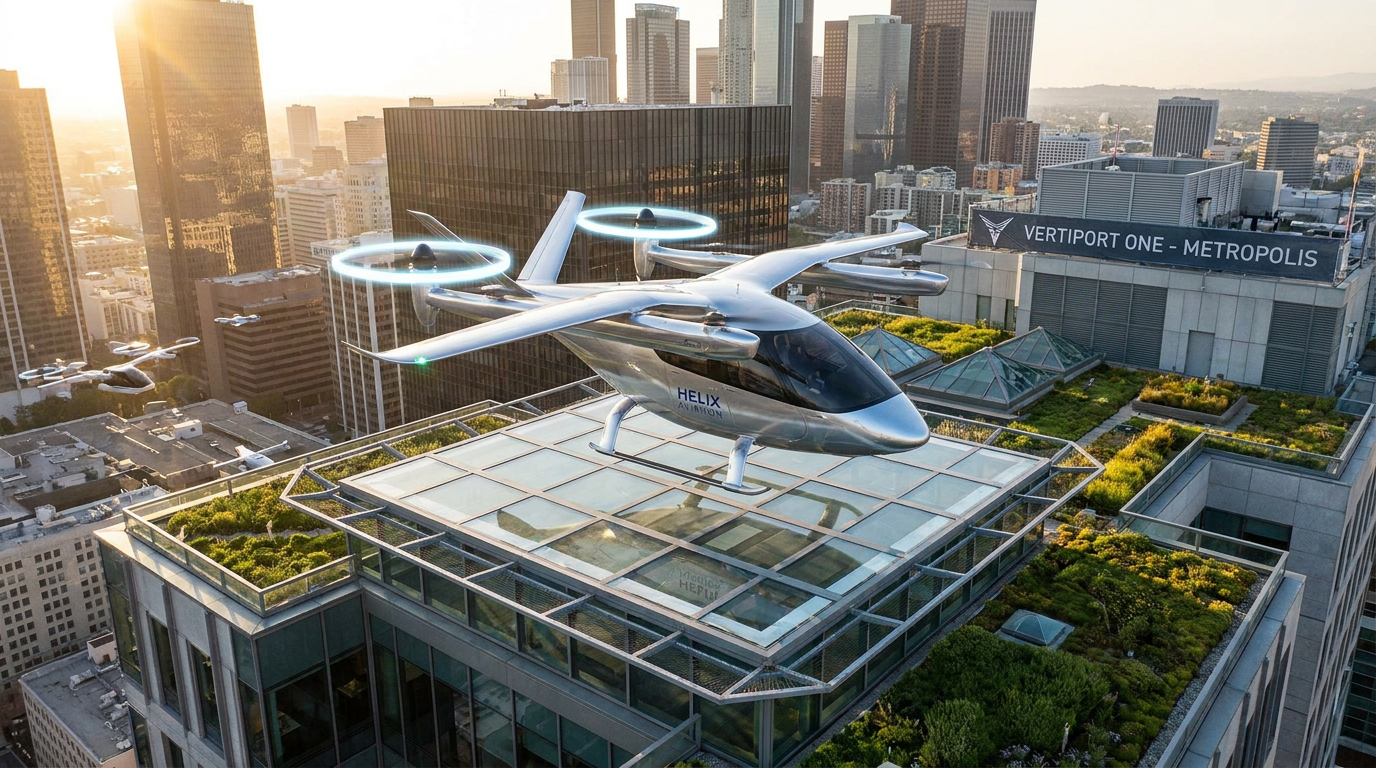
- eVTOL Manufacturers
- The companies building the aircraft argue that the technology is ready to revolutionize urban transit.
- Financial Analysts
- Wall Street is cautiously optimistic about the long-term potential but hyper-focused on near-term cash burn.
- Urban Planners & Municipalities
- City officials are focused on how these aircraft will integrate into existing transit ecosystems and neighborhoods.
- Aviation Regulators & Industry Watchers
- The FAA and other global regulators prioritize rigorous safety standards over rapid deployment.
What's not represented
- · Public Transit Advocates
- · Local Utility Providers
Why this matters
This is not just a novelty for the ultra-rich; companies are building high-volume, zero-emission air taxi networks designed to turn 90-minute urban commutes into 10-minute hops for the price of a premium rideshare. The imminent launch of these services will fundamentally reshape how millions of people navigate congested cities.
Key points
- Electric vertical takeoff and landing (eVTOL) aircraft are entering the final stages of FAA certification in 2026.
- The White House-backed eIPP program is allowing pre-certification demonstration flights across 26 U.S. states.
- Frontrunners Joby and Archer are flying production-conforming aircraft and targeting commercial launches by late 2026 or early 2027.
- Unlike helicopters, eVTOLs use distributed electric propulsion, making them significantly quieter and zero-emission.
- The business model focuses on aerial ridesharing, integrating with existing apps like Uber to offer fast urban commutes.
For decades, the "flying car" has been the ultimate symbol of a promised future that never quite arrived. But in the summer of 2026, the aviation industry is quietly crossing a threshold that turns science fiction into scheduled service. After billions of dollars in research and development, electric vertical takeoff and landing (eVTOL) aircraft are finally clearing the hardest regulatory gates in the United States.[1][2][4]
The two frontrunners in the American market, Joby Aviation and Archer Aviation, have moved beyond building bespoke prototypes and are now flying production-conforming aircraft. According to recent investor updates, both companies are targeting the completion of their Federal Aviation Administration (FAA) certification by late 2026 or early 2027, with initial commercial operations slated to begin this year in select global markets like Dubai.[4][5][6]
To understand why this moment is significant, it is necessary to understand the mechanism behind the aircraft. eVTOLs are not simply electric helicopters. They rely on Distributed Electric Propulsion (DEP), a design architecture that uses multiple small electric motors and rotors spread across the aircraft's wings and frame.[5]
In models like the Joby S4, six electrically powered tilting rotors allow the aircraft to lift straight up like a helicopter, then pivot forward to cut through the air like a traditional fixed-wing airplane. This dual capability allows them to operate from tight urban spaces while achieving cruise speeds of up to 200 miles per hour and ranges of around 100 to 150 miles on a single battery charge.[5][6]

Crucially, DEP solves the primary barrier that kept helicopters from becoming mass transit: noise. Because electric motors do not rely on combustion and the multiple rotors can spin at slower speeds, eVTOLs are remarkably quiet. In acoustic testing, they have proven to be nearly inaudible against the background hum of a city from just a few blocks away, making widespread urban vertiports politically and practically feasible.[5][6]
The technological breakthroughs, however, have always been secondary to the regulatory challenge. Convincing the FAA that a radically new category of aircraft is as safe as a commercial airliner is a grueling, multi-year process. The FAA requires eVTOLs to meet a stringent safety standard, meaning a catastrophic failure can only occur once in a billion flight hours.[4]
In 2026, the regulatory logjam finally broke. The FAA finalized its operating rules for powered-lift aircraft, giving operators a complete regulatory stack to begin commercial revenue flights once an airframe is certified. Furthermore, the White House and the FAA officially launched the eVTOL Integration Pilot Program (eIPP).[7][8]
Furthermore, the White House and the FAA officially launched the eVTOL Integration Pilot Program (eIPP).
The eIPP is a watershed mechanism for the industry. It allows pre-certification eVTOL demonstration flights in real United States airspace across 26 states. By bringing city, state, and federal regulators together to fly real aircraft before final type certification is signed, the program is designed to streamline approvals for airspace integration and infrastructure development.[2][7]

Joby Aviation is currently the most advanced in the regulatory pipeline, having reached Stage 4 of the FAA's rigorous five-stage Type Certification process. The company has already begun flying its first production-conforming aircraft—the exact design that will roll off the assembly line—and is preparing for its first commercial passenger services in the United Arab Emirates later this year.[4][5][6]
Archer Aviation is close behind, having recently become the first eVTOL developer to close Phase 3 of the FAA's parallel four-phase certification track. Archer has taken over operations at Hawthorne Airport in Los Angeles, positioning it as the anchor for a planned air taxi network that will serve as the official transportation provider for the LA28 Olympic Games.[8]
Archer CEO Adam Goldstein recently described 2026 as the industry's "Waymo moment." Just as early self-driving cars initially felt like science fiction before becoming a normal sight in cities like Phoenix and San Francisco, the goal of the eIPP and early commercial flights is to normalize the sight of electric aircraft for half a million commuters in major U.S. cities.[1][2]
The business model for these aircraft is designed to integrate seamlessly into existing transportation networks. Rather than selling the aircraft to wealthy individuals, companies like Joby and Archer plan to operate them as an aerial rideshare service. Through partnerships with Delta Air Lines, United Airlines, and Uber, passengers will eventually be able to book a multimodal trip—a car to the vertiport, an eVTOL over the traffic, and a car to the final destination—all within a single app.[6]

Despite the immense progress, significant uncertainties remain. The transition from building a handful of bespoke test aircraft to mass manufacturing hundreds of vehicles a month is notoriously difficult. Both Joby and Archer are building large-scale manufacturing facilities in Ohio and Georgia, respectively, but supply chain bottlenecks or production flaws could still delay their ambitious timelines.[4][8]
Financial endurance is another critical factor. Developing and certifying a new aircraft requires a staggering amount of capital. While Joby and Archer both entered 2026 with roughly $1.7 billion to $1.8 billion in liquidity, their cash burn rates are high. Any unexpected regulatory delays in the final stages of FAA certification could force them to raise additional capital, diluting existing shareholders.[4][8]
Finally, there is the infrastructure challenge. While eVTOLs can technically land on existing helipads, a high-volume air taxi network requires dedicated "vertiports" equipped with megawatt-class charging infrastructure. Upgrading urban electrical grids to support simultaneous fast-charging of multiple aircraft will require close coordination with local utilities and municipalities.[2][7]

Nevertheless, the momentum in 2026 is undeniable. With the regulatory framework falling into place, production lines spinning up, and the first commercial flights imminent in the Middle East, the electric air taxi has survived the hype cycle. The question is no longer if eVTOLs will fly, but how quickly they will scale to become a routine part of the daily commute.[1][4]
How we got here
2009
Joby Aviation is founded in California, beginning early research into distributed electric propulsion.
2020
The eVTOL industry sees a massive influx of capital, with billions invested in leading startups.
October 2024
The FAA finalizes the SFAR pilot certification rule, establishing how pilots will be trained for powered-lift aircraft.
March 2026
The White House and FAA launch the eVTOL Integration Pilot Program (eIPP) to allow pre-certification demonstration flights.
April 2026
Archer Aviation becomes the first developer to close Phase 3 of the FAA's four-phase Type Certification process.
Late 2026
Joby Aviation plans to launch its first commercial passenger services in Dubai.
Viewpoints in depth
eVTOL Manufacturers
The companies building the aircraft argue that the technology is ready to revolutionize urban transit.
Manufacturers like Joby and Archer emphasize that the core technology—batteries, electric motors, and fly-by-wire software—has matured past the experimental phase. They point to thousands of successful test flights as evidence that eVTOLs are safe, quiet, and reliable. Their primary focus has shifted from engineering the aircraft to scaling mass production and lobbying for faster infrastructure development.
Aviation Regulators
The FAA and other global regulators prioritize rigorous safety standards over rapid deployment.
Regulators view powered-lift aircraft as the most significant shift in aviation since the jet engine. While they are actively creating new frameworks like Part 194 and the eIPP to facilitate the industry, they insist that eVTOLs must meet the exact same "10 to the minus 9" safety threshold as commercial airliners. They are meticulously reviewing every component, from battery thermal runaway risks to software redundancy, refusing to accelerate timelines at the expense of public safety.
Financial Analysts
Wall Street is cautiously optimistic about the long-term potential but hyper-focused on near-term cash burn.
Financial analysts recognize the massive total addressable market for urban air mobility, but they remain wary of the immense capital required to get there. They closely monitor the "burn rate" of companies like Joby and Archer, noting that while they currently have strong liquidity, any unexpected delays in FAA certification could force them to raise more money, diluting the value for current shareholders.
Urban Planners
City officials are focused on how these aircraft will integrate into existing transit ecosystems and neighborhoods.
For urban planners, the aircraft itself is only half the equation. They are concerned with the logistics of building vertiports, upgrading electrical grids to handle megawatt-class charging, and managing community pushback. While they welcome the prospect of reduced traffic congestion and zero-emission transit, they want to ensure that air taxis don't simply become a nuisance for neighborhoods located under flight paths.
What we don't know
- Whether the supply chain can support the mass manufacturing of hundreds of eVTOLs per month.
- How quickly local electrical grids can be upgraded to support the megawatt-class charging required at high-volume vertiports.
- Exactly how much a consumer ticket will cost during the first year of commercial operations.
Key terms
- eVTOL
- Electric Vertical Takeoff and Landing aircraft, which use electric power to hover, take off, and land vertically.
- Type Certification
- The regulatory approval by the FAA signifying that an aircraft's design meets all safety and airworthiness standards.
- Distributed Electric Propulsion (DEP)
- An architecture that uses multiple small electric motors spread across an aircraft to increase efficiency, safety, and reduce noise.
- Vertiport
- A dedicated landing pad and charging facility designed specifically for eVTOL aircraft operations.
- Fly-by-wire
- An electronic flight control system that replaces traditional manual flight controls with an electronic interface.
Frequently asked
Will eVTOLs replace commercial airplanes?
No. They are designed for short urban and regional hops of 20 to 150 miles, replacing long car commutes rather than cross-country flights.
How much will a ride cost?
Operators initially plan to price flights similarly to an Uber Black ride, with the goal of dropping prices to match standard rideshare rates as the networks scale.
Are these aircraft safe?
Yes. The FAA requires eVTOLs to meet the same stringent safety standards as commercial airliners, meaning a catastrophic failure can mathematically only occur once in a billion flight hours.
Are they loud like helicopters?
No. Because they use multiple small electric motors that spin at slower speeds, eVTOLs are designed to blend into background city noise and are nearly inaudible from a few blocks away.
Sources
Source coverage
8 outlets
4 viewpoints surfaced








[1]NewsweekAviation Regulators & Industry Watchers
Archer Says Its Electric Air Taxi 'Waymo Moment' Is Coming in 2026
Read on Newsweek →[2]Smart Cities DiveUrban Planners & Municipalities
Leading air taxi developers are moving closer to commercial flights this year
Read on Smart Cities Dive →[3]Aerospace Testing InternationalAviation Regulators & Industry Watchers
MOSAIC rule changes how VTOLs can be certified for personal use
Read on Aerospace Testing International →[4]The Motley FoolFinancial Analysts
Joby Aviation has spent years building toward one moment
Read on The Motley Fool →[5]EcoMotors NewsAviation Regulators & Industry Watchers
The most advanced commercial eVTOLs in 2026
Read on EcoMotors News →[6]TradingKeyFinancial Analysts
Joby Aviation is positioned for future growth in electric vertical takeoff and landing (eVTOL) aircraft
Read on TradingKey →[7]Joby AviationeVTOL Manufacturers
Joby Selected as Partner in Multiple Winning Applications Under White House-Backed eIPP
Read on Joby Aviation →[8]Archer AviationeVTOL Manufacturers
Archer Announces First Quarter 2026 Operating and Financial Results
Read on Archer Aviation →
Every angle. Every day.
Get automotive stories with full source coverage and perspective breakdowns delivered to your inbox.