
Australia Leads SailGP Standings as Massive Repair Effort and Black Foils' Return Define Halifax Grand Prix
Australia's Flying Roos hold a commanding lead in the SailGP Season 6 standings heading into Halifax. Meanwhile, a 3,500-hour shipyard repair effort and the return of New Zealand's Black Foils add high stakes to the North American midpoint.

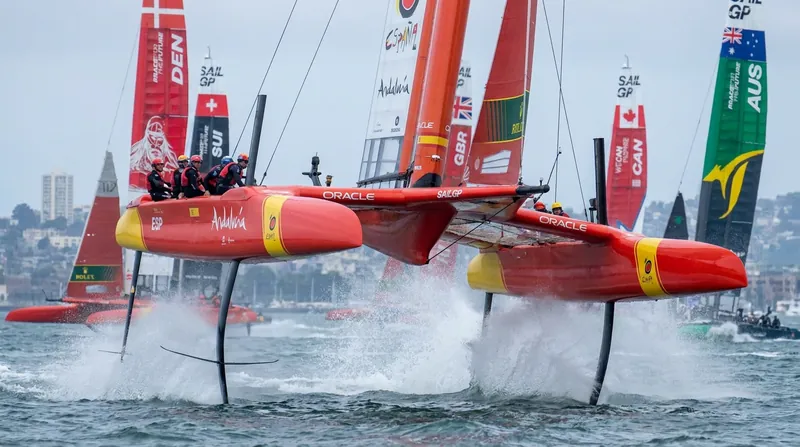
The global foiling circuit arrives in Nova Scotia this weekend for the Canada Sail Grand Prix, marking the midpoint of a fiercely contested SailGP Season 6. Set against the spectacular backdrop of Halifax Harbour, the June 20-21 event brings the world's fastest sailboats back to North American waters. With thirteen identical F50 catamarans capable of hitting 100 km/h, the stadium-style racing format promises high-stakes action just meters from the shoreline.[5]
At the top of the leaderboard, the narrative is defined by absolute dominance. Australia's BONDS Flying Roos, driven by Tom Slingsby, enter Halifax with a commanding 55 points. The Australians have been a masterclass in consistency and tactical composure, securing three consecutive event victories to firmly establish themselves as the team to beat.
Chasing the Australians are Emirates GBR, helmed by Dylan Fletcher, sitting 11 points back at 44 points. The British crew has consistently pushed Australia to the brink, most notably in a razor-thin final at the recent New York Sail Grand Prix where a last-leg collision required a chief umpire ruling to confirm Australia's win. The U.S. SailGP Team, led by Taylor Canfield, holds third place with 38 points, having quietly built a formidable campaign.
However, the championship standings only tell half the story heading into the Halifax weekend. The most intense race is currently happening off the water, inside the East River Shipyard in Nova Scotia. A massive, multi-national repair effort is underway to salvage three heavily damaged F50 catamarans following a catastrophic start-line pile-up in New York.[1]
The collision involved the United States, Red Bull Italy, and Mubadala Brazil, leaving all three vessels with severe structural damage. In response, SailGP has deployed a specialized team of 35 technicians from the UK and Canada, alongside local experts, to execute a projected 3,500 hours of repair work. The clock is ticking to get all three teams back on the start line for Friday's practice racing.[1]
"The invisible race," as it has been dubbed by league insiders, highlights the incredible logistical resilience required to maintain a 13-team global foiling fleet. Unlike previous incidents where parts were scavenged from one boat to fix another, the Halifax repair effort involves replacing massive cut-away sections of the carbon-fiber hulls with entirely new components.[1][2]
While the shipyard crews work around the clock, the biggest on-water storyline is the long-awaited return of New Zealand's Black Foils. Co-CEO and driver Peter Burling will lead his decorated team back into championship action for the first time since a dramatic crash in Auckland four months ago.[2]
The Auckland incident left the Kiwi F50 destroyed and resulted in fractures to both legs for grinder Louis Sinclair, who continues his recovery at home. After sitting out four consecutive events, the Black Foils have dropped to the very bottom of the 13-team standings. Yet, with seven events remaining on the 2026 calendar, the team remains mathematically in contention for the season-ending Grand Final in Abu Dhabi.[1][2]
The Kiwis will take to Halifax Harbour in a brand-new, custom-built F50 produced by SailGP Technologies in Southampton. The sleek black catamaran was shipped across the Atlantic in early June and is scheduled for commissioning and on-water testing just days before the official race window opens. The return of the Black Foils introduces a dangerous wild card to the fleet, as the highly experienced crew looks to shake off the rust and immediately hunt for a podium finish.[1]
For the home crowd, all eyes will be on the NorthStar SailGP Team. Driven by Olympic champion Giles Scott, the Canadian squad is looking to ignite their campaign on home waters. The 2024 Halifax event was a record-breaking success, drawing over 50,000 spectators and generating roughly $19 million for the regional economy.[4]
Anticipating even larger crowds for 2026, organizers have expanded the Race Stadium along the Halifax waterfront, adding new grandstands and exclusive viewing zones on Georges Island. The compact arena creates a natural amphitheater where every tack, gybe, and foil takeoff plays out directly in front of the fans.[5]
The SailGP format leaves no room for error. Each weekend consists of six fleet races—where all 13 boats battle simultaneously—culminating in a three-boat event final on Sunday. Points are awarded based on finishing position, heavily rewarding consistency across the varied wind and tidal conditions.[3]
As the fleet prepares to launch in Halifax, the pressure is universally high. Australia seeks to extend its dynasty, the repair teams fight simply to compete, Canada aims for hometown glory, and New Zealand begins a monumental climb from the bottom of the standings. In a sport defined by fine margins and flying carbon fiber, the North Atlantic waters are set to deliver a defining chapter of Season 6.[3]
Key points
- Australia leads the SailGP Season 6 standings with 55 points, followed by Great Britain and the USA.
- A massive 3,500-hour repair effort is underway in Nova Scotia to fix three F50s damaged in a New York pile-up.
- New Zealand's Black Foils return to the start line in a brand-new boat after missing four events due to a major crash.
- The Canada Sail Grand Prix in Halifax features an expanded stadium following a record-breaking debut.
How we got here
February 2026
The Black Foils suffer a catastrophic crash in Auckland, destroying their boat and injuring crew members.
May 30-31, 2026
Australia wins the New York Sail Grand Prix; a massive pile-up damages the USA, Italy, and Brazil boats.
Early June 2026
A brand-new F50 for the Black Foils is shipped from Southampton to Canada.
June 20-21, 2026
The Canada Sail Grand Prix takes place in Halifax Harbour.
- Championship Leaders
- Focused on maintaining momentum and widening the points gap at the top of the Season 6 standings.
- The Comeback Challengers
- Eager to test their new boat, shake off the rust, and climb from the bottom of the leaderboard after a long absence.
- The Repair Teams
- Engaged in a desperate race against time in the shipyard to ensure their heavily damaged boats make the start line.
- The Host Nation
- Looking to leverage the massive hometown crowd and expanded stadium to secure a podium finish in Canada.
Perspectives this story doesn't cover
- Local maritime businesses affected by the harbor closures
- Independent sailing analysts evaluating the F50 repair integrity
Sources
Source coverage
5 outlets
4 viewpoints surfaced





- [1]Sail-WorldThe Repair Teams
Race against time for SailGP Halifax as massive repair effort targets start line
Read on Sail-World → - [2]SailGP OfficialThe Comeback Challengers
Black Foils to make long-awaited return at Canada Sail Grand Prix
Read on SailGP Official → - [3]US SailGP TeamThe Repair Teams
How Does The SailGP Season Work And How Do Teams Win?
Read on US SailGP Team → - [4]CityNews HalifaxThe Host Nation
Economic impact study reveals SailGP success in Halifax
Read on CityNews Halifax → - [5]Spencer ClubThe Host Nation
Halifax, North American epicenter of 100 km/h foiling
Read on Spencer Club →
More in Sports
See all →Standings
Spain's Los Gallos Claim Back-to-Back SailGP Victories, Narrowing Australia's Championship Lead
4 sources
Injury
SailGP Injury Report: Sinclair Begins Recovery as Fleet Confronts the Physical Toll of Foiling
3 sources
Injury
SailGP Injury Report: Jensen Returns to Australian Lineup as Ashby Suffers Setback
4 sources
Standings
Spain's Halifax Victory Ignites Three-Way Tie for Second in SailGP Championship Standings
3 sources
Comments
Every angle. Every day.
Get Sports stories with full source coverage and perspective breakdowns, free every day.