
How Hydrogen Trains Are Quietly Decarbonizing Rural Railways
Hydrogen-powered trains are emerging as the elegant, zero-emission solution for vast stretches of rural track where traditional overhead electrification is too expensive.
By Factlen Editorial Team
- Rail Operators & Planners
- Focuses on the economic necessity of hydrogen to decarbonize rural routes without the massive capital expense of overhead wires.
- Environmental Advocates
- Champions the zero-emission technology but stresses that the hydrogen must be produced using renewable energy, not fossil fuels.
- Battery Proponents
- Argues that battery-electric trains are more efficient and cost-effective for shorter routes, reserving hydrogen only for long-haul needs.
What's not represented
- · Fossil Fuel Suppliers
- · Local Communities near Electrolysis Plants
Why this matters
Decarbonizing transportation is critical to fighting climate change, but electrifying remote rail lines is often financially impossible. Hydrogen technology allows these rural networks to eliminate diesel pollution without requiring billions of dollars in new infrastructure.
Key points
- Hydrogen trains generate electricity onboard using fuel cells, emitting only pure water vapor.
- They offer a zero-emission alternative for rural routes where installing overhead electric wires is too expensive.
- Stadler's FLIRT H2 train recently set a world record by traveling 1,741 miles on a single tank of hydrogen.
- Major rollouts are planned across Europe and California between 2026 and 2027.
- The primary challenge remains sourcing 'green hydrogen' produced via renewable energy rather than fossil fuels.
For over a century, the global railway industry has faced a stubborn geographical dilemma. While high-traffic urban commuter corridors and high-speed intercity routes easily justify the massive capital expense of stringing overhead electric wires, vast stretches of rural and mountainous tracks remain tethered to the technology of the past. On these sprawling, low-density routes, diesel locomotives have long been the only practical and economically viable option. They are undeniably reliable, powerful, and capable of traversing thousands of miles without specialized infrastructure. However, they are also loud, heavy, and significant contributors to global carbon emissions and local air pollution.[7][8]
As nations race to meet aggressive climate targets and decarbonize their transportation sectors, eliminating these legacy diesel fleets has become a top priority for railway planners worldwide. However, the traditional solution—electrifying these remote lines—is often financially impossible. The installation of overhead catenary wires, substations, and grid connections can cost upwards of $2 million per kilometer. When applied to hundreds of miles of track that may only see a few passenger trains a day, the math simply does not work. This economic barrier has left many regional networks in a state of environmental stagnation, waiting for a technological breakthrough.[7]
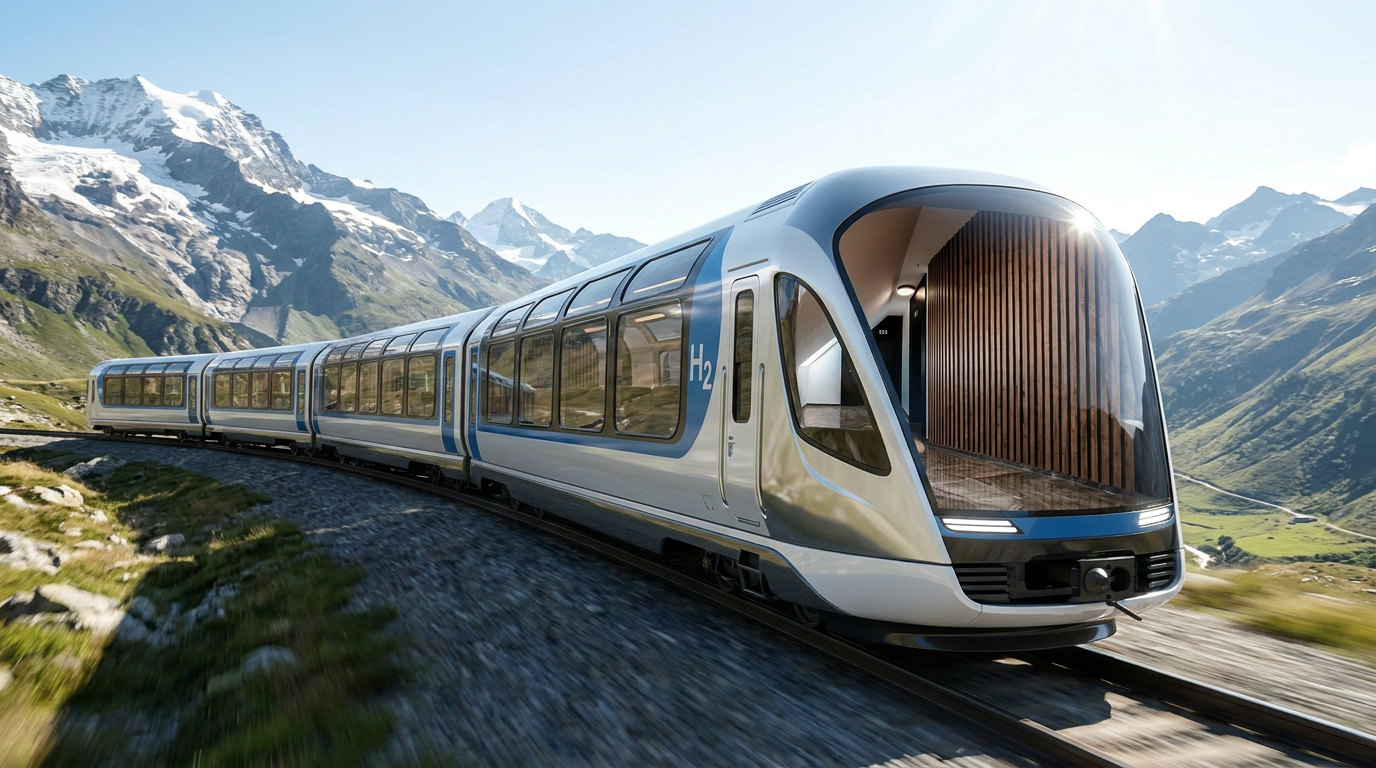
Enter the hydrogen-powered train, frequently referred to in the industry as "hydrail." This emerging technology promises to sever the rail sector's reliance on fossil fuels without requiring a continent-spanning web of copper wire. By generating their own electricity onboard, hydrogen trains can operate seamlessly on existing, unmodified tracks. They offer the quiet, smooth, and rapid acceleration of a modern electric train, but with the go-anywhere independence of a traditional diesel locomotive. For transportation authorities grappling with the mandate to achieve net-zero emissions, hydrail represents an elegant, infrastructure-light solution to a previously unsolvable problem.[8]
At the heart of this quiet transportation revolution is the hydrogen fuel cell. Unlike a traditional internal combustion engine that burns fossil fuels to create miniature explosions and drive mechanical pistons, a fuel cell relies on a silent, continuous electrochemical reaction. Modern hydrogen trains store compressed hydrogen gas in specialized, high-pressure tanks typically mounted on the roof, safely isolated from the passenger cabins below. During operation, this hydrogen gas is steadily fed into a Proton Exchange Membrane Fuel Cell (PEMFC), where it meets oxygen drawn directly from the outside ambient air.[5]
Inside the fuel cell, the magic of electrochemistry takes over. When the hydrogen molecules are forced through the specialized proton exchange membrane, they are split into their constituent parts: electrons and protons. The membrane is designed to only allow the protons to pass through. The electrons, meanwhile, are forced to detour through an external circuit, generating the electrical current that drives the train's heavy-duty traction motors. Once the electrons complete their circuit, they reunite with the protons and the oxygen on the other side of the membrane. The only byproduct of this entire complex process, expelled gently from the train's exhaust vents, is pure water vapor.[5]

To maximize operational efficiency and performance, these modern trains do not rely on fuel cells alone. They are engineered as sophisticated hybrid systems, equipped with high-performance lithium-ion battery banks that act as a crucial energy buffer. Fuel cells are highly efficient at providing a steady, continuous stream of electricity for cruising at a constant speed, but they are less adept at handling sudden, massive spikes in power demand. The onboard battery solves this problem by storing any excess power generated by the fuel cell during periods of low demand.[1][5]
When the train needs to accelerate rapidly away from a station platform or climb a steep mountain grade, the battery kicks in instantly to provide a massive surge of energy to the motors. Furthermore, these trains utilize advanced regenerative braking systems. When the train slows down, the electric traction motors run in reverse, acting as generators to capture the kinetic energy that would normally be lost as waste heat in traditional friction brakes. This captured energy is fed directly back into the battery, stretching the train's overall range and ensuring that virtually no power is wasted during the journey.[5]
Furthermore, these trains utilize advanced regenerative braking systems.
That extended operational range is proving to be hydrogen's greatest competitive advantage in the alternative fuel landscape. While battery-only electric trains (BEMUs) are excellent, highly efficient solutions for short commuter hops, they suffer from the same limitations as early electric cars. They typically require dedicated, high-voltage recharging infrastructure after traveling just 100 to 150 miles. Hydrogen trains, by contrast, boast operational ranges that directly rival their heavy-polluting diesel predecessors, allowing them to run all-day regional services without ever needing to stop and plug in.[3][7]
The true potential of this range was spectacularly demonstrated in March 2024. Swiss rail manufacturer Stadler shattered industry expectations when its FLIRT H2 passenger train officially set a Guinness World Record in Pueblo, Colorado. Operating on a dedicated test circuit under the close watch of adjudicators, the train traveled an astonishing 1,741 miles (2,803 kilometers) over 46 continuous hours on a single tank of hydrogen. This milestone definitively proved to skeptical rail operators that hydrogen technology is more than capable of handling the long-distance, uninterrupted routes that form the backbone of regional transit.[3]
With the underlying technology now proven in rigorous testing, a global commercial rollout is gathering significant momentum, led primarily by European nations eager to meet aggressive climate targets. In Germany, Siemens Mobility is preparing to launch its Mireo Plus H trains on the Südostbayernbahn network in Bavaria starting in 2026. These sleek, two-car trains, capable of reaching speeds of 140 kilometers per hour, will replace a fleet of aging diesel units. They will serve rural stations with zero local emissions, supported by a localized electrolysis plant built by Deutsche Bahn to ensure a steady fuel supply.[2]

Other European nations are following suit. Spain is preparing to launch its own fleet of hydrogen trains by 2026, specifically targeting rugged, mountainous regions where traditional electrification is nearly impossible to implement due to the terrain. Meanwhile, in Italy, Alstom's Coradia Stream H is entering service in the Valcamonica region as part of the ambitious H2iseO project. This initiative goes beyond just buying trains; it aims to create a comprehensive "Hydrogen Valley" complete with local renewable fuel production, storage, and distribution facilities that will eventually power both the railway and local bus fleets.[1][6]
The United States, where the vast majority of the national rail network remains un-electrified, is also taking its first definitive steps toward a hydrogen-powered future. California has ordered a fleet of Stadler FLIRT H2 trains to serve the Altamont Corridor Express and Amtrak San Joaquin routes, with passenger service expected to begin in 2027. State officials view the technology as a critical tool for reducing air pollution in the Central Valley, a region that has historically struggled with severe air quality issues. Because hydrogen trains can operate seamlessly on existing tracks, transportation authorities can deploy them rapidly.[4]
Despite these engineering triumphs and successful pilot programs, the transition to hydrail faces significant logistical and economic hurdles. The most pressing issue is the fuel supply chain itself. Currently, the vast majority of the world's commercially available hydrogen is "grey"—produced from natural gas in an energy-intensive process that releases carbon dioxide into the atmosphere. Running a zero-emission train on grey hydrogen largely defeats the environmental purpose of deploying the technology in the first place, merely shifting the emissions from the train's exhaust pipe to a distant chemical plant.[5][6]

For hydrogen trains to be truly zero-emission from well to wheel, they must be powered exclusively by "green hydrogen." This requires using renewable energy sources, such as wind or solar power, to split water molecules in a dedicated electrolysis plant. Building these localized green hydrogen production facilities, along with the specialized high-pressure refueling stations required at rail depots, demands massive upfront capital investment. Rail operators must essentially build an entirely new energy distribution network from scratch, a daunting task that requires deep cooperation between transit agencies, energy companies, and government regulators.[6][8]
Additionally, the day-to-day operational cost of hydrogen fuel currently remains noticeably higher than that of subsidized diesel or direct grid electricity. Early trials in places like Berlin have occasionally faced supply chain hiccups, resulting in temporary service withdrawals and underscoring the urgent need for a robust, reliable hydrogen distribution network. Ultimately, the future of rail transport will likely be a complementary ecosystem: overhead wires will power the dense, high-speed arteries, battery-electric trains will handle the short suburban capillaries, and hydrogen trains will conquer the vast, unwired frontiers, ensuring that the journey to a zero-carbon future leaves no station behind.[6][7]
How we got here
2018
Alstom's Coradia iLint completes its first passenger test run in Lower Saxony, Germany.
December 2021
Stadler's battery-powered FLIRT Akku sets a world record, paving the way for alternative propulsion.
March 2024
Stadler's FLIRT H2 sets a Guinness World Record by traveling 1,741 miles on a single hydrogen tank.
2026
Siemens Mireo Plus H scheduled to enter regular passenger service in Bavaria, Germany.
2027
California expected to launch the first hydrogen-powered passenger trains in the United States.
Viewpoints in depth
Rail Operators & Planners
Focuses on the economic necessity of hydrogen to decarbonize rural routes without the massive capital expense of overhead wires.
For transit authorities, the appeal of hydrogen is purely mathematical. Electrifying a rural rail line with overhead catenary wires can cost millions of dollars per kilometer—an impossible expense for routes that only serve a few thousand passengers a day. By adopting hydrogen trains, operators can meet strict government mandates to phase out diesel locomotives without needing to rebuild their entire infrastructure. They view hydrail as the missing link that allows them to modernize their networks rapidly and cost-effectively.
Environmental Advocates
Champions the zero-emission technology but stresses that the hydrogen must be produced using renewable energy, not fossil fuels.
Climate advocates celebrate the elimination of diesel exhaust, which heavily pollutes local communities. However, they caution against viewing hydrogen trains as a silver bullet if the fuel supply chain remains dirty. Currently, most industrial hydrogen is 'grey,' meaning it is extracted from natural gas in a process that releases significant carbon dioxide. Environmental groups argue that the true promise of hydrail will only be realized when operators commit to sourcing 'green hydrogen'—fuel produced by splitting water using wind or solar power.
Battery Proponents
Argues that battery-electric trains are more efficient and cost-effective for shorter routes, reserving hydrogen only for long-haul needs.
Engineers and analysts focused on energy efficiency point out that converting electricity into hydrogen, and then back into electricity inside a train, results in significant energy loss. They argue that for shorter commuter routes (under 150 miles), battery-electric trains (BEMUs) are far more efficient and cheaper to operate. This camp believes hydrogen should be strictly reserved for long-haul freight and deep rural routes where batteries simply cannot provide the necessary range.
What we don't know
- How quickly the cost of 'green hydrogen' will fall to achieve parity with subsidized diesel fuel.
- Whether hydrogen fuel cell technology will eventually scale up enough to replace heavy, long-haul freight locomotives, which require vastly more power than passenger trains.
Key terms
- Hydrail
- A portmanteau of 'hydrogen' and 'rail,' referring to any railway vehicle that uses hydrogen fuel cells for propulsion.
- PEMFC
- Proton Exchange Membrane Fuel Cell, the specific type of fuel cell used in trains to combine hydrogen and oxygen to generate electricity.
- Green Hydrogen
- Hydrogen fuel produced by using renewable energy (like wind or solar) to split water molecules, resulting in zero carbon emissions.
- Grey Hydrogen
- Hydrogen fuel produced from natural gas through steam methane reforming, a process that releases carbon dioxide into the atmosphere.
- BEMU
- Battery Electric Multiple Unit, a train powered entirely by onboard batteries, typically used for shorter commuter routes.
Frequently asked
Are hydrogen trains safe to ride?
Yes. Hydrogen tanks are heavily reinforced and typically mounted on the roof. Because hydrogen is much lighter than air, any potential leak dissipates rapidly upward, unlike diesel fuel which pools dangerously on the ground.
How fast can a hydrogen train go?
Current commercial models, such as the Siemens Mireo Plus H and Alstom Coradia iLint, are designed for regional transit and can reach top speeds of 140 km/h (87 mph).
Why not just use battery-powered trains?
Batteries are excellent for short commuter routes, but they are heavy and take time to recharge. Hydrogen provides a much longer operational range (over 1,000 miles) and can be refueled in about 15 minutes, making it ideal for long rural routes.
Sources
Source coverage
8 outlets
3 viewpoints surfaced








[1]AlstomRail Operators & Planners
Alstom and FNM present Italy's first hydrogen train
Read on Alstom →[2]Hydrogen EuropeRail Operators & Planners
German rail network to introduce Siemens hydrogen-powered trains
Read on Hydrogen Europe →[3]StadlerRail Operators & Planners
Stadler's FLIRT H2 hydrogen train sets new Guinness World Records title
Read on Stadler →[4]Hydrogen CentralEnvironmental Advocates
Government approves millions for hydrogen-electric rail technology of the 'future'
Read on Hydrogen Central →[5]MDPIEnvironmental Advocates
Hydrogen-Powered Trains: A Review of the Current Status and Safety Challenges
Read on MDPI →[6]Trains MagazineBattery Proponents
Hydrogen trains make progress in Europe
Read on Trains Magazine →[7]Rail ExpressBattery Proponents
The future of rail propulsion: Hydrogen or battery?
Read on Rail Express →[8]Factlen Editorial TeamRail Operators & Planners
Synthesis by Factlen editorial team
Read on Factlen Editorial Team →
Every angle. Every day.
Get automotive stories with full source coverage and perspective breakdowns delivered to your inbox.