
The Evidence-Based Guide to 2026's Top Sleep Trackers: What Actually Works
We analyzed clinical validation studies and expert testing to determine how accurately the latest smart rings and watches measure sleep stages, recovery, and overall rest.
By Factlen Editorial Team
- Consumer Tech Reviewers
- Evaluates devices based on comfort, battery life, app ecosystem, and practical usability for the average shopper.
- Clinical Sleep Researchers
- Focuses on the limitations of consumer devices compared to medical-grade polysomnography, particularly regarding sleep staging.
- Evidence-Based Synthesis
- Bridges the gap between clinical skepticism and tech enthusiasm to provide actionable buying advice.
What's not represented
- · Budget-conscious consumers priced out of hardware subscription models
- · Traditional mattress and bedding manufacturers focusing on analog sleep environments
Why this matters
Consumers spend hundreds of dollars on wearables hoping to optimize their rest and recovery. Understanding which metrics are scientifically validated—and which are educated guesses—ensures you buy the right device and use the data effectively without developing sleep anxiety.
Key points
- Modern wearables are highly accurate at tracking total sleep duration and resting heart rate.
- Consumer devices struggle to accurately identify specific sleep stages like REM and Deep sleep.
- Long-term trends in Heart Rate Variability (HRV) provide excellent insights into physical recovery and stress.
- Smart rings offer a comfort advantage over watches, leading to better long-term wear compliance.
- Shoppers should focus on broad trends rather than obsessing over nightly 'sleep scores' to avoid sleep anxiety.
The sleep tracking market in 2026 is flooded with promises of total physiological optimization. From the Oura Ring Gen 4 to the Apple Watch Series 10 and the Samsung Galaxy Ring, consumers are spending hundreds of dollars—often coupled with monthly subscription fees—to quantify their rest. But beneath the sleek marketing materials and proprietary "readiness scores," a fundamental question remains for shoppers: do these devices actually measure sleep accurately?[1][5][6]
To find out, we cross-referenced consumer tech reviews with clinical validation studies comparing modern wearables to medical-grade polysomnography (PSG). The evidence reveals a clear divide between what wearables do exceptionally well and where their algorithms overpromise. If you are shopping for a tracker, understanding this distinction is crucial to getting actual value from your purchase rather than just a stream of anxiety-inducing data.[3][4][6]
The strongest evidence supports the claim that modern wearables are highly accurate at measuring Total Sleep Time (TST) and sleep efficiency. Clinical reviews show that devices using a combination of actigraphy (motion sensing) and optical heart rate sensors can detect exactly when you fall asleep and wake up with 85% to 90% accuracy compared to clinical PSG setups.[3][4]
For the average consumer, this is the most actionable data point available. Knowing exactly how many hours you actually slept—rather than how many hours you simply spent lying in bed—is the foundation of improving sleep hygiene. Both Wirecutter and The Verge highlight that Apple and Oura excel at establishing this baseline metric, making them highly effective behavioral modification tools.[1][2]

However, the evidence weakens significantly when it comes to sleep staging. Wearables heavily market their ability to tell you exactly how much Light, Deep, and REM sleep you achieved each night. Because these devices rely on heart rate variability, temperature, and movement rather than brain waves (EEG), they are essentially making highly educated guesses about your neurological state.[3][4][6]
Systematic reviews published in medical journals indicate that consumer wearables only match PSG sleep staging about 50% to 65% of the time. They frequently confuse light sleep with REM sleep, or miscategorize deep sleep if the user happens to have a naturally low resting heart rate that mimics deep-sleep physiology.[4]
Systematic reviews published in medical journals indicate that consumer wearables only match PSG sleep staging about 50% to 65% of the time.
Therefore, consumers should view their "time in REM" or "deep sleep" scores as rough estimates rather than medical facts. Sleep specialists warn that obsessing over these specific staging numbers can actually lead to "orthosomnia"—a psychological condition where users lose sleep due to anxiety over achieving a perfect score on their sleep tracker.[3][6]
While brain waves elude wrist and finger sensors, cardiovascular metrics do not. The photoplethysmography (PPG) sensors in 2026's top devices track resting heart rate and blood oxygen levels with over 95% accuracy. This is where the true value of modern wearables lies for shoppers focused on holistic health and athletic recovery.[4][5]

By establishing a baseline Heart Rate Variability (HRV) over several weeks, devices from Oura, Whoop, and Apple can accurately detect physiological stress, impending illness, or overtraining before the user feels symptomatic. Tech reviewers consistently praise these recovery metrics as the most reliable and actionable features of premium wearables.[1][2][5]
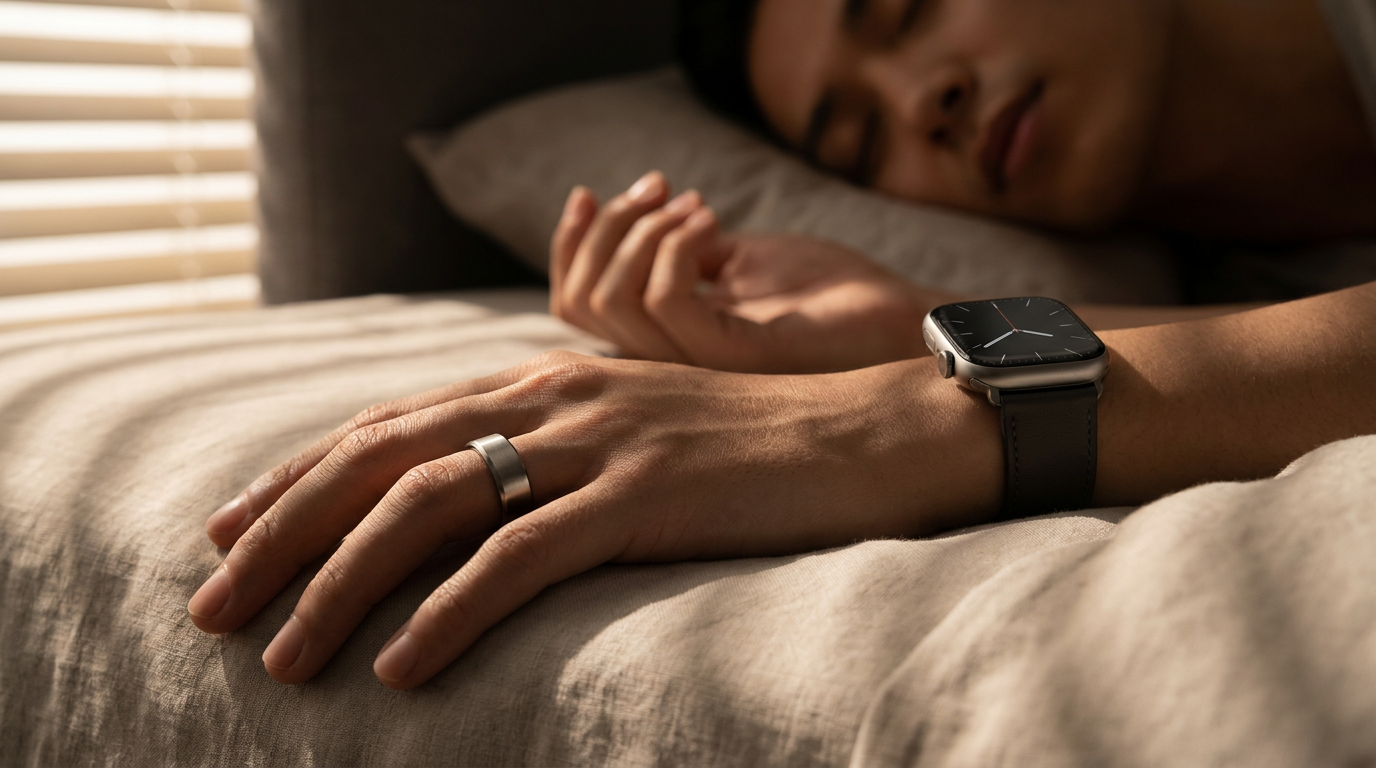
When it comes to shopping decisions, form factor plays a massive role in data quality simply due to user compliance. Tech reviewers consistently note that smart rings offer superior nighttime comfort—people simply prefer wearing a lightweight titanium band to bed over a bulky smartwatch with a glowing screen.[1][2]
Rings also benefit from reading the pulse at the finger, where blood vessels are closer to the surface than the wrist, theoretically reducing signal noise. However, watches often feature larger batteries and more powerful sensor arrays. CNET's testing of the Apple Watch Series 10 found that its high-frequency sampling provides incredibly tight heart rate graphs, though the practical difference for overnight tracking is negligible for most users.[1][5]

If your goal is to track total sleep duration, monitor resting heart rate trends, and gauge overall recovery, investing in a premium sleep tracker in 2026 is supported by strong evidence. They are excellent tools for identifying lifestyle factors—like late-night meals or alcohol consumption—that silently ruin sleep quality.[2][6]
However, if you suspect you have a clinical sleep disorder like sleep apnea, or if you are trying to micromanage your REM cycles to the minute, consumer wearables are not a substitute for a clinical sleep study. Shoppers should choose the device they find most comfortable to wear consistently, as long-term trend data is far more valuable than any single night's reading.[3][6]
How we got here
Early 2010s
First-generation fitness bands use basic actigraphy (movement) to estimate sleep, offering very low accuracy.
2018-2020
Wearables integrate advanced optical heart rate sensors and SpO2 tracking, vastly improving sleep duration accuracy.
2022
Heart Rate Variability (HRV) becomes the standard metric for calculating daily 'readiness' and recovery scores.
2024
The smart ring form factor goes mainstream with the launch of the Samsung Galaxy Ring, challenging Oura's dominance.
2026
Algorithms shift focus from raw sleep staging to holistic, AI-driven behavioral coaching based on long-term trends.
Viewpoints in depth
Clinical Sleep Researchers
Focuses on the limitations of consumer devices compared to medical-grade polysomnography.
Medical professionals and sleep researchers emphasize that while consumer wearables are excellent for broad behavioral awareness, they cannot replace clinical diagnostics. Because wearables lack EEG sensors to measure brain waves, their sleep staging data (REM vs. Deep sleep) is fundamentally an algorithmic guess based on cardiovascular patterns. Researchers warn that treating this data as medical fact can lead to unnecessary anxiety and misdiagnosis of actual sleep disorders.
Consumer Tech Reviewers
Evaluates devices based on comfort, battery life, app ecosystem, and practical usability.
For tech reviewers, the best sleep tracker isn't necessarily the one with the most clinical sensors, but the one you will actually wear every night. This perspective heavily favors the smart ring form factor due to its unobtrusive nature. Reviewers also focus heavily on the software experience, penalizing companies that hide basic health metrics behind expensive monthly paywalls, and praising apps that translate raw data into actionable, easy-to-understand lifestyle advice.
Quantified Self Advocates
Focuses on leveraging HRV and recovery trends to optimize athletic performance and daily energy.
Athletes and biohackers view sleep trackers primarily as recovery optimization tools. From this viewpoint, the exact accuracy of sleep staging is less important than the reliability of the device's Heart Rate Variability (HRV) baseline. By monitoring how their HRV responds to different stimuli—such as alcohol, late meals, or intense training—this camp uses wearables to make precise, data-driven adjustments to their daily routines to maximize daytime performance.
What we don't know
- Whether long-term use of consumer sleep trackers definitively improves health outcomes over decades.
- How next-generation non-contact radar sleep trackers will compare to wearables in real-world bedroom environments.
Key terms
- Polysomnography (PSG)
- A comprehensive, medical-grade sleep study that records brain waves, oxygen levels, heart rate, and breathing to diagnose sleep disorders.
- Photoplethysmography (PPG)
- An optical measurement technique used by wearables that shines light into the skin to detect blood volume changes, calculating heart rate and oxygen levels.
- Heart Rate Variability (HRV)
- The measure of the specific variation in time between each heartbeat, used as a key indicator of physiological stress and nervous system recovery.
- Actigraphy
- The continuous measurement of motor activity and movement using accelerometers, used by wearables to estimate when you fall asleep and wake up.
Frequently asked
Can a sleep tracker diagnose sleep apnea?
No. While devices with SpO2 sensors can flag unusual drops in blood oxygen that correlate with apnea, they are not FDA-cleared diagnostic tools. You still need a clinical sleep study for a diagnosis.
Are smart rings better than smartwatches for tracking sleep?
In terms of raw sensor accuracy, they are very similar. However, rings are generally considered better for sleep tracking simply because they are more comfortable to wear to bed, leading to more consistent data collection.
Why do different trackers give me different sleep scores?
Every company uses its own proprietary algorithm to weigh factors like resting heart rate, HRV, and movement. Because there is no standardized formula for a 'readiness score,' results will vary between brands.
What is orthosomnia?
Orthosomnia is an unhealthy obsession with achieving perfect sleep tracker metrics, which ironically causes anxiety that degrades actual sleep quality.
Sources
Source coverage
6 outlets
3 viewpoints surfaced






[1]The VergeConsumer Tech Reviewers
Samsung Galaxy Ring vs. Oura Ring 4: The ultimate sleep tracking showdown
Read on The Verge →[2]WirecutterConsumer Tech Reviewers
The Best Sleep Trackers for 2026
Read on Wirecutter →[3]Sleep FoundationClinical Sleep Researchers
Clinical Accuracy of Consumer Sleep Trackers: What the Data Says
Read on Sleep Foundation →[4]PubMed CentralClinical Sleep Researchers
Validation of commercial sleep trackers against polysomnography: A systematic review
Read on PubMed Central →[5]CNETConsumer Tech Reviewers
Apple Watch Series 10 Sleep Tracking Tested: Incremental but Powerful
Read on CNET →[6]Factlen Editorial TeamEvidence-Based Synthesis
Synthesis by Factlen editorial team
Read on Factlen Editorial Team →

Every angle. Every day.
Get shopping stories with full source coverage and perspective breakdowns delivered to your inbox.