
OLED vs. Mini-LED Gaming Monitors: The 2026 Buyer's Guide
As 2026 monitor technologies mature, the choice between OLED and Mini-LED comes down to room lighting, productivity needs, and motion clarity preferences.
By Factlen Editorial Team
- Dark-Room Enthusiasts
- Gamers and cinephiles who prioritize perfect black levels, infinite contrast, and instantaneous motion clarity above all else.
- Hybrid Prosumers
- Users who split their time between gaming and 8-hour productivity shifts, prioritizing sustained brightness and zero burn-in risk.
- Hardware Manufacturers
- Brands pushing the limits of both technologies, offering dual-mode OLEDs for esports and high-zone-count Mini-LEDs for HDR punch.
What's not represented
- · Console-only gamers who rely on living room TVs rather than desktop monitors.
- · Budget buyers looking for sub-$300 standard IPS displays without advanced dimming.
Why this matters
Dropping $800 to $1,200 on a premium display is a major investment. Choosing the wrong panel technology for your specific room lighting or daily workflow can lead to eye strain, washed-out colors, or permanent screen burn-in.
Key points
- OLED monitors deliver perfect black levels and unmatched 0.03ms motion clarity, making them ideal for dark rooms and competitive gaming.
- Mini-LED monitors offer blindingly high sustained brightness and zero burn-in risk, excelling in sunlit rooms and heavy productivity workflows.
- New 2026 OLED panels feature RGB stripe sub-pixel layouts, largely resolving historical issues with text clarity and color fringing.
- Mini-LED currently dominates the sub-$700 value market, while OLED remains the premium choice for high-end enthusiasts.
The premium gaming monitor market in 2026 has coalesced around two heavyweight display technologies: Organic Light-Emitting Diode (OLED) and Mini-LED. Gone are the days when standard edge-lit LCDs dominated the high-end space. Today, buyers dropping substantial money on a 4K display are forced to choose between the perfect black levels of OLED and the searing brightness of Mini-LED. With both technologies now offering high refresh rates—often reaching 240Hz at 4K resolution—the decision is no longer about which panel is objectively superior, but rather which set of trade-offs best aligns with a user's specific environment and daily workflow.[1][5]
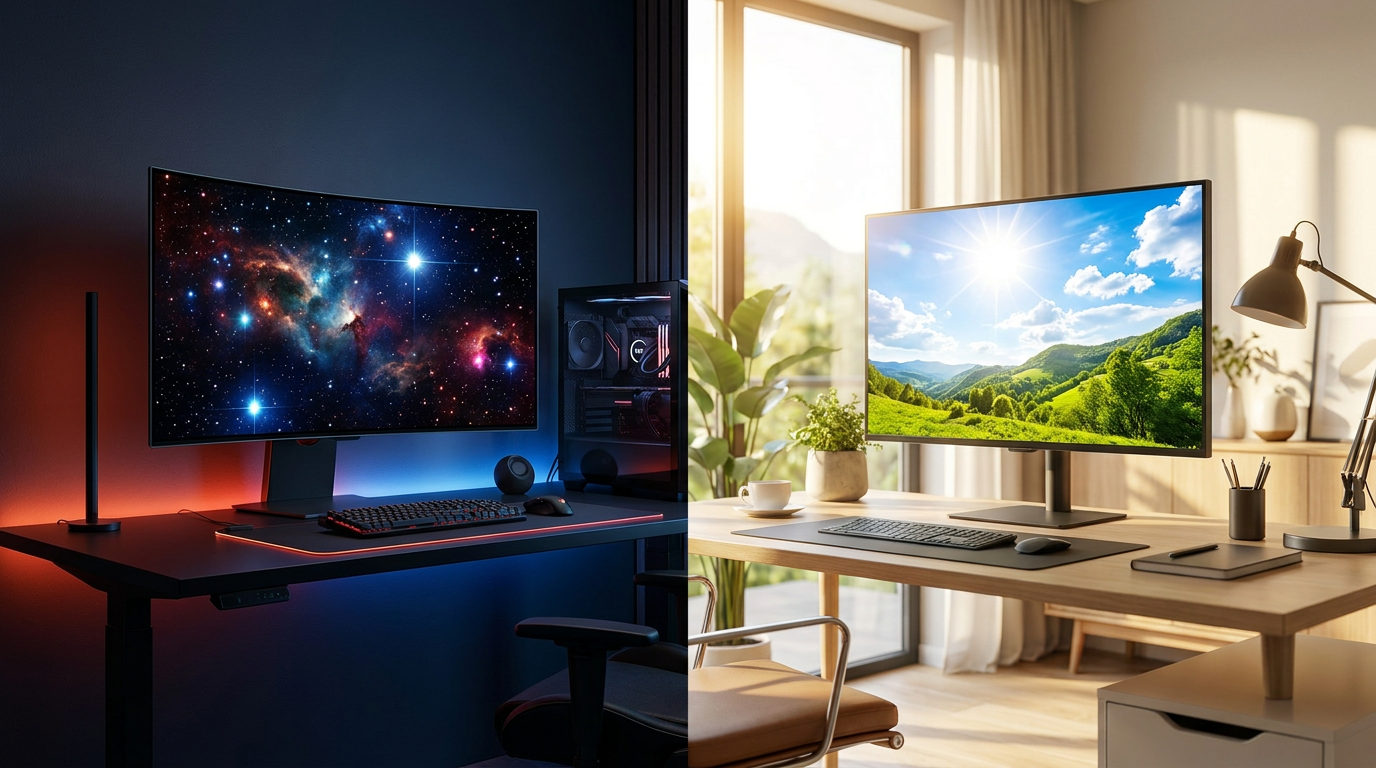
To understand the divide, one must look at how each panel generates an image. The primary argument for OLED rests on its self-emissive nature. Because an OLED panel lacks a traditional backlight, each of its over eight million pixels produces its own light and can turn off completely independently. This mechanism delivers an infinite contrast ratio, ensuring that a starry night sky in a game features pinpoint white stars against a canvas of absolute, inky black.[1][5]
Conversely, the core mechanism of Mini-LED relies on an advanced backlighting system placed behind a traditional LCD layer. Instead of a single light source, Mini-LED monitors utilize thousands of microscopic diodes grouped into specific dimming zones. High-end 2026 models frequently feature between 1,196 and over 2,000 independent zones that brighten or dim based on the content displayed. While this cannot match the per-pixel precision of OLED, it allows the monitor to push massive amounts of light through the LCD layer, creating a vibrant, punchy image.[1][5]

The case for OLED is built heavily on motion clarity and dark-room immersion. Because self-emissive pixels change state almost instantaneously, modern OLEDs boast response times as low as 0.03 milliseconds. The evidence for this advantage is clear in the competitive gaming space, where dual-mode OLED monitors—capable of running at 4K 240Hz for visual fidelity or switching to 1080p 480Hz for esports—have become the gold standard. For players sensitive to motion blur or ghosting, OLED provides a remarkably fluid experience that traditional liquid crystals struggle to match.[2][6]
However, the case against OLED centers on two persistent limitations: burn-in risk and full-screen brightness constraints. When an OLED screen displays static elements—such as a Windows taskbar, a video editing timeline, or a game's heads-up display—for thousands of hours, the organic compounds can degrade unevenly, leaving a permanent ghost image. Furthermore, to protect the panel and manage heat, OLEDs utilize an Automatic Brightness Limiter (ABL). While they can hit impressive peak brightness in small highlights, their sustained full-screen brightness typically hovers around 400 to 500 nits, which can look dim in a sunlit room.[1][3]
This is where the argument for Mini-LED gains overwhelming traction. The primary advantage of Mini-LED is its ability to sustain blindingly high brightness levels across the entire screen without any risk of permanent image retention. Evidence from recent hardware testing shows that premium Mini-LED displays can comfortably sustain over 1,000 nits of full-screen brightness. For users working in rooms with uncontrolled daylight or large windows, this raw luminance easily overpowers ambient glare, keeping the image vivid and legible where an OLED might look washed out.[1][5]
This is where the argument for Mini-LED gains overwhelming traction.
Yet, the case against Mini-LED highlights its struggles with high-contrast precision. Because the backlight zones are larger than individual pixels, illuminating a small bright object on a dark background often causes light to bleed into the surrounding dark pixels. This artifact, known as blooming or haloing, is particularly noticeable when viewing white text on a black background or playing atmospheric horror games. Additionally, the liquid crystals in a Mini-LED panel take slightly longer to transition than OLED pixels, resulting in minor motion smearing during fast-paced action.[1][3]
A major battleground in the 2026 monitor landscape has been text clarity for productivity workflows. Historically, OLED monitors suffered from noticeable color fringing around text due to non-standard sub-pixel layouts, making them frustrating for coding or heavy reading. However, the latest generation of QD-OLED and WOLED panels have largely neutralized this disadvantage by adopting a standard RGB stripe layout. While Mini-LED still holds a slight edge in absolute sharpness for static text, the gap has narrowed significantly, making modern OLEDs far more viable for hybrid work-and-play setups.[1][2]

Price and value dynamics also heavily influence the 2026 market. The threshold for decision-making often sits around the $600 to $700 mark. Below this price point, Mini-LED models deliver exceptional value, offering high refresh rates and strong HDR performance without the premium tax associated with organic panels. Above this threshold, OLED dominates the enthusiast space, though aggressive pricing strategies have recently introduced entry-level 1440p OLED options closer to $450, forcing buyers to carefully weigh their priorities.[3][4]
Ultimately, an OLED monitor fits well when the user's environment is light-controlled and their primary focus is media consumption or competitive gaming. It is the definitive choice for dark-room immersion, where its perfect black levels and instantaneous pixel response times can be fully appreciated without ambient glare washing out the picture. Gamers who prioritize zero motion blur and cinematic contrast will find OLED unmatched.[5][6]
Conversely, an OLED display does not fit well when the monitor must double as a full-time productivity workstation. Users who spend eight hours a day staring at static spreadsheets, coding environments, or fixed user interfaces will inevitably face burn-in anxiety, despite modern software mitigations. Furthermore, placing an OLED opposite a bright, sunlit window will severely compromise its visual impact due to its lower sustained brightness.[3][5]

On the other hand, a Mini-LED monitor fits well when the display serves as a hybrid hub for both intensive productivity and high-end gaming. It is the ideal solution for brightly lit rooms, where its massive sustained luminance can punch through daylight. Prosumers who need a reliable, bright screen for all-day work without the looming threat of permanent image retention will find Mini-LED to be a stress-free, high-performance workhorse.[1][3]
Finally, a Mini-LED monitor does not fit well when absolute visual precision in dark scenes is required. Users who are highly sensitive to blooming artifacts will find the halo effect around bright highlights distracting during moody, low-light games or movies. Additionally, top-tier competitive players who demand the absolute lowest motion blur may find the slight pixel transition delay of an LCD panel a noticeable downgrade from the instantaneous clarity of an OLED.[1][5]
How we got here
2022
The first mainstream QD-OLED gaming monitors hit the market, introducing incredible contrast but raising burn-in concerns.
2024
Mini-LED zone counts cross the 1,000-zone threshold in consumer displays, drastically reducing blooming artifacts.
Early 2026
Third and fourth-generation OLED panels introduce RGB stripe layouts, solving long-standing text clarity issues for hybrid workers.
Mid 2026
Dual-mode monitors capable of switching between 4K 240Hz and 1080p 480Hz become the new enthusiast standard.
Viewpoints in depth
Dark-Room Enthusiasts
Gamers who prioritize perfect contrast and zero motion blur above all other metrics.
For this camp, the monitor is a dedicated entertainment device used primarily in light-controlled environments. They argue that the infinite contrast ratio and per-pixel dimming of OLED create an unmatched level of immersion, particularly in HDR gaming. Furthermore, the 0.03ms response time eliminates the motion smearing that plagues LCD panels, making OLED the only acceptable choice for fast-paced, competitive titles. They view burn-in as a manageable risk, mitigated by modern panel care features and responsible usage habits.
Hybrid Prosumers
Users who need a single display for both 8-hour work shifts and high-end gaming.
This group views the monitor as a multi-purpose tool that must survive grueling productivity sessions without degrading. They champion Mini-LED because it completely eliminates the anxiety of permanent image retention from static taskbars, coding environments, or spreadsheets. Additionally, they value the raw luminance of Mini-LED, which allows the screen to punch through the glare of a sunlit home office. For them, the minor blooming artifacts in dark scenes are a worthwhile trade-off for a stress-free, brightly lit workday.
Hardware Manufacturers
Display brands balancing the limits of physics to cater to both market segments.
Manufacturers acknowledge that neither technology is perfect, leading them to aggressively develop both product lines. For the OLED segment, they are pushing dual-mode capabilities (allowing users to toggle between 4K 240Hz and 1080p 480Hz) and advanced heatsinks to push brightness higher while mitigating burn-in. On the Mini-LED front, they are continually increasing the number of local dimming zones—moving from hundreds to thousands—to tighten backlight control and minimize the halo effect, attempting to mimic OLED's precision while maintaining LCD's durability.
What we don't know
- Whether future Micro-LED technology will eventually merge the benefits of both panels at a consumer-friendly price point.
- Exactly how long the latest 2026 OLED panels can last under heavy productivity use before showing signs of degradation.
Key terms
- Blooming
- A visual artifact where light from a bright object bleeds into surrounding dark areas on an LCD screen, common in Mini-LEDs.
- Burn-in
- Permanent image retention caused by the uneven degradation of pixels over time, primarily affecting OLED screens displaying static content.
- Dimming Zones
- Specific clusters of backlight LEDs in a Mini-LED monitor that can brighten or darken independently to improve contrast.
- Nits
- A unit of measurement for screen brightness; higher numbers indicate a display that can output more light.
- Response Time
- The time it takes for a pixel to change from one color to another, which directly affects motion blur in fast-paced games.
Frequently asked
Will my OLED monitor get burn-in from working from home?
While modern OLEDs feature advanced mitigation software like pixel shifting, working 8-hour days with static taskbars or spreadsheets still poses a long-term burn-in risk.
Are Mini-LED monitors fast enough for competitive gaming?
Yes, modern Mini-LEDs offer high refresh rates and fast response times, though they slightly trail the near-instantaneous 0.03ms motion clarity of OLED panels.
Which monitor type is better for a brightly lit room?
Mini-LED is significantly better for bright rooms due to its ability to sustain over 1,000 nits of full-screen brightness, easily overpowering ambient sunlight.
Sources
Source coverage
6 outlets
3 viewpoints surfaced






[1]RTINGS.comHybrid Prosumers
Mini LED vs OLED: Understanding Different Monitor Technologies
Read on RTINGS.com →[2]TFTCentralDark-Room Enthusiasts
The Best OLED Gaming Monitors to Buy in 2026
Read on TFTCentral →[3]KTCHybrid Prosumers
4K 240Hz OLED vs 5K Mini-LED: 2026 Buying Guide
Read on KTC →[4]Tom's HardwareDark-Room Enthusiasts
Best OLED Gaming Monitors 2026
Read on Tom's Hardware →[5]ASUS ROGHardware Manufacturers
Mini LED vs OLED: An Ultimate Comparison Guide
Read on ASUS ROG →[6]MSIHardware Manufacturers
Best Gaming Monitors 2026: 4K, 240Hz, QD-OLED & Mini-LED
Read on MSI →

Every angle. Every day.
Get shopping stories with full source coverage and perspective breakdowns delivered to your inbox.