
How Women's Wrestling Became the Fastest-Growing Sport in America
Driven by a massive grassroots surge and Title IX incentives, women's wrestling has exploded in popularity, culminating in the first-ever NCAA championship in 2026.
By Factlen Editorial Team
- Grassroots Advocates
- Focuses on expanding youth participation, state sanctioning, and creating inclusive environments for young female athletes.
- Collegiate Administrators
- Focuses on the institutional growth of the sport, Title IX compliance, and the transition from emerging to championship status.
- Elite Competitors
- Focuses on the highest levels of competition, Olympic pipelines, and the technical development of world-class athletes.
- Independent Analysts
- Synthesizes the cultural, legal, and athletic trends driving the sport's explosion across all levels.
What's not represented
- · International Wrestling Federations
- · High School Athletic Directors
Why this matters
The institutionalization of women's wrestling provides thousands of new collegiate athletic scholarships for young women, helps universities balance Title IX requirements, and creates a robust domestic pipeline for future US Olympic teams.
Key points
- Girls' wrestling is currently the fastest-growing high school sport in the United States, with participation topping 74,000.
- The NCAA hosted its first-ever unified Women's Wrestling Championships in March 2026, with McKendree University winning the team title.
- Forty-six states now hold officially sanctioned girls-only high school state championships, removing the need for girls to compete against boys.
- The sport's low overhead costs and ability to provide dozens of female roster spots make it an ideal tool for universities seeking Title IX compliance.
For decades, the American wrestling mat was an almost exclusively male domain. Girls who wanted to compete had to join boys' teams, often facing logistical hurdles, social stigma, and sheer physical disparities. But over the last five years, a quiet revolution has transformed the sport. Girls' wrestling is now the fastest-growing high school sport in the United States, outpacing traditional powerhouses like basketball, soccer, and track. This surge in participation is reshaping athletic departments nationwide, proving that when young women are given dedicated spaces to compete in combat sports, they turn out in record numbers.[1][4]
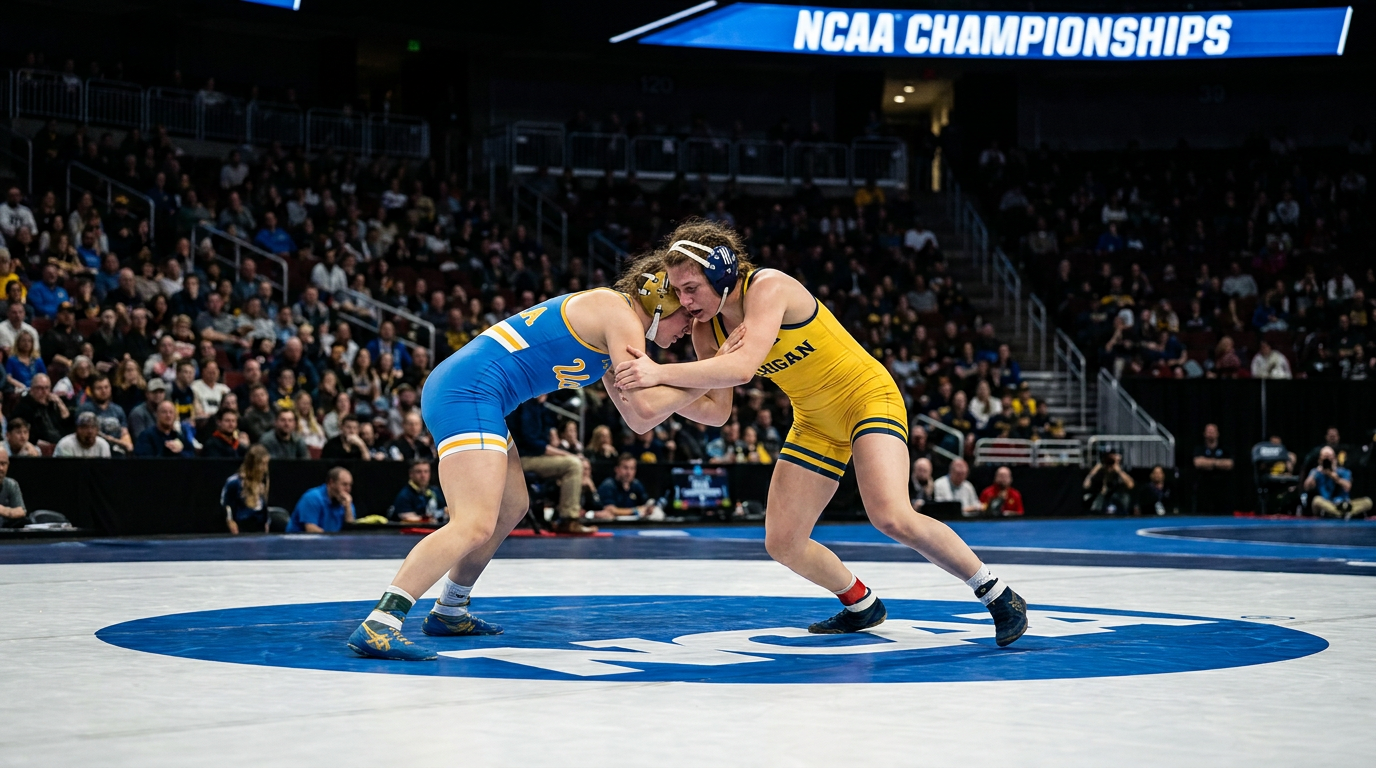
That grassroots explosion culminated in a historic milestone in March 2026. Inside Xtream Arena in Coralville, Iowa, the NCAA hosted its first-ever National Collegiate Women's Wrestling Championships. After advancing rapidly through the NCAA's Emerging Sports for Women program, women's wrestling was officially crowned the association's 91st championship sport. This provided a unified national stage for athletes across Division I, Division II, and Division III to compete under a single collegiate banner, validating decades of quiet work by athletes who previously had to rely on club tournaments for national exposure.[2]
The inaugural tournament delivered immediate drama and showcased the sport's deepening talent pool. McKendree University, a Division II powerhouse that had long dominated the pre-NCAA club circuit, captured the first official team title. The Bearcats narrowly defeated the University of Iowa—a Division I blue-blood that recently launched a heavily funded women's program—by a thrilling score of 171 to 166. Individual champions like McKendree's Tristan Kelly and Iowa's Kennedy Blades etched their names into history, providing the sport with its first generation of official NCAA heroes.[2]
To truly understand the significance of the 2026 collegiate championships, one must look at the staggering numbers at the high school level. According to the National Federation of State High School Associations (NFHS), girls' wrestling participation topped 74,000 in the 2024-25 academic year. That represents a massive 15 percent jump from the previous year alone, and a monumental leap from the mere 804 girls who wrestled nationally in 1994. The sport is currently adding hundreds of new high school programs every single season.[1][3][4]

The primary catalyst for this surge has been the creation of girls-only competitive spaces. Prior to 1998, when Hawaii became the first state to officially sanction a girls' state championship, female wrestlers had no choice but to compete directly against boys. Today, 46 states hold officially sanctioned state championship tournaments exclusively for girls. This separation was crucial; it removed the intimidation factor and allowed female athletes to compete against opponents of their own gender, size, and physiological strength.[1][3]
This state-by-state domino effect was heavily driven by organizations like the National Wrestling Coaches Association (NWCA). By aggressively lobbying state athletic associations to separate the genders, advocates removed the primary barrier to entry for young women interested in combat sports. The NWCA recognized that without official sanctioning, schools were hesitant to allocate funding for dedicated coaches, uniforms, and travel. When girls realize they can compete on a level playing field with full institutional backing, participation numbers reliably skyrocket, transforming wrestling from a niche pursuit for a few determined girls into a mainstream athletic option.[3][5]

The high school boom created an immediate and overwhelming demand for collegiate opportunities. Until recently, female wrestlers who wanted to continue their athletic careers had severely limited options. Many relied on the NAIA, which adopted women's wrestling as a championship sport in 2022, or competed in loosely affiliated club-level organizations. The lack of NCAA recognition meant that many top-tier female athletes were forced to abandon the sport after high school, draining the United States of potential international talent.[3][5]
The high school boom created an immediate and overwhelming demand for collegiate opportunities.
The NCAA formally recognized this demand by placing women's wrestling into its Emerging Sports for Women program in 2020. The program is specifically designed to help universities provide more athletic opportunities for female students and incubate sports until they reach the 40-program threshold required for championship consideration. Women's wrestling moved through this pipeline with unprecedented speed, blowing past the required benchmarks years ahead of schedule as universities across the country scrambled to add programs to their athletic departments.[2]
By the 2024-25 season, 95 NCAA schools reported sponsoring varsity women's wrestling programs, supporting more than 1,700 student-athletes. This rapid collegiate adoption was fueled not just by the sport's surging grassroots popularity, but by its distinct utility to university administrators. Wrestling requires relatively low overhead costs compared to sports like ice hockey or rowing, as programs can utilize existing mats, weight rooms, and arena spaces already established for men's teams. This makes it an incredibly attractive option for athletic directors looking to expand their offerings without breaking the budget.[2][5]
Furthermore, adding women's wrestling helps universities navigate the complex requirements of Title IX. Under federal law, universities must provide equitable athletic opportunities for male and female students. Because college football rosters require upwards of 100 male athletes, athletic directors constantly search for viable women's sports to balance the ledger. Women's wrestling emerged as an ideal solution, allowing schools to add dozens of female roster spots while simultaneously tapping into a highly motivated and rapidly expanding recruiting base. This synergy between legal compliance and athletic demand has been a major accelerant.[5]

The collegiate sanctioning also closes a critical gap in the United States' Olympic pipeline. Women's freestyle wrestling has been an official Olympic sport since the 2004 Athens Games. However, without a robust NCAA infrastructure, American women were at a distinct developmental disadvantage compared to international rivals from countries like Japan, whose federations heavily subsidized female combat sports from a young age. American women often had to train in isolation or rely on regional training centers, lacking the daily grind of collegiate competition that hardens male Olympic hopefuls.[3][5]
The new NCAA championship structure provides American Olympic hopefuls with elite coaching, state-of-the-art training facilities, and high-level domestic competition on a weekly basis. The presence of Olympic medalists like Sarah Hildebrandt and Kennedy Blades in the collegiate ecosystem underscores how seamlessly the NCAA platform will feed into Team USA's international ambitions. By the time these athletes reach the Olympic trials, they will have already survived the crucible of a collegiate season, making the American national team significantly deeper and more battle-tested on the global stage.[2][5]
Interestingly, the rise of the women's sport has also triggered a renaissance for the men. After decades of stagnant or declining numbers, boys' high school wrestling participation rebounded to over 300,000 in 2025, reaching levels not seen since the 1980s. Coaches attribute this to a broader cultural revitalization of the sport, as wrestling rooms across the country become more inclusive, family-oriented environments. The rising tide of girls' participation has brought new energy, new fans, and new funding to wrestling programs as a whole.[1][4][5]
Despite the overwhelming success, the sport still faces growing pains. The rapid expansion has created a nationwide shortage of qualified female coaches and referees. While organizations like the NWCA have launched leadership academies to transition former athletes into coaching roles, the demand for experienced mentors currently outpaces the supply. Many new girls' programs are still coached by men who are adapting to the specific technical and cultural nuances of women's freestyle wrestling. Building a sustainable pipeline of female leadership remains the next great frontier for the sport's advocates.[3][5]

Looking ahead, the unified NCAA championship model is already poised for evolution. Because the sport has grown so rapidly across all collegiate tiers, the NCAA has announced that Division III will split off to host its own exclusive national championship beginning in the 2027-28 academic year. This will create even more championship opportunities and allow smaller institutions to compete for national titles against schools with similar athletic budgets and philosophies. It is a testament to how quickly the sport has outgrown its initial emerging status.[3]
What was once considered a niche pursuit or a novelty has cemented itself as a permanent fixture in the American athletic landscape. The 2026 NCAA Championships in Coralville were not just a tournament; they were the culmination of a decades-long fight for space on the mat. For the 74,000 high school girls lacing up their shoes this season, the path from the local gymnasium to a national collegiate title—and perhaps the Olympic podium—is finally clear and unobstructed. The sport has proven that if you build the infrastructure, the athletes will arrive in force.[4][5]
How we got here
1994
Only 804 girls wrestle in United States high schools.
1998
Hawaii becomes the first state to officially sanction a girls' wrestling championship.
2004
Women's freestyle wrestling makes its debut at the Athens Olympic Games.
2020
The NCAA adds women's wrestling to its Emerging Sports for Women program.
2025
Girls' high school wrestling participation tops 74,000 nationwide.
March 2026
The NCAA hosts its first-ever unified Women's Wrestling Championships in Coralville, Iowa.
Viewpoints in depth
Grassroots Advocates
High school coaches and parents who fought for state sanctioning.
For decades, advocates argued that forcing girls to wrestle boys suppressed participation and created unnecessary physical risks. By lobbying state athletic associations to create girls-only divisions, they proved that young women were eager to participate in combat sports if given a fair and supportive environment. They view the NCAA championship as the ultimate validation of their grassroots efforts.
Collegiate Administrators
Athletic directors managing budgets and Title IX compliance.
From an institutional perspective, women's wrestling is a highly efficient addition to an athletic department. Because it utilizes existing wrestling mats and facilities, the startup costs are minimal compared to sports like equestrian or rowing. Furthermore, adding a roster of 30-40 female athletes helps universities offset the massive male rosters required for college football, ensuring compliance with federal Title IX equity mandates.
Elite Competitors
Olympic hopefuls and national team coaches.
USA Wrestling and national team coaches view the NCAA pipeline as the missing piece for international dominance. Previously, American women had to rely on regional training centers or club teams, putting them at a disadvantage against internationally subsidized athletes. The NCAA system now provides elite coaching, daily high-level competition, and institutional support, hardening athletes before they ever reach the Olympic trials.
What we don't know
- Whether the supply of qualified female coaches can scale quickly enough to meet the explosive demand of new high school and collegiate programs.
- How the impending split of Division III into its own championship in 2027-28 will affect the competitive balance of the remaining unified divisions.
Key terms
- Title IX
- A federal civil rights law prohibiting sex-based discrimination in education programs, which drives universities to balance athletic opportunities between men and women.
- Emerging Sports for Women
- An NCAA program designed to incubate and grow new women's sports until they reach the 40-program threshold required for championship status.
- Freestyle Wrestling
- The style of wrestling used in women's collegiate and Olympic competition, which allows the use of the wrestler's or the opponent's legs in offense and defense.
- Sanctioned Sport
- A sport officially recognized and regulated by a state's high school athletic association, allowing for official state championship tournaments.
Frequently asked
When did women's wrestling become an NCAA sport?
The NCAA officially approved it as a championship sport in January 2025, with the first unified national tournament held in March 2026.
Do girls still have to wrestle boys in high school?
While girls can still join boys' teams in areas without dedicated programs, 46 states now offer sanctioned girls-only championships, allowing female athletes to compete against their peers.
Who won the first NCAA women's wrestling title?
McKendree University won the inaugural 2026 team championship in Coralville, Iowa, narrowly defeating the University of Iowa.
Is women's wrestling in the Olympics?
Yes, women's freestyle wrestling has been an official Olympic sport since the 2004 Games in Athens.
Sources
Source coverage
5 outlets
4 viewpoints surfaced




[1]National Federation of State High School AssociationsGrassroots Advocates
High school athletics participation increases
Read on National Federation of State High School Associations →[2]NCAACollegiate Administrators
Everything to know about the 2026 National Collegiate Women's Wrestling Championships
Read on NCAA →[3]National Wrestling Coaches AssociationGrassroots Advocates
Growing Women's Wrestling
Read on National Wrestling Coaches Association →[4]USA WrestlingElite Competitors
Girls wrestling participation hits record
Read on USA Wrestling →[5]Factlen Editorial TeamIndependent Analysts
Synthesis by Factlen editorial team
Read on Factlen Editorial Team →

More in sports
See all 12 stories →Standings
WTT Rankings Race Heats Up as Global Stars Converge for U.S. Smash
6 sources

Injury
Field Hockey Injury Report: How Setbacks Are Forging the Next Generation of Stars
6 sources

Winter Sports Tech
The Physics of Modern Skiing: How Graphene and Smart Polymers Are Revolutionizing the Slopes
7 sources

Standings
Belgium Men and Netherlands Women Dominate FIH Pro League Standings as India Stuns Germany
7 sources

Every angle. Every day.
Get sports stories with full source coverage and perspective breakdowns delivered to your inbox.