
Fresh Dog Food vs. Premium Kibble: The Scientific and Financial Trade-Offs
As fresh dog food subscriptions surge in popularity, veterinary studies reveal clear benefits in digestibility and hydration, but premium kibble remains the most cost-effective and convenient choice for complete canine nutrition.
By Factlen Editorial Team
- Veterinary Consensus
- Prioritizes evidence-based nutrition, AAFCO/WSAVA compliance, and views both diet types as viable if properly formulated.
- Fresh Food Advocates
- Argues that minimally processed, high-moisture whole foods provide superior digestibility and long-term health benefits.
- Practical Pet Parents
- Balances canine health with budget constraints and convenience, often favoring premium kibble or hybrid feeding strategies.
What's not represented
- · Raw Diet Advocates
- · Commercial Pet Food Manufacturers
Why this matters
Dog owners are increasingly bombarded with marketing claiming that traditional kibble is harmful and fresh food is mandatory for a healthy pet. Understanding the actual scientific and financial trade-offs allows pet parents to make guilt-free, evidence-based decisions that fit their budget and their dog's specific needs.
Key points
- Fresh dog food is up to 40% more digestible than premium kibble, leading to significantly less fecal waste.
- The high moisture content in fresh food (71%) promotes better hydration and kidney health compared to dry kibble (6-10%).
- Premium kibble remains the most cost-effective and convenient way to provide complete, vet-approved nutrition.
- A 100% fresh diet can cost three to four times as much as a premium kibble diet, making it prohibitive for many large-breed owners.
- Hybrid feeding—mixing kibble with a fresh food topper—has emerged as a popular compromise for budget-conscious pet parents.
The pet food aisle has transformed into a high-stakes debate over canine longevity and health. In 2026, the choice for health-conscious dog owners often boils down to two distinct paths: premium extruded kibble or gently cooked fresh food subscriptions.[6]
The rise of fresh food has disrupted the industry. Brands delivering human-grade, gently cooked meals on dry ice promise better digestion, shinier coats, and more energy. On the other side stands the veterinary establishment's gold standard: premium kibbles backed by decades of feeding trials and formulated by board-certified veterinary nutritionists.[5]
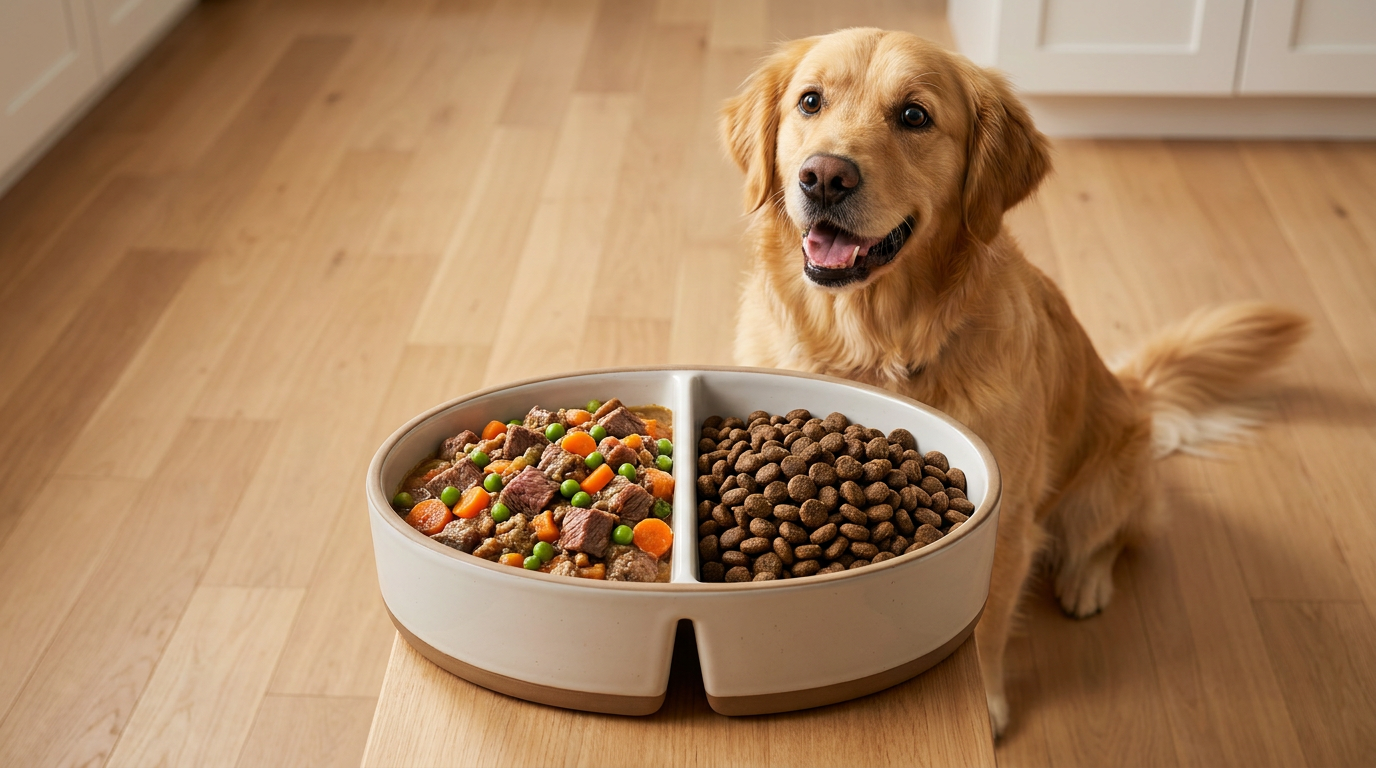
To understand the trade-offs, we must look at how these foods are manufactured. Premium kibble is created through high-heat extrusion, baking a dough of proteins, carbohydrates, and synthetic vitamins into shelf-stable pellets. Fresh food uses whole meats and vegetables, gently cooked at lower temperatures to kill pathogens without degrading natural amino acids, and is then flash-frozen.[6]
The most significant physiological difference between the two diets is digestibility. A landmark study published in Translational Animal Science by University of Illinois researchers tested human-grade fresh food against premium kibble using precision-fed assays.[1]
The evidence for fresh food's digestibility is striking. The researchers found that fresh diets are up to 40 percent more digestible than traditional dry food. Because the proteins break down more completely into usable amino acids, the dog's body absorbs far more of the actual food.[1]
This high bioavailability leads to a highly visible benefit: waste reduction. Dogs fed a fresh whole-food diet produce up to 66 percent less fecal matter by volume compared to those eating kibble. Less waste goes in, and significantly less waste comes out.[1]

Hydration is another major dividing line. Premium kibble contains roughly 6 to 10 percent moisture, requiring dogs to compensate by drinking heavily from their water bowls. Fresh food boasts a moisture content of around 71 percent.[2]
Premium kibble contains roughly 6 to 10 percent moisture, requiring dogs to compensate by drinking heavily from their water bowls.
According to studies indexed by the National Institutes of Health, dogs eating fresh food consume significantly more total water per day—combining dietary moisture and bowl drinking—than kibble-fed dogs. This enhanced hydration is particularly beneficial for kidney function and urinary tract health.[2]
The financial burden, however, is the most quantifiable trade-off. Data from industry cost analyses show that fresh food averages about $1.40 per 100 calories, while premium dry food costs roughly $0.25 per 100 calories.[4]
For a medium-sized 50-pound dog, a premium kibble diet typically costs between $70 and $120 per month. A 100 percent fresh food subscription for that same dog will run between $200 and $300 per month, representing a massive annual premium.[4]

The veterinary consensus, guided by organizations like the American College of Veterinary Internal Medicine, emphasizes that a higher price tag does not automatically equal a healthier dog. Vets stress that as long as a food meets rigorous standards and is formulated by qualified nutritionists, it provides complete and balanced nutrition.[5]
For dogs with specific medical conditions, the calculus changes. Research in Frontiers in Veterinary Science highlights that dogs with Inflammatory Bowel Disease or severe food allergies often see rapid symptom resolution on fresh diets due to the lack of artificial preservatives and highly digestible novel proteins.[3]
In a direct trade-off analysis, the case for premium kibble is strong. The argument for kibble centers on unmatched convenience, rigorous safety testing, and complete nutritional profiles at a fraction of the cost. The argument against it focuses on heavy processing, lower moisture, and the inclusion of feed-grade ingredients that some dogs struggle to digest. The evidence supporting kibble includes generations of dogs living long, healthy lives on these extruded diets, backed by extensive veterinary trials.[5][6]
Conversely, the case for fresh food is equally compelling. The argument for fresh food highlights superior nutrient absorption, excellent hydration, and highly palatable meals for picky eaters. The argument against it points to the prohibitive cost, the demanding freezer storage requirements, and the lack of decades-long longevity studies compared to legacy brands. The evidence supporting fresh food points to measurable, clinically proven improvements in gut microbiome health, digestibility, and stool quality.[1][3][6]

Recognizing these stark trade-offs, a massive middle ground has emerged in 2026: the hybrid topper strategy. Pet parents use a high-quality premium kibble for 70 percent of the dog's caloric needs, and mix in 30 percent fresh food to boost moisture, protein quality, and mealtime excitement without breaking the bank.[4][6]
Ultimately, fresh dog food fits well when a pet parent has a flexible budget, ample freezer space, a picky eater, or a dog with chronic digestive issues that have not resolved on traditional diets. It is an excellent, science-backed way to feed a dog if the logistics align with the household.[3][6]
Premium kibble fits well when budget constraints are tight, when owners travel frequently with their pets, or when feeding large breeds where the monthly cost of fresh food rivals a car payment. In these scenarios, high-quality dry food remains a scientifically sound, highly effective choice that fully supports canine health and vitality.[4][5]
How we got here
1950s-1990s
Extruded kibble dominates the market due to its extreme convenience, long shelf life, and low cost.
2010s
The humanization of pets trend accelerates, leading to the launch of direct-to-consumer fresh dog food subscriptions.
2019
University of Illinois publishes a landmark study proving human-grade fresh food is significantly more digestible than kibble.
2026
Hybrid feeding strategies become mainstream as pet parents balance the proven benefits of fresh food with the economic realities of inflation.
Viewpoints in depth
The Veterinary Consensus
Why board-certified nutritionists defend premium kibble.
Veterinary nutritionists emphasize that dogs have adapted over thousands of years to digest starches and processed diets. They argue that legacy kibble brands undergo rigorous, decades-long feeding trials that newer fresh food companies simply haven't existed long enough to replicate. From this perspective, as long as a diet meets AAFCO standards and is formulated by a credentialed expert, the delivery mechanism—whether extruded pellet or gently cooked stew—is secondary to the actual nutrient profile.
The Fresh Food Advocates
The argument for biological appropriateness and whole ingredients.
Advocates for fresh diets argue that surviving is not the same as thriving. They point to the human health consensus against ultra-processed foods and apply the same logic to canines. By feeding gently cooked meats and vegetables, they argue owners can reduce systemic inflammation, protect kidney health through natural hydration, and improve the gut microbiome. For this camp, the upfront financial cost of fresh food is offset by fewer veterinary bills and a longer healthspan in the dog's senior years.
The Hybrid Feeders
Finding the middle ground between optimal health and financial reality.
A growing segment of pet owners and pragmatic veterinarians advocate for the 'topper' method. Recognizing that a 100% fresh diet is financially out of reach for many—especially owners of large breeds—they use premium kibble as a nutritionally complete base. By replacing 20% to 30% of the kibble with fresh food, dogs receive a significant boost in moisture, varied amino acids, and mealtime enrichment, while keeping the monthly budget manageable.
What we don't know
- Because the fresh dog food industry is relatively young, there are no decades-long, multi-generational longevity studies comparing fresh diets directly to legacy kibble brands.
- It remains unclear exactly how much fresh food is required in a 'hybrid' diet to achieve the maximum health benefits; the 20% to 30% rule is a practical estimate rather than a clinically proven threshold.
Key terms
- Extrusion
- A high-heat, high-pressure manufacturing process used to turn raw ingredients into shelf-stable dry kibble.
- Bioavailability
- The proportion of nutrients in a food that are successfully absorbed and utilized by the dog's body.
- AAFCO
- The Association of American Feed Control Officials, which sets the baseline nutritional standards for commercial pet food in the United States.
- WSAVA Guidelines
- Recommendations by the World Small Animal Veterinary Association that help pet owners identify foods formulated by qualified nutritionists and backed by rigorous quality control.
Frequently asked
Is fresh dog food actually better than kibble?
Fresh food is significantly more digestible and hydrating, which benefits gut and kidney health. However, premium kibble is also nutritionally complete and perfectly healthy for most dogs.
Can I mix fresh food and kibble together?
Yes. Many pet parents use a 'topper' strategy, mixing 20% to 30% fresh food with a kibble base to provide varied nutrition and moisture while keeping costs down.
Does kibble clean a dog's teeth better than fresh food?
This is largely a myth. While some prescription dental kibbles are designed to scrape plaque, standard kibble shatters when chewed and offers minimal dental benefits. Both diets require regular tooth brushing.
Why is fresh dog food so expensive?
Fresh food uses whole, human-grade ingredients, requires gentle cooking in smaller batches, and must be shipped and stored using cold-chain logistics (dry ice and refrigeration), all of which drive up costs.
Sources
Source coverage
6 outlets
3 viewpoints surfaced






[1]Translational Animal ScienceFresh Food Advocates
True Nutrient and Amino Acid Digestibility of Dog Foods Made with Human-Grade Ingredients
Read on Translational Animal Science →[2]National Institutes of HealthVeterinary Consensus
Total Water Intake and Urine Parameters in Dogs Fed a Fresh Food Diet
Read on National Institutes of Health →[3]Frontiers in Veterinary ScienceFresh Food Advocates
Stool quality and gut microbiome changes in dogs fed a gently cooked fresh diet versus kibble
Read on Frontiers in Veterinary Science →[4]RoverPractical Pet Parents
How Much Does Dog Food Cost? A Breakdown by Type
Read on Rover →[5]American College of Veterinary Internal MedicineVeterinary Consensus
Canine Nutrition Guidelines and WSAVA Compliance
Read on American College of Veterinary Internal Medicine →[6]Factlen Editorial TeamPractical Pet Parents
Synthesis by Factlen editorial team
Read on Factlen Editorial Team →

More in shopping
See all 5 stories →


Every angle. Every day.
Get shopping stories with full source coverage and perspective breakdowns delivered to your inbox.