
Quantum Computing Enters the Fault-Tolerant Era as Error Correction Breakthroughs Scale
Recent milestones in quantum error correction have proven that logical qubits can be stabilized, transforming quantum computing from a theoretical physics problem into a scalable engineering discipline.
By Factlen Editorial Team
- Hardware Developers
- Focused on scaling physical qubit counts and proving that fault tolerance is achievable across different architectures.
- Application Researchers
- Focused on how reliable logical qubits will unlock new hybrid algorithms for chemistry, materials science, and cryptography.
- Engineering Pragmatists
- Emphasizing the massive physical overhead, cooling, and control challenges that remain before commercial utility is reached.
What's not represented
- · Cybersecurity experts preparing for post-quantum cryptography
- · Material scientists awaiting quantum simulation tools
Why this matters
For decades, quantum computers were too fragile to be useful, severely limiting their real-world applications. Recent breakthroughs in error correction mean these machines are finally transitioning from laboratory experiments to reliable tools capable of revolutionizing drug discovery, battery design, and cryptography.
Key points
- Recent breakthroughs have proven that quantum error correction works in hardware, not just in theory.
- Microsoft and Quantinuum achieved an 800-fold reduction in logical error rates using trapped-ion qubits.
- Google demonstrated exponential error suppression, proving that adding more physical qubits reduces overall system noise.
- The industry is now focused on the massive engineering challenges of scaling physical qubits to support fault-tolerant applications.
The promise of quantum computing has always been accompanied by a massive asterisk. While these machines theoretically possess the power to simulate complex molecules, optimize global supply chains, and break modern encryption, they have historically been crippled by their own fragility. The fundamental building blocks of quantum computers—qubits—are notoriously sensitive. A stray photon, a microscopic fluctuation in temperature, or even a cosmic ray can cause a qubit to lose its quantum state, destroying the calculation in an instant. For decades, this vulnerability relegated quantum computing to the realm of theoretical physics, prompting skeptics to wonder if the technology would ever survive contact with reality.[7]
But over the past 24 months, the narrative has fundamentally shifted. The quantum computing industry has crossed a critical threshold, moving out of the "Noisy Intermediate-Scale Quantum" (NISQ) era and into the foundational stages of fault-tolerant computing. This transition is not marked by a sudden explosion in the sheer number of raw qubits, but by a profound breakthrough in how those qubits are managed. Researchers have proven that quantum errors can not only be detected but actively corrected in real-time, preventing computations from collapsing.[5][6]
This milestone represents the moment quantum computing transitions from a physics research problem into a scalable engineering discipline. By demonstrating that error rates can be exponentially suppressed, companies like Google, Microsoft, Quantinuum, and IBM have answered the field's most existential question. The debate is no longer about whether a reliable quantum computer can be built, but rather how quickly the necessary engineering can be scaled to meet commercial demands.[4][7]
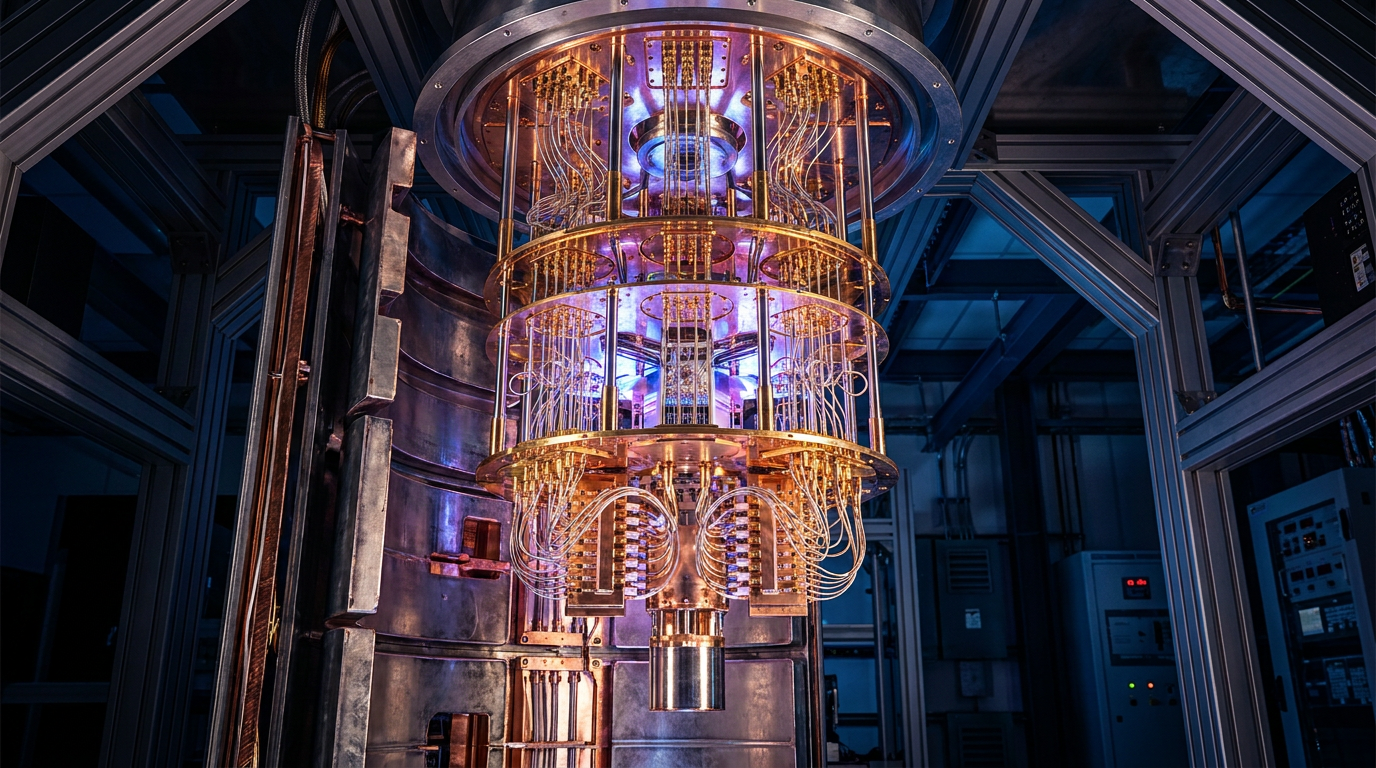
To understand the magnitude of this breakthrough, one must understand the difference between a "physical" qubit and a "logical" qubit. A physical qubit is the actual hardware element—often a superconducting circuit cooled to near absolute zero, or a single atom trapped by lasers—that stores quantum information. Because these physical qubits are inherently noisy and prone to decoherence, relying on them individually for long calculations is a mathematical gamble.[1][5]

The solution is Quantum Error Correction (QEC), a framework that creates "logical" qubits. A logical qubit is not a physical object, but rather a virtual abstraction created by entangling multiple physical qubits together. By spreading a single piece of quantum information across a redundant network of physical qubits, the system can monitor for errors and correct them on the fly. If one physical qubit flips or loses its state due to environmental noise, the surrounding qubits preserve the overarching logical state, allowing the computation to proceed uninterrupted.[3][7]
In classical computing, error correction is relatively straightforward: you simply make multiple copies of the data and use majority voting to weed out errors. However, a fundamental principle of quantum mechanics known as the "no-cloning theorem" dictates that an unknown quantum state cannot be perfectly copied. Therefore, quantum error correction requires an incredibly complex choreography of entanglement and syndrome measurements, checking for errors without actually looking directly at the quantum data—which would cause it to collapse.[6][7]
For years, the theoretical math behind QEC was sound, but the hardware lagged behind. The paradox of quantum error correction was that adding more physical qubits to a system often introduced more noise than it corrected. The overhead was staggering, and the control electronics were simply not fast or precise enough to catch and fix errors before the entire system decohered. Breaking past this "break-even" point—where adding more qubits actually reduces the overall error rate—was the holy grail of quantum engineering.[3][5]
That threshold has now been definitively crossed. In a landmark demonstration, Microsoft partnered with Quantinuum to apply a novel qubit-virtualization system to Quantinuum's trapped-ion hardware. The joint team successfully created four highly reliable logical qubits out of just 30 physical qubits. More importantly, they demonstrated a staggering 800-fold improvement in the logical error rate compared to the underlying physical error rate.[1][2]
In a landmark demonstration, Microsoft partnered with Quantinuum to apply a novel qubit-virtualization system to Quantinuum's trapped-ion hardware.
The Microsoft and Quantinuum system proved its stability by running 14,000 independent instances of a quantum circuit without a single error. This was not a post-selected experiment where failed runs were discarded after the fact; it was a clean, continuous execution of quantum logic. By achieving a circuit error rate of just 0.00001, the team demonstrated that logical qubits could be maintained long enough to perform meaningful, complex algorithms that would otherwise disintegrate on noisy hardware.[1][7]
Simultaneously, Google Quantum AI achieved a parallel milestone using an entirely different hardware architecture. Working with their superconducting processors, Google researchers demonstrated exponential error suppression by scaling a surface code. They proved that as they increased the size of the error-correcting grid—moving from a distance-3 code to a distance-5 code—the logical error rate dropped significantly.[3][6]

Google's achievement is critical because it validates the foundational premise of fault-tolerant scaling. It proves that the "overhead" strategy works: as long as the baseline physical qubits are of sufficient quality, throwing more physical qubits at the problem will exponentially drive down the logical error rate. This provides a clear, mathematically sound roadmap for building larger systems capable of executing billions of quantum gates without failure.[3][7]
Other players are rapidly advancing their own fault-tolerant roadmaps. IBM, a pioneer in superconducting quantum processors, has laid out a comprehensive framework to deliver a system called Quantum Starling by 2029. Starling is projected to feature 200 logical qubits capable of executing 100 million quantum gates. To get there, IBM is developing new high-rate quantum low-density parity-check (qLDPC) codes, which aim to drastically reduce the number of physical qubits required to create a stable logical qubit.[4][7]
Meanwhile, companies utilizing neutral-atom architectures, such as QuEra Computing and Atom Computing, are demonstrating that their platforms are uniquely suited for efficient error correction. Neutral atoms can be dynamically moved and reconfigured during a computation, allowing for highly efficient entanglement and error checking. These platforms are targeting dozens of logical qubits in the near term, proving that the race to fault tolerance is a multi-architecture sprint.[6][7]

Despite these monumental breakthroughs, the path to commercial quantum utility remains steep. The primary challenge is the sheer physical overhead required for error correction. Depending on the architecture and the specific error-correcting code used, a single logical qubit might require anywhere from 10 to over 1,000 physical qubits to maintain stability. Scaling a system to the hundreds of logical qubits needed for commercially disruptive applications means engineering chips with tens of thousands, or even millions, of physical qubits.[5][7]
Managing a system of that scale introduces immense classical engineering hurdles. The cryogenic cooling systems must be large enough to house massive quantum processors while maintaining temperatures colder than deep space. The control electronics—the classical computers that send microwave or laser pulses to manipulate the qubits and read their states—must process gigabytes of error-correction data in microseconds without generating excess heat or electromagnetic interference.[3][6]
Furthermore, researchers must combat "crosstalk," a phenomenon where manipulating one physical qubit accidentally disturbs its neighbors. As qubits are packed more densely onto processors to meet the demands of error correction, isolating them from one another becomes increasingly difficult. Solving these engineering bottlenecks will require innovations in materials science, cryogenic cabling, and classical control software.[3][5]

Yet, the mood within the quantum computing industry is overwhelmingly optimistic. The transition from noisy, error-prone machines to reliable, logical systems unlocks the true potential of hybrid supercomputing. In the near future, classical supercomputers will seamlessly offload specific, highly complex calculations—such as simulating the electron interactions in a new battery material or modeling the folding of a protein—to a fault-tolerant quantum coprocessor.[1][4]
We are entering an era where quantum computers will no longer be judged by their raw physical qubit counts, but by their logical fidelity and their ability to execute deep, complex algorithms. The breakthroughs in quantum error correction have effectively removed the ceiling on what these machines can achieve. While the engineering road ahead is long, the fundamental physics have been validated, ensuring that the quantum future is no longer a question of if, but when.[5][7]
How we got here
Late 1990s
Theoretical foundations of Quantum Error Correction (QEC) are established, proving fault tolerance is mathematically possible.
Feb 2023
Google Quantum AI demonstrates early error suppression, showing that increasing code size can reduce logical errors.
April 2024
Microsoft and Quantinuum achieve an 800x reduction in logical error rates, creating 4 reliable logical qubits from 30 physical ones.
2025-2026
The industry enters the 'fault-tolerant foundation era' as multiple hardware architectures demonstrate scalable logical qubits.
Viewpoints in depth
Hardware Developers
Focused on scaling physical qubit counts and proving that fault tolerance is achievable across different architectures.
Companies building the physical machines—whether using superconducting circuits, trapped ions, or neutral atoms—view error correction as the ultimate validation of their roadmaps. They argue that crossing the fault-tolerant threshold proves their underlying physics are sound. Their primary focus is now on driving down the physical error rates of individual qubits, which exponentially reduces the overhead required to build stable logical qubits. For these developers, the race is about reaching the hundreds of logical qubits necessary to demonstrate definitive commercial advantage over classical supercomputers.
Application Researchers
Focused on how reliable logical qubits will unlock new hybrid algorithms for chemistry, materials science, and cryptography.
For researchers designing quantum algorithms, the arrival of logical qubits shifts the paradigm entirely. During the NISQ era, algorithms had to be incredibly short to finish before the hardware decohered. Now, researchers argue they can begin designing deep, complex circuits that run for millions of operations. This camp emphasizes that quantum computers will not operate in isolation; instead, they will function as specialized coprocessors within hybrid supercomputing environments, taking on the specific molecular simulations or optimization tasks that classical processors simply cannot handle.
Engineering Pragmatists
Emphasizing the massive physical overhead, cooling, and control challenges that remain before commercial utility is reached.
While acknowledging the theoretical triumphs of recent error correction milestones, pragmatists point to the daunting physical realities of scaling. They note that requiring hundreds or thousands of physical qubits to generate a single logical qubit creates a massive bottleneck. This camp highlights the immense classical engineering challenges ahead: building dilution refrigerators large enough to house millions of qubits, managing the heat generated by control electronics, and mitigating the crosstalk that occurs when qubits are packed too densely. They caution that while the physics problem is solved, the engineering timeline may still span a decade.
What we don't know
- Which hardware architecture—superconducting circuits, trapped ions, or neutral atoms—will ultimately prove the most efficient for scaling logical qubits.
- Exactly how many physical qubits will be required to create a single logical qubit in a commercially viable, million-qubit system.
- When the first definitive 'quantum advantage'—solving a commercially valuable problem faster than any classical supercomputer—will be achieved using logical qubits.
Key terms
- Qubit
- The fundamental unit of quantum information, capable of existing in multiple states simultaneously, unlike a classical bit which is strictly 0 or 1.
- Logical Qubit
- A stable, error-corrected abstraction created by entangling multiple physical qubits to protect quantum information from noise.
- Quantum Error Correction (QEC)
- A set of algorithms and physical architectures designed to detect and fix errors in quantum computations without destroying the underlying quantum state.
- Decoherence
- The process by which a quantum system loses its delicate quantum state due to interactions with its surrounding environment, resulting in calculation errors.
- Fault Tolerance
- The ability of a computing system to continue operating reliably even when individual components fail or produce errors.
Frequently asked
What is a logical qubit?
A logical qubit is a highly stable, virtual qubit created by grouping many fragile physical qubits together using error-correcting codes. If one physical qubit fails, the others preserve the information.
Why are quantum computers so error-prone?
The physical components that store quantum information are incredibly sensitive to their environment. Even microscopic changes in temperature or stray electromagnetic waves can cause them to lose their quantum state, a process called decoherence.
Will quantum computers replace classical computers?
No. Classical computers are perfectly suited for general-purpose tasks like web browsing and word processing. Quantum computers will act as specialized coprocessors to solve highly complex problems in chemistry, logistics, and cryptography.
When will quantum computers be commercially useful?
With recent breakthroughs in error correction, experts predict that hybrid quantum-classical systems capable of solving commercially relevant problems will begin to emerge between 2027 and 2030.
Sources
Source coverage
7 outlets
3 viewpoints surfaced







[1]MicrosoftHardware Developers
Advancing science: Microsoft and Quantinuum demonstrate the most reliable logical qubits
Read on Microsoft →[2]QuantinuumHardware Developers
Entering a new era of quantum computing
Read on Quantinuum →[3]Google Quantum AIHardware Developers
Our quantum error correction milestone
Read on Google Quantum AI →[4]IBMHardware Developers
Realizing large-scale, fault-tolerant quantum computing
Read on IBM →[5]Spin QuantaApplication Researchers
2026 Qubit Breakthroughs: Quantum Computing Enters the Fault-Tolerant Foundation Era
Read on Spin Quanta →[6]BQP SimApplication Researchers
The biggest quantum computing breakthroughs in 2026
Read on BQP Sim →[7]Factlen Editorial TeamEngineering Pragmatists
Synthesis by Factlen editorial team
Read on Factlen Editorial Team →
Every angle. Every day.
Get technology stories with full source coverage and perspective breakdowns delivered to your inbox.