
Return of the Sail: How Wind-Assisted Propulsion is Decarbonizing Global Shipping
Commercial cargo ships are retrofitting massive rigid wings and spinning rotor sails to harness wind power, cutting fuel consumption and emissions by up to 30%.
By Factlen Editorial Team
- Maritime Shipowners
- Focuses on the financial return on investment, fuel cost savings, and meeting strict international emissions regulations.
- WAPS Technology Developers
- Prioritizes proving real-world performance data, refining AI control systems, and scaling up manufacturing.
- Port Operators
- Concerned primarily with the logistical challenges of accommodating massive sails without disrupting cargo loading cranes.
- Climate Advocates
- Views wind propulsion as a crucial, immediate stopgap to cut emissions today while the industry waits for green fuels to mature.
What's not represented
- · Seafarers and Crew
- · Alternative Fuel Producers
Why this matters
Shipping accounts for 3% of global greenhouse gas emissions, and zero-carbon alternative fuels are still years away from mass adoption. Wind-assisted propulsion offers an immediate, proven way to drastically cut emissions on the ships that deliver 80% of the world's goods today.
Key points
- Commercial cargo ships are increasingly adopting wind-assisted propulsion to cut fuel costs and emissions.
- Modern systems use rigid composite wings or spinning Flettner rotors rather than traditional canvas sails.
- The Pyxis Ocean bulk carrier achieved peak fuel savings of 11 tonnes per day during its global trial.
- Artificial intelligence automatically adjusts the sails in real-time to maximize thrust based on wind conditions.
- Port clearance remains a challenge, prompting developers to engineer sails that can fold or tilt horizontally.
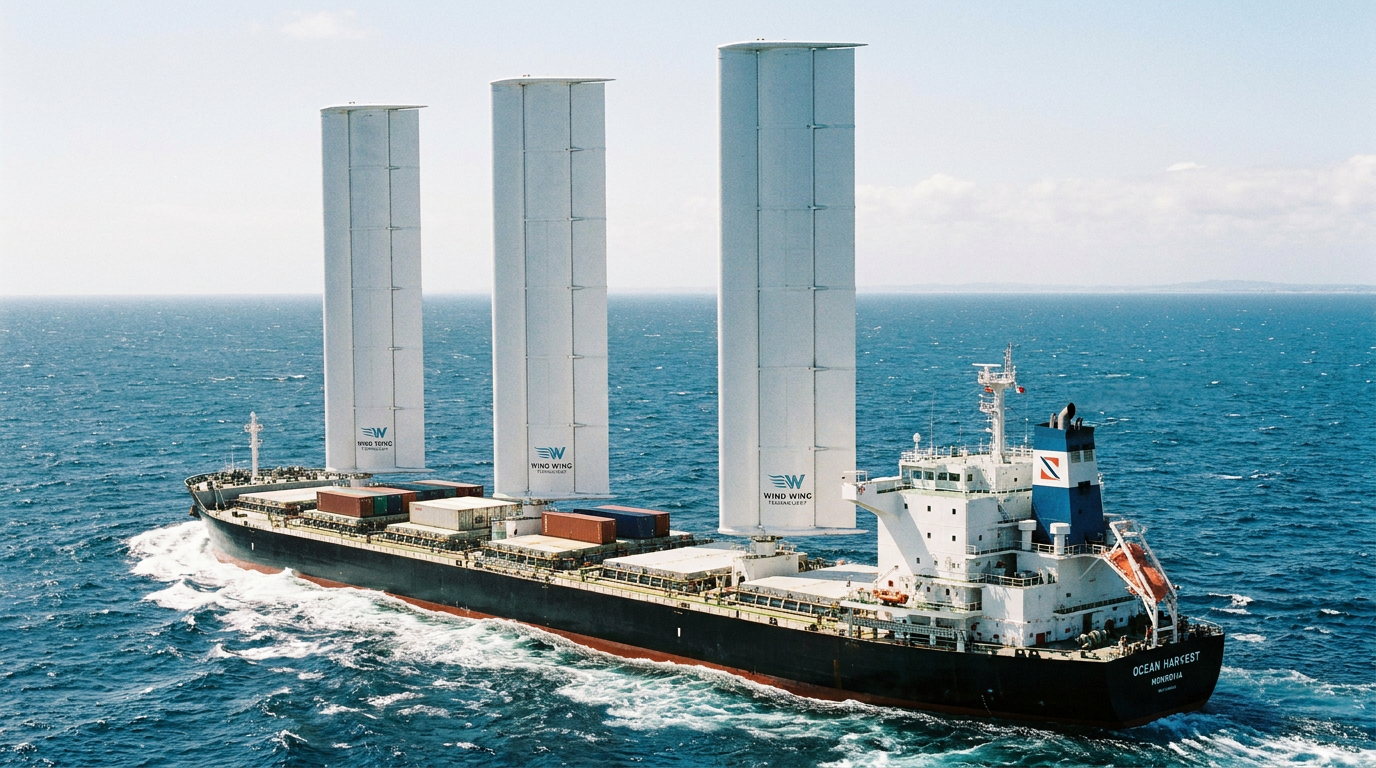
The maritime industry is returning to its roots. Across the world's oceans, massive commercial cargo ships are once again harnessing the wind. But instead of the canvas rigging of the 19th century, these modern vessels are equipped with towering composite wings and spinning high-tech cylinders.[1]
Shipping is the invisible backbone of global trade, responsible for transporting roughly 80% of the world's goods by volume. However, that immense logistical network comes with a steep environmental cost. The maritime sector accounts for approximately 3% of global greenhouse gas emissions, a figure the International Maritime Organization (IMO) is under intense pressure to reduce.[1]
While the industry has heavily invested in developing zero-carbon alternative fuels like green methanol and ammonia, those solutions face severe bottlenecks. The fuels are currently expensive to produce, and the global port infrastructure required to bunker them is still years away from maturity. Shipowners need a way to cut emissions today, using the fleets they already have.[1]
Enter Wind-Assisted Propulsion Systems (WAPS). These technologies do not aim to replace the massive diesel engines that power modern freighters. Instead, they provide auxiliary thrust, allowing the ship to maintain its standard cruising speed while significantly throttling down the main engine.[1]
One of the most visually striking approaches is the rigid wingsail. Functioning much like an airplane wing standing upright on the deck, these solid structures use aerodynamic lift to pull the ship forward. Because they are made from lightweight composite materials, they can be built to towering heights without destabilizing the vessel.[1][7]
The most prominent test case for rigid wingsails is the Pyxis Ocean, an 81,000-ton Kamsarmax bulk carrier chartered by agricultural giant Cargill. In August 2023, the vessel was retrofitted with two 37.5-meter-tall WindWings, developed by UK-based BAR Technologies, and sent on a global trial across the Pacific, Atlantic, and Indian Oceans.[2][7]
The empirical data from that trial has proven the technology's viability. Independent verification by the classification society DNV confirmed that in optimal open-sea conditions, the Pyxis Ocean reduced its main engine energy consumption by 32% per nautical mile. This translated to peak fuel savings of 11 tonnes per day, with an average savings of 3 tonnes per day across all weather conditions.[2][4][8]

The empirical data from that trial has proven the technology's viability.
A completely different, yet equally effective, approach is the rotor sail. Based on a concept invented in the 1920s by German engineer Anton Flettner, rotor sails are tall, spinning vertical cylinders. They rely on the Magnus effect—the same aerodynamic force that causes a spinning tennis ball to curve in flight.[3]
As the cylinder spins, it drags the surrounding air with it. When wind hits the spinning cylinder, the air moves faster on one side than the other, creating a pressure differential that generates powerful forward thrust. Finnish company Norsepower has become the industry leader in modernizing this century-old physics principle.[3]

Norsepower's technology was put to the test on the SC Connector, a 12,251-ton Ro-Ro cargo vessel operating in the notoriously rough North Sea. The installation achieved a remarkable 25% reduction in carbon emissions. Crucially, because the SC Connector frequently navigates under bridges and powerlines, Norsepower engineered the world's first tiltable rotor sails, which can lay almost flat on the deck when clearance is required.[3]
Other vessels are utilizing automated soft sails and suction wings. The Canopée, a specialized cargo ship designed to transport Ariane 6 rocket components, uses four automated OceanWings. Operational data from its first two years at sea confirmed average fuel savings of 1.3 tonnes per day per sail, proving the reliability of the technology under demanding transatlantic schedules.[5]
The secret to modern wind propulsion is artificial intelligence. Human crews cannot manually adjust massive sails fast enough to capture shifting ocean winds efficiently. Instead, these systems are fully automated. Onboard sensors continuously monitor wind speed and angle, feeding data into algorithms that instantly adjust the pitch of a wingsail or the rotational speed of a Flettner rotor to maximize thrust.[1][3]
Despite the impressive fuel savings, wind propulsion is not a silver bullet. The technology is inherently at the mercy of the weather. In calm seas or when facing direct headwinds, the systems provide negligible propulsive benefit. If rigid sails are not properly feathered into the wind during a gale, they can even induce added hydrodynamic drag, forcing the engine to work harder.[1][7]
Furthermore, the physical presence of towering structures on a ship's deck creates severe logistical headaches at port. Modern container terminals rely on massive gantry cranes that swing back and forth over the vessel. Sails that cannot fold, retract, or tilt risk colliding with port infrastructure, making cargo loading impossible.[2][7]

The financial equation also remains a hurdle. Installing a wind-assisted propulsion system requires a multi-million dollar upfront capital expenditure. However, with the European Union now including shipping in its Emissions Trading System (ETS), the cost of emitting carbon is rising sharply. As fuel and carbon taxes increase, the return-on-investment timeline for wind technology shrinks rapidly.[1]
The industry is now moving from experimental trials to commercial scale. By the end of 2025, analysts projected that over 100 large commercial vessels would be equipped with wind-assisted propulsion. In April 2026, Mitsui O.S.K. Lines (MOL) received Approval in Principle for a revolutionary new liquefied CO2 carrier equipped with three Wind Challenger sails, signaling that even the most specialized vessels are embracing the technology.[6]

Wind power will not entirely replace the internal combustion engine in global shipping. But as a free, universally available, and zero-carbon source of energy, it has emerged as the most effective immediate solution to decarbonize the maritime sector while the world waits for the fuels of the future.[1]
How we got here
1924
Anton Flettner successfully tests the first rotor ship, the Buckau, proving the Magnus effect works for marine propulsion.
2020
Norsepower installs the world's first tiltable rotor sails on the SC Connector, allowing it to navigate under North Sea bridges.
August 2023
The Pyxis Ocean, a massive bulk carrier, embarks on its maiden voyage equipped with two 37.5-meter WindWings.
March 2024
Six-month trial data confirms the Pyxis Ocean saved an average of 3 tonnes of fuel per day across global routes.
April 2026
Mitsui O.S.K. Lines (MOL) receives Approval in Principle for a new liquefied CO2 carrier equipped with Wind Challenger sails.
Viewpoints in depth
Maritime Shipowners
Shipowners view wind propulsion primarily through the lens of regulatory compliance and fuel economics.
With the International Maritime Organization tightening carbon intensity rules and the EU expanding its emissions trading system to shipping, owners are facing massive financial penalties for burning heavy fuel oil. While the upfront capital expenditure for wind systems is in the millions, the operational cost of wind is zero. Owners are closely watching trial data to calculate exactly when that investment breaks even, viewing wind as an immediate bridge until green fuels become commercially viable.
Port Operators
Ports are concerned that towering sails will disrupt the highly choreographed ballet of global logistics.
A modern container port relies on massive gantry cranes swinging cargo over the decks of ships. Vertical sails, even when folded, introduce new obstacles that can slow down loading times. Port authorities argue that widespread adoption of wind-assisted propulsion will require standardized folding mechanisms and potentially redesigned berths to ensure that saving fuel at sea doesn't cause expensive bottlenecks at the dock.
Technology Developers
Engineers are focused on moving wind propulsion from a mechanical challenge to a software optimization problem.
For developers like BAR Technologies and Norsepower, the physical sails are only half the product. The real differentiator is the artificial intelligence that controls them. Developers argue that human crews cannot manually adjust sails fast enough to capture shifting ocean winds efficiently. By fully automating the deployment, angle, and rotation based on real-time weather data, they aim to guarantee the fuel savings promised to shipowners.
What we don't know
- Exactly how much port infrastructure will need to be modified to accommodate a global fleet of sail-equipped cargo ships.
- Whether wind-assisted propulsion will remain a permanent fixture once zero-carbon fuels like green ammonia become cheap and abundant.
Key terms
- Wind-Assisted Propulsion Systems (WAPS)
- Technologies like rigid sails or spinning rotors that harness wind to supplement a ship's main engine.
- Flettner Rotor
- A tall, spinning vertical cylinder that uses the aerodynamic Magnus effect to generate forward thrust.
- Magnus Effect
- The observable phenomenon where a spinning object drags air with it, creating a pressure difference that results in a perpendicular force.
- Rigid Wingsail
- A solid, vertical sail that functions similarly to an airplane wing standing upright, generating lift to push a ship forward.
- EEXI
- Energy Efficiency Existing Ship Index, a mandatory international regulation requiring older ships to improve their energy efficiency and reduce emissions.
Frequently asked
Can these cargo ships sail on wind alone?
No. Wind-assisted propulsion systems are designed to supplement the main engine, not replace it, allowing the ship to maintain its normal speed while burning significantly less fuel.
What happens when there is no wind?
The ship's automated sensors detect the lack of wind and rely entirely on the main diesel or alternative-fuel engines to maintain speed.
Do the giant sails get in the way at ports?
Yes, port clearance is a major challenge. To solve this, modern systems are designed to fold flat onto the deck or tilt horizontally so port cranes can load and unload cargo.
Sources
Source coverage
8 outlets
4 viewpoints surfaced








[1]Factlen Editorial TeamClimate Advocates
Synthesis by Factlen editorial team
Read on Factlen Editorial Team →[2]CargillMaritime Shipowners
Cargill Shares Outcome of the World's First Wind-Powered Ocean Vessel's Maiden Voyage
Read on Cargill →[3]NorsepowerWAPS Technology Developers
Norsepower and SEA-CARGO announce agreement to install world's first tiltable Rotor Sail
Read on Norsepower →[4]DNVClimate Advocates
Performance Verification of Wind-Assisted Ship Propulsion Systems
Read on DNV →[5]OceanWingsWAPS Technology Developers
Canopée: Two years after its launch, operational data confirms average fuel savings
Read on OceanWings →[6]Mitsui O.S.K. LinesMaritime Shipowners
World's First Liquefied CO2 Carrier Equipped with Wind Challenger - Approval in Principle Obtained
Read on Mitsui O.S.K. Lines →[7]The Maritime ExecutivePort Operators
Cargill Reports Strong Results for First Six Months of Wind-Assisted Bulker
Read on The Maritime Executive →[8]Offshore EnergyClimate Advocates
WindWings on Pyxis Ocean cut energy consumption of main engine by 32% per NM, DNV confirms
Read on Offshore Energy →
Every angle. Every day.
Get transportation stories with full source coverage and perspective breakdowns delivered to your inbox.