
Why Pediatricians Are Prescribing 'Risky Play' for Children's Mental Health
A growing medical consensus suggests that shielding children from physical risk is fueling anxiety and stunting development, prompting a push to bring danger back to the playground.
By Factlen Editorial Team
- Child Development Advocates
- Argue that physical risk is an essential developmental nutrient that builds resilience, prevents anxiety, and fosters independence.
- Safety-First Institutions
- Focus on mitigating liability and preventing immediate physical injuries through structured environments and supervision.
- Academic Researchers
- Study the cognitive mechanisms of play, demonstrating how playground risk-assessment translates into real-world survival skills.
What's not represented
- · Personal injury lawyers
- · Urban playground designers constrained by municipal liability
Why this matters
For decades, parents have been told that keeping children perfectly safe is the ultimate goal. The new medical consensus reveals that shielding kids from physical risk is actually fueling the youth anxiety epidemic—and that a few scraped knees are essential for building resilient, capable adults.
Key points
- Pediatricians now recommend 'risky play' as a preventative treatment for childhood anxiety and obesity.
- Experts distinguish between 'risks' (which children can assess) and 'hazards' (hidden dangers they cannot).
- A June 2026 study found that playground risk-taking translates directly into real-world safety skills, like crossing streets.
- Statistically, unstructured outdoor play results in fewer severe injuries than organized sports.
- Adults are encouraged to swap the phrase 'be careful' for prompts that build situational awareness.
For decades, the prevailing philosophy of modern parenting and playground design has been to eliminate danger. Rubberized surfaces replaced gravel, climbing structures were lowered, and adult supervision became constant. The goal was to keep children "as safe as possible." But a growing consensus among pediatricians, child psychologists, and developmental researchers suggests this well-intentioned hyper-vigilance has backfired. By stripping childhood of physical risk, adults may be inadvertently fueling a crisis of anxiety, sedentary behavior, and stunted executive function.[1][2]
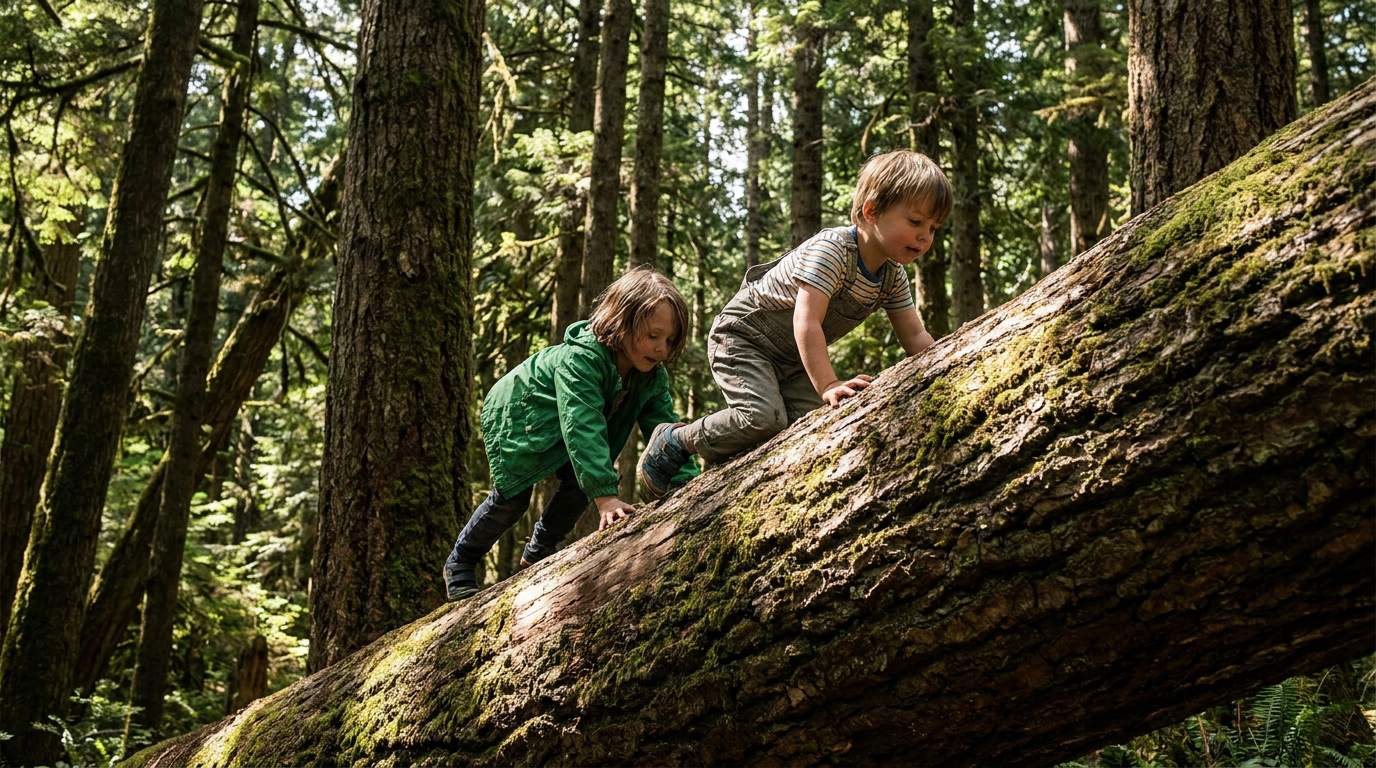
The paradigm is now shifting toward a new standard: keeping children "as safe as necessary." At the forefront of this movement is the concept of "risky play"—thrilling, exciting forms of unstructured play that involve a degree of uncertainty and the genuine possibility of minor physical injury. Rather than viewing a scraped knee or a bruised shin as a parenting failure, experts are increasingly framing these minor injuries as the necessary cost of building long-term physical and psychological resilience.[1][4]
The Canadian Paediatric Society (CPS) recently formalized this shift in a landmark position statement, urging healthcare providers to actively prescribe outdoor risky play as preventative medicine. The guidelines represent a stark departure from the traditional medical focus on absolute injury prevention. Instead, the CPS argues that the developmental benefits of testing physical limits far outweigh the statistical risks of playground accidents, positioning risky play as a crucial intervention for soaring rates of childhood obesity, anxiety, and behavioral issues.[1][5]
To understand why risky play is so vital, it is necessary to define what it actually looks like in practice. Researchers generally categorize it into six distinct types: play involving great heights (like climbing trees), high speeds (riding bikes or sledding), dangerous tools (whittling with a pocket knife), dangerous elements (playing near water or fire), rough-and-tumble play (wrestling), and play with the chance of getting lost (wandering in the woods without direct supervision).[7]

Crucially, proponents of risky play draw a hard line between a "risk" and a "hazard." A risk is a challenge that a child can see, evaluate, and choose to engage with based on their self-perceived skill level—such as deciding how high to climb on a boulder. A hazard, by contrast, is a hidden danger that is beyond a child's developmental capacity to recognize or manage, such as an improperly anchored slide, a rotten tree branch, or a busy roadway. The goal of risky play is to eliminate hazards while preserving risks.[2][5]

When children engage with these visible risks, they are essentially conducting their own scientific experiments. They push themselves slightly out of their comfort zones, testing the laws of physics and the limits of their own bodies. This process triggers a framework known as the "dynamic risk management model." It begins with risk willingness—the natural urge to take on a challenge—followed by cognitive risk assessment, and finally, risk handling, which involves the physical coordination required to navigate the situation.[3][7]
A June 2026 study published in the Journal of Environmental Psychology demonstrated that the skills forged in these playful experiments do not remain confined to the playground. Researchers found that children who regularly engaged in risky play developed superior risk management skills for real-world, high-consequence scenarios. For instance, children who took more physical chances during playtime were able to make safe, efficient decisions much more quickly when asked to navigate a simulated busy street intersection. The playground risk directly translated into practical pedestrian safety.[3]
Researchers found that children who regularly engaged in risky play developed superior risk management skills for real-world, high-consequence scenarios.
This transfer of skills highlights a counterintuitive truth: shielding children from all physical risk may actually make them less safe in the long run. When adults constantly intervene to prevent falls or dictate how a child should move, they deprive the child of the opportunity to develop proprioception—the awareness of where their body is in space—and the ability to independently assess danger. Without these internal alarms, children are ill-equipped to handle unexpected physical challenges when they eventually navigate the world without adult supervision.[2][3][7]
Beyond physical safety, the psychological benefits of risky play are profound, particularly regarding the modern epidemic of childhood anxiety. From an evolutionary perspective, children are hard-wired to seek out thrilling, slightly scary situations. By deliberately exposing themselves to fear-provoking scenarios—like balancing on a high log or swinging fast—they experience physiological arousal and practice regulating their emotional response.[1][6]

This self-directed exposure therapy teaches children a vital psychological lesson: "I can feel fear, manage it, and survive." When children realize they can cope with uncertainty and recover from minor failures, they build a deep reservoir of self-efficacy. Conversely, when adults constantly caution children to "be careful," it can inadvertently signal to the child that the world is inherently dangerous and that adults do not trust their capabilities, thereby feeding a cycle of anxiety and dependence.[2][4][6]
The decline of risky play is deeply intertwined with broader societal shifts. Over the last few decades, unscheduled, unsupervised outdoor play has steadily given way to highly structured, adult-led extracurricular activities and indoor screen time. A recent ParticipACTION report card gave Canadian children a "D-" for active play, reflecting a landscape where parents feel immense pressure to curate their children's experiences and fear judgment or liability if their child gets hurt.[1][2][4]
Yet, the statistical reality of playground danger rarely matches parental perception. Data highlighted by child development experts reveals that from 2007 to 2022, there were only two deaths resulting from falls on playgrounds, compared to 480 deaths from motor vehicle crashes. Statistically, a child is in far more danger during the drive to the playground than they are while climbing a tree. Furthermore, research indicates that children are actually less likely to be injured during unstructured free play than during organized sports.[6]

Reintroducing risky play does not mean abandoning common sense or evidence-based safety measures. Pediatricians emphasize that children should still wear helmets while biking, and toddlers should not be left unsupervised near open water or traffic. The foundation of healthy risky play is that it is child-led but adult-supported. The adult's role shifts from a director who eliminates all danger to a lifeguard who monitors for hidden hazards while allowing the child to dictate the pace of their own exploration.[5][7]
Experts suggest that parents and educators can foster this environment by changing their language. Instead of the reflexive "be careful," adults can use prompts that encourage situational awareness, such as "Notice how slippery that rock is," or "What is your plan for getting down from that branch?" This subtle shift in framing invites the child into the problem-solving process, building the executive function required to make safe decisions independently.[4][7]
Ultimately, the movement to restore risky play is about trusting children's innate developmental drives. By stepping back and allowing kids to experience the thrill of speed, the challenge of height, and the sting of a scraped knee, society can help cultivate a generation that is not only physically literate but psychologically resilient. In the effort to protect children from every conceivable harm, the science suggests that a little bit of danger is exactly what they need to thrive.[1][2][8]
How we got here
Late 20th Century
Playground design shifts heavily toward rubberized surfaces and lower structures to eliminate all injury risk.
2022
A major ParticipACTION report gives children a 'D-' for active play, sparking concern among health professionals.
Jan 2024
The Canadian Paediatric Society releases landmark guidelines officially endorsing risky play for mental and physical health.
June 2026
The Journal of Environmental Psychology publishes a study linking childhood play risk to real-world pedestrian safety skills.
Viewpoints in depth
Pediatric & Child Psychology Experts
Medical professionals who view physical risk as a necessary developmental nutrient.
This camp argues that the modern obsession with absolute physical safety has created a psychological crisis. By shielding children from every scraped knee, adults have deprived them of the opportunity to develop resilience, executive function, and self-efficacy. Pediatricians in this group point to soaring rates of childhood anxiety and obesity as direct consequences of highly structured, risk-averse environments, and advocate for 'prescribing' unstructured outdoor play as preventative medicine.
Risk-Averse Institutions & Parents
Stakeholders focused on immediate injury prevention and liability mitigation.
Municipalities, school boards, and many modern parents operate under immense pressure to prevent any harm from befalling children. Driven by fears of litigation, social judgment, and genuine concern for safety, this perspective favors rubberized playgrounds, strict supervision, and the removal of unpredictable natural elements. They argue that while resilience is important, it should not come at the cost of preventable physical injuries, leading to policies like bans on tobogganing or tree-climbing on public property.
Public Health Officials
Agencies attempting to balance injury prevention with the need for physical activity.
Public health bodies are increasingly caught in the middle of this debate. While their traditional mandate has been to reduce emergency room visits through strict safety guidelines (like helmet laws and traffic safety), they are now recognizing that excessive risk aversion is contributing to a sedentary lifestyle epidemic. Their current focus is on educating the public on the difference between a 'risk' and a 'hazard,' aiming to keep children 'as safe as necessary' rather than 'as safe as possible.'
What we don't know
- Exactly how much risky play is required to yield measurable reductions in clinical anxiety.
- How to effectively rewrite municipal liability laws to protect schools and parks that intentionally design riskier play spaces.
Key terms
- Risky Play
- Thrilling and exciting forms of free play that involve uncertainty of outcome and a possibility of minor physical injury.
- Hazard
- A hidden danger that is beyond a child's developmental capacity to recognize or manage, such as an improperly anchored slide.
- Dynamic Risk Management Model
- The cognitive and physical process of evaluating a danger and executing the necessary movements to navigate it safely.
- Proprioception
- The body's subconscious ability to perceive its own position and movement in space, which is crucial for balance and coordination.
Frequently asked
Does risky play mean leaving kids unsupervised?
No. It means adults act as lifeguards who remove hidden hazards (like broken equipment) but allow children to take visible risks (like climbing high) without constant interruption.
Will my child get seriously injured?
Research shows severe injuries are incredibly rare in unstructured free play. In fact, children are statistically more likely to be injured participating in adult-organized sports.
How does risky play help with anxiety?
It acts as a natural form of exposure therapy. By deliberately putting themselves in slightly scary situations, children learn to experience fear, manage their physiological response, and realize they can survive uncertainty.
Sources
Source coverage
8 outlets
3 viewpoints surfaced








[1]Canadian Paediatric SocietyChild Development Advocates
Healthy childhood development through outdoor risky play
Read on Canadian Paediatric Society →[2]Global NewsSafety-First Institutions
Children’s playtime shouldn’t be ‘as safe as possible,’ doctors say
Read on Global News →[3]PsyPostAcademic Researchers
Childhood risk-taking during play translates into practical safety skills
Read on PsyPost →[4]CBC NewsSafety-First Institutions
Kids need to get outside and take physical risks, pediatricians say
Read on CBC News →[5]SickKids HospitalChild Development Advocates
The importance of risky play for childhood development
Read on SickKids Hospital →[6]Let GrowChild Development Advocates
Pediatricians: Kids Need Risky Play
Read on Let Grow →[7]Boston UniversityAcademic Researchers
Why is Risky Play Important?
Read on Boston University →[8]Factlen Editorial TeamChild Development Advocates
Synthesis by Factlen editorial team
Read on Factlen Editorial Team →

Every angle. Every day.
Get lifestyle stories with full source coverage and perspective breakdowns delivered to your inbox.