
Heat Pump vs. Vented Dryers: The 2026 Efficiency and Cost Comparison
As energy standards tighten and electricity costs rise, heat pump dryers offer massive efficiency gains over traditional vented models, though they require a higher upfront investment and longer drying times.
By Factlen Editorial Team
- Efficiency Advocates
- Focus on long-term financial and environmental savings.
- High-Volume Households
- Prioritize speed, capacity, and straightforward operation.
- Appliance Technicians
- Emphasize repairability, maintenance, and total cost of ownership.
What's not represented
- · Renters who do not control their appliance purchases but pay the utility bills.
- · Commercial laundromat operators balancing equipment costs against energy overhead.
Why this matters
Laundry is one of the most energy-intensive chores in any household. Choosing the right dryer technology dictates not only your monthly utility bills for the next decade but also how long your clothing lasts and where you can safely install the appliance.
Key points
- Heat pump dryers use 50% to 70% less energy than traditional vented models by recycling warm air.
- Vented dryers remain significantly faster, drying typical loads in half the time of a heat pump unit.
- The upfront cost of a heat pump dryer is generally $650 to $800 higher than a standard vented machine.
- Heat pump models are ventless, allowing them to be installed in interior rooms or apartments without exterior access.
- Lower operating temperatures make heat pump dryers much gentler on delicate fabrics, extending clothing lifespan.
The humble clothes dryer is undergoing a quiet revolution. For decades, the standard vented dryer has been the default choice in most homes, operating essentially like a giant hair dryer that blasts hot air through wet clothes and expels the moisture outside. But as energy costs rise and environmental standards tighten, a new generation of appliances is challenging the status quo, forcing homeowners to rethink how they do laundry.[6]
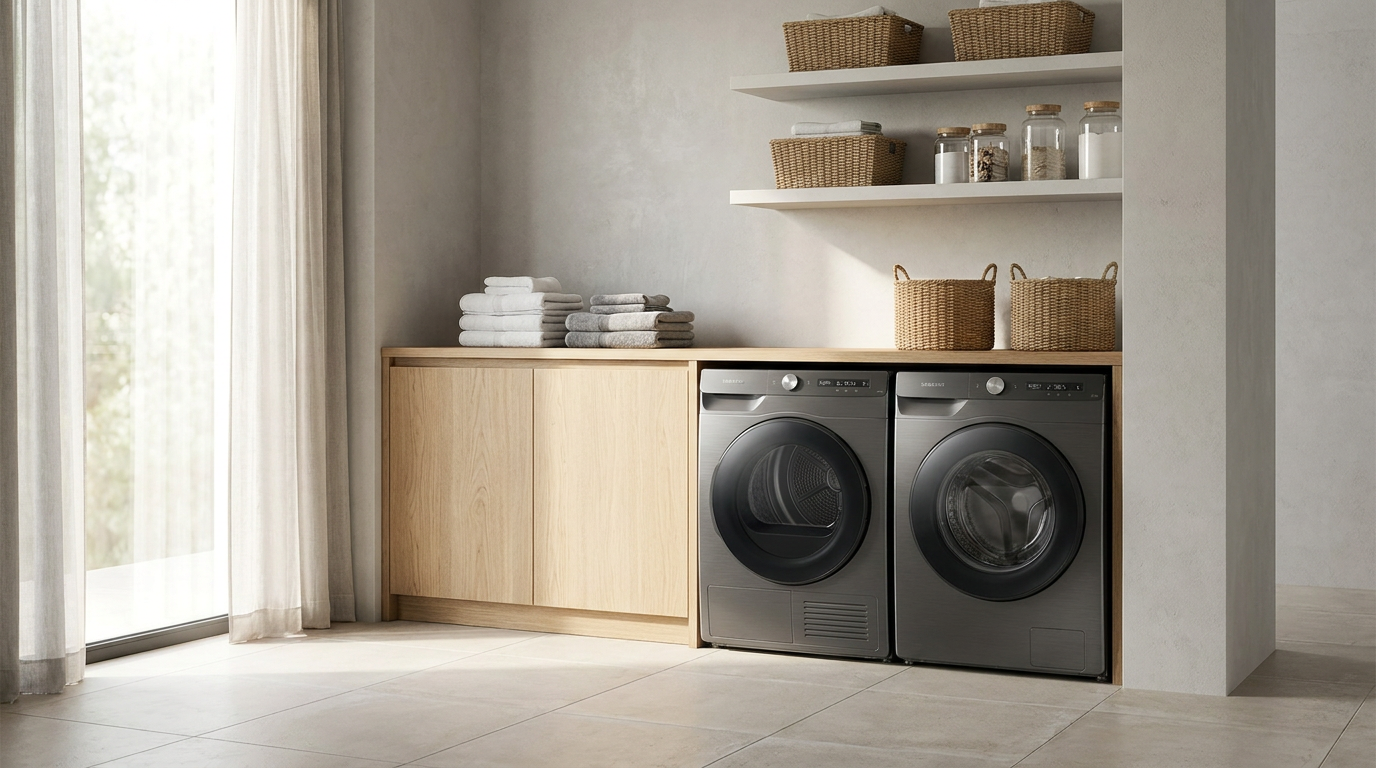
The leading alternative is the heat pump dryer, which operates much like a refrigerator in reverse. Instead of generating new heat and immediately throwing it away, it uses a closed-loop system with a compressor and refrigerant to capture, condense, and recycle warm air. This fundamental shift in mechanics changes everything from how the machine is installed to how it treats fabrics.[3][4]
For heat pump dryers, the primary argument centers on unprecedented energy efficiency. By recycling heat rather than continuously drawing fresh electricity to warm cold air, these machines use 50 to 70 percent less energy than their traditional vented counterparts. In an era of volatile utility rates, this reduction transforms the dryer from an energy vampire into one of the most efficient appliances in the home.[1][5]
The evidence for these savings is highly quantifiable and compelling. In regions with high electricity costs, such as Massachusetts or the United Kingdom, consumer data shows that a heat pump dryer can save a household between $100 and $175 annually. Over a typical ten-to-fifteen-year lifespan, this accumulated savings easily offsets the initial purchase premium, making it a sound long-term financial decision.[2][3]

Another significant point for the heat pump column is superior fabric care. Because they rely on advanced dehumidification rather than sheer thermal force, heat pump models operate at much lower temperatures—typically around 120 degrees Fahrenheit compared to the 160 degrees or more found in vented units. This gentler approach prevents shrinkage, protects elastic fibers, and extends the life of delicate garments.[1][4]
Furthermore, the installation flexibility of heat pump dryers is a major advantage for modern living spaces. Because they are completely ventless and collect moisture in a tank or drain it directly into a sink, they can be placed in interior closets, high-rise apartments, or basements without the need to drill a costly hole through an exterior wall.[3][5]
However, the argument against heat pump dryers begins at the cash register. Shoppers can expect to pay a premium of roughly $650 more upfront for a heat pump model compared to a basic vented unit. For households on a strict appliance replacement budget, or those who only do laundry occasionally, this initial financial hurdle can be difficult to justify despite the long-term payback.[3][5]
The second major point against heat pump technology is the extended drying time. While a traditional vented dryer might power through a heavy load of towels in 45 to 60 minutes, a heat pump dryer typically requires 90 to 120 minutes to achieve the exact same result. The lower temperatures mean the moisture extraction process is inherently slower and requires more patience.[1][3]

The second major point against heat pump technology is the extended drying time.
Maintenance also presents a different set of expectations for the user. While vented dryers require annual duct cleaning to prevent dangerous fire hazards, heat pump dryers demand more frequent, albeit minor, user intervention. Owners must regularly clean secondary lint filters and condenser coils to maintain the machine's efficiency, a chore that some consumers find tedious to remember.[3][6]
Turning to the traditional vented dryer, the primary argument for this legacy technology remains its speed and simplicity. Vented dryers are straightforward machines with fewer complex electronic components, making them fast, highly reliable, and generally cheaper to repair if a basic heating element happens to fail after years of heavy use.[3]
The evidence supporting vented dryers is most visible in their sheer volume output. For large, busy families doing multiple loads of laundry back-to-back on a Sunday afternoon, the rapid turnaround time of a vented unit keeps the household chores moving smoothly. In these high-volume situations, a heat pump dryer can create a frustrating bottleneck.[3]
Yet, the argument against vented dryers is increasingly tied to hidden environmental and HVAC costs. Because they aggressively expel conditioned indoor air to the outside, they create negative pressure in the home, forcing heating and cooling systems to work harder to replace that lost air, which creates hidden energy costs beyond the dryer's own electricity consumption.[4]
In fact, regulatory bodies are beginning to actively phase out this inefficient drying technology. In the United Kingdom and parts of the European Union, proposed energy standards aim to eliminate the sale of traditional vented and standard condenser dryers by 2027, pushing the market entirely toward heat pumps as the new baseline standard.[2]

Ultimately, a heat pump dryer fits well when a household prioritizes long-term utility savings, cares deeply about preserving the quality of expensive clothing, or lives in a space where exterior venting is physically impossible. It is the ideal choice for those who do laundry steadily throughout the week rather than in one massive, rushed batch.[6]
Conversely, a heat pump dryer does not fit well when a buyer is severely constrained by an upfront budget, lacks the discipline to perform regular filter maintenance, or manages a large household that requires rapid, back-to-back drying cycles to keep up with daily demands.[6]
A traditional vented dryer fits well when a home already has clean, accessible exterior ductwork, the household prioritizes speed above all else, and the local cost of electricity is low enough that the efficiency gains of a heat pump would take over a decade to materialize.[6]
It does not fit well when a home is undergoing a green energy retrofit, when the laundry room is situated in the center of the floorplan, or when the household washes a high volume of delicate activewear that quickly degrades under high heat.[6]
As the appliance market evolves through 2026, the gap between these two technologies is steadily narrowing. Heat pump models are slowly coming down in price and increasing in drum capacity, making the transition easier for consumers who are ready to trade a bit of speed for significant, long-term environmental and financial savings.[6]
How we got here
Mid-20th Century
Vented electric and gas dryers become standard appliances in North American homes, prioritizing speed over energy efficiency.
1990s
Heat pump dryers are introduced in Europe, where high electricity costs and smaller homes drive demand for efficient, ventless options.
2014
Heat pump dryers begin entering the North American market, initially as expensive, compact units for niche buyers.
2022–2024
Major manufacturers release full-sized heat pump models, bringing the technology to mainstream consumers as global energy prices spike.
2027 (Proposed)
New energy efficiency standards in the UK and EU aim to effectively phase out the sale of traditional vented dryers.
Viewpoints in depth
Efficiency Advocates
Focus on long-term financial and environmental savings.
This camp, which includes green building organizations and energy regulators, argues that the traditional vented dryer is an outdated energy vampire. They point to the 50 to 70 percent reduction in electricity usage as a necessary step for household sustainability. From their perspective, the higher upfront cost is a short-term hurdle that is easily justified by the lifetime reduction in utility bills and the lower strain on municipal power grids.
High-Volume Households
Prioritize speed, capacity, and straightforward operation.
For large families or those who run multiple loads of laundry daily, the primary metric of success is throughput. This perspective argues that the 90-to-120-minute cycle times of heat pump dryers create unacceptable bottlenecks on laundry day. They favor vented dryers for their brute-force speed and simple maintenance, noting that the time saved is often worth the higher monthly electricity costs.
Appliance Technicians
Emphasize repairability, maintenance, and total cost of ownership.
Repair professionals often highlight the mechanical complexity of heat pump systems. While they acknowledge the energy savings, they caution that heat pump dryers require diligent user maintenance—specifically cleaning secondary filters—to prevent compressor failure. They point out that when a vented dryer breaks, it is usually a cheap heating element; when a heat pump dryer fails, the repair can be complex and expensive, potentially wiping out years of energy savings if the unit is out of warranty.
What we don't know
- How quickly the North American market will adopt heat pump technology compared to the rapid regulatory shifts in Europe.
- Whether the long-term repair costs of complex heat pump compressors will offset their energy savings as these units age past their warranties.
Key terms
- Heat Pump Technology
- A closed-loop system that uses a compressor and refrigerant to capture, heat, and recycle air, rather than constantly generating new heat.
- Vented Dryer
- A traditional dryer that draws in ambient air, heats it, passes it through wet clothes, and expels the hot, moisture-laden air outside through a duct.
- Condenser Dryer
- A ventless dryer that extracts moisture by cooling the warm air inside the drum, but unlike a heat pump, it uses a traditional heating element to warm the air initially.
- Kilowatt-hour (kWh)
- A unit of energy used by utility companies to calculate electricity bills, representing one kilowatt of power sustained for one hour.
Frequently asked
Do heat pump dryers need to be vented outside?
No. Heat pump dryers are completely ventless. They extract moisture from the air and either collect it in a removable water tank or pump it directly into a standard drain.
Will a heat pump dryer shrink my clothes?
Heat pump dryers are actually much gentler on clothes than vented dryers. Because they operate at significantly lower temperatures, the risk of shrinking or damaging delicate fabrics is greatly reduced.
Why do heat pump dryers take so long?
They use a lower, safer heat to gently extract moisture rather than blasting clothes with high temperatures. This dehumidification process is more efficient but inherently slower, often taking up to two hours for a full load.
Are vented dryers being banned?
In some regions, yes. The UK and parts of the EU have proposed phasing out the sale of inefficient vented and standard condenser dryers by 2027, though existing units will not be confiscated.
Sources
Source coverage
6 outlets
3 viewpoints surfaced






[1]ChoiceEfficiency Advocates
Heat pump dryers vs vented dryers
Read on Choice →[2]Which?Appliance Technicians
Heat pump tumble dryers
Read on Which? →[3]Yale ApplianceHigh-Volume Households
Vented vs Condenser vs Heat Pump Dryers (2025): Real Costs, Pros & Trade-Offs
Read on Yale Appliance →[4]Green Building CanadaEfficiency Advocates
Are Heat Pump Clothes Dryers Worth It?
Read on Green Building Canada →[5]Urner'sEfficiency Advocates
Heat Pump Dryers: A Smart Investment for Long-Term Savings
Read on Urner's →[6]Factlen Editorial TeamAppliance Technicians
Synthesis by Factlen editorial team
Read on Factlen Editorial Team →

More in shopping
See all 5 stories →


Every angle. Every day.
Get shopping stories with full source coverage and perspective breakdowns delivered to your inbox.