
The 2026 Guide to Cold-Climate Heat Pumps: How Inverter Technology is Electrifying Winter
Modern cold-climate heat pumps can now extract warmth from sub-zero air without relying on expensive backup heating. Here is how inverter technology, new 2026 efficiency standards, and federal incentives are changing home retrofits.
By Factlen Editorial Team
- Pragmatic HVAC Professionals
- Focus on system reliability, proper sizing, and hybrid solutions for extreme cold.
- Electrification Advocates
- Focus on eliminating residential fossil fuel use to reduce greenhouse gas emissions.
- Cost-Focused Consumers
- Focus on upfront installation costs versus long-term utility savings and tax credits.
What's not represented
- · Natural gas utility companies facing reduced residential demand
- · Renters who cannot control their building's HVAC upgrades
Why this matters
Heating and cooling account for the largest portion of residential energy use. Upgrading to a modern heat pump can cut winter utility bills by up to 50% while unlocking $2,000 in federal tax credits, fundamentally changing how homes are powered.
Key points
- Modern cold-climate heat pumps use variable-speed inverters to extract heat from sub-zero air, eliminating the need for inefficient electric resistance backup.
- The 2026 ENERGY STAR Version 6.2 update officially sunsets central AC certifications, prioritizing versatile heat pump technology.
- Homeowners can claim a $2,000 annual federal tax credit for qualifying heat pumps, compared to just $600 for gas furnaces.
- In extreme northern climates, dual-fuel hybrid systems remain popular, pairing a heat pump with a backup gas furnace for polar vortex events.
The era of the traditional gas furnace and standard air conditioner is facing a quiet but massive disruption. As homeowners plan renovations in 2026, the default HVAC replacement has shifted toward a technology that was once considered viable only in mild climates: the air-source heat pump. Driven by federal incentives, shifting energy codes, and a desire for predictable utility bills, the electrification of home heating is accelerating faster than industry analysts predicted just a few years ago.[2][8]
For decades, the conventional wisdom in northern states and Canada was absolute: if the temperature dropped below freezing, a home needed a combustion furnace or an oil tank. Early-generation heat pumps simply could not extract enough thermal energy from frigid air, hitting a "balance point" around 30°F. Below that threshold, they relied on electric resistance "heat strips"—essentially giant, energy-devouring toasters that caused winter electric bills to skyrocket and left homeowners shivering.[1][8]
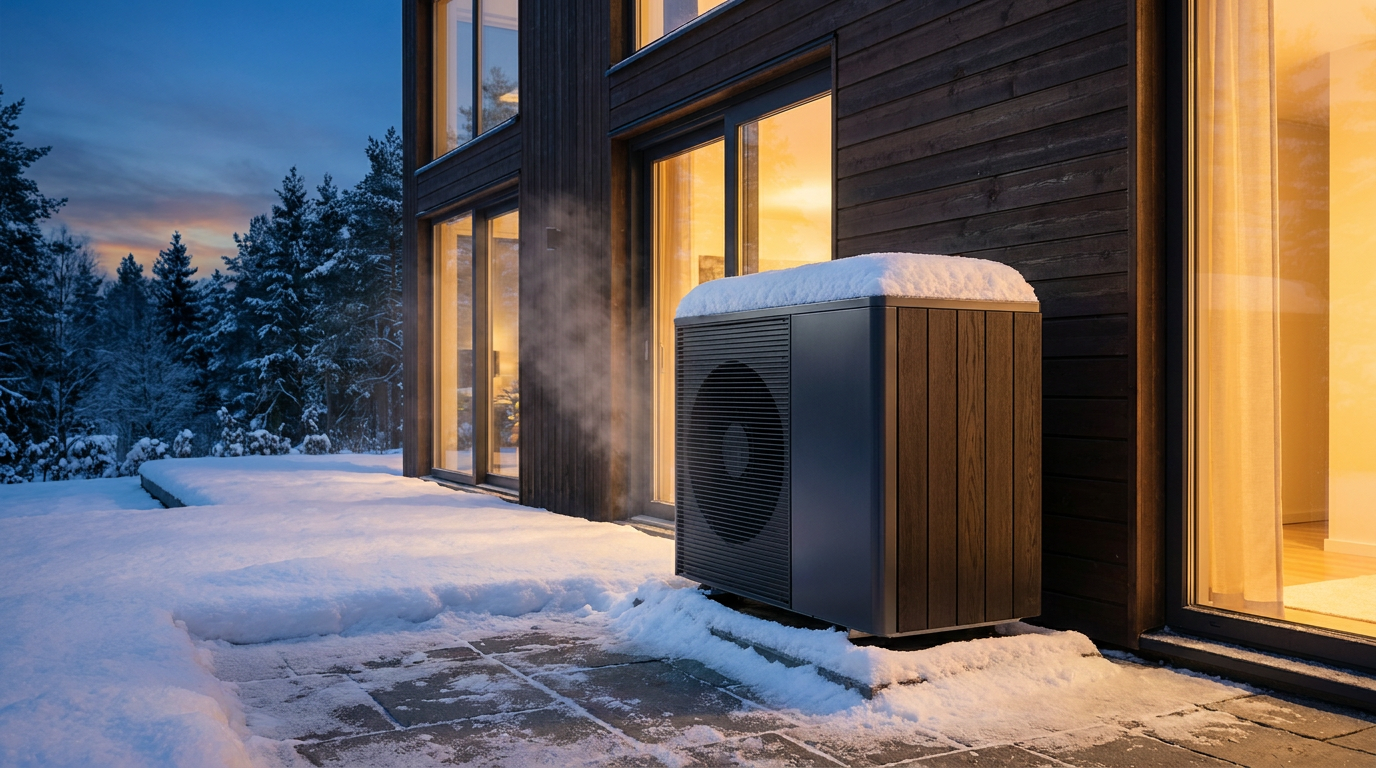
That limitation has been effectively engineered out of existence by the modern Cold Climate Heat Pump (CCHP). The breakthrough lies in variable-speed inverter compressors. Unlike older single-stage units that only know how to turn fully on or fully off, an inverter acts like a car's transmission. It can rev up the compressor's motor frequency to pump more refrigerant, capturing the limited thermal energy present even in sub-zero air without triggering the dreaded backup heat strips.[1][8]

The real-world capabilities of these systems were recently validated by the U.S. Department of Energy’s Cold Climate Heat Pump Challenge. Testing prototypes from eight major manufacturers—including Bosch, Carrier, Daikin, and Trane—the DOE required units to maintain 100% of their heating capacity at 5°F. Field validations conducted by the Pacific Northwest National Laboratory confirmed that these systems not only met the capacity requirements but operated efficiently at temperatures plunging to -15°F and below.[4][6]
This technological leap coincides with a major regulatory shift in 2026. In February, the ENERGY STAR program rolled out its Version 6.2 specifications, tightening the minimum efficiency thresholds for heat pumps. More significantly, the program officially sunset its certification for traditional central air conditioners, signaling a definitive policy preference for versatile, electrified home comfort systems that can both heat and cool year-round.[3][5]
The transition is also being forced by environmental regulations. Starting in 2026, all new HVAC installations must utilize low-Global Warming Potential (GWP) refrigerants, such as R-32 or R-454B, phasing out the long-standard R-410A. These new refrigerants not only reduce environmental impact in the event of a leak by roughly 70%, but they also require a smaller refrigerant charge, which further improves the system's overall efficiency and lowers long-term service costs.[7][8]
The transition is also being forced by environmental regulations.
For homeowners, the most compelling argument for upgrading is financial. Under Section 25C of the Inflation Reduction Act, qualifying high-efficiency heat pumps are eligible for a federal tax credit of 30% of the project cost, capped at $2,000 annually. In stark contrast, traditional gas furnaces and standard AC units are capped at just $600. Because this credit resets every January 1st, savvy remodelers are phasing their upgrades—installing a heat pump one year and adding insulation or a heat pump water heater the next.[1][7]

Despite these advancements, the transition is not one-size-fits-all. In the most extreme northern climates (IECC Climate Zones 6 and 7), many HVAC professionals still recommend a "dual-fuel" or hybrid approach. This configuration pairs a high-efficiency cold-climate heat pump with a backup gas furnace. The heat pump handles 80% to 90% of the winter heating load, while the furnace only engages during severe polar vortex events, offering homeowners maximum peace of mind.[1][2][4]
Successful retrofits require more than just swapping boxes. Treating a heat pump installation as a simple 1-to-1 replacement without a proper "Manual J" load calculation often leads to undersized equipment or noisy, inefficient operation. Because heat pumps deliver a lower, more continuous heat compared to the intense blasts of a gas furnace, existing ductwork must be evaluated and often sealed or modified to handle the different airflow requirements.[2][8]
Smart controls and zoning have evolved from luxury add-ons to essential components of a 2026 heat pump system. Modern thermostats use remote sensors to monitor temperature differentials across the house, allowing the variable-speed compressor to gently ramp up or down. This continuous, low-level operation not only maximizes the system's Coefficient of Performance (COP) but eliminates the hot and cold spots that plague traditional single-stage heating, fundamentally changing the way a home feels in the dead of winter.[2][6][8]
The return on investment for a cold-climate heat pump depends heavily on the fuel it is replacing. Homeowners transitioning from electric baseboard heating, propane, or heating oil often see their winter heating bills drop by 30% to 50%. However, for those switching from cheap natural gas, the monthly savings may be negligible, making the upfront incentives and the addition of high-efficiency summer cooling the primary financial drivers.[1][8]

For older homes lacking central ductwork—which accounts for nearly a third of residences in the Northeast—ductless mini-split heat pumps offer a minimally invasive retrofit. These systems utilize a single outdoor compressor connected to multiple indoor air-handling heads, allowing for room-by-room temperature control without the need to tear open walls to install bulky sheet metal.[4][7]
Looking ahead, the Department of Energy is heavily emphasizing "grid-interactive" capabilities. As millions of homes electrify their heating, winter peak demand on the electrical grid will surge. The newest CCHP prototypes are designed to communicate with utility companies, slightly reducing their power draw by 15% to 60% during peak demand events with minimal impact on indoor comfort, helping to stabilize the grid while earning homeowners additional utility rebates.[4]
Ultimately, 2026 marks the tipping point where heat pumps transition from a niche eco-upgrade to the standard bearer of residential HVAC. With inverter technology conquering the cold, federal tax credits lowering the barrier to entry, and building codes increasingly favoring electrification, the cold-climate heat pump has proven it can handle the harshest winters while keeping homes comfortable and carbon-free.[2][8]
How we got here
2022–2023
The Department of Energy tests Cold Climate Heat Pump prototypes in extreme winter conditions.
Jan 2025
The R-410A refrigerant phase-out begins, shifting the industry to low-GWP alternatives.
Feb 2026
ENERGY STAR Version 6.2 takes effect, sunsetting central AC certifications in favor of heat pumps.
Through 2032
The $2,000 annual IRA tax credit for heat pumps remains available to homeowners.
Viewpoints in depth
Electrification Advocates
Focus on eliminating residential fossil fuel use.
Agencies like the DOE and environmental groups view the cold-climate heat pump as the linchpin of residential decarbonization. Because the electrical grid is becoming greener, replacing millions of gas and oil furnaces with high-efficiency electric heat pumps drastically cuts greenhouse gas emissions. They argue that with modern inverter technology, the old excuse that heat pumps 'don't work in the cold' is no longer scientifically valid.
Pragmatic HVAC Professionals
Focus on system reliability, proper sizing, and hybrid solutions.
Contractors working in the field emphasize that a heat pump is only as good as its installation. They caution against treating heat pumps as simple drop-in replacements for gas furnaces, noting that existing ductwork often needs modification to handle different airflow patterns. In extreme northern climates, many still strongly advocate for 'dual-fuel' systems, keeping a gas furnace as a fail-safe for polar vortex events.
Cost-Focused Consumers
Focus on upfront costs versus long-term utility savings.
For homeowners, the decision often comes down to pure economics. While the $2,000 federal tax credit softens the blow, full system replacements can still cost upwards of $15,000. The return on investment is highly favorable for those switching from expensive propane, oil, or electric baseboards, but the math is tighter for homes currently heated by cheap natural gas.
What we don't know
- How quickly the electrical grid in colder regions will adapt to the increased winter peak demand as millions of homes electrify their heating.
- Whether the upfront costs of high-efficiency inverter systems will decrease as manufacturing scales up and low-GWP refrigerants become the standard.
Key terms
- Coefficient of Performance (COP)
- A ratio measuring a heat pump's efficiency, calculated by dividing the heat output by the electrical energy input.
- Inverter Compressor
- A variable-speed motor that can precisely adjust its output to match the home's heating or cooling needs, rather than just turning fully on or off.
- Dual-Fuel System
- A hybrid heating setup that pairs an electric heat pump with a backup gas furnace for extreme cold weather.
- Manual J Calculation
- A detailed engineering assessment used to determine the exact heating and cooling loads of a home to properly size HVAC equipment.
- SEER2 / HSPF2
- The updated federal metrics for measuring the seasonal cooling (SEER2) and heating (HSPF2) efficiency of heat pumps.
Frequently asked
Do heat pumps really work in freezing weather?
Yes. Modern cold-climate heat pumps use variable-speed inverters to extract heat from the air even when temperatures drop to -15°F or lower.
Can I keep my existing ductwork?
Usually, yes. However, because heat pumps move a higher volume of cooler air compared to gas furnaces, your ducts should be inspected for leaks and proper sizing.
How much is the federal tax credit for a heat pump?
Under the Inflation Reduction Act, qualifying heat pumps are eligible for a tax credit of 30% of the installation cost, up to $2,000 per year.
What is a dual-fuel heat pump?
It is a hybrid system that uses an electric heat pump for most of the winter, but automatically switches to a backup gas furnace during extreme cold snaps.
Sources
Source coverage
8 outlets
3 viewpoints surfaced








[1]HVAC Pro SalesPragmatic HVAC Professionals
Performance in Extreme Climates: The Cold Climate Breakthrough
Read on HVAC Pro Sales →[2]ECCO SupplyPragmatic HVAC Professionals
Top HVAC Trends Homeowners Will Ask About in 2026
Read on ECCO Supply →[3]Intelligent LivingCost-Focused Consumers
ENERGY STAR Heat Pump Version 6.2: What it Means for 2026 Buyers
Read on Intelligent Living →[4]U.S. Department of EnergyElectrification Advocates
Residential Cold Climate Heat Pump Technology Challenge
Read on U.S. Department of Energy →[5]ENERGY STARElectrification Advocates
Air-Source Heat Pump Specification Version 6.2
Read on ENERGY STAR →[6]Pacific Northwest National LaboratoryElectrification Advocates
Performance Results from DOE Cold Climate Heat Pump Challenge Field Validation
Read on Pacific Northwest National Laboratory →[7]Budget HeatingPragmatic HVAC Professionals
Complete air conditioner buying guide for 2026
Read on Budget Heating →[8]Factlen Editorial TeamCost-Focused Consumers
Synthesis by Factlen editorial team
Read on Factlen Editorial Team →

Every angle. Every day.
Get home stories with full source coverage and perspective breakdowns delivered to your inbox.