
The 'Library of Things' Movement: How Communities Are Moving Beyond Books
Neighborhoods worldwide are embracing the 'Library of Things' model, allowing residents to borrow tools, appliances, and gear instead of buying them.
By Factlen Editorial Team
- Circular Economy Advocates
- This camp views the movement primarily as a vital tool for reducing global resource consumption and electronic waste.
- Public Library Administrators
- Library professionals see 'Things' as a natural extension of their historic mandate to provide equitable access to resources.
- Community Organizers
- Grassroots leaders focus on the social cohesion and immediate financial relief these hubs provide to neighborhoods.
What's not represented
- · Traditional hardware retailers
- · Tool manufacturers
Why this matters
By shifting from individual ownership to community access, residents can save thousands of dollars on infrequently used items while drastically reducing local electronic waste and carbon emissions.
Key points
- Libraries of Things allow communities to borrow tools, appliances, and gear instead of buying them.
- The movement has grown to roughly 2,000 formal locations globally by 2026.
- Borrowing items saves residents money and drastically reduces electronic waste and carbon emissions.
- Traditional public libraries are increasingly adding non-traditional items to their catalogs.
- Many hubs also host skill-sharing workshops to teach residents DIY and repair techniques.
The average power drill is used for just 13 minutes over its entire lifetime. Yet, millions of homes have one sitting in a closet, gathering dust until the next minor home repair. This staggering inefficiency is the exact problem a growing global movement is attempting to solve.[6]
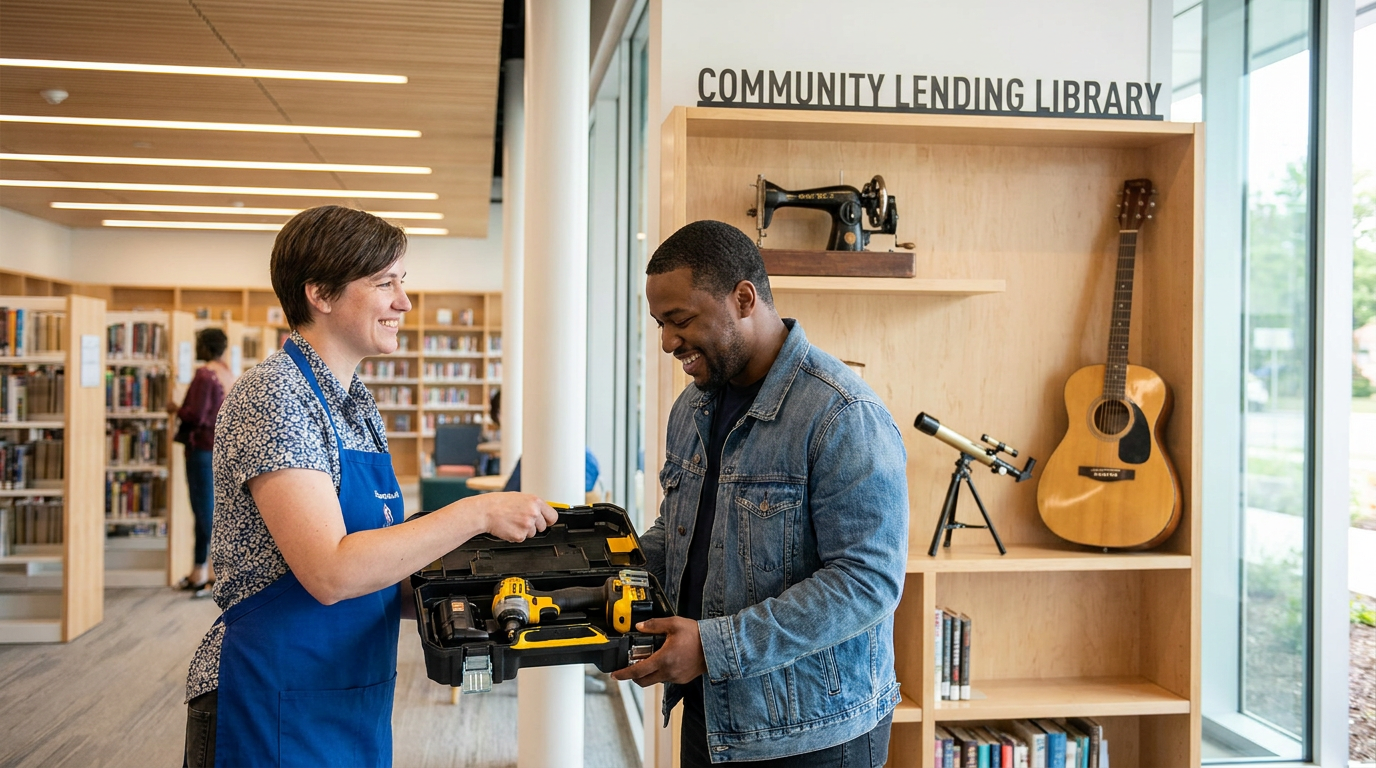
The "Library of Things" (LoT) movement is rapidly changing how communities interact with household items. Instead of books, these community hubs lend out everything from carpet cleaners and sewing machines to camping gear and musical instruments, operating on the simple premise that access is more valuable than ownership.[7]
What started as a fringe sharing-economy experiment has blossomed into a robust global network. As of 2026, there are roughly 2,000 formally established Libraries of Things worldwide, operating alongside countless informal neighborhood sharing networks and tool libraries.[2]
The surge in popularity is driven by a perfect storm of economic pressure, environmental awareness, and a desire for local connection. Public libraries and community centers are increasingly adopting the model as a core service, aligning with new sustainability mandates and shifting patron expectations.[3][7]
The primary driver for many users is simple economics. High-quality tools and appliances are expensive, and buying them for a single, weekend project rarely makes financial sense for the average household.[6]
In the United Kingdom, the flagship "Library of Things" social enterprise reports that its 39,000 members have collectively saved over £10 million by renting rather than buying. By offering commercial-grade equipment for a few pounds a day, the model democratizes access to tools that would otherwise be cost-prohibitive.[1]

Beyond personal savings, the movement is a practical, grassroots application of the "circular economy." The traditional linear economy—extract, make, use, and throw away—is highly resource-intensive and ecologically damaging, particularly when 80% of household items are used less than once a month.[6]
By sharing items, communities drastically reduce the demand for new manufacturing and the subsequent electronic waste. The UK network alone estimates it has prevented 480 tonnes of waste and saved 1,500 tonnes of carbon dioxide emissions, proving that sustainable living does not require sacrificing modern conveniences.[1]
By sharing items, communities drastically reduce the demand for new manufacturing and the subsequent electronic waste.
The logistics of a Library of Things vary depending on the community's size and needs. Some operate as standalone social enterprises with self-service smart lockers located in high-street shops, transit hubs, or community centers, allowing residents to reserve items online and pick them up instantly.[1]
Increasingly, traditional public libraries are incorporating "Things" directly into their catalogs. The Indianapolis Public Library, for example, is currently running a major pilot program through 2026, allowing patrons to check out assistive devices, gardening tools, and arts supplies just like a hardcover novel.[4]
If the pilot proves successful, the Indianapolis library plans to expand the collection to five new branches every six months, illustrating how institutionalized the concept is becoming in civic infrastructure.[4]
What goes into a Library of Things is usually dictated by the specific needs of the local population. In late 2025, the city of Hillsboro, Oregon, surveyed over 1,500 residents to decide exactly what to add to their collection for the 2026 calendar year.[5]

The winning items in Hillsboro included a kids' telescope, a document scanner, and a portable PA system—highlighting that communities want access to educational and event-hosting tools just as much as they want power drills and hedge trimmers.[5]
The movement isn't limited to dense urban centers. In South Devon, UK, the "Share Shed" operates as the world's first traveling Library of Things, driving a van stocked with over 350 items to seven different towns on a weekly schedule, ensuring rural residents aren't left out of the sharing economy.[8]
The impact of these libraries extends far beyond the physical items they lend. They serve as vital community hubs where neighbors meet, interact, and share knowledge that might otherwise be lost in an increasingly digital world.[7]

Many locations host regular "skillshare" events, where experienced locals teach others how to safely use the tools, repair broken appliances, or tackle DIY home improvements, fostering a profound sense of neighborhood self-reliance.[1][2]
As the movement matures in 2026, the focus is shifting toward financial sustainability and broader municipal support. Organizations like Shareable are providing toolkits and software to help new communities launch their own hubs, with a stated goal of bringing a Library of Things to every community by 2050.[2]
By challenging the default assumption that every household needs to own every item it occasionally uses, the Library of Things movement is quietly rewiring local economies. It proves that for a growing number of people, access is ultimately more valuable than ownership.[7]
How we got here
1979
The Berkeley Public Library opens its Tool Lending Library, one of the earliest modern examples of the concept.
2014
Early grassroots experiments in London begin testing the modern 'Library of Things' model in local communities.
2017
The Share Shed launches in South Devon, UK, becoming the world's first mobile, traveling Library of Things.
2025
Major municipal library systems, such as Indianapolis, launch extensive pilot programs to integrate non-traditional items into their catalogs.
2026
The movement reaches approximately 2,000 formal locations globally, driven by sustainability goals and community demand.
Viewpoints in depth
Circular Economy Advocates
This camp views the movement primarily as a vital tool for reducing global resource consumption and electronic waste.
Advocates point out that the traditional model of individual ownership is ecologically unsustainable. With the average household item used less than once a month, manufacturing millions of single-use tools drives unnecessary greenhouse gas emissions and resource extraction. By transitioning to a model of shared access, they argue communities can drastically cut their carbon footprint and divert hundreds of tonnes of usable materials from landfills, proving that sustainable living doesn't require sacrificing access to modern conveniences.
Public Library Administrators
Library professionals see 'Things' as a natural extension of their historic mandate to provide equitable access to information and resources.
For administrators, lending out a telescope or a sewing machine is conceptually no different than lending a book. As digital media replaces physical volumes, libraries are actively rethinking their physical spaces and collections to remain relevant community anchors. They highlight that these collections democratize access to expensive technology and tools, supporting local entrepreneurs, hobbyists, and low-income families who might otherwise be priced out of purchasing such equipment.
Community Organizers
Grassroots leaders focus on the social cohesion and immediate financial relief these hubs provide to neighborhoods.
Organizers emphasize the human element of the sharing economy. Beyond the environmental metrics, they measure success in money saved by residents and the connections forged during skill-share workshops. They argue that in an era of increasing social isolation and economic strain, a Library of Things acts as a vital 'third space' where neighbors interact, share expertise, and build local resilience without the pressure of commercial transactions.
What we don't know
- Whether large-scale tool manufacturers will eventually adapt their business models to support community sharing rather than individual sales.
- How municipal budgets will sustain the maintenance and replacement costs of heavily used items over the next decade.
Key terms
- Circular Economy
- An economic system aimed at eliminating waste and the continual use of resources by reusing, repairing, and sharing items.
- Sharing Economy
- A peer-to-peer economic model where individuals share access to goods and services, often facilitated by a community hub or digital platform.
- Skillshare
- A community event or workshop where individuals teach practical skills, such as DIY repairs or sewing, to their neighbors.
- Social Enterprise
- A business that has specific social or environmental objectives as its primary purpose, reinvesting profits back into the community.
Frequently asked
What exactly is a Library of Things?
It is a community lending hub where residents can borrow infrequently used items—like power tools, camping gear, and kitchen appliances—instead of buying them.
Do I have to pay to borrow items?
It depends on the model. Public library programs are typically free with a library card, while independent social enterprises usually charge a small, affordable rental fee to cover maintenance.
How are the items maintained?
Most hubs employ local fixers or rely on skilled volunteers to clean, test, and repair items between rentals, ensuring they remain safe and functional.
Can I donate my old tools?
Many independent libraries do not accept random donations because they require commercial-grade, easily repairable items to withstand heavy use, though some smaller community hubs do rely on donated goods.
Sources
Source coverage
8 outlets
3 viewpoints surfaced





[1]Library of Things (UK)Community Organizers
Our Impact: Making Borrowing Better Than Buying
Read on Library of Things (UK) →[2]ShareableCircular Economy Advocates
The Library of Things Toolkit and Co-Lab
Read on Shareable →[3]The Digital LibrarianPublic Library Administrators
Library Tech Trends for 2026
Read on The Digital Librarian →[4]Indianapolis Public LibraryPublic Library Administrators
Library of Things 2025-2026 Pilot Program
Read on Indianapolis Public Library →[5]City of HillsboroPublic Library Administrators
New Library of Things Items Coming in 2026: Community Voting Results
Read on City of Hillsboro →[6]Active SustainabilityCircular Economy Advocates
The Library of Things: Rent, and promote the circular economy
Read on Active Sustainability →[7]Factlen Editorial TeamCommunity Organizers
Synthesis by Factlen editorial team
Read on Factlen Editorial Team →[8]Share ShedCommunity Organizers
The World's First Travelling Library of Things
Read on Share Shed →
Every angle. Every day.
Get community stories with full source coverage and perspective breakdowns delivered to your inbox.