
The Science of the Maillard Reaction: Unlocking Restaurant-Quality Flavor at Home
The complex chemical reaction between amino acids and sugars is the hidden engine behind the flavor of seared steaks, roasted coffee, and baked bread.
By Factlen Editorial Team
- Culinary Scientists & Chefs
- Focus on manipulating variables like moisture, heat, and pH to maximize flavor and texture.
- Food Industry Manufacturers
- Focus on the kinetics of the reaction to create artificial flavors, optimize processing, and ensure shelf-stability.
- Public Health Researchers
- Focus on the byproducts of the reaction, balancing the creation of dietary antioxidants against the formation of acrylamide.
What's not represented
- · Home Appliance Manufacturers
- · Evolutionary Biologists
Why this matters
Understanding the chemistry behind browning transforms home cooking from guesswork into a repeatable science. By controlling heat, moisture, and pH, anyone can consistently unlock deep flavors and avoid the frustration of steamed, gray food.
Key points
- The Maillard reaction is a chemical process between amino acids and reducing sugars that creates deep flavors and browning.
- The reaction requires high heat, typically accelerating only when surface temperatures exceed 140°C (280°F).
- Surface moisture prevents browning by capping the food's temperature at the boiling point of water (100°C).
- Unlike caramelization, which only involves sugars, the Maillard reaction requires the presence of proteins.
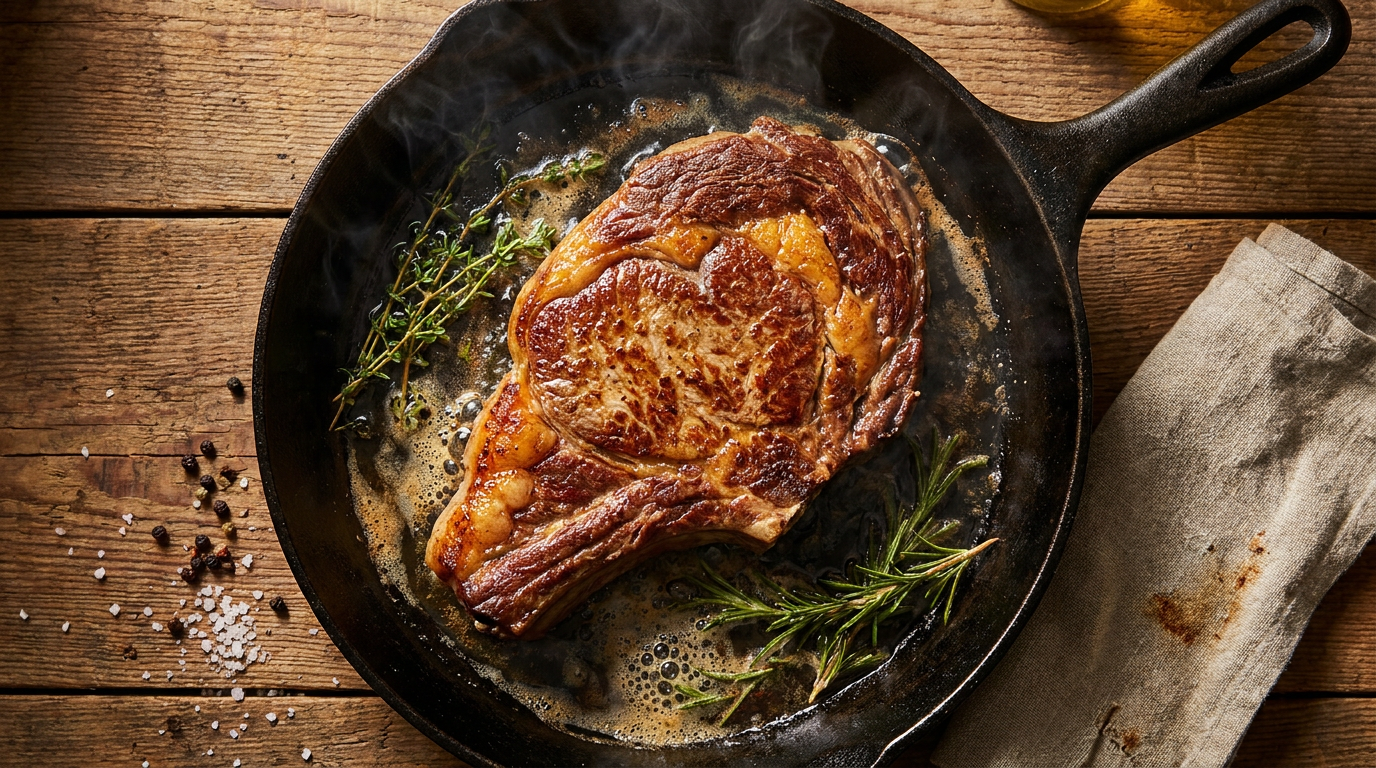
There is a distinct moment in cooking when raw ingredients transform into something entirely different. The aroma of a steak hitting a hot cast-iron skillet, the golden crust forming on a loaf of sourdough, and the deep, roasted scent of coffee beans all share a common origin. This transformation is not culinary magic; it is one of the most widely practiced chemical processes in the world.[3]
Known as the Maillard reaction, this process is the engine of flavor in the kitchen. It is responsible for the complex, savory, and toasted notes that elevate simple ingredients into memorable dishes. While humans have been utilizing this reaction since the discovery of fire, the mechanics behind it were only formally described a little over a century ago.[1][2]
In 1912, French chemist and physician Louis-Camille Maillard was attempting to understand biological protein synthesis when he observed that amino acids and sugars behaved in fascinating ways when heated together. Though he was not studying food science, his observations unlocked the fundamental secret of why cooked food tastes good.[3][5]
At its core, the Maillard reaction is a form of non-enzymatic browning. Unlike the browning of a sliced apple, which relies on enzymes, this reaction requires three specific conditions: amino acids (the building blocks of proteins), reducing sugars (like glucose or fructose), and high heat.[1][3][4]

The reaction typically kicks into high gear when the surface temperature of the food reaches between 140°C and 165°C (280°F to 330°F). When heat hits the food, the reactive carbonyl group of the sugar interacts with the nucleophilic amino group of the amino acid.[3][5]
This initial condensation forms an unstable chemical structure known as glycosylamine. As the temperature is maintained, this unstable compound undergoes a rearrangement to create a ketosamine, setting off a rapid cascade of further chemical reactions.[1][5]
This cascade acts as a flavor multiplier. The reaction produces hundreds of new volatile compounds, which then break down to form even more complex molecules. In a single piece of seared steak, scientists have identified over 600 distinct flavor compounds generated by this process.[2][3][6]
The reaction produces hundreds of new volatile compounds, which then break down to form even more complex molecules.
These compounds fall into several categories that our olfactory system interprets as delicious. Pyrazines deliver toasted and roasted flavors, while furans contribute sweet, meaty, and nutty aromas. Finally, the reaction creates large polymer molecules called melanoidins, which provide the characteristic golden-brown color to bread crusts and seared meats.[4][5]

A common misconception in the kitchen is confusing the Maillard reaction with caramelization. While both processes require high heat and result in browning, they are chemically distinct. Caramelization involves the breakdown of sugars alone, whereas the Maillard reaction strictly requires the presence of proteins.[1][6]
Understanding this science allows home cooks to manipulate variables for better results, and the most critical variable to manage is moisture. Water boils at 100°C (212°F), meaning that as long as liquid water is present on the surface of food, its temperature cannot exceed that boiling point.[2][6]
Because the Maillard reaction requires temperatures upwards of 140°C, surface moisture acts as an absolute barrier to browning. This is why chefs insist on patting meat completely dry with a paper towel before searing, and why overcrowding a pan leads to steaming rather than developing a crust.[1][2][3]

Beyond moisture control, cooks can also manipulate the pH of their ingredients to accelerate the reaction. The Maillard process proceeds significantly faster in an alkaline environment.[3]
When an alkali is introduced, the amino groups in the proteins are deprotonated, increasing their nucleophilicity and making them more reactive to sugars. This chemical hack is why traditional pretzels are dipped in a lye solution before baking, and why adding a pinch of baking soda to onions will cause them to brown in a fraction of the usual time.[3][6]

While the culinary benefits are undeniable, researchers also study the reaction for its health implications. At excessively high temperatures, the reaction can produce acrylamide, a compound currently studied as a probable carcinogen. Conversely, the Maillard reaction also generates beneficial dietary antioxidants.[3][4][5][6]
How we got here
1912
French chemist Louis-Camille Maillard first describes the reaction between amino acids and sugars.
1953
Chemist John E. Hodge publishes a definitive paper outlining the complex multi-step mechanism of the Maillard reaction.
2002
Researchers discover that acrylamide, a probable carcinogen, can form as a byproduct of the reaction at very high temperatures.
Viewpoints in depth
Culinary Scientists & Chefs
Focus on manipulating variables like moisture, heat, and pH to maximize flavor and texture.
For culinary professionals, the Maillard reaction is a tool to be controlled. They emphasize practical techniques to overcome the reaction's hurdles, primarily by eliminating surface moisture that caps temperatures at 100°C. By understanding that the reaction requires temperatures above 140°C, chefs utilize dry-heat methods, cast-iron pans, and alkaline hacks (like baking soda) to force the chemical cascade, prioritizing the sensory experience of the final dish.
Food Industry Manufacturers
Focus on the kinetics of the reaction to create artificial flavors, optimize processing, and ensure shelf-stability.
Industrial food science views the Maillard reaction through the lens of scale and consistency. Flavorists isolate the specific pyrazines and furans produced during browning to synthesize artificial meat or roasted flavors for packaged goods. Manufacturers also study the reaction's kinetics to optimize factory cooking times and temperatures, ensuring that every batch of baked goods or roasted coffee achieves the exact same melanoidin-driven color profile without slowing down the production line.
Public Health Researchers
Focus on the byproducts of the reaction, balancing the creation of dietary antioxidants against the formation of acrylamide.
The medical and public health community takes a more cautious view of high-heat browning. While acknowledging that the Maillard reaction produces certain beneficial antioxidants, researchers closely monitor the formation of acrylamide—a byproduct created when starchy foods are cooked at very high temperatures. Their guidance typically centers on moderation, advising consumers to aim for a golden-yellow color rather than dark brown or charred, in order to minimize exposure to potential carcinogens.
What we don't know
- The exact long-term human health impact of dietary acrylamide consumed in typical home-cooked quantities.
- The complete catalog of every transient intermediate molecule formed during the rapid ketosamine rearrangement phase.
Key terms
- Amino acids
- The building blocks of proteins, which act as one of the two essential starting materials for the Maillard reaction.
- Reducing sugars
- Simple carbohydrates, such as glucose or fructose, that react with amino acids under heat.
- Melanoidins
- Large, brown-colored polymer molecules created at the end of the reaction, responsible for the color of cooked food.
- Pyrazines
- Volatile flavor compounds produced during the browning process that contribute toasted or roasted aromas.
- Acrylamide
- A chemical byproduct that can form in some starchy foods during high-temperature cooking, currently studied for health implications.
Frequently asked
Is the Maillard reaction the same as caramelization?
No. Caramelization involves only the breakdown of sugars under high heat. The Maillard reaction requires both sugars and amino acids (proteins) to occur.
Why won't my meat brown in the pan?
Excess moisture is usually the culprit. Water boils at 100°C, which prevents the meat's surface from reaching the 140°C threshold needed for the Maillard reaction.
Does the Maillard reaction only happen to meat?
No. It occurs in any food containing both proteins and sugars, including bread crusts, roasted coffee beans, cookies, and toasted marshmallows.
How can I speed up the browning process?
The reaction accelerates in alkaline environments. Adding a tiny pinch of baking soda to ingredients like onions can significantly speed up browning.
Sources
Source coverage
6 outlets
3 viewpoints surfaced






[1]Culinary Arts SwitzerlandCulinary Scientists & Chefs
What Is the Maillard Reaction? The Science of Flavor
Read on Culinary Arts Switzerland →[2]BBC Good FoodCulinary Scientists & Chefs
The Maillard reaction: what it is and how to use it
Read on BBC Good Food →[3]WikipediaFood Industry Manufacturers
Maillard reaction
Read on Wikipedia →[4]Journal of Food Science and NutritionFood Industry Manufacturers
Kinetics and Mechanisms of the Maillard Reaction in Food
Read on Journal of Food Science and Nutrition →[5]BBC Science FocusPublic Health Researchers
What is the Maillard reaction?
Read on BBC Science Focus →[6]Factlen Editorial TeamCulinary Scientists & Chefs
Synthesis by Factlen editorial team
Read on Factlen Editorial Team →
Every angle. Every day.
Get food drink stories with full source coverage and perspective breakdowns delivered to your inbox.