
Fed Holds Rates Steady as New Chair Kevin Warsh Signals Hawkish Pivot and Sweeping Overhaul
In his first meeting as Federal Reserve Chair, Kevin Warsh held interest rates at 3.5% to 3.75% but shocked markets by dropping forward guidance and signaling potential rate hikes.
By Factlen Editorial Team
- Financial Markets
- Adjusting to a less transparent Fed and the sudden pricing-in of higher borrowing costs.
- Monetary Hawks
- Prioritizing price stability above all else, even at the risk of economic slowing.
- Main Street Borrowers
- Facing the prolonged squeeze of high interest rates and elevated consumer prices.
- Institutional Reformers
- Supporting the structural overhaul of the Fed's data and communication practices.
What's not represented
- · Labor Unions
- · Real Estate Developers
Why this matters
The Federal Reserve's pivot directly impacts the cost of borrowing across the economy. With the central bank signaling that interest rates will remain elevated—and could even rise—consumers will face persistently high costs for mortgages, auto loans, and credit card debt through the end of the year.
Key points
- The Federal Reserve unanimously voted to keep its benchmark interest rate unchanged at a range of 3.5% to 3.75%.
- In a hawkish shift, nine of 19 Fed officials now project at least one rate hike by the end of 2026.
- Chair Kevin Warsh announced the end of "forward guidance," opting for shorter, fact-based policy statements.
- Warsh launched five task forces to review the Fed's communications, data sources, balance sheet, and inflation framework.
- The hawkish pivot follows a surge in U.S. inflation to 4.2%, driven largely by energy shocks from the U.S.-Iran conflict.
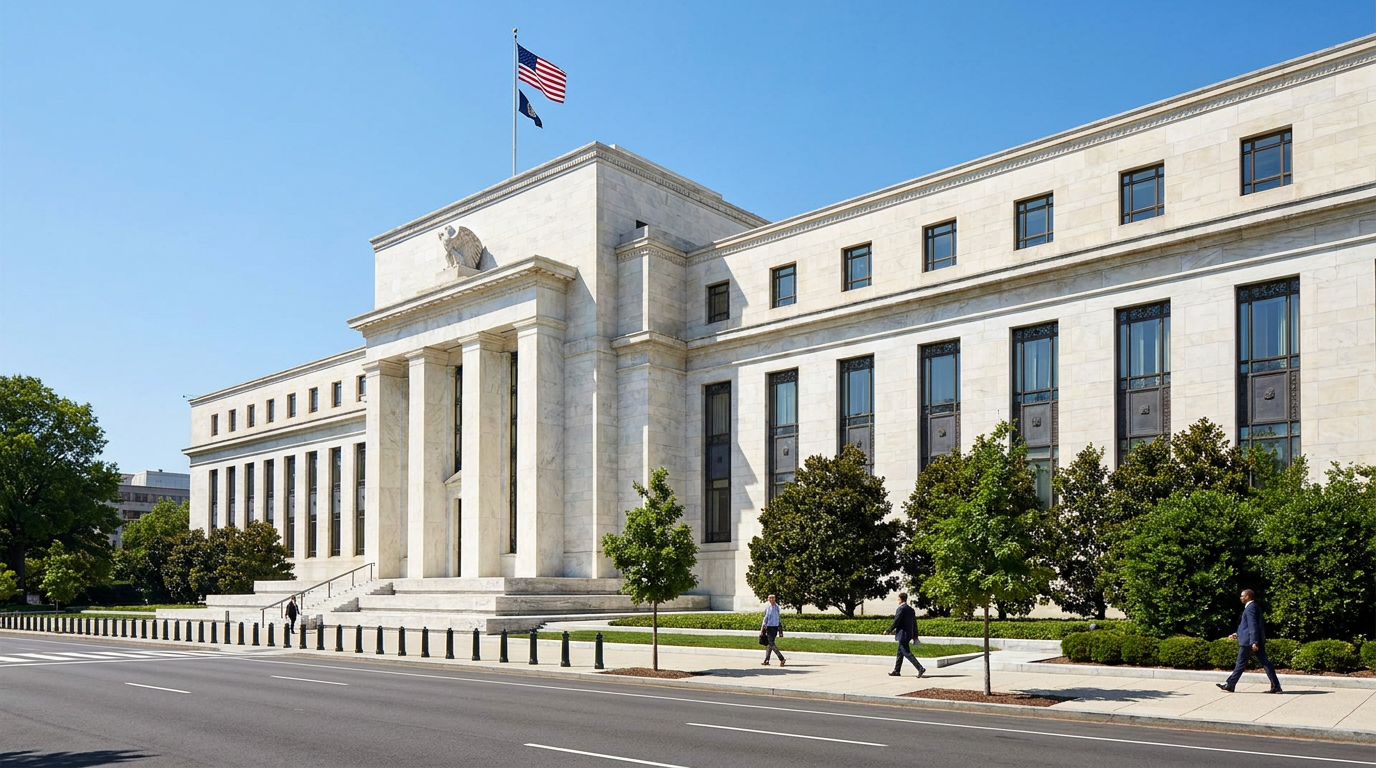
The Federal Reserve has officially entered the Kevin Warsh era, and the new chairman wasted no time tearing up the central bank's established playbook. In a unanimous 12-0 vote on Wednesday, the Federal Open Market Committee (FOMC) opted to hold its benchmark interest rate steady at a range of 3.5% to 3.75%. But while the rate decision was widely anticipated, the messaging surrounding it delivered a jolt to financial markets. Warsh used his debut meeting to signal a starkly hawkish pivot on inflation and announced a sweeping structural overhaul of how the world's most powerful central bank operates.[1][5][6][7]
Financial markets, which had spent the early part of 2026 anticipating rate cuts, reacted swiftly to the realization that borrowing costs might actually climb. The S&P 500 closed down 1.2%, the tech-heavy Nasdaq Composite sank 1.3%, and the Dow Jones Industrial Average dropped roughly 500 points. Simultaneously, yields on short-term U.S. Treasury bonds spiked as investors demanded higher returns to compensate for the prospect of tighter monetary policy.[1][3][4]
The catalyst for the market sell-off was the Fed's quarterly Summary of Economic Projections, colloquially known as the "dot plot." The updated chart revealed that nine of the 19 Fed officials now project at least one quarter-point rate hike before the end of 2026. This marks a dramatic reversal from just three months ago, when not a single policymaker forecasted a rate increase and the median projection pointed to multiple cuts.[3][4][7]

The hawkish shift is a direct response to a sudden reacceleration in consumer prices. U.S. inflation jumped to an annualized rate of 4.2% in May, the highest level recorded since April 2023 and more than double the Fed's stated 2% target. The surge has been heavily driven by a severe energy shock stemming from the recent U.S.-Iran conflict, which disrupted global oil tanker traffic through the critical Strait of Hormuz.[3][4][5]
While a recently brokered ceasefire has helped oil prices retreat from their wartime peaks, gasoline prices remain significantly elevated, cascading into the broader costs of goods and transportation. In its newly abbreviated policy statement, the FOMC explicitly acknowledged that inflation remains elevated "in part reflecting supply shocks that have driven price increases in certain sectors, including energy."[4][5]

The macroeconomic reality places Warsh in a precarious political position. Appointed earlier this year by President Donald Trump—who has vocally pressured the central bank to lower borrowing costs—Warsh has inherited an economy where political demands run in direct opposition to the incoming price data. To preserve an institutional firewall, former Chair Jerome Powell has opted to remain on the Board of Governors, though he has signaled he will keep a low profile during the transition.[3][7]
Beyond the immediate trajectory of interest rates, Warsh used his inaugural press conference to dismantle the communication strategies championed by his predecessors. Most notably, he announced the immediate end of "forward guidance"—the practice of telegraphing the Fed's likely future policy moves to help markets prepare. Warsh argued that such guidance is "not well suited" to the current volatile economic environment, preferring instead to let markets react to incoming data.[6][7]
Beyond the immediate trajectory of interest rates, Warsh used his inaugural press conference to dismantle the communication strategies championed by his predecessors.
This philosophical shift was immediately evident in Wednesday's official policy statement. The document was significantly shorter than those issued during the Powell era, stripped of boilerplate language and the so-called "easing bias" that had previously hinted at future rate cuts. Returning to a terse format reminiscent of former Fed Chairman Alan Greenspan, the statement offered no clues about the next meeting, simply promising that the committee "will deliver price stability."[3][5][7]
"I can't give you any forward guidance about what we're going to do next," Warsh told reporters during the press briefing. "The good news is we'll be meeting in six weeks." Underscoring his distaste for the current forecasting apparatus, Warsh confirmed that he personally abstained from submitting his own economic projections for the June dot plot, though he encouraged his colleagues to continue the practice for now.[4][6][7]
To formalize his vision for a "regime change," Warsh announced the immediate formation of five dedicated task forces designed to review and overhaul the central bank's core operations. Composed of independent subject-matter experts from both inside and outside the institution, the groups are expected to deliver formal recommendations by the end of the year.[2][8]
The first two task forces will examine the Fed's communication strategies and its balance sheet management. Warsh has previously argued that the central bank talks too much and should rely less on buying and selling open-market securities, leaning instead on its traditional federal-funds rate targeting. The communications review will evaluate the utility of the dot plot, meeting minutes, and the frequency of press conferences themselves.[8]

A third task force will scrutinize the Fed's reliance on existing data sources. Warsh expressed a desire to phase out "old-fashioned survey methods," which have suffered from declining response rates, in favor of real-time data analytics. A fourth group will investigate how artificial intelligence, automation, and shifting labor productivity are transforming the broader economy and impacting long-term growth.[6][8]
The final, and perhaps most consequential, task force will review the Fed's inflation framework. While the mere mention of an inflation review sparked immediate speculation, Warsh firmly shut down any suggestion that the central bank might shift its goalposts to tolerate higher baseline prices. "I see no reason to revisit the 2% goal until we've reached it," he emphasized, reaffirming the institution's unwavering commitment to its legislative mandate.[6][8]
For Main Street, the immediate takeaway from the June meeting is that relief from high borrowing costs is not on the horizon. With the federal funds rate anchored at 3.5% to 3.75%—and the door now open to a potential hike—rates on mortgages, auto loans, and credit cards will remain elevated through the summer.[3][5]
As the U.S. economy navigates the lingering effects of an international energy shock and the uncertainties of an election year, the Federal Reserve is pulling back the curtain. Under Kevin Warsh, the central bank is promising fewer forecasts, shorter statements, and a relentless focus on price stability, leaving financial markets to chart their own course through the turbulence.[6][8]
How we got here
December 2025
The Federal Reserve issues its last interest rate cut, bringing the rate to 3.5-3.75%.
February 2026
Conflict with Iran disrupts the Strait of Hormuz, causing a global energy price shock.
May 15, 2026
Jerome Powell's term as Fed Chair ends; he remains on the Board of Governors.
May 22, 2026
Kevin Warsh is sworn in as the 17th Chair of the Federal Reserve.
June 17, 2026
Warsh leads his first FOMC meeting, holding rates steady but signaling potential hikes and overhauling Fed communications.
Viewpoints in depth
Monetary Hawks
Prioritizing price stability above all else, even at the risk of economic slowing.
Hawkish policymakers and economists argue that the Fed cannot afford to ignore the recent surge in inflation to 4.2%, regardless of its cause. They maintain that even if the price spikes are driven by external energy shocks, the central bank must tighten financial conditions to prevent those costs from embedding themselves into the broader economy and triggering a wage-price spiral. For this camp, the credibility of the Fed's 2% target is paramount, and rate hikes remain a necessary tool.
Financial Markets
Adjusting to a less transparent Fed and the sudden pricing-in of higher borrowing costs.
Wall Street analysts and bond traders are grappling with the abrupt end of 'forward guidance.' Markets had grown accustomed to the Jerome Powell era, where the Fed heavily telegraphed its moves to prevent sudden shocks. The new regime's refusal to offer a roadmap, combined with the surprise hawkishness of the dot plot, has forced investors to rapidly reprice risk. This camp worries that a less communicative Fed could lead to increased market volatility and sudden sell-offs as traders are left to guess the central bank's next move.
Institutional Reformers
Supporting the structural overhaul of the Fed's data and communication practices.
Reform-minded economists and former central bankers have praised Warsh's decision to launch the five task forces. They argue that the Fed has suffered from groupthink, an over-reliance on outdated survey methodologies, and a tendency to trap itself with overly specific forward guidance. By bringing in outside experts to review the balance sheet and inflation framework, this camp believes the Fed can modernize its operations, better understand the impacts of AI on productivity, and restore its institutional agility.
Main Street Borrowers
Facing the prolonged squeeze of high interest rates and elevated consumer prices.
For everyday consumers and small business owners, the Fed's hawkish pivot means prolonged financial pain. This camp is already struggling with the dual burden of 4.2% inflation—particularly at the gas pump—and the highest borrowing costs in decades. The prospect of mortgage rates, auto loans, and credit card APRs remaining elevated, or even climbing further, threatens to cool consumer spending and constrain small business expansion. They argue that raising rates to combat a geopolitical oil shock unfairly punishes domestic consumers.
What we don't know
- It remains unclear exactly what recommendations the five new task forces will produce by the end of the year.
- Whether the Fed will actually execute a rate hike in 2026 depends heavily on whether energy prices stabilize or continue to drive up core inflation.
- It is unknown how the White House will react to the Fed's hawkish pivot, given President Trump's previous demands for rate cuts.
Key terms
- Federal funds rate
- The target interest rate set by the Fed at which commercial banks borrow and lend their excess reserves to each other overnight.
- Forward guidance
- Public statements made by a central bank about the likely future path of its monetary policy, used to influence market expectations.
- Dot plot
- A chart published quarterly by the Fed showing where each of its policymakers predicts interest rates will be in the coming years.
- Hawkish
- An economic policy stance that prioritizes keeping inflation low, typically by raising interest rates, even at the risk of slowing economic growth.
- Easing bias
- Language in a central bank's policy statement indicating that its next move is more likely to be an interest rate cut than a hike.
Frequently asked
Did the Fed raise interest rates today?
No, the Federal Reserve unanimously voted to keep the benchmark interest rate unchanged at a range of 3.5% to 3.75%.
Will interest rates go down in 2026?
It is increasingly unlikely. Nine of the 19 Fed officials now project at least one rate hike by the end of the year, a sharp reversal from earlier forecasts of rate cuts.
Why is inflation rising again?
The recent spike in inflation, which hit 4.2% in May, is largely driven by an energy shock resulting from the U.S.-Iran conflict and disruptions in the Strait of Hormuz.
What are the new Fed task forces?
Chair Kevin Warsh established five task forces to review the Fed's communications, balance sheet, data sources, inflation framework, and the economic impact of productivity and AI.
Sources
Source coverage
8 outlets
4 viewpoints surfaced








[1]BloombergMonetary Hawks
Warsh Rocks Bond Market in Debut, Sparks Surge in Rate-Hike Bets
Read on Bloomberg →[2]CNBCFinancial Markets
Analysis: Chairman Kevin Warsh’s task forces are the key to understanding the new Fed
Read on CNBC →[3]The Washington PostMain Street Borrowers
Fed keeps interest rates steady, signals possible hike amid inflation
Read on The Washington Post →[4]The GuardianFinancial Markets
US stock markets drop as Fed leaves rates unchanged and signals possible hike
Read on The Guardian →[5]CBS NewsMain Street Borrowers
Fed leaves interest rates unchanged amid resurgent inflation
Read on CBS News →[6]Business InsiderFinancial Markets
Kevin Warsh just took over the Fed — and he's already tearing up the playbook
Read on Business Insider →[7]ReutersMonetary Hawks
Fed begins Warsh era by keeping U.S. rates on hold, sees one hike later this year
Read on Reuters →[8]American BankerInstitutional Reformers
Warsh says little, makes news in first FOMC press conference
Read on American Banker →
Every angle. Every day.
Get business stories with full source coverage and perspective breakdowns delivered to your inbox.