
How Mass Timber is Reshaping Architecture and Turning Buildings into Carbon Sinks
Engineered wood products like Cross-Laminated Timber are challenging the dominance of concrete and steel, offering a faster, fire-resistant, and climate-friendly way to build high-rises.
By Factlen Editorial Team
- Sustainable Architecture Advocates
- Focuses on the urgent need to replace carbon-heavy materials with renewable carbon sinks.
- Fire Safety & Code Officials
- Prioritizes rigorous empirical testing and controlled, phased regulatory expansion to ensure public safety.
- Construction & Developer Industry
- Values the economic efficiencies of prefabrication, faster assembly times, and reduced labor costs.
What's not represented
- · Traditional steel and concrete manufacturers facing market disruption
- · Indigenous communities managing ancestral forest lands
Why this matters
The built environment is responsible for nearly 40% of global carbon emissions. Shifting from concrete and steel to sustainably harvested mass timber offers one of the most viable paths to decarbonize construction while building faster and more efficiently.
Key points
- Mass timber utilizes engineered wood panels, like CLT, to build structures that rival the strength of steel and concrete.
- Because wood absorbs carbon as it grows, mass timber buildings act as long-term carbon sinks, reducing embodied emissions by up to 60%.
- Despite being made of wood, mass timber is highly fire-resistant; its outer layer chars at a predictable rate, protecting the structural core.
- Recent updates to the International Building Code now allow mass timber buildings to reach up to 18 stories tall.
For over a century, the skylines of the world's major cities have been defined by two materials: concrete and steel. These industrial giants made the modern metropolis possible, allowing architects to push buildings higher into the clouds than ever before. But today, a quiet revolution is taking root in the world's forests and factories, challenging the dominance of traditional construction. Driven by urgent climate goals and breakthroughs in engineering, architects are increasingly turning to an ancient material reimagined for the future: wood. This is not the light-frame timber used to build suburban homes, but a highly engineered, structurally massive alternative that is reshaping how we think about the built environment.[6]
Known broadly as mass timber, this category of construction relies on large, solid wood panels and beams that are strong enough to serve as the primary load-bearing structure of mid-rise and high-rise buildings. Unlike traditional lumber, which is limited by the natural size and imperfections of a single tree, mass timber is an engineered composite. By taking smaller, sustainably harvested pieces of wood and binding them together under immense pressure, manufacturers can create structural elements that rival the strength and stability of steel.[1]
The most prominent product driving this architectural shift is Cross-Laminated Timber, or CLT. To manufacture a CLT panel, factories take standard dimensional lumber and stack it in alternating, perpendicular layers—typically three, five, or seven plies thick. These layers are coated with structural adhesives and compressed in massive hydraulic presses. The perpendicular orientation of the wood grain is the secret to CLT's success; it neutralizes wood's natural tendency to expand and contract, resulting in a rigid, dimensionally stable panel that can span two directions and serve as massive floor slabs or load-bearing walls.[1]
While CLT is typically used for flat surfaces like floors and walls, it is frequently paired with Glued Laminated Timber, or glulam, to complete the structural frame. Glulam is created by bonding layers of timber together with the grain of all layers running parallel to the length of the piece. This process yields incredibly strong beams and columns that can support massive vertical loads or be manufactured into sweeping, curved arches. Together, CLT and glulam form a comprehensive structural system that can entirely replace a building's concrete core and steel skeleton.[1]

The primary catalyst accelerating the adoption of mass timber is the urgent need to decarbonize the construction industry. The built environment is responsible for nearly 40% of global greenhouse gas emissions, with the manufacturing of building materials—specifically concrete and steel—accounting for a massive portion of that footprint. The chemical processes required to produce cement, and the extreme heat needed to forge steel, release billions of tons of carbon dioxide into the atmosphere every year. Mass timber offers a radical alternative: a structural material that actually removes carbon from the air.[2]
As trees grow, they act as natural carbon sinks, absorbing carbon dioxide from the atmosphere through photosynthesis and storing it within their cellular structure. Under natural conditions, that carbon is eventually released back into the atmosphere when the tree dies and decomposes. However, when a tree is sustainably harvested and transformed into mass timber, that carbon remains locked inside the wood for the entire lifespan of the building. A seedling planted in the harvested tree's place then begins the sequestration cycle anew, effectively turning cities into massive, long-term carbon vaults.[2]
The environmental math of this substitution is striking. Comprehensive life-cycle analyses have demonstrated that replacing traditional steel and concrete with mass timber can reduce a building's embodied carbon by up to 60%. Embodied carbon refers to the total emissions generated by the extraction, manufacturing, transportation, and assembly of a building's materials. Because wood requires significantly less energy to process than mined metals or limestone, the carbon savings begin long before the first panel arrives at the construction site.[2]
Despite the clear environmental benefits, the idea of building wooden skyscrapers inevitably raises a primal concern: fire. For generations, building codes have strictly limited the height of wooden structures specifically to prevent the devastating urban conflagrations of the 19th and early 20th centuries. It seems deeply counterintuitive to construct a 15-story building out of a combustible material. However, mass timber behaves fundamentally differently in a fire than the thin, light-frame wood used in residential housing.[6]
Despite the clear environmental benefits, the idea of building wooden skyscrapers inevitably raises a primal concern: fire.
Mass timber's fire resistance relies on a mechanism known as the char rate. When a massive block of wood is exposed to intense flames, it does not easily ignite or burn through. Instead, the outermost layer of the wood burns and turns to char. This blackened layer of charcoal acts as a highly effective thermal insulator, protecting the unburned wood deep inside the panel or beam. Because wood chars at a highly predictable rate—typically around 0.65 millimeters per minute—structural engineers can mathematically oversize the timber components. In the event of a fire, the outer layer is sacrificed to char, while the pristine inner core retains enough structural capacity to keep the building standing.[3]

This charring mechanism has been validated by rigorous, full-scale fire testing. In preparation for landmark tall timber projects, researchers have subjected exposed glulam columns and CLT panels to extreme furnace tests. In multiple instances, mass timber elements have successfully withstood temperatures exceeding 1,800 degrees Fahrenheit for over three hours without losing their structural integrity—performance that meets or exceeds the fire ratings required for non-combustible steel and concrete assemblies. These empirical results have been the key to unlocking regulatory approval.[3]
Armed with this fire testing data, the regulatory landscape has shifted dramatically in favor of mass timber. The International Building Code (IBC), the foundational model code adopted by most U.S. jurisdictions, underwent a historic revision in 2021. For the first time, the IBC introduced three entirely new construction types specifically designed to accommodate tall mass timber buildings, officially recognizing engineered wood as a viable material for high-rise construction.[5]
These new classifications—Type IV-A, IV-B, and IV-C—dictate how tall a timber building can be and how much of the wood must be protected. Type IV-A allows for the tallest structures, permitting mass timber buildings to reach up to 18 stories, provided that all the structural wood is fully encapsulated behind fire-resistant materials like gypsum wallboard. Type IV-B allows buildings up to 12 stories, while Type IV-C permits buildings up to 9 stories with the highest allowance for exposed, visible timber.[5]

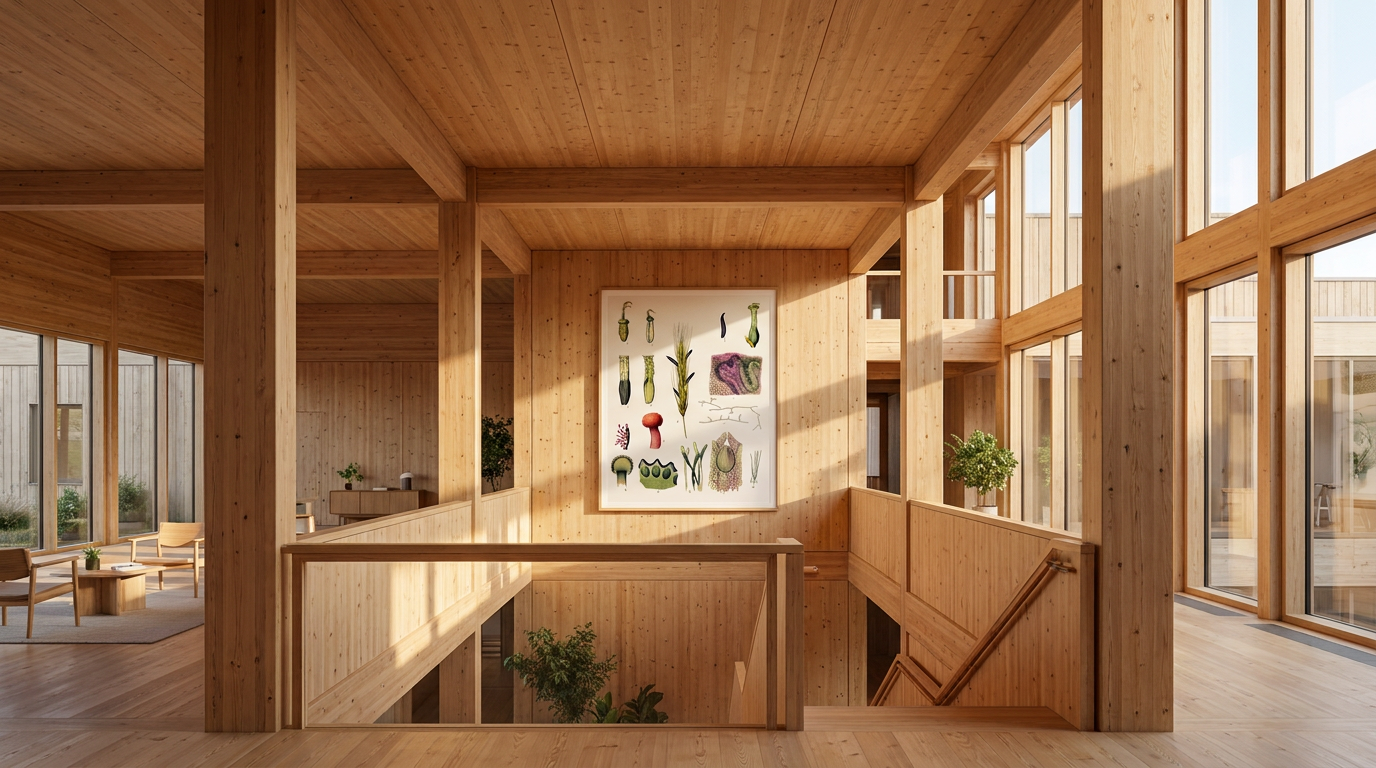
The subsequent 2024 update to the IBC delivered another major victory for architects and developers by expanding design flexibility. A significant change to Type IV-B construction now allows for 100% of mass timber ceilings and integral beams to remain exposed to the interior, a massive increase from the previous 20% limit. This regulatory tweak is crucial because the aesthetic warmth and biophilic appeal of exposed wood—which has been shown to reduce stress and improve occupant well-being—is one of the primary reasons developers choose mass timber in the first place.[1][5]
Beyond carbon and aesthetics, mass timber is fundamentally transforming the logistics of the construction site. Traditional concrete construction is a messy, weather-dependent process that requires building forms, pouring wet concrete, and waiting days for it to cure. Mass timber, by contrast, relies heavily on prefabrication. Long before they reach the site, CLT panels and glulam beams are cut to millimeter precision in a factory using computer numerical control (CNC) machines. Openings for doors, windows, plumbing, and electrical conduits are all pre-routed into the wood.[4]
When these prefabricated components arrive at the construction site, they are hoisted by cranes and bolted together with the precision of flat-pack furniture. This industrialized approach to building drastically accelerates project timelines, with some developers reporting construction speed increases of up to 20%. The process requires smaller labor crews, generates significantly less on-site waste, and dramatically reduces the noise and heavy truck traffic that typically plague urban construction zones.[4]

Despite its rapid ascent, the mass timber industry still faces significant engineering and logistical hurdles. Moisture management is a critical concern; because wood is highly susceptible to water damage and fungal growth, construction teams must meticulously protect the timber from rain and humidity during the assembly process. Additionally, because solid wood panels are rigid and lack the mass of concrete, acoustic detailing requires specialized engineering to prevent sound from easily transmitting between floors and adjacent apartments.[2]
On a macroeconomic scale, the ultimate success of mass timber hinges on the integrity of the forestry supply chain. The environmental premise of building with wood collapses if increased demand leads to the clear-cutting of old-growth forests or illegal logging. To ensure mass timber remains a genuine climate solution, the industry must scale in lockstep with certified sustainable forestry practices, ensuring that every tree harvested is replaced and that forest ecosystems are protected.[2]
As building codes continue to modernize and domestic manufacturing capacity expands, mass timber is poised to move from a niche architectural statement to a mainstream construction standard. It represents a rare alignment of aesthetic beauty, economic efficiency, and environmental necessity. By returning to one of humanity's oldest building materials and engineering it for the demands of the 21st century, the architecture industry is proving that the cities of the future don't have to be built at the expense of the natural world—they can be built in partnership with it.[6]
How we got here
1990s
Cross-Laminated Timber (CLT) technology is initially developed and refined in Europe, primarily in Austria and Germany.
2015
The International Building Code (IBC) first recognizes CLT as a structural building component, opening the door for its use in the United States.
2021
The IBC introduces three new construction types (IV-A, IV-B, IV-C), officially allowing mass timber buildings to reach up to 18 stories.
2022
Ascent, a 25-story mass timber tower in Milwaukee, Wisconsin, is completed, becoming the tallest timber building in the world.
2024
The updated 2024 IBC takes effect, significantly expanding design flexibility by allowing 100% of mass timber ceilings to remain exposed in 12-story buildings.
Viewpoints in depth
Sustainable Architecture Advocates
Focuses on the urgent need to replace carbon-heavy materials with renewable carbon sinks.
This camp views mass timber not just as a building material, but as a critical climate intervention. Because the global built environment generates nearly 40% of annual global CO2 emissions—with concrete and steel production making up a massive share—advocates argue that shifting to timber is one of the few ways to turn buildings from carbon emitters into carbon vaults. They emphasize that as long as the wood is sourced from certified sustainable forests, the architectural shift actively incentivizes responsible forest management.
Fire Safety & Code Officials
Prioritizes rigorous empirical testing and controlled, phased regulatory expansion to ensure public safety.
For regulators and fire safety engineers, the aesthetic and environmental benefits of wood are secondary to life safety. This perspective has historically been skeptical of tall wooden structures, but has been won over by extensive, full-scale burn tests. They focus heavily on the predictable 'char rate' of thick timber and mandate strict encapsulation rules (like covering wood in fire-rated gypsum board) for the tallest structures. Their primary concern moving forward is ensuring that local fire departments are trained on how mass timber behaves differently than traditional light-frame wood during an active blaze.
Construction & Developer Industry
Values the economic efficiencies of prefabrication, faster assembly times, and reduced labor costs.
Developers and general contractors look at mass timber through the lens of project economics and site logistics. While the raw material cost of mass timber can sometimes exceed traditional steel or concrete, this camp highlights the massive savings in labor and time. Because panels are precision-milled in a factory and arrive on-site ready to be bolted together, construction timelines can be slashed by up to 20%. Furthermore, timber components weigh significantly less than concrete, which reduces the need for massive foundational work and lowers heavy machinery costs on site.
What we don't know
- It remains unclear if the global sustainable forestry supply chain can scale rapidly enough to meet surging demand without inadvertently encouraging deforestation.
- Long-term data on the acoustic performance and moisture resilience of mass timber high-rises over multi-decade lifespans is still being gathered.
Key terms
- Mass Timber
- A category of engineered wood products made by binding smaller pieces of wood together to create large, solid structural panels and beams capable of supporting high-rise buildings.
- Cross-Laminated Timber (CLT)
- An engineered wood panel made by gluing layers of lumber together at right angles, providing immense strength and dimensional stability in multiple directions.
- Glued Laminated Timber (Glulam)
- Structural beams and columns created by bonding layers of timber together with the grain all running parallel to the length of the piece.
- Embodied Carbon
- The total greenhouse gas emissions generated by the extraction, manufacturing, transportation, and assembly of a building's materials.
- Char Rate
- The predictable speed at which the outer layer of a thick piece of wood burns and turns to charcoal, which acts as an insulator against further fire damage.
- Biophilic Design
- An architectural approach that seeks to connect building occupants more closely to nature, often by incorporating natural lighting and exposed natural materials like wood.
Frequently asked
Is mass timber safe in a fire?
Yes. Unlike light-frame wood, massive timber panels do not easily ignite. When exposed to fire, the outer layer chars at a predictable rate, creating an insulating barrier that protects the structural integrity of the unburned wood inside.
How tall can a mass timber building be?
Under the 2024 International Building Code, mass timber buildings can reach up to 18 stories (Type IV-A), provided the timber is fully encapsulated in fire-resistant materials like gypsum board.
Does building with wood cause deforestation?
It can, if not managed properly. However, the mass timber industry relies heavily on sustainably managed forests, where harvested trees are continuously replanted. In fact, sustainable harvesting can optimize a forest's ability to sequester carbon.
Is mass timber cheaper than concrete and steel?
The raw materials can sometimes be more expensive, but mass timber often reduces overall project costs by slashing construction time, requiring smaller labor crews, and lowering the weight burden on the building's foundation.
Sources
Source coverage
6 outlets
3 viewpoints surfaced






[1]WoodWorksConstruction & Developer Industry
Mass Timber Explained: Common Products and Code Paths
Read on WoodWorks →[2]American UniversitySustainable Architecture Advocates
Fact Sheet: Mass Timber Construction and Carbon Removal
Read on American University →[3]TimberlabFire Safety & Code Officials
Fire Testing and Mass Timber Resiliency
Read on Timberlab →[4]Built Environment NetworkSustainable Architecture Advocates
100 Projects UK CLT: Sustainability and Efficiency
Read on Built Environment Network →[5]International Code CouncilFire Safety & Code Officials
Mass Timber and the 2024 IBC: Heights, Areas, and Fire Safety
Read on International Code Council →[6]Factlen Editorial TeamConstruction & Developer Industry
Synthesis by Factlen editorial team
Read on Factlen Editorial Team →
Every angle. Every day.
Get home stories with full source coverage and perspective breakdowns delivered to your inbox.