
OLED vs. Mini-LED in 2026: The Ultimate Display Technology Comparison
The premium display market has fractured into two distinct tracks, forcing buyers to choose between the perfect contrast of OLED and the explosive brightness of Mini-LED.
By Factlen Editorial Team
- Cinematic Purists
- Advocates who prioritize absolute picture accuracy, perfect blacks, and infinite contrast.
- Bright-Room Pragmatists
- Users who value sustained brightness, daylight visibility, and durability for mixed usage.
- Value-Conscious Upgraders
- Shoppers focused on maximizing screen real estate and performance-per-dollar.
What's not represented
- · Micro-LED Early Adopters
- · Budget LCD Shoppers
Why this matters
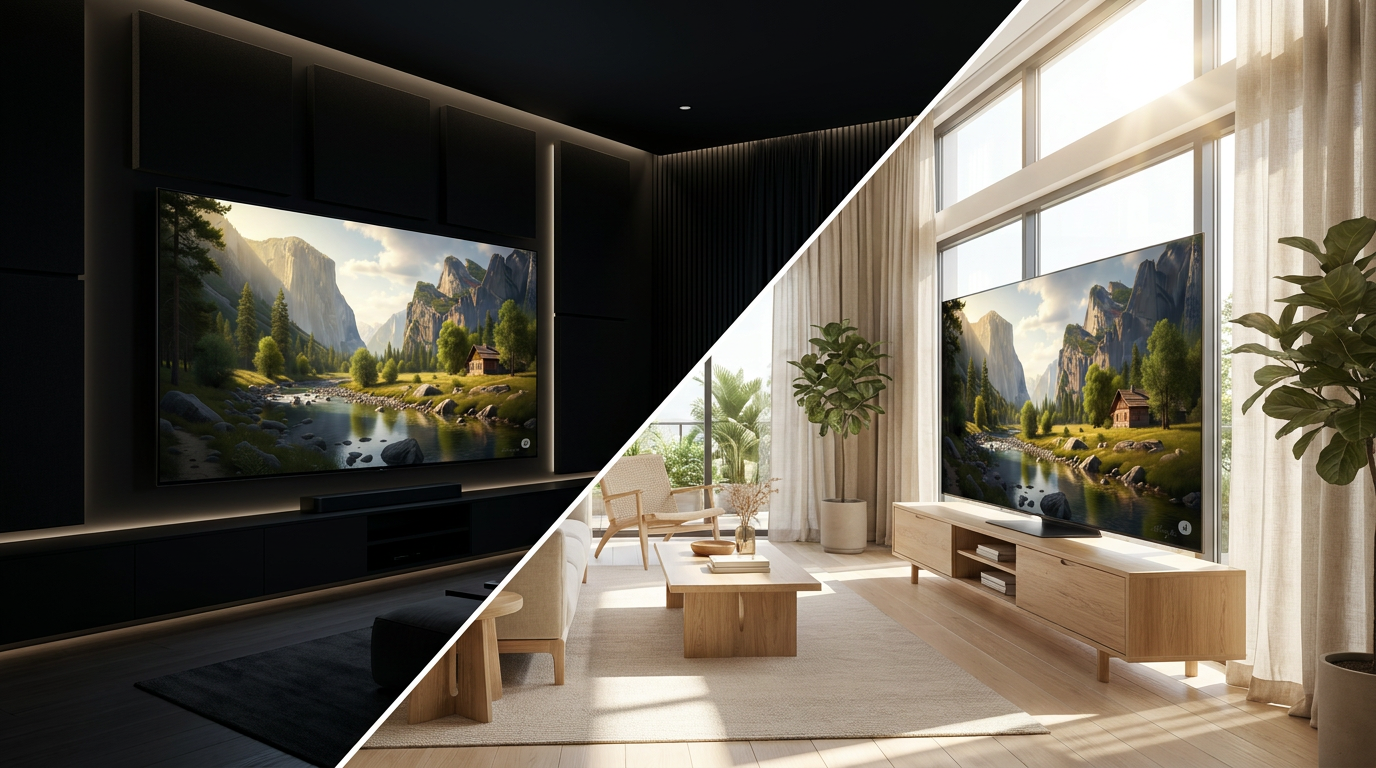
Choosing the wrong display technology can result in thousands of dollars spent on a screen that either washes out in your bright living room or suffers from distracting halos in your dark home theater. Understanding the specific trade-offs between OLED and Mini-LED ensures you match the panel's physics to your actual viewing habits.
Key points
- OLED technology delivers perfect black levels and infinite contrast by turning off individual pixels.
- Mini-LED utilizes thousands of backlight dimming zones to achieve explosive peak brightness.
- OLED is the superior choice for dark-room cinematic viewing and competitive gaming.
- Mini-LED excels in sun-drenched living rooms and offers immunity to static UI burn-in.
- The ultra-large screen market (85 inches and above) is dominated by the cost efficiency of Mini-LED.
In 2026, the premium display market has fractured into two distinct tracks, forcing consumers to choose between two fundamentally different technologies: OLED and Mini-LED. Gone are the days when a single television or monitor could be crowned the undisputed champion for every living room. Instead, buyers are faced with a high-stakes trade-off between infinite contrast and explosive brightness. As manufacturers push both technologies to their physical limits, the decision no longer hinges on which panel is objectively better, but rather which set of compromises best fits the specific lighting conditions and viewing habits of the user.[1][2]
The core divergence lies in how these panels generate light. OLED, or Organic Light-Emitting Diode, operates without a backlight. Every single pixel on a 4K OLED display—all 8.2 million of them—produces its own light and can turn off completely independently. Mini-LED, conversely, is a highly advanced evolution of traditional LCD technology. It utilizes a backlight composed of thousands of microscopic light-emitting diodes grouped into dimming zones. While a traditional LED TV might have a few dozen zones, modern Mini-LED displays boast anywhere from one thousand to over forty thousand distinct zones that brighten or darken to control the image displayed on the LCD layer above them.[1][6]
The argument for OLED is built entirely on its unmatched contrast and pixel-level precision. Because each pixel can shut off completely, the technology achieves a true zero-nit black level, resulting in mathematically infinite contrast. The evidence for this superiority is most visible in dark-room viewing; reviewers consistently note that OLED eliminates the halo effect entirely. When a bright starship glides across a pitch-black galaxy, the space around the ship remains completely devoid of light, creating a three-dimensional depth that backlit panels fundamentally struggle to replicate.[1][3][5]

Beyond perfect blacks, the case for OLED is bolstered by its color purity and flawless viewing angles. Because the light is generated at the very surface of the pixel without passing through complex LCD filtering layers, the image does not wash out when viewed from an off-axis angle. The evidence is clear in side-by-side testing: OLED maintains its color saturation and contrast perfectly, regardless of where the viewer is sitting. This makes it highly practical for wide seating arrangements where guests are spread across a large sectional sofa.[2][5]
Conversely, the argument against OLED centers on its physical brightness limitations and the risk of organic degradation. The primary evidence against the technology is its Auto Brightness Limiter (ABL). To prevent the panel from overheating, the ABL aggressively dims the screen during full-screen bright scenes. While an OLED might hit impressive peak brightness in a tiny one-percent window, a bright hockey rink or a daytime sky often forces the panel to drop its luminance to between 200 and 300 nits, which can look dull in a sunlit room.[1][7]
The conversation around OLED longevity inevitably turns to burn-in—the permanent retention of static images on the screen. While 2026 models feature robust mitigation tools, including advanced heat sinks and invisible pixel-shifting algorithms, the underlying organic chemistry still degrades over time. The evidence from long-term stress tests shows that for users who treat their display as a dedicated PC monitor with persistent taskbars, or who leave the same cable news network running for eight hours a day, the risk of permanent image retention remains a tangible drawback.[1][7]
The conversation around OLED longevity inevitably turns to burn-in—the permanent retention of static images on the screen.
On the other side of the aisle, the argument for Mini-LED is built on raw, unadulterated luminance and daylight resilience. High-end Mini-LED panels in 2026 routinely push past 2,000 nits of sustained brightness, with flagship models eclipsing 4,000 nits. The evidence for this advantage is immediate in any sun-drenched living room: Mini-LED can punch through heavy afternoon glare without breaking a sweat. Because the backlight relies on inorganic LEDs, the technology is entirely immune to burn-in, offering total peace of mind for productivity workflows and static user interfaces.[2][4][6]

Mini-LED also flexes its muscles in a metric known as color volume—the ability to display saturated colors at extremely high brightness levels. When an OLED panel attempts to display a vivid daytime sky, its white subpixel often takes over, which can slightly wash out the color intensity. The evidence shows that Mini-LED displays, particularly those equipped with Quantum Dot enhancement layers, can maintain rich, deeply saturated reds and greens even when pushing past 1,500 nits. This results in HDR content that feels tangibly more vibrant and lifelike in well-lit environments.[3][5]
The primary argument against Mini-LED is the persistence of blooming, an unavoidable byproduct of its zone-based architecture. Even with tens of thousands of dimming zones, a single zone is still larger than an individual pixel. The evidence is visible when a bright object, such as white subtitle text, appears against a black background; the backlight must illuminate an area slightly larger than the text itself. This causes light to spill into the surrounding dark pixels, creating a visible halo that can break the immersion of moody, high-contrast cinematic scenes in pitch-black rooms.[1][3]
For gamers, the trade-off analysis becomes highly specific to the genre being played. The case for OLED in gaming rests on its near-instantaneous pixel response time, which virtually eliminates motion blur and ghosting during fast-paced competitive action. However, the evidence supporting Mini-LED for gaming highlights its ability to sustain blindingly bright HDR highlights—like staring directly into a virtual sun in an open-world RPG—without aggressively dimming the rest of the screen, providing a visceral impact that OLED currently cannot match.[1][3][6]
The financial dynamics of the 2026 market also heavily influence the decision, particularly for buyers chasing cinematic scale. Manufacturing massive OLED panels remains an incredibly expensive endeavor, with prices scaling exponentially once the screen size exceeds 77 inches. The evidence in retail pricing shows that Mini-LED, leveraging mature LCD manufacturing infrastructure, has democratized the ultra-large screen segment. Buyers looking to fill a massive wall can secure an 85-inch, 98-inch, or even 115-inch Mini-LED display for a fraction of the cost of a comparable OLED.[3][4]

Ultimately, OLED fits exceptionally well when the viewing environment is light-controlled, such as a dedicated home theater or a basement gaming setup. It is the definitive choice for cinephiles who prioritize shadow detail, infinite contrast, and perfect viewing angles from any seat in the room. Conversely, OLED does not fit well when the display will be placed opposite massive, unshaded windows, or when the primary use case involves leaving static broadcast news networks or PC taskbars on the screen all day, where dimming and burn-in anxiety introduce unnecessary friction.[1][2][7]
Mini-LED fits perfectly when the television serves as the centerpiece of a bright, open-concept living room, where its sheer light output can overcome afternoon glare. It is also the superior choice for hybrid workers using the display as a massive productivity monitor, as the immunity to burn-in allows for stress-free multitasking. However, Mini-LED does not fit well for users who exclusively watch movies in total darkness and are highly sensitive to blooming around letterbox bars, as the backlight zones will inevitably reveal themselves.[4][6][7]
By treating the purchase as a matching exercise between the room's lighting and the panel's physics, buyers can confidently navigate the 2026 display market without buyer's remorse. There is no single winner that conquers every scenario. Instead, the industry has successfully engineered two distinct, highly capable technologies that cater to entirely different environments, ensuring that whether you are building a pitch-black cinema or outfitting a sunlit family room, a flawless viewing experience is well within reach.[1][4]
How we got here
2013
The first consumer OLED televisions hit the market, introducing perfect black levels but struggling with low brightness.
2019
Mini-LED technology emerges as a premium alternative, drastically increasing the number of dimming zones over traditional LCDs.
2022
Quantum Dot OLED (QD-OLED) is introduced, improving OLED color brightness and narrowing the gap with backlit displays.
2024
Mini-LED zone counts explode past 10,000 on flagship models, significantly reducing the halo effect.
2026
The market firmly bifurcates, with OLED dominating dark-room performance and Mini-LED ruling bright rooms and ultra-large sizes.
Viewpoints in depth
Cinematic Purists
Advocates who prioritize absolute picture accuracy, perfect blacks, and infinite contrast.
For home theater enthusiasts and professional colorists, the conversation begins and ends with OLED. This camp argues that the foundation of a perfect image is the black level; if the blacks are elevated or polluted by blooming, the entire color palette suffers. They point to the pixel-level precision of OLED as the only way to faithfully reproduce the creator's intent, arguing that the blinding peak brightness of Mini-LED is often unnatural and unnecessary in a properly light-controlled viewing environment.
Bright-Room Pragmatists
Users who value sustained brightness, daylight visibility, and durability for mixed usage.
This perspective argues that perfect black levels are irrelevant if the screen is washed out by afternoon sunlight. Bright-room pragmatists prioritize the sheer luminance of Mini-LED, which can punch through glare and deliver vibrant HDR impact regardless of the ambient lighting. Furthermore, they heavily weight the peace of mind that comes with zero burn-in risk, arguing that a premium display should handle static news tickers, sports scores, and PC taskbars without requiring the user to constantly babysit the panel.
Value-Conscious Upgraders
Shoppers focused on maximizing screen real estate and performance-per-dollar.
For this camp, the ultimate luxury is size. They argue that the immersive impact of a 98-inch or 115-inch screen far outweighs the microscopic contrast advantages of an OLED. Because Mini-LED leverages highly efficient LCD manufacturing processes, it allows consumers to purchase massive, theater-scale displays at prices that would be impossible for OLED technology. They view Mini-LED as the ultimate democratization of the premium large-screen market.
What we don't know
- Whether emerging Micro-LED technology will eventually combine the benefits of both panels at a consumer-friendly price.
- How long the latest generation of OLED heat-sinks will truly delay burn-in over a decade of heavy use.
- If future Mini-LED algorithms can completely eliminate blooming without crushing shadow detail.
Key terms
- OLED
- Organic Light-Emitting Diode, a display technology where each individual pixel generates its own light and can turn off completely.
- Mini-LED
- An advanced backlight technology that uses thousands of microscopic LEDs grouped into zones to illuminate an LCD panel.
- Local Dimming
- The ability of a display to dim specific zones of its backlight to improve contrast and deepen black levels.
- Blooming
- A visual artifact where light spills from a bright object into surrounding dark areas, commonly seen on backlit displays.
- ABL (Auto Brightness Limiter)
- A safety feature in OLED displays that automatically dims the screen when a large portion of the image becomes too bright, preventing overheating.
- Nits
- A unit of measurement for display brightness; the higher the number, the brighter the screen.
Frequently asked
Is Mini-LED completely immune to burn-in?
Yes. Because Mini-LED uses inorganic light-emitting diodes rather than organic compounds, it does not suffer from the permanent image retention risks associated with OLED panels.
Does OLED still have a problem with bright rooms?
While newer OLEDs are significantly brighter than older models, they still aggressively dim full-screen bright scenes to prevent overheating, making them less ideal for sun-drenched rooms.
What is the halo effect or blooming?
Blooming occurs on Mini-LEDs when the backlight zone illuminating a bright object spills light into the surrounding dark pixels, creating a faint glow around things like white subtitles.
Which technology is better for a PC monitor?
Mini-LED is generally safer for heavy productivity due to its immunity to static UI burn-in, though OLED is preferred for gaming and color-critical dark-room editing.
Sources
Source coverage
7 outlets
3 viewpoints surfaced







[1]RTINGSCinematic Purists
OLED vs Mini LED: Which TV is better?
Read on RTINGS →[2]Tom's GuideBright-Room Pragmatists
OLED vs Mini-LED: What's the difference?
Read on Tom's Guide →[3]What Hi-Fi?Cinematic Purists
Mini LED vs OLED: which TV screen technology is better?
Read on What Hi-Fi? →[4]CNETBright-Room Pragmatists
OLED vs Mini-LED in 2026: The Ultimate Display Showdown
Read on CNET →[5]PCWorldValue-Conscious Upgraders
The current OLED vs. Mini-LED battle is give-and-take
Read on PCWorld →[6]AsusValue-Conscious Upgraders
Mini LED vs OLED: Which is Better for You?
Read on Asus →[7]KTCPlayBright-Room Pragmatists
Workflow Friction Comparison: OLED vs Mini-LED
Read on KTCPlay →
More in shopping
See all 5 stories →


Every angle. Every day.
Get shopping stories with full source coverage and perspective breakdowns delivered to your inbox.