
The Science of Aquafaba: How Chickpea Water Revolutionized Egg-Free Cooking
Discovered just a decade ago, the starchy liquid leftover from cooked chickpeas has transformed plant-based baking by perfectly mimicking the foaming and binding properties of egg whites.
By Factlen Editorial Team
- Plant-Based Chefs
- Chefs who view aquafaba as a revolutionary tool for vegan gastronomy.
- Food Scientists
- Researchers focused on the biochemical properties and industrial applications of legume water.
- Zero-Waste Advocates
- Sustainability advocates who champion aquafaba as a prime example of upcycling.
What's not represented
- · Commercial Egg Producers
- · Industrial Food Manufacturers
Why this matters
For decades, home cooks and those with egg allergies struggled to replicate the delicate, airy textures of meringues and mousses. Understanding the chemistry of aquafaba unlocks an accessible, zero-waste ingredient that perfectly mimics egg whites, making advanced baking possible for everyone.
Key points
- Aquafaba is the starchy, protein-rich liquid left over after boiling legumes like chickpeas.
- The liquid contains saponins, which act as natural surfactants to trap air when whipped.
- Three tablespoons of aquafaba can functionally replace one whole egg in most baking recipes.
- Unlike egg whites, aquafaba contains very little protein and cannot coagulate under heat.
- The ingredient provides a safe, accessible alternative for vegans and individuals with egg allergies.
For generations, home cooks and professional chefs alike have routinely poured the cloudy, viscous liquid from canned chickpeas down the drain, dismissing it as a useless byproduct of the canning process. Yet this humble brine, now universally known as aquafaba, has revolutionized plant-based cooking and allergy-friendly baking over the last decade. By providing a perfect, whole-food substitute for egg whites, it has unlocked a realm of delicate pastries and aerated desserts that were previously impossible to create without animal products. The transformation of this discarded liquid into a highly prized culinary ingredient represents one of the most significant modern breakthroughs in both home cooking and practical food science.[6]
Before this discovery, the culinary world struggled immensely to replicate the delicate, airy architecture of whipped egg whites. Traditional vegan egg substitutes—such as mashed bananas, applesauce, or ground flaxseed mixed with water—are inherently dense and heavy. While these traditional alternatives work adequately as moisture-retaining binders for dense muffins, pancakes, or quick breads, they fundamentally fail at trapping air. Delicate desserts like macarons, marshmallows, lemon meringue pie, and light mousses remained largely off-limits to those avoiding eggs. Bakers were forced to rely on expensive, highly processed commercial egg replacers that often yielded inconsistent textures and left undesirable chemical aftertastes in delicate pastries.[5]
The breakthrough that changed plant-based baking occurred in December 2014, when French musician and culinary experimenter Joël Roessel noticed a peculiar property of canned bean water. During his kitchen experiments, Roessel observed that the liquid could form stable foams remarkably similar to isolated protein powders. Recognizing the potential of this discovery, Roessel shared his experiments on a dedicated blog, demonstrating the liquid's foaming capabilities by successfully creating a vegan chocolate mousse and a classic French floating island dessert. While his initial recipes still required the addition of starches and gums to stabilize the foam, his observation laid the critical groundwork for the aquafaba revolution.[1]
A few months later, software engineer and vegan food enthusiast Goose Wohlt built upon Roessel's foundational experiments. Wohlt made the crucial discovery that the cooking liquid could replace egg whites entirely on its own, without the need for any additional chemical stabilizers or gums. He successfully baked a perfect, two-ingredient egg-free meringue using nothing but chickpea liquid and sugar. Wohlt coined the term "aquafaba"—combining the Latin words aqua (water) and faba (bean)—and shared his findings online. Shortly after, a dedicated Facebook group was formed, sparking a viral, crowdsourced movement where thousands of home cooks began testing and perfecting aquafaba recipes across the globe.[1]

The secret to aquafaba's remarkable success lies in the complex chemistry that occurs during the prolonged boiling process of legumes. When chickpeas or white beans are cooked, a specific mixture of water-soluble compounds leaches from the solid seeds into the surrounding water, transforming it from a simple cooking liquid into a highly functional biochemical matrix. This unique composition includes proteins (primarily albumins and globulins), complex carbohydrates (such as starches and soluble fiber), and naturally occurring plant chemicals called saponins. Together, these leached elements perfectly mimic the physical properties of egg whites when subjected to mechanical aeration.[2]
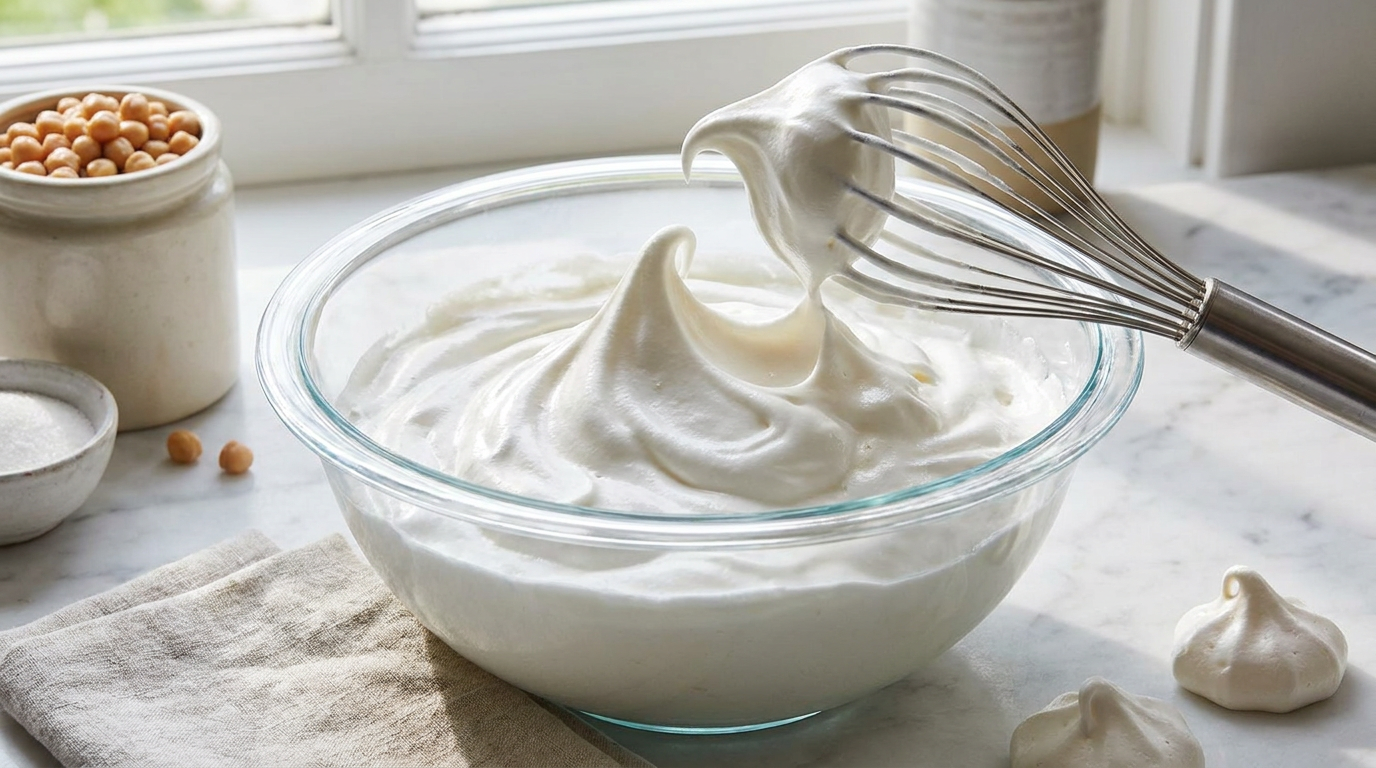
Within this chemical matrix, saponins act as powerful natural surfactants. Much like household soap, these compounds reduce the surface tension of the water they are dissolved in. When mechanical force is applied to the liquid via a hand whisk or an electric stand mixer, these saponins allow the water to easily trap and hold onto microscopic air bubbles, creating a voluminous, expanding foam. Without these surfactants, the water would simply splash around the bowl; with them, the liquid rapidly transforms into a thick, white cloud that looks entirely indistinguishable from softly whipped egg whites.[2]
Within this chemical matrix, saponins act as powerful natural surfactants.
However, trapping air is only half the battle; the foam must also remain stable enough to be baked. This is where the leached starches and proteins come into play, providing the necessary structural integrity. As the whisk continuously beats air into the aquafaba, the proteins unfold and bond together, while the starches gelatinize slightly. This creates a stable, microscopic network that reinforces the walls of the air bubbles, preventing them from collapsing under their own weight. This structural reinforcement allows the whipped aquafaba to hold stiff peaks, enabling bakers to pipe it into intricate shapes for macarons or meringue kisses.[2]
Despite these striking functional similarities, aquafaba is nutritionally distinct from the poultry eggs it replaces. It is exceptionally low in calories and contains only about ten percent of the protein found in egg whites by weight. While a standard egg white contains roughly three to four grams of protein, a functionally equivalent serving of aquafaba contains only a fraction of a gram. Because it is essentially just starchy water, it does not offer the nutritional density, fat, or protein profile that whole eggs provide to a daily diet, making it a functional culinary tool rather than a nutritional supplement.[1][3]

Interestingly, this exceptionally low protein content makes aquafaba uniquely safe and beneficial for individuals with phenylketonuria (PKU). PKU is a rare genetic disorder that prevents the body from properly metabolizing phenylalanine, an amino acid found in all protein-rich foods. For individuals managing this strict medical diet, traditional eggs are entirely off-limits due to their high protein load. Aquafaba provides a revolutionary way for these individuals to enjoy traditionally egg-heavy textures—like fluffy cakes, meringues, and mousses—without risking the dangerous neurological consequences associated with consuming excess protein.[1][3]
Conversely, this lack of protein also dictates the ingredient's strict culinary limitations. Because aquafaba does not contain enough protein to denature and coagulate under heat, it cannot provide the rigid, standalone structure required for certain dishes. While an egg will solidify into a firm mass when fried or scrambled, aquafaba will simply evaporate or melt back into a liquid. Therefore, it cannot be used to make omelets, quiches, frittatas, or traditional angel food cake, which relies entirely on the coagulation of dense egg proteins to maintain its towering structure in the oven.[1]
For home cooks utilizing the ingredient in appropriate baking applications, the standard conversion ratio is remarkably straightforward and easy to memorize. Three tablespoons (approximately 45 milliliters) of aquafaba effectively replace one whole egg, while two tablespoons (approximately 30 milliliters) replace a single egg white. When adapting traditional recipes, bakers simply measure out the required volume of liquid and proceed with the recipe exactly as written, whipping the aquafaba just as they would an egg white until the desired soft or stiff peaks are achieved.[3][4]
Beyond the realm of baking, the liquid excels in savory recipes and beverages requiring emulsification. Because it contains both water-loving and fat-loving compounds, it serves as an excellent stabilizing base for rich, egg-free mayonnaise and garlic aioli, seamlessly binding oil and water together. Furthermore, it is increasingly utilized by professional bartenders to create the signature frothy head on classic cocktails like the whiskey sour or amaretto sour, providing a food-safe, vegan alternative to raw egg whites that carries zero risk of salmonella transmission.[1][3]

While aquafaba can be produced from scratch by slowly boiling dried chickpeas at home, the liquid drained directly from canned beans offers the most reliable and immediate consistency. If homemade aquafaba is too thin and watery, culinary experts recommend simmering it gently on the stove to evaporate the excess water. The liquid should be reduced until it achieves the slightly slimy, viscous texture of a raw egg white. Once cooled, this concentrated liquid will whip up just as effectively as the canned variety, allowing cooks to minimize waste while preparing dried legumes.[4][5]
What began as an experimental post on a niche culinary blog has rapidly evolved into a foundational staple of modern food science and plant-based gastronomy. By transforming a universally discarded waste product into a highly functional, versatile ingredient, aquafaba has permanently expanded the boundaries of accessible cooking. It stands as a testament to the power of upcycling and open-source culinary innovation, proving that sometimes the most revolutionary ingredients are already sitting in our pantries, waiting to be discovered.[6]
How we got here
Dec 2014
French musician Joël Roessel discovers that canned bean water can form foams and publishes his findings on a blog.
Mar 2015
Software engineer Goose Wohlt successfully bakes an egg-free meringue using the liquid, coining the term 'aquafaba'.
Late 2015
A dedicated Facebook group forms, rapidly popularizing the ingredient and crowdsourcing new recipes worldwide.
2016-Present
Aquafaba enters mainstream culinary science, appearing in commercial vegan products like mayonnaise and baked goods.
Viewpoints in depth
Plant-Based Chefs
Chefs who view aquafaba as a revolutionary tool for vegan gastronomy.
For plant-based culinary professionals, aquafaba represents the missing link in vegan baking. Prior to its discovery, creating airy, structured desserts like macarons, lemon meringue pie, or chocolate mousse without animal products required complex, expensive, and often unreliable commercial chemical replacers. Aquafaba democratized these techniques, offering a cheap, accessible, and whole-food solution that behaves almost identically to egg whites in aerated applications.
Food Scientists
Researchers focused on the biochemical properties and industrial applications of legume water.
Food scientists are primarily interested in the precise mechanisms that give aquafaba its unique properties. They focus on the synergistic relationship between the saponins, which act as foaming agents, and the leached starches and proteins that stabilize the emulsion. Researchers are currently exploring how to optimize the boiling process to extract maximum functional compounds, viewing aquafaba not just as a home-kitchen hack, but as a potential scalable, sustainable emulsifier for the commercial packaged food industry.
Zero-Waste Advocates
Sustainability advocates who champion aquafaba as a prime example of upcycling.
From a sustainability perspective, aquafaba is celebrated as a triumph of zero-waste cooking. Millions of gallons of chickpea brine are poured down residential and commercial drains every year. Zero-waste advocates highlight aquafaba as a perfect example of how rethinking food waste can yield highly valuable culinary resources, reducing the overall environmental footprint of our food systems by extracting maximum utility from a single crop.
What we don't know
- Food scientists are still studying the exact molecular interactions between aquafaba's starches and proteins that create such stable foams.
- It remains unclear how to perfectly standardize the concentration of canned aquafaba across different commercial bean brands.
- Researchers are exploring whether the liquid from other lesser-known legumes could yield even better emulsifying properties than chickpeas.
Key terms
- Aquafaba
- The viscous water in which legume seeds, most commonly chickpeas, have been cooked, used as an egg replacement.
- Saponins
- Naturally occurring plant chemicals that act as surfactants, allowing liquids to foam and trap air when whipped.
- Surfactant
- A substance that reduces the surface tension of a liquid, helping it to emulsify or hold onto air bubbles.
- Emulsification
- The process of forcing two immiscible liquids, such as oil and water, to combine into a stable, uniform mixture.
- Denature
- The process in which proteins lose their natural structure when exposed to heat or acid, causing them to coagulate or set.
Frequently asked
Can I use the water from beans other than chickpeas?
Yes. While chickpea water is the most popular due to its neutral flavor and light color, the liquid from white beans (like navy or cannellini beans) works exceptionally well and is nearly identical in function.
Does aquafaba make baked goods taste like beans?
No. While raw aquafaba has a mild bean aroma, the scent and flavor completely dissipate during the baking or cooking process, leaving no savory taste in sweet desserts.
How long does aquafaba last in the fridge?
Stored in an airtight container, aquafaba will last in the refrigerator for up to a week. It can also be frozen in ice cube trays for several months without losing its foaming properties.
Do I need a stand mixer to whip aquafaba?
While it is possible to whip it by hand, it is highly discouraged. Aquafaba takes significantly longer to reach stiff peaks than egg whites—often requiring 5 to 10 minutes of continuous high-speed whipping with a hand or stand mixer.
Sources
Source coverage
6 outlets
3 viewpoints surfaced






[1]WikipediaZero-Waste Advocates
Aquafaba
Read on Wikipedia →[2]ResearchGateFood Scientists
Aquafaba as an egg white substitute in food foams and emulsions
Read on ResearchGate →[3]HealthlineFood Scientists
Aquafaba: An Egg and Dairy Substitute Worth Trying?
Read on Healthline →[4]The Vegan SocietyPlant-Based Chefs
Aquafaba – what it is, how to use it and some great recipes!
Read on The Vegan Society →[5]Allina HealthFood Scientists
Aquafaba: The new vegan substitute for eggs
Read on Allina Health →[6]Factlen Editorial TeamZero-Waste Advocates
Synthesis by Factlen editorial team
Read on Factlen Editorial Team →
Every angle. Every day.
Get food drink stories with full source coverage and perspective breakdowns delivered to your inbox.