
How 'Sponge Cities' Are Using Nature to Solve Urban Flooding
Faced with escalating climate threats, cities worldwide are abandoning traditional concrete drainage in favor of nature-based infrastructure that absorbs and stores heavy rainfall.
By Factlen Editorial Team
- Urban Ecologists & Planners
- Advocate for nature-based solutions, emphasizing the environmental co-benefits like biodiversity, water purification, and heat reduction.
- Civil & Structural Engineers
- Support green infrastructure but stress the necessity of hybrid systems, warning that nature alone cannot handle extreme, once-in-a-century deluges.
- Municipal Policymakers
- Focus on the economic viability, funding mechanisms, and logistical hurdles of retrofitting dense urban environments.
What's not represented
- · Real estate developers facing new zoning mandates
- · Residents in historically flood-prone low-income neighborhoods
Why this matters
As climate change accelerates the frequency of extreme downpours, traditional urban drainage systems are failing, leading to catastrophic property damage and loss of life. The transition to nature-based infrastructure offers a proven, cost-effective blueprint for making our cities resilient, livable, and safe.
Key points
- Sponge cities use nature-based solutions like wetlands and permeable pavements to absorb rainwater instead of funneling it into overwhelmed sewers.
- The concept was pioneered in China, which aims to retrofit 80% of its urban areas to absorb 70% of stormwater by 2030.
- Beyond flood prevention, green infrastructure filters pollutants, cools urban heat islands, and boosts biodiversity.
- Nature-based climate adaptations are estimated to be 50% more cost-effective than traditional concrete infrastructure.
- Experts advocate for a hybrid approach, combining natural sponges with traditional tunnels to handle extreme, once-in-a-century storms.
For over a century, modern urban planning has treated rainwater as an enemy to be banished. As cities expanded, they paved over natural landscapes with impermeable asphalt and concrete, relying on a vast, hidden network of pipes and pumps to whisk water away as quickly as possible. But as climate change accelerates, bringing heavier and more frequent torrential downpours, this "gray infrastructure" is failing. Drainage systems are routinely overwhelmed, leading to catastrophic flash floods that paralyze transit, destroy property, and cost lives. In response, a radical paradigm shift is taking hold in urban design: instead of fighting water, cities are learning to absorb it.[1][5][7]
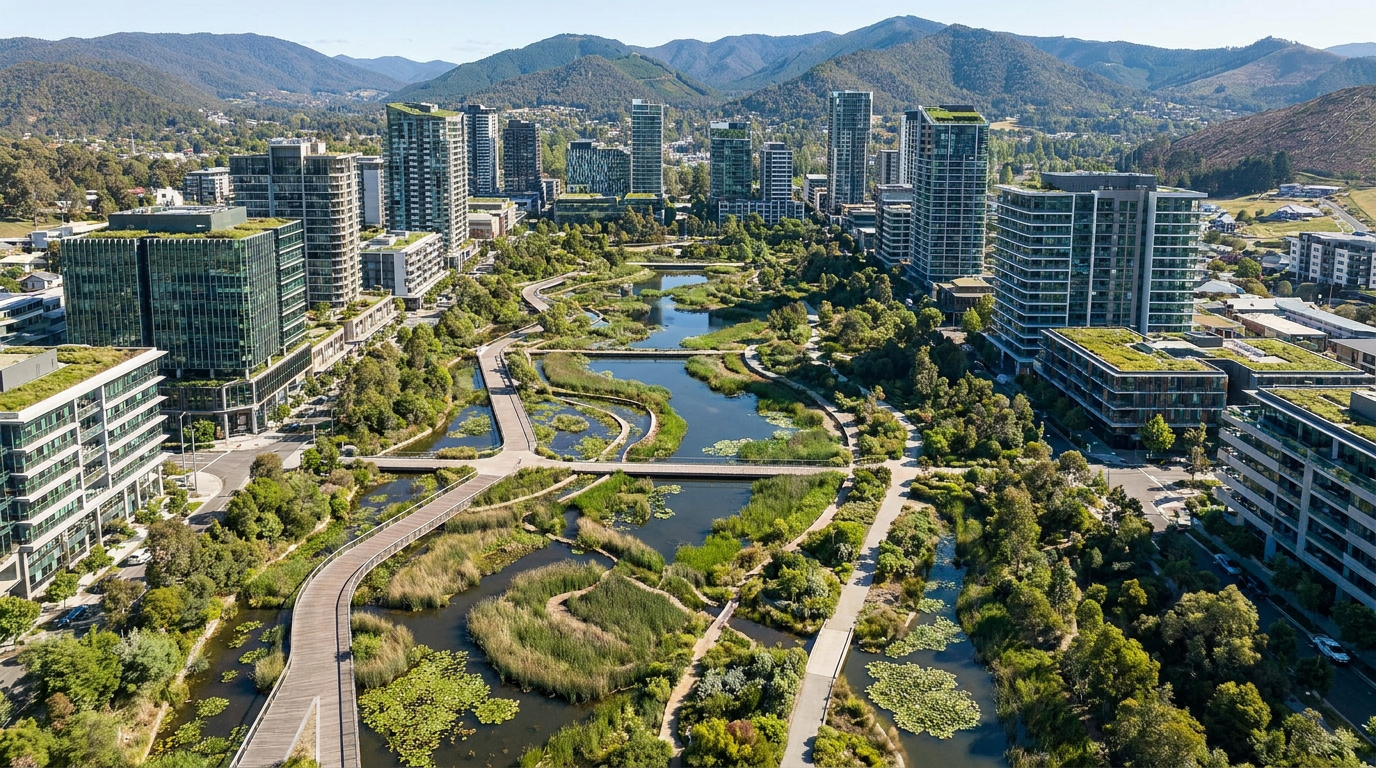
The concept, widely known as the "sponge city," represents a fundamental rethinking of urban hydrology. First popularized in the early 2000s by Chinese landscape architect Kongjian Yu, the model abandons the futile attempt to channel water away through concrete conduits. Instead, it uses nature-based solutions to mimic the natural water cycle. By integrating green and blue infrastructure—such as wetlands, rain gardens, and permeable pavements—a sponge city captures, stores, and slowly releases stormwater back into the environment.[1][4]
The urgency of the climate crisis has propelled the sponge city from a niche architectural theory into massive national policy. In 2014, facing severe urban flooding and simultaneous water scarcity, the Chinese government launched the world's most ambitious sponge city initiative. The mandate set a staggering goal: by 2030, 80 percent of China's urban areas must be equipped to absorb and reuse at least 70 percent of their stormwater runoff. Dozens of pilot cities, including Shenzhen and Wuhan, were selected to test these nature-based interventions on a metropolitan scale.[2][3]
At the core of the sponge city mechanism is the unsealing of the urban surface. Traditional city streets and sidewalks are entirely impervious, turning even moderate rainfall into rapid surface runoff. Sponge cities replace these hardscapes with permeable pavements made of porous asphalt, pervious concrete, or interlocking pavers. These materials allow water to filter directly through the surface into an underlying stone reservoir base, where it temporarily pools before slowly percolating into the subsoil, effectively stopping floods before they can form.[3][5]

Beyond permeable streets, sponge cities rely on dedicated retention zones to handle larger volumes of water. Urban parks are redesigned not just for recreation, but as active hydrological tools. Sunken parks, bioswales, and constructed wetlands act as massive natural basins. During heavy storms, these areas are designed to safely flood, holding millions of gallons of excess water. Once the storm passes, the retained water slowly drains into the earth, replenishing depleted groundwater aquifers rather than overwhelming municipal sewer systems.[4][5]
The sponginess of a city extends upward as well. In densely packed urban cores where ground space is at a premium, green roofs have become a vital component of the strategy. Buildings are topped with specialized vegetation and integrated retention systems that capture rain before it ever hits the street. For example, the AERA office building in Berlin features a publicly accessible roof garden with dozens of plant species that store water for dry periods, significantly reducing the building's runoff contribution during sudden cloudbursts.[5][6]
Empirical data from early adopters suggests these interventions are highly effective. Field studies in China's pilot districts have demonstrated that sponge city infrastructure can reduce peak rainfall runoff by roughly 20 to 28 percent during standard storm events. By slowing the velocity of the water and reducing the total volume hitting the drainage network at any one time, cities can dramatically lower the peak flood levels that typically cause the most severe infrastructural damage.[3][7]
Empirical data from early adopters suggests these interventions are highly effective.
The model is not limited to Asia; European cities are aggressively adopting similar strategies following their own climate wake-up calls. In 2011, a once-in-a-millennium storm deluged Copenhagen, Denmark, causing nearly $2 billion in damages in just two hours. In response, the city launched a comprehensive "Cloudburst Management Plan." Copenhagen transformed public squares into permeable retention basins and redesigned parks to hold floodwater, proving that historic European capitals can successfully retrofit their rigid layouts for climate resilience.[1]

While some cities must engineer their sponginess from scratch, others benefit from natural geography. A recent analysis by the engineering firm Arup assessed the "sponginess" of major global cities, looking at the ratio of green and blue spaces to hard, gray infrastructure. Auckland, New Zealand, topped the index with a 35 percent sponginess rating. Thanks to its abundant parks, natural waterways, and permeable soil types, the city possesses a high baseline capacity to absorb heavy rainfall, offering a blueprint for how new urban developments should be zoned.[1][4]
The advantages of sponge cities extend far beyond flood mitigation, offering a suite of environmental co-benefits. One of the most significant is water purification. In traditional systems, stormwater washes oil, heavy metals, and trash from city streets directly into local rivers. In a sponge city, rainwater is filtered through the root systems of plants and layers of soil within bioswales and rain gardens. This natural biofiltration process strips out pollutants, drastically improving the water quality of the surrounding ecosystem.[4][5]
Furthermore, the proliferation of green infrastructure provides a powerful countermeasure to the urban heat island effect. Concrete and asphalt absorb and radiate solar radiation, making cities significantly hotter than surrounding rural areas. By replacing these surfaces with vegetation and water features, sponge cities naturally cool the ambient air through evapotranspiration. These lush, green corridors also provide crucial habitats for urban wildlife and create accessible recreational spaces that have been shown to improve the mental and physical well-being of residents.[2][5]

From a financial perspective, the transition to nature-based solutions is proving to be highly pragmatic. According to the World Economic Forum, nature-based climate adaptations are, on average, 50 percent more cost-effective than purely engineered alternatives. They also deliver an estimated 28 percent more added value when factoring in the economic benefits of improved public health, increased property values near green spaces, and the reduction in energy costs associated with natural cooling.[1][2]
Despite their immense promise, urban ecologists and engineers caution that sponge cities are not a panacea for all climate extremes. The absorption capacity of green infrastructure has a physical limit. During unprecedented, torrential downpours—the kind of extreme weather events that are becoming increasingly common—the soil can become fully saturated. Once a sponge is full, it cannot absorb any more water, and surface flooding will inevitably occur if there is no backup system in place.[3][4]
Because of these limits, the most resilient cities are adopting a hybrid approach. Civil engineers emphasize that nature-based solutions must work in tandem with, rather than entirely replace, traditional gray infrastructure. Copenhagen's master plan, for instance, pairs its green parks with massive subterranean tunnels designed to quickly redirect catastrophic overflow. The green infrastructure handles the routine heavy rains and delays the peak flow, buying crucial time for the mechanical pumps and tunnels to manage the absolute extremes.[1][6]

Scaling these hybrid systems globally faces significant logistical and bureaucratic hurdles. Retrofitting dense, established cities requires navigating a maze of fragmented administrative responsibilities. Water management, urban planning, parks departments, and transportation authorities often operate in silos, making the integrated design required for a sponge city difficult to execute. Additionally, while the long-term savings are clear, the upfront capital required to tear up existing streets and install permeable infrastructure can be politically challenging to secure.[2][6]
Nevertheless, the momentum behind the sponge city movement is accelerating as the cost of inaction becomes unbearable. The transition represents a profound philosophical shift in how human settlements interact with the natural world. By moving away from a posture of rigid resistance and learning to accommodate the natural flow of water, cities are not just protecting themselves from the next great storm; they are building healthier, more vibrant, and deeply resilient environments for the future.[1][7]
How we got here
Early 2000s
The sponge city concept is developed and popularized by Chinese landscape architect Kongjian Yu.
July 2011
A catastrophic once-in-a-millennium storm hits Copenhagen, prompting the city to develop its hybrid Cloudburst Management Plan.
2014
The Chinese government officially launches the Sponge City Initiative to address severe urban flooding and water scarcity.
2030
The target year for 80 percent of China's urban areas to meet the national sponge city absorption standards.
Viewpoints in depth
Urban Ecologists' view
Advocates emphasize that nature-based solutions solve multiple urban crises simultaneously.
For urban ecologists and landscape architects, the sponge city is about far more than just flood mitigation; it is a holistic approach to healing the urban environment. They point to the cascading co-benefits of unsealing concrete surfaces. By reintroducing wetlands, bioswales, and green roofs, cities can naturally filter heavy metals and pollutants out of the water supply, drastically improve local air quality, and combat the deadly urban heat island effect. Furthermore, these green corridors restore fragmented habitats for local wildlife and provide residents with vital recreational spaces that improve public health.
Civil Engineers' view
Engineers stress that green infrastructure must be paired with traditional gray infrastructure to prevent catastrophic failures.
While highly supportive of permeable pavements and retention parks, structural and civil engineers caution against viewing sponge cities as a standalone cure for climate change. They note that the absorption capacity of soil and vegetation has a hard physical limit. During the unprecedented, multi-day torrential downpours that are becoming more frequent, the ground becomes fully saturated. Once the "sponge" is full, engineers argue that cities still desperately need robust, high-capacity gray infrastructure—such as deep subterranean overflow tunnels and mechanical pumping stations—to prevent catastrophic surface flooding.
Municipal Policymakers' view
City officials focus on the complex logistical and financial hurdles of retrofitting existing urban grids.
For the policymakers tasked with implementing these designs, the primary friction points are bureaucratic and financial rather than ecological. Retrofitting a dense, historic city requires tearing up existing roads and navigating a maze of underground utilities. Furthermore, municipal governance is often highly siloed, with transportation, parks, and water management departments operating independently with separate budgets. Policymakers argue that while the long-term economic benefits of sponge cities are clear, securing the massive upfront capital required for these integrated overhauls remains a significant political challenge.
What we don't know
- How well current sponge city designs will hold up against the most extreme, unprecedented weather events projected for the late 21st century.
- Whether the long-term maintenance costs of widespread permeable pavements and bioswales will strain municipal budgets more than traditional concrete systems.
Key terms
- Gray Infrastructure
- Traditional, engineered water management systems built from concrete and steel, such as pipes, storm drains, and pumps.
- Green Infrastructure
- Nature-based systems designed to manage water and provide environmental benefits, including parks, wetlands, and planted roofs.
- Permeable Pavement
- Porous road and sidewalk materials that allow water to seep through the surface into the ground below, reducing runoff.
- Bioswale
- A vegetated, shallow depression in the landscape designed to capture, treat, and infiltrate stormwater runoff as it moves downstream.
- Urban Heat Island Effect
- A phenomenon where urban areas experience significantly higher temperatures than surrounding rural areas due to the heat-absorbing properties of concrete and asphalt.
- Evapotranspiration
- The process by which water is transferred from the land to the atmosphere by evaporation from the soil and transpiration from plants, which naturally cools the air.
Frequently asked
What exactly is a sponge city?
A sponge city is an urban area designed to naturally absorb, store, and filter rainwater using green infrastructure like wetlands, permeable pavements, and green roofs, rather than relying solely on concrete pipes.
Why are traditional drainage systems failing?
Traditional systems were designed for historical weather patterns. As climate change causes heavier and more frequent downpours, the sheer volume of water overwhelms concrete pipes, leading to flash floods.
Can sponge cities handle extreme hurricanes?
Green infrastructure has a physical limit and can become fully saturated during unprecedented storms. For extreme events, experts recommend a hybrid approach that pairs natural sponges with traditional pumps and overflow tunnels.
Are sponge cities more expensive to build?
While retrofitting existing streets requires upfront capital, the World Economic Forum estimates that nature-based solutions are 50% more cost-effective overall than engineered alternatives when factoring in long-term resilience and health benefits.
Sources
Source coverage
7 outlets
3 viewpoints surfaced







[1]World Economic ForumUrban Ecologists & Planners
How can sponge cities prevent floods?
Read on World Economic Forum →[2]World BankMunicipal Policymakers
Nature-based solutions in China: Financing 'sponge cities' for integrated urban flood management
Read on World Bank →[3]MDPICivil & Structural Engineers
Sponge City Construction and Urban Resilience
Read on MDPI →[4]University of the Built EnvironmentUrban Ecologists & Planners
What is a sponge city? And how does it work?
Read on University of the Built Environment →[5]The Rivers TrustUrban Ecologists & Planners
Sponge Cities: Nature-based Solutions
Read on The Rivers Trust →[6]IFAT MunichCivil & Structural Engineers
Water-conscious cities and sponge city concepts
Read on IFAT Munich →[7]Factlen Editorial TeamMunicipal Policymakers
Synthesis by Factlen editorial team
Read on Factlen Editorial Team →
Every angle. Every day.
Get environment stories with full source coverage and perspective breakdowns delivered to your inbox.