
Plant-Based vs. Animal Leather: The Trade-Offs of Fashion's Material Revolution
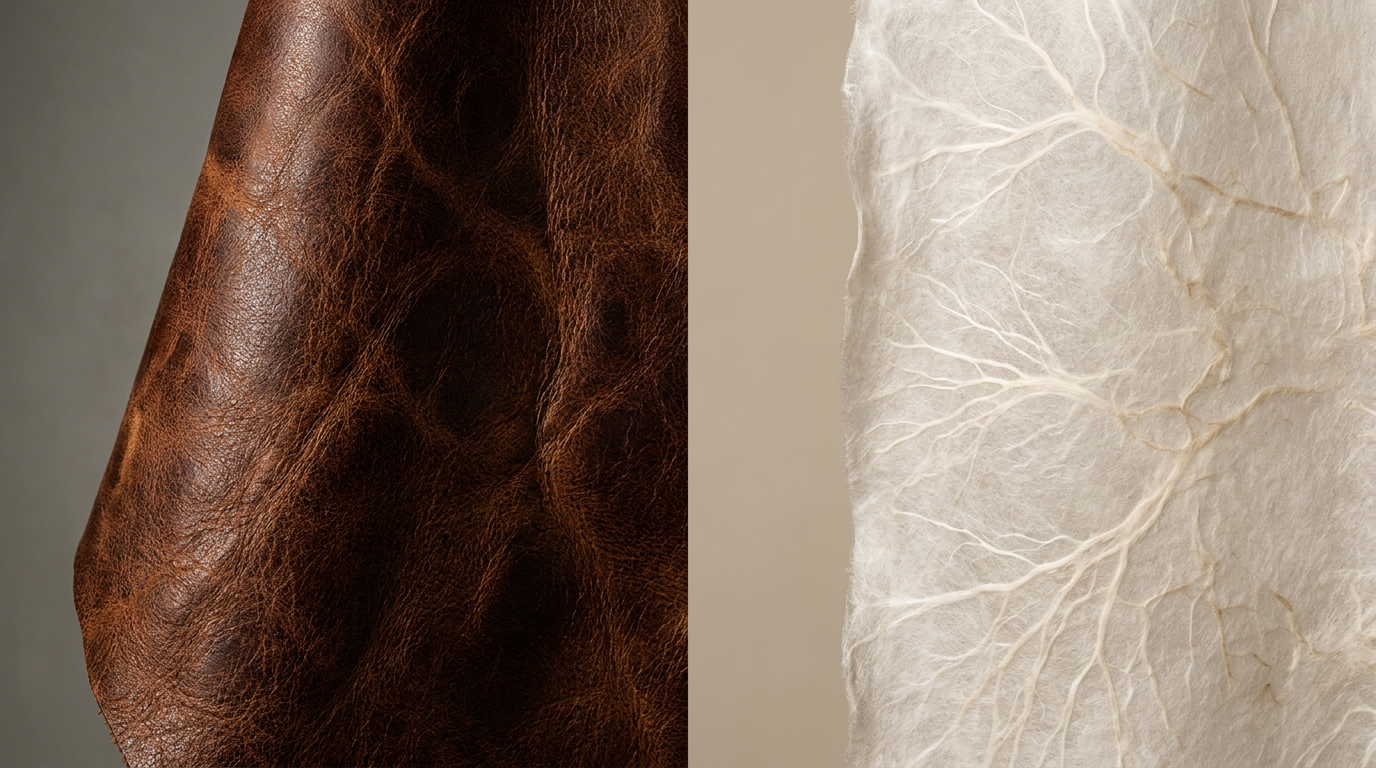
Mycelium leather, grown from the root structures of fungi, is emerging as a commercially viable alternative to traditional animal hides. This trade-off analysis compares the unmatched durability of conventional leather against the radical environmental benefits of lab-grown bio-textiles.
By Factlen Editorial Team
- Scientific & Environmental Researchers
- Academics conducting life cycle assessments on fashion materials.
- Biomaterial Innovators
- Startups and engineers scaling lab-grown textiles to replace animal agriculture.
- Sustainable Luxury Brands
- High-end fashion houses transitioning away from animal products and plastics.
- Independent Analysts
- Market observers weighing the economic and functional trade-offs of the material shift.
What's not represented
- · Cattle Farmers
- · Tannery Workers
- · Fast Fashion Manufacturers
Why this matters
The materials we choose to wear have a massive impact on global water use, deforestation, and greenhouse gas emissions. As bio-textiles reach price and performance parity with animal hides, consumers and brands finally have a scalable, cruelty-free alternative that doesn't rely on polluting plastics.
Key points
- Mycelium leather is grown from fungal root structures in a matter of weeks, compared to the years required to raise cattle.
- Traditional leather still holds a slight edge in raw tensile strength and long-term, heavy-duty abrasion resistance.
- Mycelium production uses 97% less water and generates 89% fewer greenhouse gas emissions than conventional tanning.
- Production costs for lab-grown leather have plummeted to $23 per square meter, nearing price parity with animal hides.
- The primary challenge for bio-textiles is finding 100% natural coatings that provide water resistance without compromising biodegradability.
The fashion industry is undergoing a fundamental material reckoning, driven by the urgent need to decouple luxury and utility from environmental degradation. For decades, the choice was binary: traditional animal leather, prized for its longevity but burdened by its ecological toll, or synthetic "vegan" leathers made from polyurethane, which merely traded animal cruelty for fossil fuel dependence and microplastic pollution. Now, a third category has reached commercial viability. Mycelium leather, cultivated from the root-like structures of fungi, is rapidly scaling from experimental laboratories to high-end runways. Brands like Stella McCartney and Hermès are actively integrating these bio-based textiles into their collections, setting the stage for a direct showdown between centuries-old tanning traditions and cutting-edge biotechnology.[6]
The mechanisms behind these two materials could not be more divergent. Traditional leather is a co-product of the global meat and dairy industries, requiring years of animal husbandry followed by resource-intensive tanning processes—often utilizing heavy metals like chromium—to prevent the biological decay of the hide. In stark contrast, mycelium leather is grown in controlled indoor facilities using agricultural waste, such as sawdust, as a substrate. The fungal network binds the organic matter into dense, fibrous mats over a period of just a few weeks. These mats are then compressed, tanned using eco-friendly agents, and dyed to replicate the exact texture, flexibility, and appearance of animal hides, fundamentally rewriting the timeline and resource requirements of textile production.[3][4]
For traditional animal leather, the primary argument centers on its historically unmatched durability and structural integrity. Proponents emphasize that high-quality, full-grain leather possesses an inherent toughness that allows it to withstand decades of heavy abrasion, stretching, and exposure to the elements. Furthermore, animal leather ages gracefully, developing a unique patina over time rather than simply degrading. Because it is largely a byproduct of the agricultural sector, the traditional leather industry argues that it is upcycling millions of tons of hides that would otherwise be sent to landfills, providing a highly functional material that rarely needs to be replaced in a consumer's lifetime.[1][7]

Against traditional leather, the environmental and ethical tolls present a severe liability in an increasingly climate-conscious market. The production pipeline is inextricably linked to the massive greenhouse gas emissions, land use, and deforestation associated with cattle farming. Beyond the agricultural footprint, the conventional tanning process is notoriously toxic. The widespread use of chromium and other harsh chemicals poses significant risks to local waterways, ecosystems, and the health of tannery workers. Additionally, the ethical concerns surrounding animal exploitation have alienated a growing demographic of consumers who refuse to support industries tied to slaughter, regardless of the material's longevity.[4]
The evidence quantifying traditional leather's impact is stark. Comprehensive life cycle assessments consistently rank bovine leather as having the highest environmental impact among textiles, driven primarily by its carbon footprint and toxicity potential. The process requires immense volumes of water, both for raising the livestock and for the chemical baths used during tanning. While the material itself can last for generations, the upfront ecological cost is staggering, making it increasingly difficult for fashion houses to justify its use while simultaneously pledging to meet aggressive net-zero emissions targets and sustainability goals.[1][4]
For mycelium leather, the core advantage is a radical reduction in environmental footprint without relying on the plastics that plague early vegan alternatives. Cultivating fungi requires no arable land, no animal slaughter, and minimal energy, as the growth occurs at ambient temperatures. The resulting material is cruelty-free, highly customizable in terms of thickness and texture, and inherently biodegradable. Because the growth environment is strictly controlled, manufacturers can produce uniform sheets of material without the scars, bites, or irregular shapes that result in significant cutting waste when working with natural animal hides.[2][3]

For mycelium leather, the core advantage is a radical reduction in environmental footprint without relying on the plastics that plague early vegan alternatives.
Against mycelium leather, the primary constraints are current structural limitations and scaling bottlenecks. While the material mimics the hand-feel of luxury calfskin, its raw tensile strength and resistance to tearing have not yet fully matched the toughest animal hides. Furthermore, to achieve the water resistance and colorfastness expected by modern consumers, mycelium mats often require secondary coatings. If these coatings rely on synthetic polymers like polyurethane, it compromises the material's biodegradability, creating a tension between performance and pure sustainability. Finally, while production is expanding, the specialized infrastructure required to grow mycelium at a global scale remains in its infancy.[1][4]
The evidence supporting mycelium's viability is anchored in recent laboratory and market data. Testing demonstrates that mycelium leather can achieve a tensile strength of 12.4 megapascals, approaching the 15.8 megapascals of conventional leather. Environmentally, the metrics are transformative: mycelium production consumes 97 percent less water than conventional tanning and generates an 89 percent reduction in greenhouse gas emissions. Economically, the gap is closing rapidly. Production costs have plummeted from $127 per square meter in 2015 to approximately $23 per square meter today, placing it within striking distance of traditional leather's $18 to $22 range.[1]
This side-by-side trade-off analysis ultimately hinges on the coating dilemma. To bridge the final gap in durability, biomaterial engineers are experimenting with polylactic acid and other bio-based resins to enhance flex strength and water resistance without resorting to petrochemicals. When treated effectively, mycelium leather can become more than twice as strong as untreated animal leather in specific flex tests, though long-term real-world aging data is still being collected. The industry is racing to perfect these finishing techniques, knowing that true circularity requires a product that is both tough enough to wear daily and capable of breaking down naturally at the end of its lifecycle.[2][4]

Mycelium leather fits well when brands are designing luxury handbags, everyday footwear, and high-end fashion accessories. It is the ideal choice for environmentally conscious consumers who are willing to pay a premium for innovation and cruelty-free credentials. Because it can be grown to exact specifications, it is highly suited for designers looking to minimize scrap waste and experiment with novel textures. It perfectly aligns with corporate sustainability mandates and appeals to a demographic that prioritizes a product's ecological backstory as much as its aesthetic appeal.[5][6]
Mycelium leather does not fit when manufacturing heavy-duty industrial gear, motorcycle protection, or heritage footwear designed to endure extreme physical punishment. In applications where maximum abrasion resistance and structural failure could result in injury, the slightly lower tensile strength and unproven multi-decade longevity of fungal leather make it a premature substitute. It is also not currently suited for ultra-low-cost fast fashion, as the specialized bio-manufacturing process still carries a price premium over mass-produced synthetic plastics.[1][2]
Conversely, traditional leather fits well when maximum abrasion resistance and decades-long longevity are the absolute priorities. It remains the superior choice for work boots, saddlery, professional athletic equipment, and heritage items that are expected to be passed down through generations. For consumers who value the unique patina and self-healing properties of natural hide, and for applications where the material will be subjected to constant friction and harsh weather, high-quality full-grain leather remains the undisputed benchmark of performance.[1][7]

Traditional leather does not fit when a company is attempting to meet strict net-zero emissions targets or appealing to the rapidly expanding vegan and eco-conscious market segments. It is entirely incompatible with cruelty-free certifications and presents a massive liability for brands trying to clean up their supply chain's water usage and chemical toxicity. As regulatory scrutiny over deforestation and industrial pollution intensifies, relying solely on animal hides is becoming a strategic risk for global fashion conglomerates.[4][7]
Ultimately, the comparison between mycelium and traditional leather is no longer a theoretical exercise but a commercial reality. While animal hides retain their crown for ultimate, heavy-duty durability, mycelium has proven it can meet the rigorous aesthetic and functional demands of the luxury fashion sector. As bio-manufacturing scales and natural coating technologies improve, the performance gap will continue to narrow. The future of textiles is unlikely to be a total eradication of traditional leather, but rather a significant market correction where fungi-based materials become the new standard for everyday luxury, leaving animal hides reserved only for the most extreme, specialized applications.[7]
How we got here
2012
Product designers begin experimenting with mycelium-based materials for home furnishings, realizing its potential to mimic leather.
2017
Sustainable fashion pioneer Stella McCartney begins experimenting with early prototypes of mushroom leather.
2020
Major fashion brands including Adidas and Kering form a consortium to invest in the development and scaling of mycelium textiles.
2023
Production costs for mycelium leather drop significantly, approaching price parity with high-end traditional animal hides.
2025
The first commercially available luxury items manufactured completely from high-end mycelium leather hit the consumer market.
Viewpoints in depth
Biomaterial Innovators
Startups and engineers scaling lab-grown textiles.
Companies like MycoWorks and Bolt Threads argue that biotechnology has advanced to the point where animal agriculture is no longer necessary for high-performance textiles. They emphasize that mycelium can be engineered to specific thicknesses and textures, eliminating the cutting waste associated with irregular animal hides. Their focus is on achieving price parity and scaling production infrastructure to meet the massive demand from global fashion houses.
Scientific & Environmental Researchers
Academics conducting life cycle assessments on fashion materials.
Researchers focus on the empirical data of environmental impact, noting the staggering 97% reduction in water use and 89% drop in greenhouse gas emissions when switching to mycelium. However, they also caution against greenwashing, pointing out that if mycelium requires synthetic polyurethane coatings to achieve water resistance, its end-of-life biodegradability is compromised. They advocate for continued development of 100% bio-based finishing resins.
Sustainable Luxury Brands
High-end fashion houses transitioning away from animal products.
Designers like Stella McCartney view mycelium as the holy grail of sustainable fashion—a material that offers the premium hand-feel and luxury aesthetic of calfskin without the ethical baggage of animal slaughter or the ecological damage of plastic vegan leather. For these brands, adopting mycelium is both a moral imperative and a strategic move to capture the loyalty of younger, climate-conscious luxury consumers.
Traditional Leather Industry
Tanneries and trade groups defending natural animal hides.
The traditional leather sector argues that their product is the ultimate sustainable material because it is a byproduct of the meat industry that would otherwise go to waste. They highlight that high-quality, full-grain leather can last for decades, developing a unique patina and outliving any synthetic or lab-grown alternative. From their perspective, the focus should be on cleaning up the tanning process rather than abandoning a historically proven, highly durable material.
What we don't know
- How mycelium leather will physically age and degrade over a 20-to-30-year lifespan compared to heritage animal leather.
- Whether 100% bio-based coatings can eventually match the waterproofing performance of synthetic polyurethane.
- How quickly global supply chains can scale to meet the massive volume demands of fast-fashion retailers.
Key terms
- Mycelium
- The infinitely renewable, root-like network of fungal threads that grows beneath the ground or inside organic material.
- Tensile Strength
- A measurement of the maximum amount of stress or pulling force a material can withstand before breaking or tearing.
- Life Cycle Assessment (LCA)
- A comprehensive scientific method used to evaluate the total environmental impact of a product from raw material extraction through to disposal.
- Chromium Tanning
- A common, chemically intensive process used to treat animal hides to prevent decomposition, known for producing toxic wastewater.
Frequently asked
What exactly is mycelium leather made from?
It is grown from mycelium, the vegetative root-like structure of fungi. The fungi are cultivated on agricultural waste like sawdust, forming dense fibrous mats that are then compressed and tanned.
Is mycelium leather as strong as animal leather?
It is very close but not quite as strong in its raw form. Testing shows mycelium reaches about 78% of the tensile strength of conventional leather, though bio-based coatings can significantly improve its durability.
Does mycelium leather biodegrade?
Yes, raw mycelium leather is highly biodegradable and can break down in natural environments within a few months. However, if synthetic coatings are applied for water resistance, the biodegradability can be reduced.
Why not just use plastic-based vegan leather?
Traditional vegan leathers are typically made from polyurethane (PU) or polyvinyl chloride (PVC). While cruelty-free, they rely on fossil fuels, do not biodegrade, and shed harmful microplastics into the environment.
Sources
Source coverage
7 outlets
4 viewpoints surfaced






[1]Biology JournalScientific & Environmental Researchers
Mycelium-based leather and bacterial cellulose as sustainable alternatives
Read on Biology Journal →[2]FaunalyticsScientific & Environmental Researchers
Fungi Fashion: The Sustainable Appeal Of Mycelium Leather
Read on Faunalytics →[3]EnvisioningBiomaterial Innovators
Mycelium Leather Technology and Impact
Read on Envisioning →[4]National Institutes of HealthScientific & Environmental Researchers
Mycelium-like leather as a sustainable alternative for fashion
Read on National Institutes of Health →[5]SNS InsiderBiomaterial Innovators
Mushroom Leather Makes A Major Commercial Impact
Read on SNS Insider →[6]Mission MagazineSustainable Luxury Brands
Fashion Houses Hop on the Mycelium Bandwagon
Read on Mission Magazine →[7]Factlen Editorial TeamIndependent Analysts
Synthesis by Factlen editorial team
Read on Factlen Editorial Team →

Every angle. Every day.
Get shopping stories with full source coverage and perspective breakdowns delivered to your inbox.