
The 5 AM Myth: Why Forcing Yourself to Wake Up Early Is Destroying Your Productivity
Productivity gurus have long preached that waking up at 5 a.m. is the secret to success, but chronobiologists warn that fighting your genetic sleep rhythm actually causes cognitive decline. Understanding your biological chronotype—not your alarm clock—is the true key to unlocking peak performance.
By Factlen Editorial Team
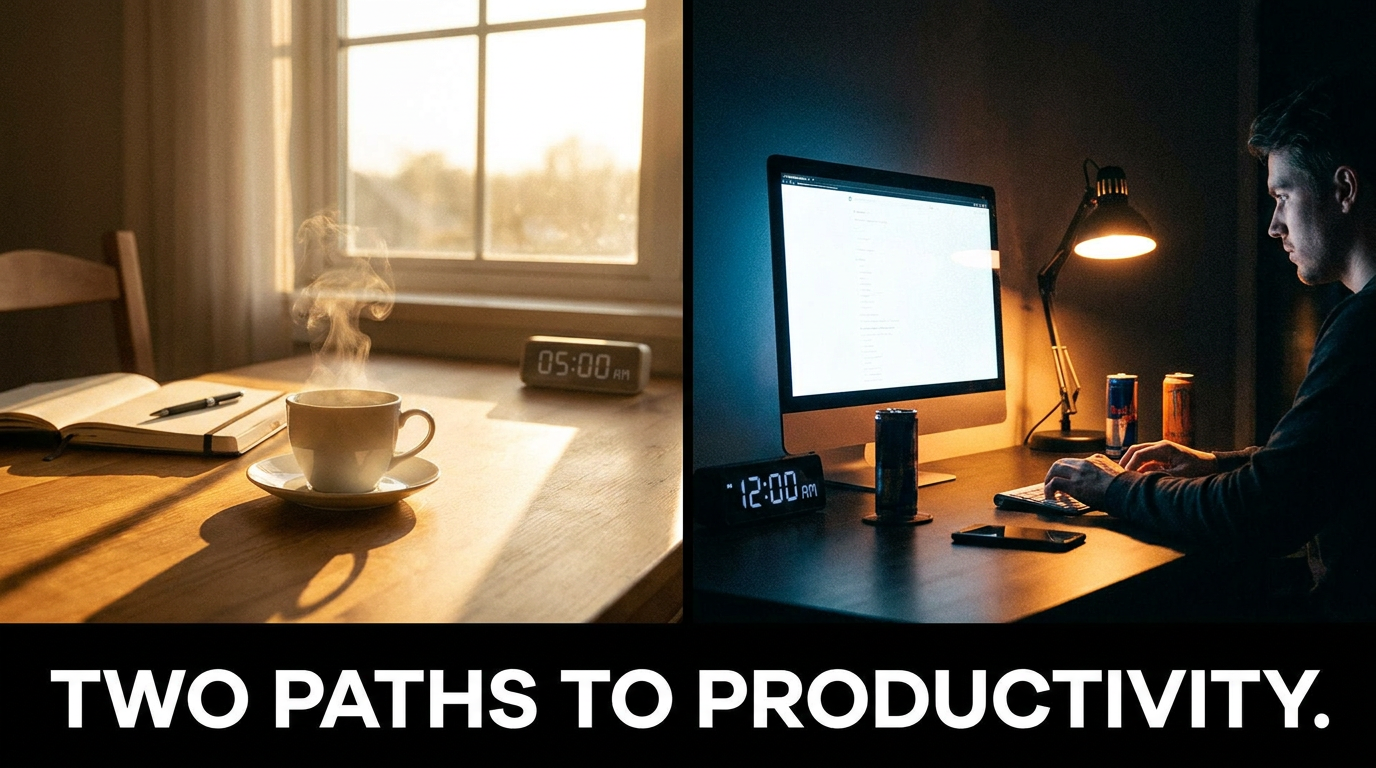
- Productivity Realists
- Advocate for energy management over time management, urging professionals to align their deep work with their natural biological peaks.
- Sleep Scientists
- Argue that sleep timing is a genetic trait, not a behavioral choice, and warn that fighting it causes measurable cognitive and physical harm.
- Early-Rising Advocates
- Maintain that waking up before the rest of the world provides uninterrupted time and builds the psychological discipline necessary for elite success.
What's not represented
- · Shift Workers
- · Parents of Young Children
Why this matters
For decades, hustle culture has equated early rising with moral superiority and professional success, leaving millions feeling guilty and exhausted. By aligning your work schedule with your genetic chronotype instead of an arbitrary alarm clock, you can eliminate 'social jetlag,' reduce burnout, and unlock your actual peak cognitive performance.
Key points
- Chronotypes are hardwired biological rhythms that dictate your ideal sleep and wake times.
- Nearly 50% of your chronotype is determined purely by genetic factors.
- Only 15% of the population naturally thrives on a 5 a.m. wake-up schedule.
- Forcing an unnatural early wake-up causes 'social jetlag' and measurable cognitive decline.
- Corporate schedules artificially reward early risers, creating a selection bias in leadership.
- Aligning deep work with your genetic peak hours is more effective than waking up early.
Waking up at 5 a.m. has become the ultimate modern badge of honor. From Apple CEO Tim Cook’s famous 3:45 a.m. alarm to the ubiquitous advice of productivity gurus, hustle culture has firmly established the pre-dawn hours as the undisputed secret to elite success. The premise is seductive in its simplicity: conquer your morning, conquer your life. Millions of ambitious professionals set their alarms for the darkest hours of the night, hoping to unlock superhuman focus, get ahead of their competitors, and build the discipline required to achieve their wildest career goals.[9]
For a vast majority of these people, however, the pursuit of this pre-dawn perfection ends in quiet disaster. After a few days of forced early rising, the initial burst of motivation gives way to chronic fatigue, brain fog, and a mid-afternoon energy crash that derails the rest of the day. When the routine inevitably fails, the individual is left feeling like a lazy, undisciplined failure. They assume they simply did not have the willpower to join the ranks of the elite, internalizing the struggle as a deep personal flaw rather than a biological mismatch.
But a growing consensus among sleep scientists, organizational psychologists, and productivity experts is pushing back against this narrative. The 'morning routine myth'—the idea that a single, standardized wake-up time works for everyone—is fundamentally flawed because it ignores hardwired human biology. Rather than a lack of discipline, the inability to thrive at 5 a.m. is a natural physiological response. Embracing your biological reality, rather than fighting it, is emerging as the true secret to sustainable productivity.[5]
The foundation of this scientific pushback lies in chronobiology, the study of biological rhythms. At the core of this field is the concept of the chronotype: your body’s natural, internal timing system that dictates your ideal loop for sleep and wakefulness. This internal clock regulates everything from core body temperature to the precise timing of hormone releases, dictating exactly when you feel sharpest and when your brain requires rest.[8]
Crucially, your chronotype is not a lifestyle choice or a habit that can be permanently rewritten through sheer force of will. Research published in Nature Communications reveals that approximately 50% of your chronotype is determined purely by genetic factors. Asking a natural night owl to permanently adapt to a 5 a.m. wake-up is biologically equivalent to forcing a left-handed person to write with their right hand; they can technically do it, but it will always require excess effort, yield messier results, and cause constant underlying stress.[1]
To understand why forcing an early wake-up fails so spectacularly for most people, sleep specialists often categorize the population into distinct chronotypes. The most popular framework divides people into four categories: Lions, Bears, Wolves, and Dolphins. Each group possesses a unique biological operating window that dictates their peak cognitive performance, and attempting to operate outside of that window triggers a cascade of physiological friction.
The traditional 'Lions'—those who naturally wake up at dawn, feel fantastic at 6 a.m., and peak in their cognitive abilities before noon—make up only about 15% of the population. These are the individuals for whom the 5 a.m. club was inadvertently designed. The vast majority of people, roughly 70%, are 'Bears,' whose energy levels rise steadily with the sun and peak in the late morning or early afternoon. Another 15% are 'Wolves,' or natural night owls, whose brains do not fully activate until later in the day and who find their deepest focus long after the sun has gone down.

When the 85% of the population who are not Lions attempt to mimic the extreme early-bird schedule, they induce a physiological state known as 'social jetlag.' The American Academy of Sleep Medicine defines this as the chronic exhaustion that occurs when your internal biological clock is forced to operate in a different time zone than your socially mandated schedule. It carries the exact same physiological toll as flying across multiple time zones every single day.[2]
The cognitive toll of this biological misalignment is severe and measurable. When an evening chronotype forces an early alarm, they truncate their natural sleep phase, leading to immediate cognitive impairments. Sleep scientists note that decision-making quality degrades, emotional regulation drops significantly, and the capacity for deep, uninterrupted focus vanishes. Every single action taken during these biologically mismatched hours requires an estimated 20% more effort, slowly draining the individual's overall stamina.[4]
The cognitive toll of this biological misalignment is severe and measurable.
If early rising is biologically detrimental to the vast majority of people, why are so many highly successful executives and top-performing students natural early risers? The answer, according to researchers analyzing corporate performance data, is not that waking up early inherently creates success. Instead, the phenomenon is driven heavily by systemic selection bias within the modern workplace.[3]
The standard 9-to-5 corporate schedule was designed decades ago and artificially rewards natural morning chronotypes. Because traditional performance evaluations, crucial morning meetings, and high-stakes decisions often occur before noon, Lions are evaluated during their genetic energy spikes. Meanwhile, Wolves are evaluated during their biological slumps, making them appear less engaged or capable, regardless of their actual talent or intelligence.[3]

Hustle culture routinely misinterprets this unearned biological advantage as superior moral discipline. Society celebrates the early riser as a person of character and ambition, while unfairly stigmatizing the late sleeper as lazy or unmotivated. This cultural bias forces millions of talented individuals to spend their mornings fighting their own biology, and their evenings feeling guilty about staying awake when their brains are finally ready to perform.[7]
Instead of fighting their DNA, a new wave of professionals is embracing a paradigm shift: prioritizing energy management over time management. This approach recognizes that not all hours are created equal. Fifteen minutes of deep, focused reading hits the brain entirely differently at 11:00 a.m. than it does at 11:00 p.m., depending entirely on the individual's chronotype.[3]
Implementing this shift requires auditing your personal biology to find your 'Power Hour'—the specific window when your focus is naturally sharpest. Rather than obsessing over the time on the alarm clock, productivity realists advocate for mapping your most complex, high-stakes tasks strictly to your genetic peak hours. If your brain works best at 8 p.m., forcing yourself to do deep work at 6 a.m. is a massive waste of potential.[6]
For natural night owls, this peak often occurs late in the evening, a phenomenon backed by distinct hormonal advantages. During these late hours, evening chronotypes experience historically low cortisol levels. Because cortisol is the primary hormone that drives stress and anxiety, its absence allows the mind to feel safe, calm, and free to create without the heavy burden of daytime pressures.

Furthermore, the late-night hours provide a protective barrier against the demands of the modern world. With no incoming emails, no smartphone notifications, and no societal expectations, the brain networks of a late sleeper can communicate beautifully without interruption. This allows night owls to achieve psychological flow states much more rapidly than they ever could during a chaotic morning.
Of course, acknowledging the science of chronotypes does not instantly solve the friction of living in a society built for early birds. Not everyone has the luxury of telling their boss they will start their workday at noon. Many people are trapped in rigid schedules dictated by corporate policies, school drop-offs, or client demands, forcing them to navigate a world that actively works against their biology.
For night owls trapped in traditional schedules, experts recommend aggressive mitigation strategies rather than blind adherence to hustle culture. This includes fiercely protecting required sleep hours, using bright light therapy immediately upon waking to help reset the circadian rhythm, and ruthlessly defending the later parts of the day for heavy cognitive lifting, rather than wasting that peak energy on administrative tasks.

However, the landscape of work is slowly beginning to change. The rise of remote work and asynchronous communication is slowly dismantling the tyranny of the early alarm clock. Forward-thinking organizations are beginning to realize that they lose massive amounts of high-quality output by forcing their employees into a rigid, one-size-fits-all schedule, and are allowing workers to align their hours with their energy.
Ultimately, the most effective morning routine is not the one that starts the earliest, but the one that respects your biological reality. Your chronotype is not a limitation to overcome; it is a genetic baseline to leverage. By letting go of the guilt associated with the 5 a.m. myth and learning to work with your body’s natural rhythms, you can trade chronic exhaustion for sustainable, peak performance.[5]
How we got here
2016
Oxford University publishes research demonstrating that approximately 50% of a person's chronotype is determined by genetic factors.
2018
The publication of 'The 5 AM Club' popularizes the idea that extreme early rising is a prerequisite for elite success.
2019
Sleep science research highlights the cognitive decline and health risks associated with 'social jetlag' in night owls forced into early schedules.
2024–2026
A growing 'anti-hustle' movement and the normalization of remote work lead to widespread mainstream pushback against one-size-fits-all morning routines.
Viewpoints in depth
Chronobiologists' view
Sleep timing is a hardwired genetic reality, not a measure of willpower.
Researchers emphasize that the internal biological clock, or circadian rhythm, is dictated by cellular programming. Forcing a natural night owl to wake up at 5 a.m. does not train them to become an early bird; it simply truncates their sleep cycle and induces chronic 'social jetlag.' This misalignment leads to measurable drops in emotional regulation, decision-making quality, and long-term metabolic health.
Hustle Culture's view
Early mornings provide a psychological edge and uninterrupted focus.
Proponents of extreme early rising argue that the hours before dawn are the only time truly free from digital distractions and societal demands. Beyond the quiet environment, they view the sheer difficulty of waking up early as a daily exercise in discipline—a psychological victory that sets a proactive, rather than reactive, tone for the rest of the day.
Workplace Reformers' view
Corporate schedules must adapt to biological realities to maximize output.
Organizational psychologists and modern productivity experts argue that the rigid 9-to-5 schedule artificially rewards early risers while suppressing the potential of evening chronotypes. They advocate for asynchronous work models and flexible hours, arguing that companies are leaving massive amounts of high-quality cognitive work on the table by forcing employees to operate outside their genetic peak performance windows.
What we don't know
- Whether future corporate structures will fully embrace asynchronous work to accommodate all chronotypes.
- The exact evolutionary reason why human populations developed such a wide variance in sleep-wake cycles.
- How long-term exposure to artificial blue light might be permanently altering the genetic expression of chronotypes in younger generations.
Key terms
- Chronotype
- A person's natural, genetically determined inclination regarding the times of day when they prefer to sleep and when they are most alert.
- Social Jetlag
- The chronic fatigue and cognitive impairment caused by the mismatch between a person's biological clock and their socially mandated schedule.
- Cortisol
- A hormone that naturally spikes in the morning to help wake the body and prepare it for the day's stress, but remains low at night.
- Selection Bias
- A statistical error where a specific group (like early risers) is overrepresented in success metrics because the environment (like corporate schedules) was built to favor them.
Frequently asked
Can I train myself to become a morning person?
While you can shift your sleep schedule slightly through strict light exposure and routines, your underlying chronotype is genetically hardwired and cannot be permanently changed.
Why do so many successful CEOs wake up at 4 or 5 a.m.?
Researchers point to selection bias. The traditional corporate schedule naturally rewards early risers, giving them a biological advantage that is often mistaken for superior discipline.
What if my job requires me to be at work at 8 a.m., but I'm a night owl?
Sleep scientists recommend aggressively protecting your required sleep hours, using bright light therapy immediately upon waking, and saving your most complex cognitive tasks for later in the day when your energy naturally peaks.
Sources
Source coverage
9 outlets
3 viewpoints surfaced









[1]Nature CommunicationsSleep Scientists
Genetic determinants of chronotype and their association with health
Read on Nature Communications →[2]American Academy of Sleep MedicineSleep Scientists
Social jetlag and its consequences for human health
Read on American Academy of Sleep Medicine →[3]Harvard Business ReviewProductivity Realists
How to Manage Your Energy, Not Your Time
Read on Harvard Business Review →[4]Growth Systems DailyProductivity Realists
The 5 AM Club Is Wrong: What Science Says About Waking Up Early
Read on Growth Systems Daily →[5]Factlen Editorial TeamProductivity Realists
Synthesis by Factlen editorial team
Read on Factlen Editorial Team →[6]Early To RiseProductivity Realists
The 5 AM Club Myth: Do Successful Entrepreneurs Really Wake Up at 5AM?
Read on Early To Rise →[7]Growth Lane HubProductivity Realists
The 5 AM Club Myth: Do Successful Entrepreneurs Really Wake Up at 5AM?
Read on Growth Lane Hub →[8]Till Roenneberg ResearchSleep Scientists
The Munich ChronoType Questionnaire (MCTQ)
Read on Till Roenneberg Research →[9]The 5 AM Club (Book)Early-Rising Advocates
The 5AM Club: Own Your Morning. Elevate Your Life.
Read on The 5 AM Club (Book) →
Every angle. Every day.
Get opinion stories with full source coverage and perspective breakdowns delivered to your inbox.