
How LED Volumes Went Mainstream: The Tech Democratizing Hollywood
Once reserved for $100 million blockbusters, virtual production and LED volumes have become accessible to independent filmmakers in 2026, radically shifting how movies are made.
By Factlen Editorial Team
- Indie Filmmakers
- View virtual production as a democratizing force that allows them to achieve blockbuster visuals on micro-budgets.
- VFX & Technical Crews
- Emphasize the shift from post-production fixes to intense pre-production planning and on-set real-time rendering.
- Studio Executives
- Focus on the efficiency, scalable IP management, and logistical savings of shooting entirely on controlled soundstages.
What's not represented
- · Traditional Set Builders
- · Location Scouts
Why this matters
The barrier to entry for high-end visual storytelling has collapsed. Independent creators can now build photorealistic, multi-million-dollar worlds on a fraction of the budget, promising a surge of visually ambitious original films that don't rely on major studio backing.
Key points
- LED volumes allow actors to perform in front of real-time 3D environments, providing realistic in-camera lighting.
- The technology has scaled down, allowing indie filmmakers to use 'micro-volumes' for around $50,000.
- Virtual production shifts the workload from post-production to an intense pre-production phase.
- On-set 'Brain Bars' act as digital gaffers, adjusting the 3D world in real time using game engines.
- AI tools like NeRFs allow creators to instantly turn 2D photos into 3D film sets.
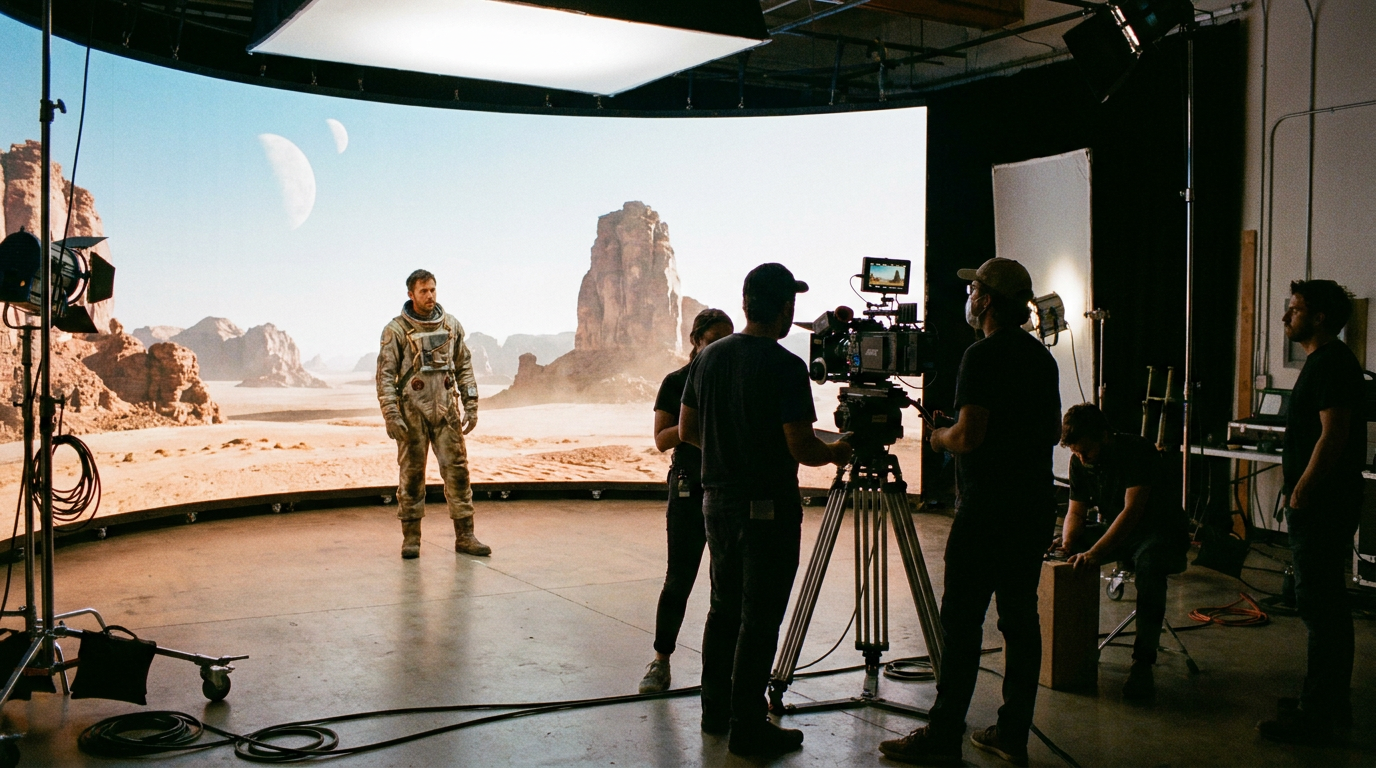
The image of actors standing inside a massive, glowing cylinder of LED screens—the "Volume"—was once the exclusive domain of major studio franchises. When the technology debuted, it required nine-figure budgets, custom-built hardware, and an army of specialized technicians. But by 2026, the landscape of filmmaking has fundamentally shifted. Virtual production is no longer a studio luxury; it has become the great equalizer for independent cinema, allowing small crews to punch far above their financial weight.[1][3]
The core of this revolution is the LED volume, a physical stage surrounded by high-resolution screens that display real-time, photorealistic 3D backgrounds. Instead of acting in front of a blank green screen and waiting months to see the final environment composited in post-production, actors and directors can see the finished world directly through the camera lens on the day of the shoot.[4][6]
The mechanism relies on a seamless marriage between physical camera equipment and video game technology. Using software like Epic Games' Unreal Engine 5.5, digital environments are rendered in real time. Sensors on the physical cinema camera track its exact position, tilt, and focal length, feeding that data back to the game engine instantly. As the physical camera moves, the digital background shifts in perfect parallax, creating a flawless illusion of three-dimensional depth.[4]

This real-time rendering solves one of the oldest headaches in visual effects: lighting. With traditional green screens, the bright green light inevitably bounces back onto the actors—known as "green spill"—requiring tedious, frame-by-frame color correction in post-production. In an LED volume, the screens themselves act as the primary light source. If an actor is standing in a virtual Martian desert, they are physically bathed in the exact amber hues and ambient reflections of that digital sun.[2][6]
The financial math of virtual production has changed dramatically over the last few years. A full-scale Hollywood volume still costs upwards of $15 million to build and maintain. However, the rise of "micro-volumes" has opened the door for indie creators. A functional 40-square-meter LED setup can now be assembled for around $50,000, and daily rentals for localized, pre-built stages have plummeted to rates accessible to low-budget productions.[2][3]
Industry experts refer to this democratization as the "Costco hack." The underlying mathematics driving a massive studio LED wall are fundamentally the same as those powering a high-end consumer television. Independent filmmakers are realizing that with a thoughtful depth-of-field strategy, a modest array of modular LED panels can read as a sprawling, multi-million-dollar stage on camera.[1]
This accessibility is radically altering production logistics. On a recent independent sci-fi thriller shot in New York City, the production saved an estimated $15,000 in travel and location fees simply by scanning a Utah desert and projecting it inside a Brooklyn warehouse. Entire scenes that would have previously required company moves, weather contingencies, and permit battles are now shot comfortably on a climate-controlled soundstage.[3]

This accessibility is radically altering production logistics.
However, virtual production requires a massive philosophical shift in how movies are made. The traditional Hollywood model relies heavily on post-production to finalize visual effects, often adopting a "we'll fix it in post" mentality. Virtual production flips this timeline entirely, demanding an intense "pre-viz" (pre-visualization) phase. Directors must lock in their storyboards, environments, and lighting decisions weeks before the cameras ever roll.[1][4]
Filmmakers describe this intense preparation phase as "threading the eye of the needle." The pressure is heavily front-loaded, requiring decisive creative choices early in the process. But once the production passes through that gate and steps onto the stage, the creative freedom is immense. Directors can move mountains, change the time of day, or alter the weather with a single click, enjoying the spontaneity of a live-action shoot within a fully digital world.[1]
This real-time control has given rise to a new on-set department: the "Brain Bar." These technicians are not traditional IT support staff or post-production artists; they are digital gaffers and real-time environment operators. Seated at a bank of computers just off-camera, the Brain Bar manipulates the Unreal Engine environment live, responding to the director's requests as quickly as a traditional lighting crew would adjust a physical lamp.[3][4]

The democratization of the volume is accelerating further thanks to the integration of artificial intelligence. Historically, building a photorealistic 3D background required weeks of labor from senior 3D modelers. In 2026, AI-native platforms like Cascade allow creators to generate production-ready 3D assets and manage complex workflows using natural language prompts, acting as a creative co-pilot.[5]
Furthermore, the use of Neural Radiance Fields (NeRFs) and 3D Gaussian Splatting allows indie crews to capture a real-world location with a drone or a smartphone, process the data through AI, and instantly project a fully navigable 3D replica onto their LED wall. The barrier to entry for world-building has never been lower, bypassing the need for massive visual effects houses.[5][6]
Despite the rapid advancements, micro-volumes are not without their physical limitations. Cheaper LED panels often suffer from lower pixel pitches, which can cause moiré patterns—a distracting, wavy visual artifact—if the camera gets too close to the screen. Indie cinematographers must carefully manage their focal lengths to keep the physical screen slightly out of focus, preserving the illusion of depth.[3]
Additionally, the hidden costs of virtual production can catch inexperienced producers off guard. LED walls require massive power draws, generate significant heat that necessitates heavy air conditioning, and demand specialized data infrastructure. The technology does not eliminate filmmaking problems; it simply relocates them from post-production to pre-production.[3]
Yet, the trajectory is clear. As real-time rendering becomes indistinguishable from reality and hardware costs continue to fall, the LED volume is transitioning from a specialized VFX tool to a fundamental piece of filmmaking equipment. For independent creators, the ability to tell visually expansive stories without a studio budget is no longer a futuristic promise—it is a daily reality.[1][6]
How we got here
2019
The Mandalorian popularizes the use of massive LED volumes for blockbuster television production.
2022
Unreal Engine 5 is released, bringing photorealistic real-time lighting (Lumen) to virtual production.
2024
Smaller, modular LED panels become widely available, sparking the rise of indie 'micro-volumes'.
2026
AI-native tools like Cascade launch, allowing solo creators to generate Hollywood-grade 3D assets instantly.
Viewpoints in depth
Indie Filmmakers
Viewing virtual production as a democratizing force that unlocks blockbuster visuals on micro-budgets.
For independent directors and producers, the LED volume represents the ultimate creative equalizer. Historically, writing a script set on Mars or in a sprawling cyberpunk city meant securing a massive studio budget or accepting subpar visual effects. By utilizing micro-volumes and the 'Costco hack' of consumer-grade screen math, indie creators can now shoot visually expansive stories in a single rented warehouse. They value the technology for its ability to eliminate weather delays, cut travel costs, and provide actors with tangible environments to react to, rather than empty green rooms.
VFX & Technical Crews
Emphasizing the radical shift from post-production fixes to intense pre-production planning.
The technical workforce views virtual production as a fundamental rewiring of the filmmaking pipeline. For decades, visual effects artists suffered under the 'fix it in post' mentality, often working grueling hours to composite backgrounds and remove green spill long after the shoot wrapped. Virtual production forces directors to make those decisions during 'pre-viz.' While this places immense pressure on the newly formed 'Brain Bar' to perform flawlessly on set, technical crews largely prefer this model, as it integrates them directly into the live-action shoot and reduces post-production crunch.
Studio Executives
Focusing on the efficiency, scalable IP management, and logistical predictability of the technology.
From a studio perspective, virtual production is an exercise in risk mitigation and asset management. Shooting on a controlled LED stage eliminates the unpredictable variables of location shooting, such as lost daylight, bad weather, and permit disputes. Furthermore, once a digital environment is built in Unreal Engine, it becomes a permanent asset. Studios can reuse the exact same digital sets across multiple seasons of television, spin-offs, and video game tie-ins, creating a highly efficient, scalable ecosystem for their intellectual property.
What we don't know
- Whether the cost of high-end, moiré-free LED panels will drop fast enough to completely replace green screens in the next five years.
- How traditional below-the-line jobs, like location scouts and practical set builders, will adapt to the shrinking demand for physical locations.
- The long-term environmental impact of the massive power grids required to run LED volumes and server farms simultaneously.
Key terms
- LED Volume
- A physical stage surrounded by massive LED screens that display real-time 3D backgrounds during filming.
- Unreal Engine
- A powerful real-time 3D creation tool originally built for video games, now used to render photorealistic film backgrounds.
- Brain Bar
- The specialized technical crew on set responsible for operating the game engine and adjusting the virtual environment in real time.
- Pre-viz (Pre-visualization)
- The process of visualizing complex scenes, lighting, and camera moves in a 3D environment before actual filming begins.
- Micro-volume
- A smaller, budget-friendly LED wall setup designed for independent productions rather than massive blockbusters.
- NeRFs (Neural Radiance Fields)
- An AI technique that generates highly realistic, navigable 3D scenes from a set of standard 2D photographs.
Frequently asked
Does virtual production completely replace green screens?
No. Green screens remain cheaper for initial setup and are still used for specific VFX-heavy shots, but LED volumes eliminate the costly post-production work of removing green spill and compositing backgrounds.
Do I need a massive budget to use an LED volume?
Not anymore. While Hollywood stages cost millions, indie filmmakers in 2026 are renting "micro-volumes" or using localized setups for a fraction of the cost, sometimes under $50,000 for an entire shoot.
How does AI fit into virtual production?
AI tools are now used to instantly generate 3D background assets from 2D photos, build environments, and manage complex workflows, drastically reducing the time needed by 3D artists.
Sources
Source coverage
6 outlets
3 viewpoints surfaced






[1]No Film SchoolIndie Filmmakers
Virtual Production at SXSW 2026: The Costco Hack
Read on No Film School →[2]Royal DisplayStudio Executives
LED Wall vs. Green Screen: Real Cost Comparison
Read on Royal Display →[3]Film PlatformsIndie Filmmakers
The Rise of the Micro-Volume in Indie Film
Read on Film Platforms →[4]Unreal EngineVFX & Technical Crews
Virtual Production & Real-Time Filmmaking
Read on Unreal Engine →[5]Advanced TelevisionVFX & Technical Crews
Hollywood film-makers launch Cascade AI production tool
Read on Advanced Television →[6]Factlen Editorial TeamStudio Executives
Synthesis by Factlen editorial team
Read on Factlen Editorial Team →
Every angle. Every day.
Get entertainment stories with full source coverage and perspective breakdowns delivered to your inbox.