
The Anatomy of the 500 km/h Smash: Inside the Fastest Move in Sports
Badminton's jump smash generates projectile speeds exceeding Formula 1 cars and high-speed trains. Sports scientists are now decoding the precise biomechanical chain that makes the shuttlecock the fastest object in competitive play.
By Factlen Editorial Team
- Sports Biomechanists
- Focus on the kinetic chain, energy transfer, and the physiological limits of the human shoulder and forearm.
- Equipment Manufacturers
- Emphasize the role of carbon-graphite engineering, string repulsion, and aerodynamic racket frames in achieving record speeds.
- Elite Players & Coaches
- Prioritize the tactical application of the smash, focusing on timing, footwork, and the defensive split-step required to return it.
What's not represented
- · Sports Medicine Professionals treating shoulder injuries
- · Synthetic shuttlecock developers
Why this matters
Understanding the mechanics of the jump smash not only highlights the extreme athleticism required in elite badminton but also offers insights into kinetic energy transfer that can improve performance and prevent shoulder injuries in everyday racket-sport players.
Key points
- The badminton jump smash is the fastest action in racket sports, with world records exceeding 560 km/h.
- Extreme speeds are generated through a complex kinetic chain relying heavily on core rotation and forearm pronation.
- Modern carbon-graphite rackets weighing under 90 grams are essential for achieving these racket-head velocities.
- Despite high initial speeds, the shuttlecock's feathers create massive drag, decelerating it rapidly so defenders can react.
When asked to name the fastest projectile in sports, most fans instinctively point to a Formula 1 car, a golf ball driven by a professional, or perhaps a first serve in tennis. Yet the true speed king resides on a 44-foot indoor court. The badminton jump smash is a biomechanical marvel that routinely produces speeds exceeding 400 kilometers per hour, making the feathered shuttlecock the fastest moving object in any racket sport.[2][5][6]
To put this into perspective, the fastest recorded tennis serve sits around 263 km/h, while a professional baseball pitch barely scratches 170 km/h. In contrast, elite badminton players generate velocities that double those figures, transforming a five-gram piece of cork and goose feathers into a blur that tests the absolute limits of human reaction time and visual tracking.[5][6]
The current benchmark for this explosive movement was set in a controlled environment by Indian doubles specialist Satwiksairaj Rankireddy, who shattered the Guinness World Record with a staggering 565 km/h (351 mph) strike. On the women's side, Malaysia's Pearly Tan holds the record at 438 km/h. These numbers, verified by high-speed cameras at Yonex's testing facilities, represent a perfect storm of human physiology and material engineering.[1][4]

Achieving such extreme velocity is not merely a matter of arm strength. Sports biomechanists describe the jump smash as one of the most complex kinetic chains in athletic competition. The movement requires the seamless transfer of energy from the floor, through the athlete's lower body, across the core, and finally out through the fingertips in a fraction of a second.[3][6]
The sequence begins with the approach and the leap. A player tracks the descending shuttlecock, loading their weight onto their dominant leg before launching upward. This vertical leap serves a dual purpose: it allows the player to strike the shuttle at the highest possible point to create a steep downward trajectory, and it initiates the rotational energy required for the strike.[2][3]
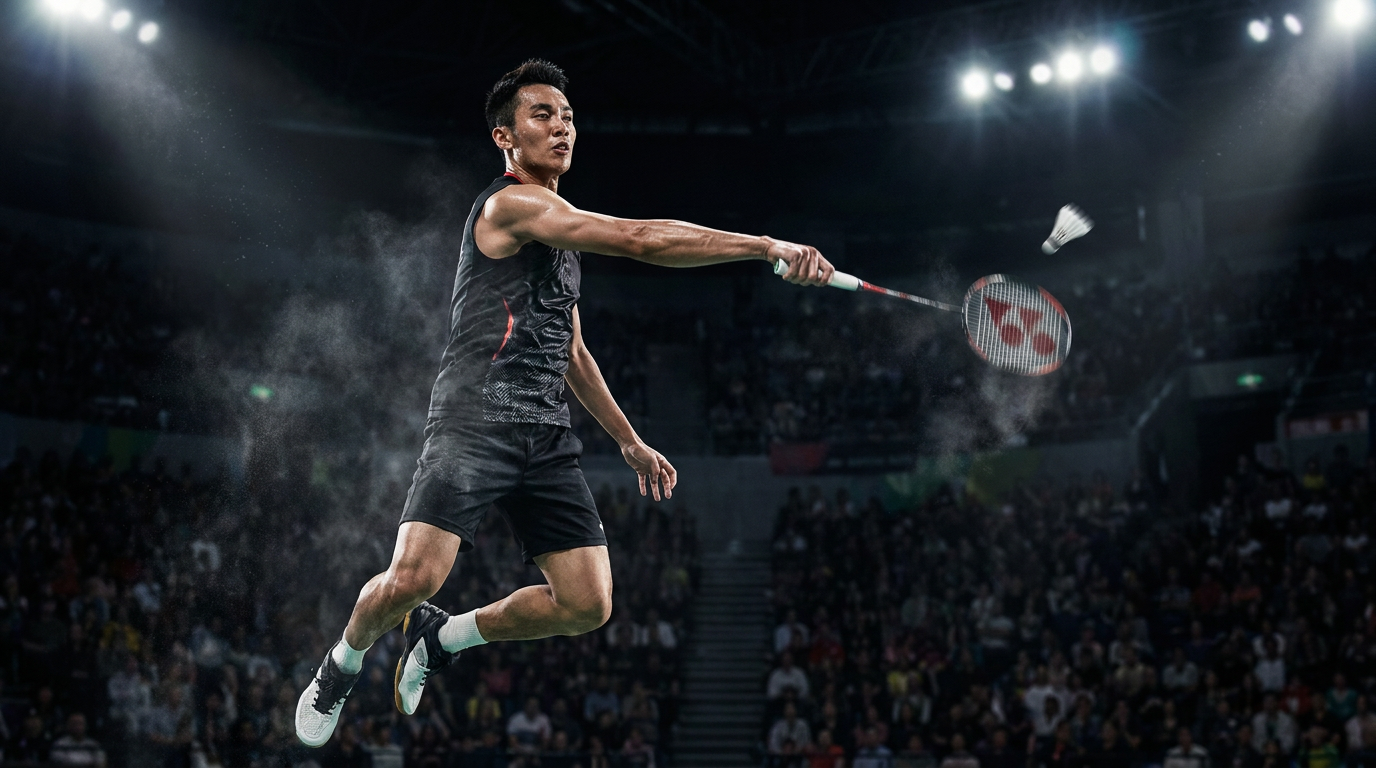
While suspended in the air, the player's body forms a distinct bow shape. The non-dominant arm points toward the shuttle to track it and maintain balance, while the dominant shoulder is pulled back, stretching the chest and core muscles. This pre-stretch stores elastic energy, much like pulling back the string of a longbow.[3][6]
As the strike initiates, the core violently contracts, snapping the torso forward. This rotational force is then transferred to the shoulder. The shoulder undergoes rapid internal rotation, whipping the upper arm forward. However, the true secret to the badminton smash's unparalleled speed lies in the final links of the kinetic chain: the elbow and the wrist.[3]

As the strike initiates, the core violently contracts, snapping the torso forward.
Unlike a tennis serve, which relies heavily on the entire arm swinging through the ball, the badminton smash is heavily dependent on forearm pronation. In the final milliseconds before impact, the forearm rotates inward with explosive speed. This pronation, combined with a relaxed wrist that snaps at the exact moment of contact, creates a whip-like effect that multiplies the racket head's velocity exponentially.[2][3][6]
The equipment plays a crucial, symbiotic role in this energy transfer. Modern badminton rackets are marvels of carbon-graphite engineering, weighing as little as 70 to 90 grams. Their extreme lightness allows players to accelerate the racket head to speeds that would be impossible with heavier sporting equipment, while specialized resin matrices prevent the shaft from snapping under the immense torque.[1][6]
String tension is equally vital. Elite players often string their rackets at tensions between 30 and 34 pounds. At these high tensions, the string bed acts less like a trampoline and more like a solid board, requiring immense swing speed to activate the 'sweet spot' but rewarding perfect timing with maximum repulsion and minimal energy loss.[1][2]
The projectile itself is a study in extreme aerodynamics. A standard shuttlecock consists of 16 goose feathers embedded in a cork base. When struck at 500 km/h, the feathers compress inward, transforming the shuttlecock into a highly aerodynamic dart. This compression drastically reduces air resistance during the initial phase of flight, allowing it to clear the net in roughly 0.06 seconds.[2][5]
However, this incredible speed is fleeting. Once the shuttlecock crosses the net, the feathers flare back out to their original shape. This creates massive aerodynamic drag, causing the projectile to decelerate more rapidly than any other ball in sports. A shuttlecock that leaves the racket at 500 km/h may be traveling at less than 100 km/h by the time it reaches the defender.[2][3][6]

This rapid deceleration is what makes the sport playable. If the shuttlecock maintained its initial velocity, human reaction times—which hover around 0.2 seconds—would be entirely insufficient to mount a defense. Defenders rely on this drag, coupled with intense visual anticipation and a perfectly timed 'split step,' to return the fastest strikes.[3][5]
The split step is a small hop executed just as the opponent strikes the shuttle. By landing on the balls of their feet exactly as the shuttle crosses the net, defenders utilize the stretch-shortening cycle of their calf muscles to explode in any direction, turning an impossible 500 km/h projectile into a manageable, albeit blistering, rally.[2][6]

As sports science advances, researchers are continuously looking for the absolute physiological ceiling of the jump smash. High-speed motion capture and force-plate analysis are helping coaches refine the kinetic chain, eliminating microscopic inefficiencies in a player's biomechanics to squeeze out an extra 10 or 20 kilometers per hour.[1][3]
Whether the 600 km/h barrier will eventually be broken remains a subject of debate among biomechanists and equipment manufacturers. While racket technology continues to evolve, the human shoulder and elbow can only withstand so much torque. For now, the 565 km/h smash stands as a testament to the breathtaking intersection of human athleticism and aerodynamic physics.[1][4][6]
How we got here
2013
Malaysia's Tan Boon Heong sets a long-standing speed record of 493 km/h under controlled testing conditions.
2017
Denmark's Mads Pieler Kolding records a 426 km/h smash during actual tournament play at the Premier Badminton League.
July 2023
Satwiksairaj Rankireddy and Pearly Tan shatter the absolute world records, hitting 565 km/h and 438 km/h respectively at Yonex's testing facility.
Viewpoints in depth
Sports Biomechanists
Focus on the kinetic chain, energy transfer, and the physiological limits of the human shoulder and forearm.
For biomechanists, the badminton smash is a masterclass in the stretch-shortening cycle and rotational physics. They study how energy originates from the floor during the jump, transfers through the hips and torso, and culminates in explosive forearm pronation. Their primary concern is mapping this kinetic chain to find microscopic inefficiencies that can be corrected to increase speed, while also studying the extreme torque placed on the shoulder joint to prevent rotator cuff injuries in elite athletes.
Equipment Manufacturers
Emphasize the role of carbon-graphite engineering, string repulsion, and aerodynamic racket frames in achieving record speeds.
Brands like Yonex and Victor view the 500 km/h barrier as an engineering challenge as much as an athletic one. They focus on developing ultra-stiff, lightweight carbon fiber shafts that snap back into place instantly upon swinging, transferring maximum energy to the shuttle. Manufacturers are constantly experimenting with aerodynamic frame shapes to reduce air resistance during the swing and testing new synthetic string matrices that can hold 34+ pounds of tension without snapping.
Elite Players & Coaches
Prioritize the tactical application of the smash, focusing on timing, footwork, and the defensive split-step required to return it.
While coaches appreciate the raw speed, they emphasize that a 500 km/h smash is useless without the footwork required to get behind the shuttlecock in the first place. From a player's perspective, the focus is on anticipation and the 'split step'—the crucial defensive hop that allows a player to react to a projectile moving faster than a Formula 1 car. They view the smash not just as a display of power, but as the final piece of a tactical setup designed to force a weak return.
What we don't know
- The absolute physiological limit of human forearm pronation before injury becomes inevitable.
- How the gradual introduction of synthetic feather shuttlecocks will alter peak smash speeds in the coming decade.
Key terms
- Kinetic Chain
- The sequence of body segments and joints working together to transfer energy from the ground, through the body, and into the racket.
- Forearm Pronation
- The inward rotation of the forearm and wrist just before impact, which creates a whip-like effect and generates the majority of the racket head's final speed.
- Split Step
- A small, timed hop executed by a defending player just as the opponent strikes the shuttle, allowing them to push off explosively in any direction.
- Aerodynamic Drag
- The air resistance that acts against the shuttlecock's feathers, causing it to decelerate exponentially as it travels across the court.
Frequently asked
How fast is the fastest badminton smash?
The current Guinness World Record for the fastest male badminton hit is 565 km/h (351 mph), set by India's Satwiksairaj Rankireddy. The female record is 438 km/h, set by Malaysia's Pearly Tan.
Why doesn't a 500 km/h shuttlecock injure players?
A shuttlecock only weighs about 5 grams and experiences massive aerodynamic drag. By the time it crosses the net and reaches the defender, its speed has typically dropped to under 100 km/h, greatly reducing its kinetic energy.
Can amateur players hit the shuttlecock this fast?
No. While amateurs can hit impressive speeds (often between 150 and 250 km/h), reaching 400+ km/h requires elite biomechanical efficiency, perfect forearm pronation, and specialized high-tension equipment.
Sources
Source coverage
6 outlets
3 viewpoints surfaced






[1]YonexEquipment Manufacturers
New Smash Speed Records Set by Yonex Athletes
Read on Yonex →[2]Badminton World FederationElite Players & Coaches
The Science of the Smash: Breaking the 500km/h Barrier
Read on Badminton World Federation →[3]Journal of Sports SciencesSports Biomechanists
Biomechanical analysis of the badminton jump smash: A review
Read on Journal of Sports Sciences →[4]Guinness World RecordsEquipment Manufacturers
Fastest badminton hit (male)
Read on Guinness World Records →[5]BBC SportElite Players & Coaches
How badminton became the fastest sport on earth
Read on BBC Sport →[6]Factlen Editorial TeamSports Biomechanists
Synthesis by Factlen editorial team
Read on Factlen Editorial Team →

More in sports
See all 9 stories →Standings
Marrit Steenbergen and Ilya Kharun Crowned Overall Champions of 2026 Mare Nostrum Swim Tour
7 sources
Injury
Akane Yamaguchi Completes Injury Comeback With Dominant Australian Open Title
6 sources
NWSL Transfer
Sam Kerr Returns to the NWSL, Signing with Gotham FC After Historic Chelsea Run
6 sources

Standings
BWF World Rankings Shakeup: Victor Lai Cracks Top 10 as An Se Young Extends Historic Reign
6 sources

Every angle. Every day.
Get sports stories with full source coverage and perspective breakdowns delivered to your inbox.