
The Rise of the 'Plyscraper': How Mass Timber is Rewriting the Skyline
Engineered wood is replacing steel and concrete in high-rises, offering a massive reduction in carbon emissions and a new aesthetic for modern cities.
By Factlen Editorial Team
- Mass Timber Advocates
- Architects and developers pushing for rapid adoption of engineered wood.
- Forestry & Climate Researchers
- Scientists analyzing the ecological math of timber demand.
- Building Safety Regulators
- Code officials and fire engineers evaluating structural risks.
What's not represented
- · Traditional Steel & Concrete Manufacturers
- · Local Fire Departments
Why this matters
The construction industry is one of the world's largest polluters. Shifting to mass timber could transform our cities from carbon emitters into massive carbon sinks, fundamentally altering the climate math of urban growth.
Key points
- Mass timber, particularly cross-laminated timber (CLT), is replacing steel and concrete in high-rise construction.
- Engineered wood acts as a massive carbon sink, locking away CO2 absorbed by trees during their growth.
- A Yale study found widespread adoption of CLT could reduce global emissions by up to 39 gigatons by 2100.
- Mass timber chars predictably in a fire, creating an insulating layer that protects the structural core.
- Updated international building codes now permit mass timber structures to reach up to 18 stories.
- Hybrid designs combining concrete cores with timber frames are pushing 'plyscrapers' beyond 30 stories.
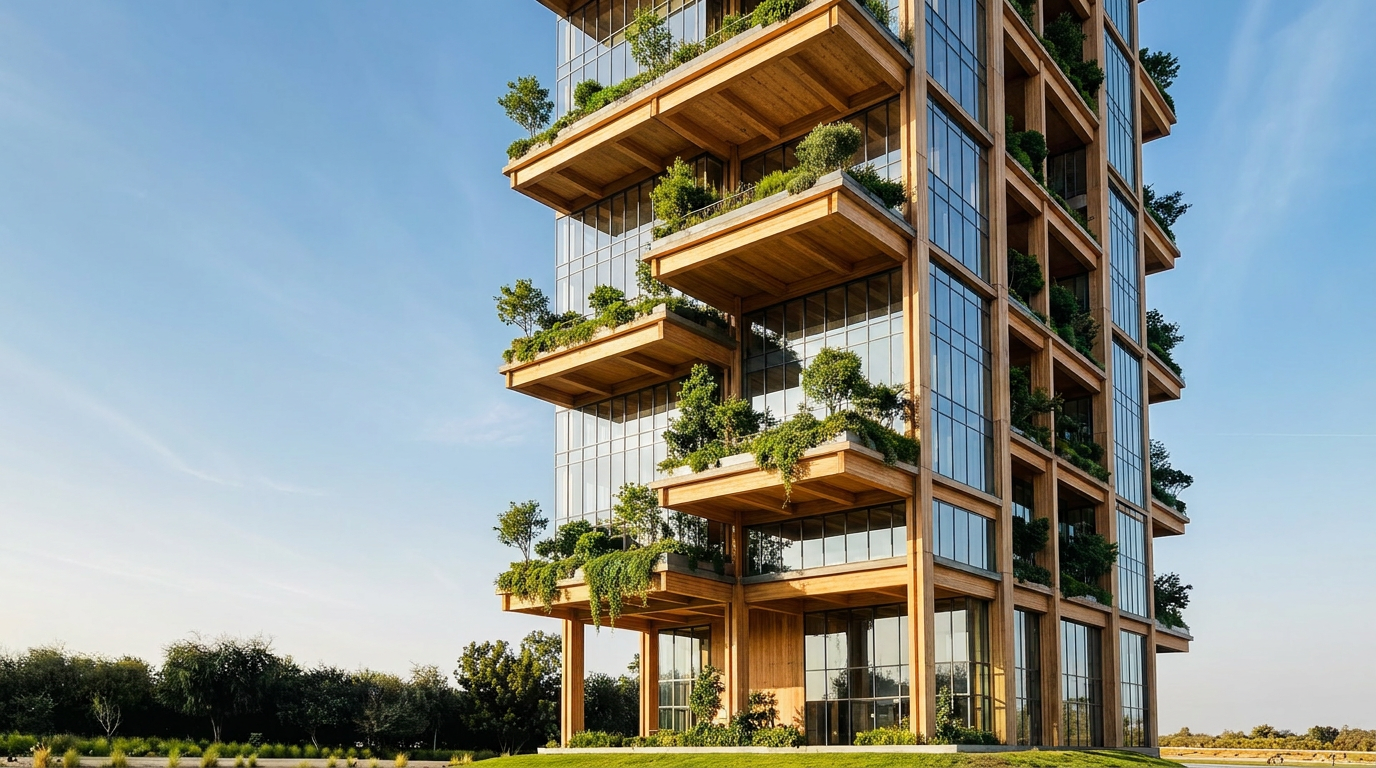
The skyline of Milwaukee is quietly rewriting the rules of modern architecture. Rising from the banks of the Milwaukee River is The Edison, a 31-story residential tower that will reach 110 meters into the sky when completed in 2026. But unlike the steel-and-glass monoliths that have defined urban centers for a century, The Edison is built primarily of wood. It is part of a rapidly accelerating global movement toward "plyscrapers"—high-rise buildings constructed from advanced engineered wood. From the 39-story Atlassian Central hybrid tower under construction in Sydney to the booming timber districts of Bordeaux, France, architects are abandoning traditional materials in favor of a technology known as mass timber.[3][4][7]
The shift is driven by a stark environmental reality. The traditional pillars of high-rise construction—concrete and steel—are produced by extractive industries that mine raw materials and heat them to extreme temperatures using fossil fuels. Together, the manufacturing of concrete and steel accounts for roughly 14 percent of all global carbon dioxide emissions. This "embodied carbon" means that a standard skyscraper has already done massive environmental damage before the lights are even turned on. As urban populations swell and the demand for new housing skyrockets, the construction industry has been searching for a structural alternative that does not accelerate the climate crisis.[4][5]
Enter mass timber. Unlike the light-frame two-by-fours used in residential homebuilding, mass timber relies on massive, manufactured slabs of wood. The most common variant, cross-laminated timber (CLT), is created by taking smaller planks of wood and gluing them together in alternating, perpendicular layers under immense pressure. This cross-hatching technique neutralizes the natural weaknesses of the wood grain, resulting in panels that are surprisingly strong—often rivaling or exceeding the strength of steel by weight. These giant puzzle pieces can be used for floors, walls, and elevator shafts, while a related product called glulam (glued-laminated timber) is used for heavy load-bearing columns and beams.[4]

The environmental math of mass timber is what has captivated climate scientists. As trees grow, they undergo photosynthesis, pulling carbon dioxide out of the atmosphere and storing it in their trunks and branches. When those trees are harvested and engineered into CLT panels, that carbon remains locked inside the wood for the entire lifespan of the building. Instead of emitting carbon during the manufacturing process, a mass timber building acts as a massive "carbon sink." A single cubic meter of engineered wood can store approximately one ton of carbon dioxide, effectively turning urban skylines into extensions of the forest.[5]
The potential scale of this climate intervention is staggering. A comprehensive study led by researchers at the Yale School of the Environment modeled the global impact of widespread mass timber adoption. The research team found that if 30 to 60 percent of new urban buildings transitioned to cross-laminated timber between now and 2100, it could reduce life-cycle greenhouse gas emissions by up to 39 gigatons. To put that in perspective, that figure is roughly equivalent to the entire planet's annual energy-related carbon emissions.[1]
However, this optimistic carbon math immediately raises a critical ecological question: Will building wooden skyscrapers lead to the catastrophic deforestation of the world's remaining old-growth forests? The Yale study directly addressed this paradox, finding that increased demand for mass timber actually incentivizes the opposite outcome. Because modern timber harvesting relies on purpose-grown, intensively managed forests, a spike in demand encourages the market to protect existing forestland and plant new trees. The researchers estimate that a global pivot to mass timber could expand productive forestland by an area roughly the size of Germany by the end of the century.[1]

The Yale study directly addressed this paradox, finding that increased demand for mass timber actually incentivizes the opposite outcome.
That ecological benefit comes with a strict caveat. The carbon-negative equation only holds true if the timber is sourced from certified, sustainably managed forests. If the supply chain relies on clear-cutting natural ecosystems without replanting, the carbon released by the destroyed soil and root networks would negate the benefits of the timber building. Consequently, architects and developers are increasingly relying on strict chain-of-custody certifications, such as those from the Forest Stewardship Council, to ensure their materials are genuinely regenerative rather than extractive.[5]
Beyond the environmental impact, the most persistent public skepticism surrounding wooden skyscrapers involves fire safety. The intuitive fear is that a 30-story wooden building is essentially a towering matchstick. In reality, mass timber performs exceptionally well in a fire, often outperforming unprotected steel. When exposed to intense heat, steel beams can warp, buckle, and fail suddenly without warning. Mass timber, because of its sheer density, behaves entirely differently.[6]
When a massive CLT panel is exposed to flames, the outer layer burns and creates a thick layer of char. This charred exterior acts as a natural, highly effective insulator, preventing oxygen from reaching the inner layers of the wood and protecting the structural core from the heat. During rigorous full-scale burn tests, mass timber compartments have demonstrated a predictable char rate that allows the building to maintain its load-bearing capacity for hours, providing ample time for evacuation and firefighting.[6]

Recognizing this structural resilience, regulatory bodies have rapidly updated their rulebooks. In recent years, the International Code Council (ICC) overhauled the International Building Code—the model for jurisdictions worldwide—to introduce new Type IV construction categories. These updates formally recognize the fire resistance of encapsulated mass timber and explicitly permit wooden structures to rise up to 18 stories without requiring special variances. This regulatory unlock has triggered a wave of new development, moving mass timber from experimental boutique projects into mainstream commercial real estate.[2]
Developers are also drawn to the sheer efficiency of the material. Mass timber buildings are essentially assembled like giant pieces of flat-pack furniture. The CLT panels and glulam beams are precision-milled in a factory to exact specifications, complete with pre-cut holes for plumbing and electrical wiring. They are then shipped to the site on flatbed trucks and bolted together by a relatively small crew. This prefabrication process can reduce on-site construction time by up to 25 percent, significantly lowering labor costs and minimizing noise and disruption in dense urban neighborhoods.[4][9]

Despite the rapid advancements, pure timber buildings do face physical height limits. As a wooden structure gets taller, the lower support columns must become increasingly thick to bear the weight, eventually consuming too much valuable floor space. To solve this, engineers have embraced hybrid designs for the world's tallest projects. Record-breaking towers like The Edison and Atlassian Central utilize a concrete foundation and a central concrete elevator core to provide lateral stiffness against wind and earthquakes, while the surrounding floors and columns are entirely mass timber.[3][4][7]
This hybrid approach represents a pragmatic middle ground, drastically reducing the building's carbon footprint while achieving heights that wood alone cannot safely support. As moisture-control techniques improve and sustainable forestry supply chains mature, the architectural consensus is shifting. The era of default concrete and steel is ending, making way for a new generation of buildings that actively heal the atmosphere they reach into.[8]
How we got here
2012
Early mass timber concepts begin gaining traction among sustainable architects.
2019
Mjøstårnet in Norway is completed, proving the viability of high-rise timber.
2021
The International Code Council updates the IBC to allow mass timber buildings up to 18 stories.
2022
Ascent MKE in Milwaukee becomes the world's tallest timber building at 25 stories.
2025
Groundbreaking begins on The Edison in Milwaukee, set to reach 31 stories.
Viewpoints in depth
Mass Timber Advocates
Architects and developers pushing for rapid adoption.
This camp views engineered wood as the only viable path to decarbonizing the construction industry. They emphasize that prefabrication reduces on-site labor and waste, while the exposed wood interiors offer biophilic benefits that improve occupant well-being. For developers, the faster construction timelines offset the currently higher material costs of CLT.
Forestry & Climate Researchers
Scientists analyzing the ecological math of timber demand.
Ecologists stress that the climate benefits of mass timber are entirely dependent on sustainable forestry. While models show that increased demand can incentivize the planting of new purpose-grown forests, researchers warn that without strict chain-of-custody certifications, a boom in timber construction could inadvertently lead to the depletion of vital old-growth ecosystems.
Building Safety Regulators
Code officials and fire engineers evaluating structural risks.
Regulators focus on empirical burn tests and structural integrity. While acknowledging that mass timber chars predictably and protects its core, they mandate strict encapsulation rules—often requiring the wood to be covered in fire-rated gypsum board in the tallest structures—to ensure buildings meet the life-safety standards traditionally achieved by non-combustible concrete.
What we don't know
- How the long-term durability of the adhesives used in CLT panels will hold up over multiple decades of structural stress.
- Whether the global supply chain of sustainably certified lumber can scale fast enough to meet the surging demand from mega-developers.
Key terms
- Cross-Laminated Timber (CLT)
- Engineered wood panels made by gluing layers of solid sawn lumber together perpendicularly for immense strength.
- Embodied Carbon
- The total greenhouse gas emissions generated during the extraction, manufacturing, and transportation of building materials.
- Biogenic Carbon Sequestration
- The process by which trees absorb carbon dioxide from the atmosphere and store it in their biological matter.
- Glulam
- Structural beams and columns made by gluing layers of timber parallel to the wood's grain.
- Hybrid-Timber Construction
- A building method that combines mass timber with traditional materials like concrete or steel, typically using a concrete core for stability.
Frequently asked
Is mass timber safe in a fire?
Yes. Unlike light-frame wood, massive timber blocks char on the outside when exposed to fire, creating an insulating layer that protects the structural core from failing.
Will building with wood cause deforestation?
Research indicates that increased demand for mass timber incentivizes the expansion of sustainably managed, purpose-grown forests, which can actually increase global tree cover.
How tall can a wooden building get?
Current building codes in many regions allow pure mass timber buildings up to 18 stories, though hybrid structures combining wood with concrete cores are reaching nearly 40 stories.
Is mass timber stronger than steel?
By weight, cross-laminated timber (CLT) can rival or exceed the strength of steel, though timber beams must be physically thicker to achieve the same load-bearing capacity.
Sources
Source coverage
9 outlets
3 viewpoints surfaced









[1]Yale School of the EnvironmentForestry & Climate Researchers
Replacing concrete and steel with mass timber could significantly reduce global carbon emissions
Read on Yale School of the Environment →[2]International Code CouncilBuilding Safety Regulators
2021 International Building Code: Type IV Construction
Read on International Code Council →[3]Construction BriefingMass Timber Advocates
Construction of 'world's tallest' mass timber high-rise underway
Read on Construction Briefing →[4]Knowable MagazineForestry & Climate Researchers
Sustainable Building Effort Reaches New Heights with Wooden Skyscrapers
Read on Knowable Magazine →[5]Lever ArchitectureMass Timber Advocates
Carbon Sequestration in Timber Structures
Read on Lever Architecture →[6]DBF SignalBuilding Safety Regulators
How New Codes and Insurance Guidance Are Unlocking Taller Wood Buildings
Read on DBF Signal →[7]Woodworking NetworkMass Timber Advocates
Construction begins on world's tallest hybrid-timber building
Read on Woodworking Network →[8]Factlen Editorial TeamForestry & Climate Researchers
Synthesis by Factlen editorial team
Read on Factlen Editorial Team →[9]Vellum ArchitectureMass Timber Advocates
Why Mass Timber Construction is the Future
Read on Vellum Architecture →
Every angle. Every day.
Get culture stories with full source coverage and perspective breakdowns delivered to your inbox.