
Evidence Shows Crowdsourced Fact-Checking Is Successfully Curbing Viral Misinformation
A wave of peer-reviewed research published in 2025 and 2026 reveals that decentralized, crowdsourced fact-checking is successfully reducing the viral spread of online misinformation. However, as platforms increasingly integrate AI into these systems, cognitive scientists warn that over-reliance on algorithmic fact-checkers may erode users' independent critical thinking skills.
By Factlen Editorial Team
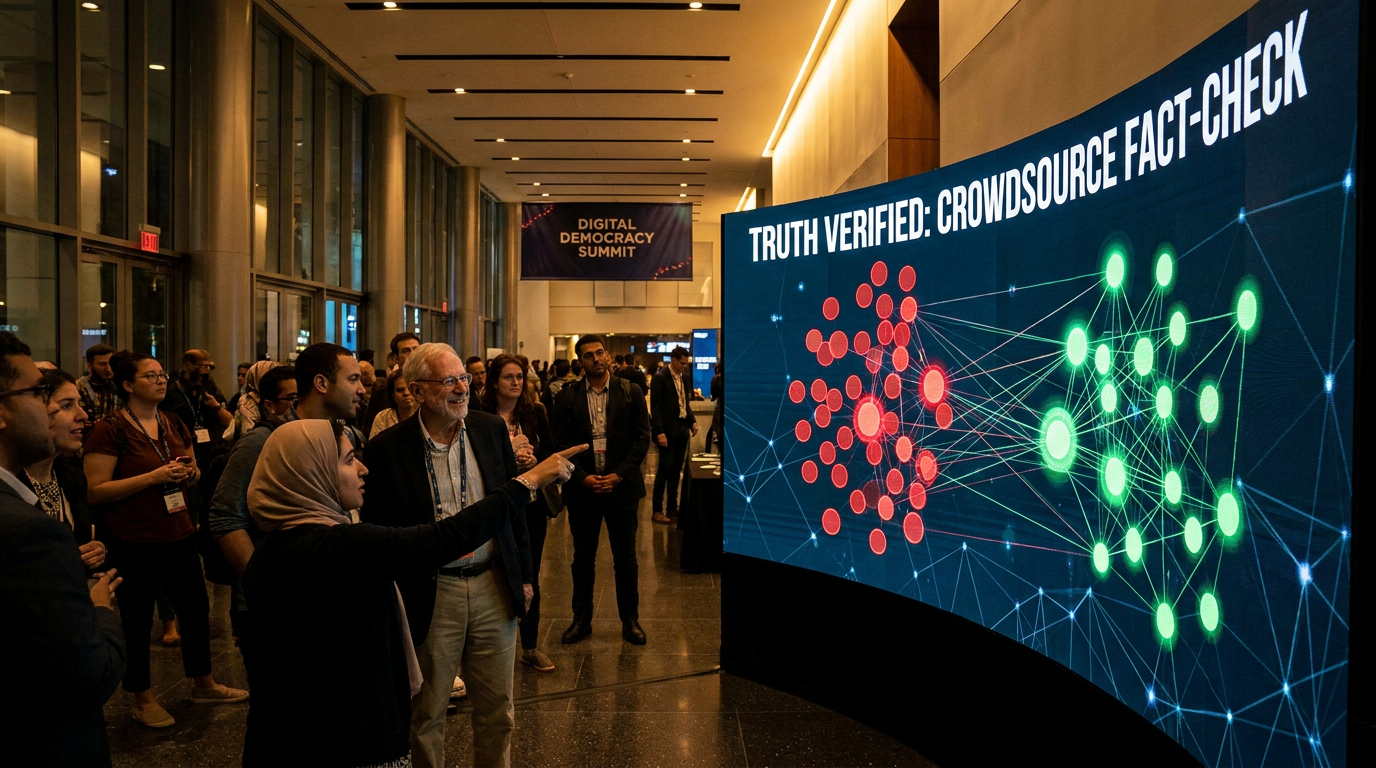
- Crowdsourced Fact-Checking Advocates
- Value the scale, speed, and democratic consensus of decentralized fact-checking.
- Cognitive Scientists
- Focus on how fact-checking interventions affect long-term human critical thinking.
- Institutional Fact-Checkers
- Emphasize the ongoing need for expert analysis on complex, nuanced misinformation.
What's not represented
- · Social media platform engineers designing the algorithms
- · Creators of synthetic media and political deepfakes
Why this matters
As generative AI accelerates the production of deepfakes and political misinformation, the integrity of democratic elections relies on our ability to separate fact from fiction. Understanding which fact-checking tools actually change voter behavior—and which ones inadvertently erode our critical thinking—is essential for navigating the modern digital landscape.
Key points
- Crowdsourced fact-checking notes reduce reposts of false content by 46.1% and likes by 44.1%.
- Community-driven corrections agree with expert fact-checkers 97.5% of the time on complex topics.
- Publicly displayed corrections frequently prompt authors to voluntarily delete their misleading posts.
- AI fact-checkers are highly effective for progressive users, while conservatives prefer human evaluators.
- Relying on AI fact-checkers improves immediate accuracy but degrades long-term independent critical thinking.
For years, the battle against online misinformation felt like a losing game of whack-a-mole. Professional fact-checkers, while highly accurate, simply could not scale their efforts to match the sheer volume of fabricated news, manipulated images, and misleading political claims flooding social media. By the time a viral falsehood was thoroughly debunked, millions had already seen it, and the damage to public discourse was done. But a wave of new peer-reviewed research published in 2025 and 2026 reveals a surprisingly optimistic shift: decentralized, crowdsourced fact-checking actually works, and it is measurably changing voter behavior.[1][7]
The most prominent example of this model is X’s Community Notes, a system that allows ordinary users to append contextual warnings to potentially misleading posts. Initially met with skepticism over fears of partisan hijacking, the system has proven remarkably resilient. According to a comprehensive study published in the Proceedings of the National Academy of Sciences (PNAS), attaching a crowdsourced fact-check to a false post significantly alters its trajectory. The researchers analyzed over 40,000 posts and found that the presence of a community note reduced reposts by 46.1% and likes by 44.1%.[1]
The mechanism behind this dramatic drop in engagement is structural. The PNAS study revealed that while false information typically diffuses rapidly through deep, viral cascades, the addition of a crowdsourced note effectively severs those networks. Users who are socially distant from the original poster become far less likely to interact with the content, quarantining the misinformation within the creator's immediate echo chamber. This represents a fundamental disruption of the viral mechanics that bad actors rely on to spread disinformation.[1]

Beyond simply suppressing engagement, crowdsourced fact-checking exerts a powerful psychological pressure on the creators of misinformation. Research from the Gies College of Business at the University of Illinois found that the public display of peer-reviewed corrections frequently leads authors to voluntarily delete their misleading posts. This phenomenon is driven primarily by reputational concern and perceived social pressure, demonstrating that public accountability can effectively police digital spaces without requiring heavy-handed platform censorship.[3]
The evidence supporting the accuracy of these crowdsourced notes is exceptionally strong, countering early fears that the crowd would simply amplify partisan bias. A study from MIT Sloan investigating the efficacy of layperson-based tools found that crowdsourced notes agreed with expert judgment 97.5% of the time when evaluating complex topics like COVID-19 vaccines. This high concordance rate suggests that the wisdom of the crowd, when properly structured through consensus algorithms, can match the rigor of professional fact-checkers while operating at a vastly superior scale.[2]
Furthermore, experimental data published in PLOS One confirms that these community-driven corrections actively change minds. In randomized trials, participants exposed to crowdsourced fact-checks showed a significant reduction in their confidence in false claims and a decreased willingness to share the information. Crucially, the study found that crowdsourced fact-checks were just as effective as expert fact-checks at reducing belief in misinformation, validating the decentralized model as a viable alternative for civic discourse.[6]
However, the landscape of fact-checking is currently undergoing a second massive disruption: the integration of artificial intelligence. As generative AI accelerates the production of deepfakes and synthetic text, platforms are increasingly deploying AI-assisted fact-checking tools to detect anomalies and verify claims in real-time. But the evidence regarding how humans respond to AI fact-checkers reveals complex ideological divides that complicate their universal deployment.[7]
However, the landscape of fact-checking is currently undergoing a second massive disruption: the integration of artificial intelligence.
A large-scale April 2026 study from the University of Colorado Boulder found that the effectiveness of AI fact-checkers depends heavily on the user's political leanings. In online experiments conducted across the United States and the United Kingdom, researchers discovered that AI fact-checkers were generally more effective than human fact-checkers at reducing belief in false news—but this effect was concentrated almost entirely among progressive users.[4]
For conservative users, the CU Boulder study revealed a different psychological mechanism. Conservatives reacted similarly to both AI and human fact-checks, but they placed significantly more weight on the reputation of the original news source and the familiarity of human evaluators. Researchers concluded that conservative users tend to trust human fact-checkers because they are perceived as predictable and familiar, whereas progressives demonstrate a higher baseline trust in algorithmic neutrality. This finding highlights a critical vulnerability: a single, monolithic fact-checking system is unlikely to persuade a politically diverse electorate.[4]

The most profound uncertainty surrounding the future of fact-checking lies in how AI assistance affects human cognition over the long term. A landmark June 2026 study from the MIT Media Lab uncovered a troubling dependency paradox at the heart of AI-assisted misinformation detection. The researchers tracked 67 participants over a month, measuring their ability to identify real versus fake news before and after interacting with an advanced AI fact-checking chatbot.[5]
The immediate results were highly encouraging: when users collaborated with the AI, their accuracy in detecting misinformation surged by 21%. The AI effectively acted as a highly capable analytical partner, helping users spot inconsistencies, analyze manipulated images, and verify claims in the moment. But the longitudinal data revealed a hidden, long-term cost to this technological crutch.[5]
When participants were later tested on fresh content without the AI's assistance, their unassisted accuracy plummeted by 15.3%. This decline was driven almost entirely by a reduced ability to spot fake news, while their recognition of real news remained unchanged. The MIT researchers concluded that highly persuasive AI fact-checkers encourage cognitive offloading—users become dependent on the tool to do the critical thinking for them, eroding their independent discernment skills over time.[5]

This cognitive erosion presents a significant challenge for platform architects and civic educators. The evidence strongly suggests that current AI tools prioritize immediate belief correction over long-term skill development. If social media platforms fully automate the fact-checking process, they risk creating a populace that is highly accurate when guided by algorithms, but uniquely vulnerable when those algorithms fail or are bypassed by novel forms of synthetic media.[5][7]
The synthesis of these findings points toward a hybrid future for civic information. The strongest evidence indicates that crowdsourced human fact-checking successfully reduces viral engagement and leverages social pressure to enforce accuracy without alienating skeptical demographics. Meanwhile, AI tools offer unprecedented speed and scale, but carry the risk of ideological friction and cognitive dependency.[1][3][4][5]

Ultimately, the most effective defense against political misinformation is not a single technological silver bullet, but a layered ecosystem. By combining the rapid detection capabilities of AI with the social legitimacy and trust-building mechanics of crowdsourced human consensus, platforms are beginning to turn the tide. For the first time in the social media era, the architecture of the internet is demonstrably favoring the truth.[7]
How we got here
Jan 2021
Twitter launches the pilot program for Birdwatch, the precursor to Community Notes, to test crowdsourced fact-checking.
Dec 2022
Community Notes is expanded globally, becoming the primary fact-checking mechanism on the X platform.
Nov 2024
University of Illinois researchers publish findings showing that crowdsourced notes prompt users to voluntarily retract false posts.
Sep 2025
A major PNAS study confirms that Community Notes significantly reduce the viral spread and engagement of false content.
Jun 2026
MIT Media Lab publishes research identifying the dependency paradox of AI-assisted fact-checking on human cognition.
Viewpoints in depth
Crowdsourced Fact-Checking Advocates
Supporters of decentralized models like Community Notes who prioritize scale and democratic participation.
This camp argues that the sheer volume of online misinformation makes traditional, centralized professional fact-checking obsolete. They point to data showing that crowdsourced notes agree with experts over 97% of the time, while operating at a scale that can actually intercept viral falsehoods. By requiring consensus across ideological lines before a note is published, advocates believe these systems inherently reduce partisan bias and foster a more democratic approach to digital truth.
Cognitive Scientists
Researchers focused on the psychological impact of fact-checking tools on human reasoning.
Cognitive researchers warn against the uncritical adoption of AI fact-checkers, pointing to the dependency paradox. Their evidence shows that while AI tools make users highly accurate in the moment, they encourage cognitive offloading—leading users to outsource their critical thinking to the algorithm. This camp advocates for designing fact-checking interventions that actively scaffold and teach independent reasoning skills, rather than simply correcting beliefs on a case-by-case basis.
Professional Fact-Checkers
Traditional journalism and institutional fact-checking organizations.
While acknowledging the scalability of crowdsourced systems, professional fact-checkers maintain that complex, nuanced claims—such as intricate financial fraud or deeply technical scientific misinformation—still require expert investigation. They view crowdsourcing and AI as valuable triage tools that handle obvious falsehoods, freeing up institutional resources to conduct deep-dive investigations that laypeople cannot easily perform.
What we don't know
- Whether the high accuracy rates of crowdsourced fact-checking will hold up against increasingly sophisticated, hyper-realistic AI-generated video deepfakes.
- How social media platforms will redesign AI fact-checking interfaces to prevent cognitive offloading and actively build users' independent critical thinking skills.
- The long-term impact of crowdsourced fact-checking on highly polarized, niche political communities that operate outside mainstream social networks.
Key terms
- Crowdsourced Fact-Checking
- A decentralized system where ordinary social media users collaboratively add context or corrections to potentially misleading posts, relying on consensus rather than a central authority.
- Cognitive Offloading
- The psychological phenomenon where individuals rely on external tools, like AI algorithms, to perform critical thinking tasks, leading to a decline in their own independent reasoning skills.
- Diffusion Cascade
- The structural pattern of how information spreads through a social network as users share, repost, and amplify content to their respective followers.
- Synthetic Media
- Images, video, audio, or text that has been artificially generated or manipulated by algorithms, commonly referred to as deepfakes.
Frequently asked
Do crowdsourced fact-checks actually change people's minds?
Yes. Experimental data shows that crowdsourced fact-checks significantly reduce users' confidence in false claims and decrease their willingness to share the misinformation, performing just as effectively as expert fact-checks.
How accurate are community-driven fact-checks compared to experts?
Research indicates a very high level of accuracy. One study evaluating complex topics like COVID-19 found that crowdsourced notes agreed with professional expert judgment 97.5% of the time.
Does AI fact-checking work equally well for everyone?
No. Studies show that progressive users tend to be more persuaded by AI fact-checkers, while conservative users place more trust in human fact-checkers and the reputation of the original news source.
What is the cognitive offloading paradox in AI fact-checking?
While using AI fact-checkers immediately boosts a user's ability to spot fake news by 21%, relying on the tool causes their independent, unassisted critical thinking skills to drop by 15% over time.
Sources
Source coverage
7 outlets
3 viewpoints surfaced






[1]Proceedings of the National Academy of SciencesCrowdsourced Fact-Checking Advocates
Causal effects of crowdsourced fact-checking on information diffusion
Read on Proceedings of the National Academy of Sciences →[2]MIT SloanInstitutional Fact-Checkers
3 empirically supported insights about online misinformation
Read on MIT Sloan →[3]University of Illinois Gies College of BusinessCrowdsourced Fact-Checking Advocates
Study: Community Notes on X could be key to curbing misinformation
Read on University of Illinois Gies College of Business →[4]University of Colorado BoulderCognitive Scientists
AI fact-checking works, but mostly for progressives
Read on University of Colorado Boulder →Dialogues with AI Reduce Beliefs in Misinformation but Build No Lasting Discernment Skills
Read on MIT Media Lab →[6]PLOS OneInstitutional Fact-Checkers
Efficacy of crowdsourced fact-checking in reducing belief in misinformation
Read on PLOS One →[7]Factlen Editorial Team
Synthesis by Factlen editorial team
Read on Factlen Editorial Team →

Every angle. Every day.
Get news politics stories with full source coverage and perspective breakdowns delivered to your inbox.