
Solid-State Audio: Why Silicon MEMS Drivers Are Replacing Magnets in Your Next Earbuds
Microscopic silicon wafers are replacing century-old magnet and coil technology in wireless earbuds, promising lightning-fast audio and ultra-thin designs.
By Factlen Editorial Team
- Audio Engineers & Innovators
- Focused on the technical superiority and precision of silicon-based sound.
- Audiophiles & Reviewers
- Praising the treble clarity but cautious about low-end bass performance.
- Wearable Tech Analysts
- Highlighting the form-factor revolution for AR and smart devices.
What's not represented
- · Hearing Aid Manufacturers looking to leverage MEMS for medical-grade audio.
- · Traditional dynamic driver manufacturers facing market disruption.
Why this matters
For consumers, solid-state audio means the end of bulky, heavy earbuds and the muddy sound associated with traditional drivers. As this technology scales in 2026, buyers can expect audiophile-grade clarity in smaller, more durable, and more comfortable wearables.
Key points
- Solid-state MEMS drivers use silicon wafers instead of magnets and coils to generate sound.
- The technology offers lightning-fast transient response, eliminating the muddy distortion of traditional drivers.
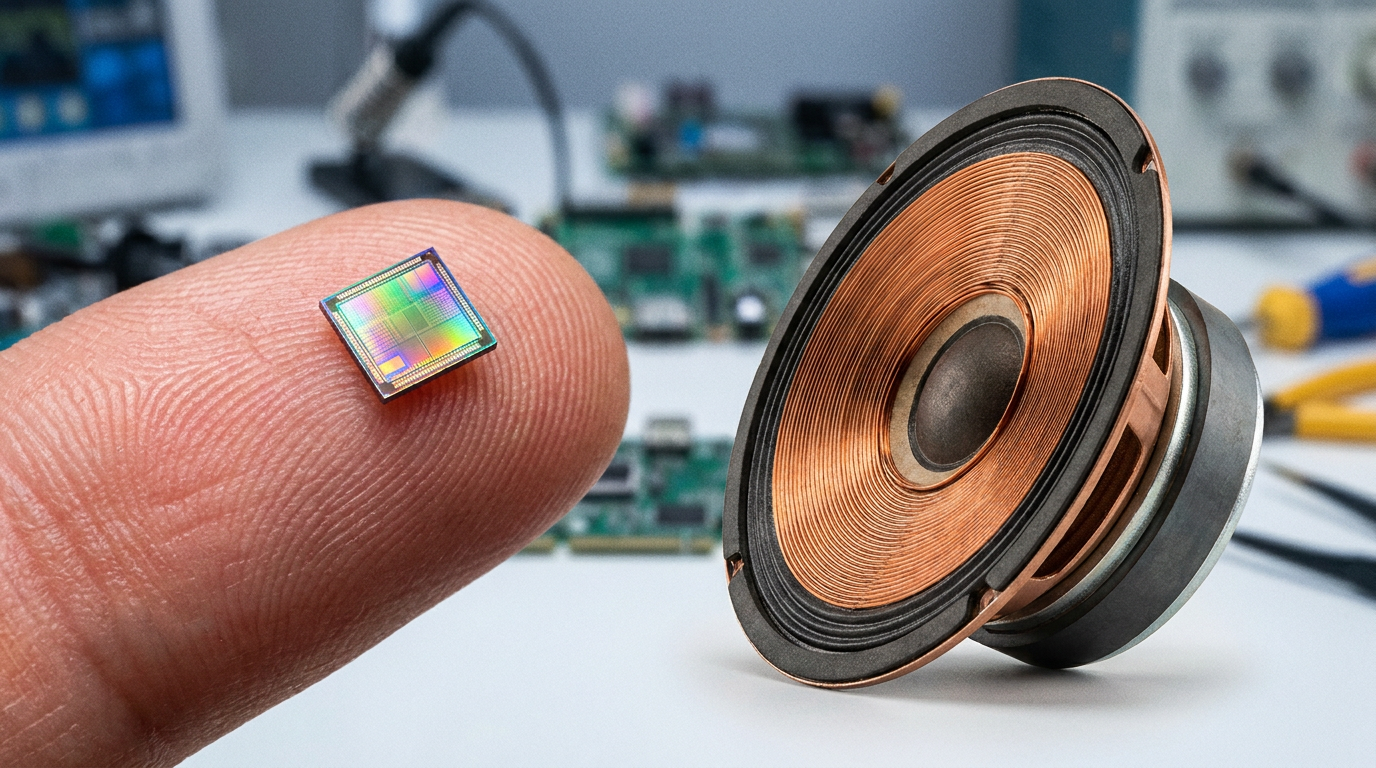
- Because MEMS chips are the size of a grain of rice, earbuds can now fit dedicated tweeters and woofers.
- The latest Lassen chip removes the need for a separate amplifier, cutting costs by 25%.
- Ultra-thin 1mm MEMS speakers are paving the way for better audio in AR glasses and smartwatches.
For nearly a century, the fundamental technology behind how we listen to recorded sound has remained stubbornly unchanged. Whether it is a towering stadium speaker, a desktop studio monitor, or the wireless earbuds sitting in your pocket, the acoustic mechanism relies on a familiar trio: a copper voice coil, a heavy magnet, and a plastic or paper cone pushing air. This mechanical system has been refined to its absolute limits over the decades, but it remains fundamentally bound by the physical constraints of weight, friction, and inertia.
But in 2026, the audio industry is undergoing its most significant hardware shift in decades. The heavy magnets and delicate copper coils that have defined speakers for generations are actively being replaced by solid-state silicon. This transition perfectly mirrors the computing industry's monumental shift from spinning hard disk drives to solid-state drives (SSDs). Just as SSDs eliminated the mechanical failure points of spinning platters, solid-state audio promises a future where internal speaker components are smaller, exponentially faster, and infinitely more reliable than their legacy mechanical predecessors.
The breakthrough technology driving this shift is known as MEMS, which stands for Micro-Electro-Mechanical Systems. Instead of relying on a bulky mechanical apparatus to push air, MEMS drivers utilize microscopic moving structures that are etched directly into silicon wafers. These are the exact same silicon materials and advanced semiconductor manufacturing processes used to build the computer processors inside modern smartphones and laptops, allowing for extreme precision at a microscopic scale that traditional speaker manufacturers could never achieve with plastic and glue.[4]
California-based xMEMS Labs has emerged as the primary architect of this acoustic revolution, holding over 190 patents for its proprietary piezoMEMS technology. When an electrical signal is applied to these specialized silicon chips, the piezoelectric material flexes and actuates with microscopic precision. This minute flexing generates sound pressure directly, entirely eliminating the need for traditional moving parts and the physical wear and tear that comes with them.[3]

The most immediate and noticeable benefit of solid-state audio is sheer speed. Traditional dynamic drivers carry physical mass; when an audio signal tells them to move, they take a fraction of a millisecond to overcome inertia, and another fraction of a millisecond to stop vibrating once the note ends. In complex, fast-paced music, this mechanical lag can create a muddy smear where notes bleed into one another.[3]
MEMS drivers, by contrast, offer a lightning-fast transient response. Because the silicon diaphragm is nearly weightless, notes start and stop instantly. Reviewers and audiophiles testing the first wave of MEMS-equipped earbuds have consistently noted that this surgical precision delivers unprecedented treble clarity, allowing listeners to hear distinct instruments and soundstage separation that traditional drivers simply cannot reproduce.[3]
Durability and manufacturing consistency also see a massive upgrade under the solid-state model. Traditional earbud drivers are assembled with microscopic drops of glue and delicate membranes that can warp or degrade under extreme humidity, temperature shifts, or physical drops. Solid-state silicon is virtually immune to these environmental variables, offering a part-to-part consistency that ensures every single earbud off the assembly line sounds exactly the same.[3]
Durability and manufacturing consistency also see a massive upgrade under the solid-state model.
However, the miniaturization enabled by MEMS is perhaps its most disruptive feature for the consumer electronics market. The company's recently announced Sycamore micro-speaker measures just one millimeter in thickness. To put that into perspective, this silicon wafer is roughly one-third the size of current dynamic driver systems, freeing up massive amounts of internal real estate inside wearable devices.[1]
This microscopic footprint is solving one of the biggest acoustic compromises in the wireless earbud industry: the lack of physical space. Historically, earbuds have been forced to rely on a single full-range driver to handle everything from the deepest bass rumbles to the highest-pitched vocals. Forcing one mechanical cone to do everything inevitably leads to acoustic distortion and a compromised listening experience.[2]

With MEMS tweeters taking up no more space than a grain of rice, manufacturers are now widely adopting two-way speaker configurations for wireless earbuds. Just like a high-end wooden bookshelf speaker, modern earbuds can now pair a traditional dynamic woofer dedicated solely to the low-end bass with a separate MEMS tweeter dedicated entirely to the crisp highs.[2]
Early adopters in the audio space, such as Creative Labs and Soundpeats, have already integrated xMEMS' Cowell chips into their flagship earbuds. These dual-driver models have earned universal praise for their balanced, distortion-free sound profiles. But the technology has continued to evolve at a breakneck pace, solving early hurdles related to power consumption and manufacturing costs.[2][4]
In March 2025, xMEMS unveiled Lassen, a revolutionary amplifier-less silicon tweeter. Previous iterations of the technology required a separate piezo amplifier chip to drive the silicon, which consumed precious battery life and internal real estate. Lassen entirely eliminates this need, reducing the cost of tweeter integration by roughly 25 percent while still delivering a staggering 115 decibels of sound pressure in the high-frequency range.[1]

This drastic reduction in cost and power consumption means solid-state audio is no longer confined to premium, audiophile-grade gear. Mass production of the Lassen chip began in late 2025, paving the way for silicon drivers to become the default standard in mainstream, affordable wireless earbuds throughout 2026.[1]
The implications of this technology extend far beyond traditional earbuds. The ultra-thin profile of MEMS drivers makes them the holy grail for emerging wearable categories. Smartwatches, open-ear fitness buds, and augmented reality (AR) glasses—where frame space is at an absolute premium and battery life is critical—can now integrate high-fidelity audio without adding bulky speaker grilles or heavy magnets.[1]

Despite these massive breakthroughs, solid-state audio is not without its physical limitations. The laws of physics still dictate that producing deep, chest-thumping sub-bass requires moving a significant volume of air. Currently, tiny silicon wafers simply cannot displace enough air to match the low-end slam of a large dynamic driver, which is exactly why hybrid dual-driver designs remain the gold standard for the foreseeable future.[2][3]
Nevertheless, the transition to solid-state audio appears inevitable across the consumer electronics landscape. By offering reference designs directly to manufacturers, the industry is ensuring a rapid transition away from legacy coils. Silicon MEMS drivers are poised to make traditional magnets a relic of the past, ushering in an era where our daily wearables are lighter, faster, and more acoustically precise than ever before.[5]
How we got here
2018
xMEMS Labs is founded in Santa Clara, California, to pioneer solid-state audio.
Jan 2024
Creative Labs releases the Aurvana Ace series, the first consumer earbuds to feature MEMS tweeters.
Nov 2024
The 1-millimeter thick Sycamore micro-speaker is announced for open earbuds and AR glasses.
Mar 2025
xMEMS unveils the Lassen chip, an amplifier-less tweeter that drastically reduces cost and power consumption.
Late 2025
Mass production of the Lassen chip begins, targeting mainstream 2026 earbud releases.
Viewpoints in depth
Audio Engineers & Innovators
Focused on the technical superiority and precision of silicon-based sound.
For acoustic engineers, the shift to MEMS is about overcoming the physical limitations of mass. Traditional dynamic drivers carry physical weight, which creates inertia—they take time to start moving and time to stop, leading to acoustic distortion. Engineers champion solid-state silicon because it is nearly weightless, allowing for a lightning-fast transient response that reproduces sound with surgical precision and zero mechanical resonance.
Audiophiles & Reviewers
Praising the treble clarity but cautious about low-end bass performance.
The audiophile community has widely praised MEMS-equipped earbuds for their unprecedented treble clarity and soundstage separation, noting that high frequencies sound crisper than ever before. However, purists point out that tiny silicon wafers cannot yet displace enough air to create the deep, chest-thumping sub-bass that a large dynamic driver can. As a result, they advocate for hybrid designs that use MEMS for the highs and traditional coils for the lows.
Wearable Tech Analysts
Highlighting the form-factor revolution for AR and smart devices.
Industry analysts view solid-state audio as a Trojan horse for the broader wearables market. Because chips like the Sycamore are only 1 millimeter thick, analysts argue that MEMS technology will finally allow hardware manufacturers to build high-quality audio into augmented reality glasses, smartwatches, and open-ear fitness trackers without compromising on battery life or aesthetic design.
What we don't know
- Whether solid-state technology will eventually be able to produce deep sub-bass without relying on a hybrid dynamic woofer.
- How quickly Apple, Sony, and Bose will integrate MEMS drivers into their flagship consumer lines.
- The exact long-term lifespan of piezoelectric silicon under heavy daily acoustic strain, though early tests show high durability.
Key terms
- MEMS (Micro-Electro-Mechanical Systems)
- Microscopic mechanical structures etched into silicon chips that can move or actuate when an electrical current is applied.
- Dynamic Driver
- The traditional speaker technology that uses a magnet and a copper voice coil to push a physical cone back and forth to create sound.
- Transient Response
- The speed at which a speaker can start and stop producing a sound, crucial for audio clarity and preventing distortion.
- Piezoelectric
- A material property where applying an electrical voltage causes the material to physically flex or change shape.
- Tweeter
- A specialized speaker driver designed specifically to produce high-frequency sounds, like cymbals or high vocals.
Frequently asked
Do MEMS earbuds sound better than regular ones?
Yes, particularly in the high frequencies. MEMS drivers offer a much faster transient response, resulting in crisper treble and better soundstage separation without distortion.
Will MEMS drivers replace traditional speakers entirely?
In small devices like earbuds and AR glasses, yes. However, for large room speakers or deep sub-bass, traditional dynamic drivers are still needed to move large volumes of air.
Are solid-state earbuds more expensive?
Initially, they were reserved for premium models. However, new amplifier-less designs introduced in 2025 have cut integration costs by 25%, making them accessible for mainstream 2026 models.
Sources
Source coverage
5 outlets
3 viewpoints surfaced





[1]SoundGuysAudiophiles & Reviewers
xMEMS unveils amplifier-less tweeter for wireless earbuds
Read on SoundGuys →[2]How-To GeekWearable Tech Analysts
Solid-state speaker technology is growing less expensive with the introduction of xMEMS' Lassen tweeter
Read on How-To Geek →[3]TechRadarAudiophiles & Reviewers
xMEMS in Headphones and Earbuds
Read on TechRadar →[4]TechHiveAudio Engineers & Innovators
Creative Labs Aurvana Ace earbuds are first to exploit MEMS solid-state micro-speakers
Read on TechHive →[5]HiFi RatingsAudio Engineers & Innovators
xMEMS launches new designs for wireless in-ear headphones
Read on HiFi Ratings →

Every angle. Every day.
Get shopping stories with full source coverage and perspective breakdowns delivered to your inbox.