
The 2026 Renaissance of Europe's Sleeper Trains: New Routes, Pods, and Climate Math
Driven by climate consciousness and citizen cooperatives, Europe's overnight rail network is undergoing a massive expansion in 2026 with new routes, next-generation privacy pods, and upgraded amenities.
By Factlen Editorial Team
- Citizen Rail Cooperatives
- Argue that grassroots funding and agile startups can revive abandoned routes and build a pan-European network without relying solely on state monopolies.
- Slow Travel Advocates
- Emphasize the environmental necessity and experiential joy of replacing short-haul flights with overnight rail journeys.
- Climate Policy Analysts
- Focus on the structural market failures—like untaxed aviation fuel and high track access charges—that make trains artificially more expensive than planes.
What's not represented
- · Low-cost airline executives
- · National railway infrastructure managers
Why this matters
The expansion of Europe's sleeper train network offers travelers a highly comfortable, low-stress alternative to short-haul flights, drastically reducing individual carbon footprints while transforming the journey itself into a core part of the vacation.
Key points
- European Sleeper took over the Paris-Berlin route in March 2026 after national carriers abandoned it.
- A new overnight route connecting Brussels and Milan via the Swiss Alps launches in September 2026.
- ÖBB is rolling out a €500 million fleet of new Nightjet trains featuring private bathrooms and single-occupancy 'Mini Cabins'.
- Trains are significantly more climate-friendly than planes, though unequal tax structures often make rail tickets more expensive.
The romantic ideal of the European sleeper train—drifting to sleep in one country and waking up to the sunrise in another—was nearly extinguished in the 2010s. Budget airlines dominated the skies, and overnight rail was dismissed as a slow, unprofitable relic. But 2026 marks a definitive turning point in the continent's travel infrastructure.[6]
Across Europe, a massive expansion of overnight rail is underway. Driven by a surge in climate consciousness and the growing appeal of the "slow travel" movement, operators are rolling out highly anticipated new routes, deploying next-generation carriages, and testing innovative cooperative business models.[1][2]
The stakes for this transit shift are remarkably high. The transport sector accounts for a full quarter of the European Union's greenhouse gas emissions, and migrating passengers from short-haul flights to rail is a central pillar of the European Green Deal's mandate to slash emissions by 90 percent by 2050.[4]
The most dramatic rail story of 2026 centers on the iconic Paris-Berlin route. When national carriers ÖBB and SNCF announced they were dropping the line due to funding disputes and a lack of subsidies, it seemed like a major setback for the night train renaissance.[2][3]

Enter European Sleeper, a Belgian-Dutch citizen cooperative funded by more than 6,000 small investors. In March 2026, the startup officially took over the Paris-Berlin route, running trains three times a week and proving that grassroots demand could sustain a vital corridor that state monopolies had abandoned.[3]
The cooperative is aggressively expanding its footprint. In July 2026, European Sleeper is adding a strategic Hamburg stop to the Paris-Berlin line, creating a seamless overnight gateway for travelers heading further north into Scandinavia.[3]
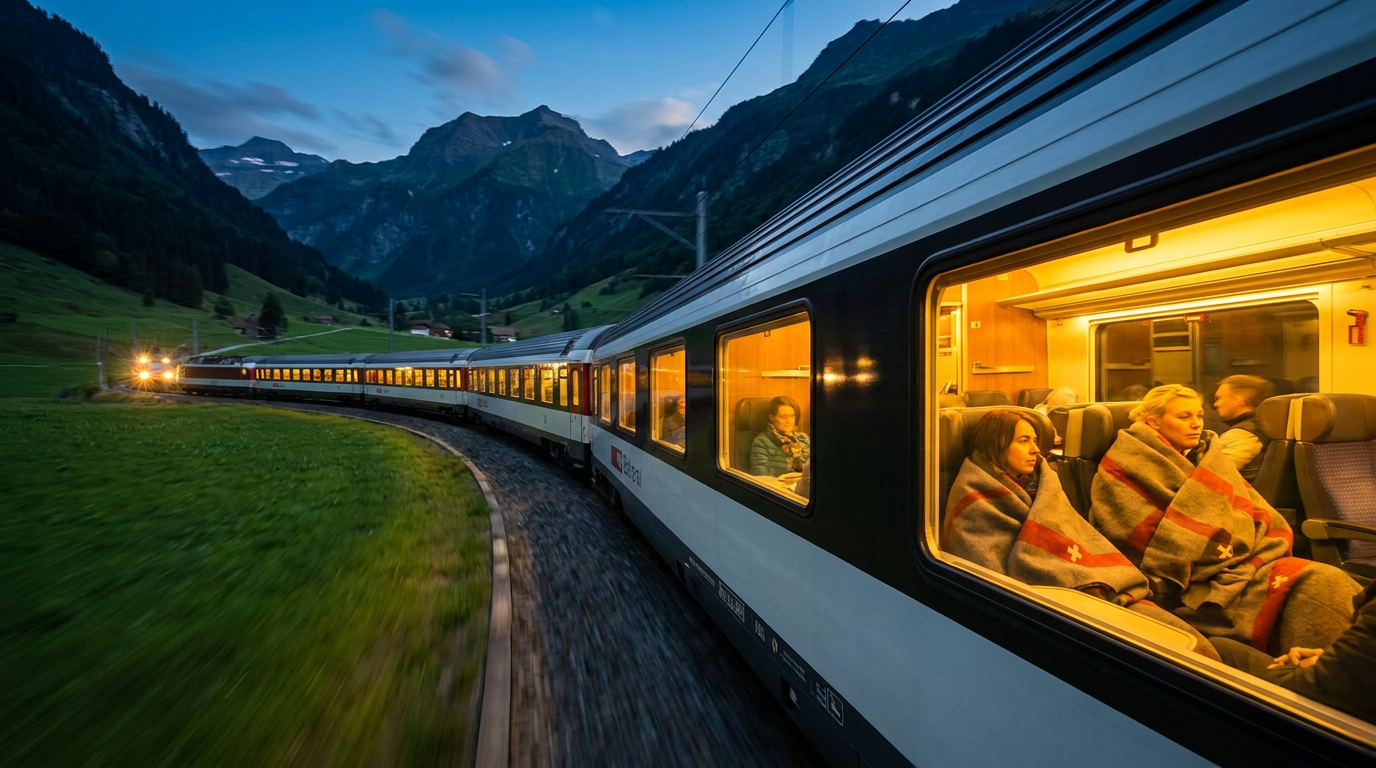
Even more ambitious is the cooperative's new north-south axis. Scheduled for a September 2026 launch, a new route will connect Brussels and Amsterdam directly to Milan. The journey will wind through Cologne and the spectacular Simplon Pass in the Swiss Alps, offering passengers stunning mountain views at dawn.[1][3]
While startups capture the headlines, Austria's state railway, ÖBB, remains the heavyweight champion of the overnight revival. Its expansive "Nightjet" network is currently in the midst of a massive €500 million fleet upgrade, replacing decades-old rolling stock with 33 custom-built, seven-car Siemens trains.[3]
While startups capture the headlines, Austria's state railway, ÖBB, remains the heavyweight champion of the overnight revival.
This new generation of Nightjet trains is specifically engineered to address the historical pain points of sleeper travel: lack of privacy, shared facilities, and poor soundproofing.[3]
The standout innovation is the "Mini Cabin"—a compact, single-occupancy sleeping pod. Designed for solo travelers who want absolute privacy without paying the premium for a full sleeper car, these pods feature electronic access, reading lights, and secure luggage storage.[3]

For those booking full sleeper cabins, the upgrades are equally significant. The new carriages feature private en-suite bathrooms with showers and toilets, alongside vastly improved acoustic insulation. These state-of-the-art trains are scheduled to debut on the Zurich-Vienna route in June 2026.[3]
The environmental argument underpinning this massive infrastructure investment is overwhelming. According to the European Environment Agency (EEA), rail travel remains the most efficient form of motorized passenger transport in Europe, producing only a fraction of the greenhouse gases emitted by cars or planes.[4]
The climate math heavily favors the train. The EEA explicitly notes that aviation's emission impacts are vastly higher on a passenger-kilometer basis, making the shift from air to rail one of the most effective individual climate actions a traveler can take.[4]
A comprehensive analysis by Greenpeace highlights just how stark the difference is. When the non-CO2 impacts of aviation—such as nitrogen oxides (NOx) and contrail cirrus clouds that trap heat in the atmosphere—are factored in, flying can be up to 80 times worse for the climate than taking an electric train.[5]

Yet, a significant structural barrier remains: cost. The same Greenpeace study analyzed over 100 European routes and found that taking the train costs, on average, twice as much as flying, and sometimes up to four times as much on highly competitive routes like London to Barcelona.[5]
This price disparity is largely artificial, driven by uneven regulatory frameworks. Low-cost airlines benefit from massive tax exemptions on kerosene fuel and minimal airport taxes. In contrast, train operators must pay hefty track access charges to national infrastructure managers for every kilometer they travel.[5]
Despite the persistent cost premium, consumer demand continues to surge. Travelers are increasingly viewing the overnight journey not as a logistical hurdle to be cleared, but as a comfortable, experiential first night of their vacation.[1][6]
As 2026 unfolds, the European sleeper train has shed its status as a nostalgic novelty. Backed by citizen investments, cutting-edge engineering, and undeniable climate imperatives, it is now a rapidly modernizing and ecologically vital piece of the continent's future.[6]
How we got here
May 2023
European Sleeper launches its first route connecting Brussels and Berlin.
December 2023
ÖBB introduces the first of its next-generation Nightjet trains with Mini Cabins.
March 2026
European Sleeper takes over the iconic Paris-Berlin route after national carriers drop it.
June 2026
Next-generation Nightjet trains debut on the Zurich-Vienna route.
September 2026
A new overnight route launches connecting Brussels and Amsterdam to Milan via the Swiss Alps.
Viewpoints in depth
Citizen Rail Cooperatives
They argue that state-owned rail monopolies are too slow and risk-averse to build a true cross-border network.
Cooperatives like European Sleeper believe that legacy national carriers are structurally unsuited to operate international night trains, often abandoning them when they fail to meet high profit margins. By crowd-funding capital from thousands of citizens, these startups prove that intense grassroots demand exists for routes like Paris-Berlin, allowing them to step in and operate lines that state monopolies deem unprofitable.
Slow Travel Advocates
They view the journey as an integral part of the vacation rather than a chore.
This camp argues that the romance, comfort, and massive carbon savings of overnight trains far outweigh the speed of low-cost flights. They advocate for a cultural shift away from hyper-mobility, suggesting that waking up to an alpine sunrise in a private cabin offers a vastly superior travel experience compared to the stress of airport security and cramped airline seating.
Climate Policy Analysts
They point out that the current market is structurally rigged against trains.
Environmental researchers argue that until governments tax aviation kerosene and reduce the exorbitant track access charges levied on rail operators, trains will remain an expensive luxury rather than a mass-market climate solution. They emphasize that the true cost of flying—including severe non-CO2 climate impacts—is currently being subsidized by the public rather than paid by the airlines.
What we don't know
- Whether the European Union will eventually mandate taxes on aviation fuel to level the pricing playing field.
- If citizen cooperatives like European Sleeper can maintain long-term profitability without state subsidies.
Key terms
- Slow Travel
- A movement emphasizing connection to local cultures and the environment, prioritizing low-carbon transport like trains over quick flights.
- Mini Cabin
- A compact, single-occupancy sleeping pod introduced on new-generation ÖBB Nightjet trains for solo traveler privacy.
- Track Access Charges
- Tolls paid by train operators to national infrastructure managers for the right to use the railway network.
- Non-CO2 Aviation Impacts
- Climate-warming effects from airplanes beyond carbon dioxide, such as nitrogen oxides (NOx) and contrails.
Frequently asked
What new sleeper train routes are opening in 2026?
Major additions include European Sleeper's Paris-Berlin-Hamburg route and a new Brussels-Milan connection, alongside upgraded ÖBB Nightjet services on the Zurich-Vienna line.
What is a 'Mini Cabin' on a sleeper train?
It is a compact, single-occupancy sleeping pod introduced on new-generation ÖBB Nightjet trains, designed to give solo travelers privacy without having to book a full cabin.
Are sleeper trains actually better for the environment than flying?
Yes. When factoring in non-CO2 emissions like nitrogen oxides and contrails, trains can be up to 80 times less polluting than short-haul flights.
Why are train tickets often more expensive than flights?
Airlines benefit from tax-free aviation fuel and low airport fees, while train operators must pay high track access tolls to run on national railway networks.
Sources
Source coverage
6 outlets
3 viewpoints surfaced






[1]ForbesSlow Travel Advocates
These 4 European Night Trains Are Debuting In 2026
Read on Forbes →[2]National GeographicSlow Travel Advocates
Europe gets a slew of new sleeper services
Read on National Geographic →[3]PixidiaCitizen Rail Cooperatives
2026 marks a turning point for night trains in Europe
Read on Pixidia →[4]European Environment AgencyClimate Policy Analysts
Transport and environment report 2020 - Train or plane?
Read on European Environment Agency →[5]GreenpeaceClimate Policy Analysts
Ticket Prices of Planes Vs Trains: A Europe-wide Analysis
Read on Greenpeace →[6]Factlen Editorial TeamCitizen Rail Cooperatives
Synthesis by Factlen editorial team
Read on Factlen Editorial Team →

Every angle. Every day.
Get travel stories with full source coverage and perspective breakdowns delivered to your inbox.