
Why Pediatricians Are Urging Parents to Let Kids Engage in 'Risky Play'
New guidelines from pediatric societies and child development experts recommend unstructured 'risky play' to build resilience, reduce anxiety, and improve physical literacy.
By Factlen Editorial Team

- Pediatricians & Psychologists
- Argue that micro-doses of fear during play are essential for developing emotional regulation and preventing clinical anxiety.
- Early Childhood Educators
- Emphasize the physical and sensory benefits of risky play, focusing on how to safely scaffold these experiences in group settings.
- Safety-Conscious Parents
- Highlight the intense cultural pressure to prevent all injuries and the difficulty of overcoming the biological instinct to protect their children.
What's not represented
- · Urban Planners & Playground Designers
- · Advocates for children with physical disabilities
Why this matters
In an era of rising childhood anxiety and sedentary behavior, shifting from 'as safe as possible' to 'as safe as necessary' can fundamentally change how children develop confidence, emotional regulation, and physical capability.
Key points
- Pediatricians are urging a shift from keeping children 'as safe as possible' to 'as safe as necessary.'
- Risky play involves manageable challenges like climbing, speed, and rough-and-tumble activities.
- Experts distinguish between 'risks' (which kids can evaluate) and 'hazards' (hidden dangers adults must remove).
- Navigating manageable fear during play helps children develop emotional regulation and resilience.
- Adults are encouraged to ask prompting questions rather than defaulting to 'be careful.'
For decades, the prevailing parenting instinct has been to eliminate danger. Playgrounds were redesigned with rubberized surfaces, tree-climbing was discouraged, and the phrase 'be careful' became the soundtrack of modern childhood. But a growing consensus among pediatricians, child psychologists, and educators is pushing back against this hyper-vigilant approach, arguing that well-intentioned overprotection is actually harming children's development.[1][7]
The new medical advice is counterintuitive to many modern parents: children need to engage in 'risky play' to develop properly. The Canadian Paediatric Society (CPS) recently released sweeping guidelines urging a shift in how adults supervise children, recommending that kids be kept 'as safe as necessary, not as safe as possible.'[2][3]
This distinction is more than just semantic. According to Dr. Emilie Beaulieu, a pediatrician and lead author of the CPS guidance, overprotecting children from minor scrapes and bruises is inadvertently contributing to a rise in childhood anxiety and a decline in physical literacy. The medical community is increasingly viewing unstructured outdoor play not just as a fun pastime, but as a critical public health intervention.[2]
To understand the medical push for risky play, it is necessary to define what the term actually means. Researchers generally categorize risky play into six distinct areas: playing at heights, playing at high speeds, using potentially dangerous tools like whittling knives, being near dangerous elements like fire or water, engaging in rough-and-tumble play, and wandering or exploring without direct adult supervision.[2][4]

Crucially, experts draw a hard line between a 'risk' and a 'hazard.' A risk is a challenge that a child can see, evaluate, and decide whether to undertake based on their own perceived abilities—such as deciding how high to climb on a jungle gym. A hazard, conversely, is a hidden danger that a child cannot anticipate, such as a rotten tree branch or an improperly anchored slide. Adults are supposed to eliminate hazards, but leave the risks intact.[1][3]
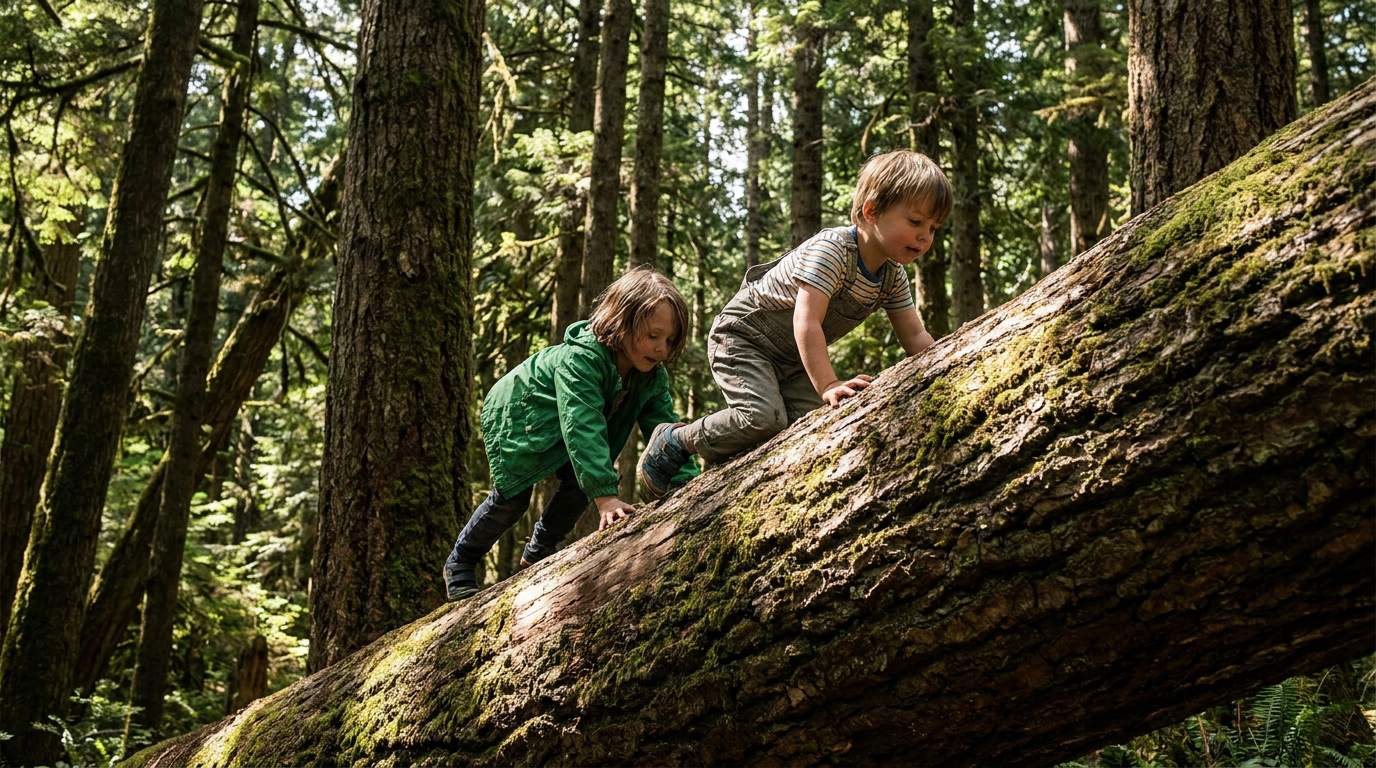
The physical benefits of this unstructured, slightly dangerous play are profound. When children balance on fallen logs or swing at high speeds, they are engaging multiple sensory systems simultaneously, forcing their brains and bodies to map their environment in real-time.[5]
This includes the proprioceptive system, which governs body awareness through movement and pressure, and the vestibular system, which manages balance and spatial orientation. Engaging these systems through self-directed risk-taking promotes motor development and physical literacy in ways that highly structured, adult-led sports often do not, building a foundation for lifelong physical health.[5]
But the most urgent arguments for risky play are increasingly centered on mental health. Before the pandemic, roughly one in eight children in high-income countries experienced mental health difficulties; today, some estimates place that figure closer to one in five. Experts believe the decline in free play is a significant contributing factor.[4]
But the most urgent arguments for risky play are increasingly centered on mental health.
Psychologists argue that a risk-averse culture has deprived children of the opportunity to practice managing fear. When a child climbs slightly higher than they are comfortable with, they experience a spike in physiological arousal. By navigating that fear and returning to safety, they learn emotional regulation. They learn that they can feel terrified and still survive, which builds the neurological scaffolding for resilience.[4][6]
Peter Gray, a professor of psychology and neuroscience at Boston College, notes that from an evolutionary standpoint, children deliberately induce fear in themselves through play to develop courage. Depriving them of these micro-doses of fear leaves them ill-equipped to handle real-world anxiety later in life, making them more likely to panic when faced with unexpected challenges.[6]
The data also challenges the perceived physical dangers of unstructured play. While parents often worry about playground injuries, statistics cited by researchers show that from 2007 to 2022, there were 480 child deaths from motor vehicle crashes compared to just two from playground falls. Furthermore, children are statistically less likely to be injured during unstructured free play than during organized sports.[6]

Despite the evidence, implementing risky play is incredibly difficult for modern parents, who face both internal anxiety and external social judgment. The fear of being labeled a negligent parent often drives adults to intervene prematurely, shutting down play before a child has the chance to test their limits.[1][4]
To bridge this gap, educators and pediatricians suggest 'scaffolding'—acting as a guide rather than a controller. Instead of yelling 'be careful,' which can instill a generalized sense of fear and signal a lack of trust, adults are encouraged to ask prompting questions that engage the child's critical thinking.[1][5]

Phrases like 'Do you see how high you are?' or 'Notice how slippery that rock is' prompt the child to assess their own environment and make a calculated decision. It shifts the burden of risk assessment from the adult's brain to the child's, empowering them to take ownership of their physical safety.[1]
Ultimately, the goal of risky play is not to put children in harm's way, but to prepare them for a world that is inherently unpredictable. By stepping back and allowing children to test their limits, parents can help them build an internal sense of worth and the quiet confidence that comes from knowing they can handle whatever comes their way.[5][7]
How we got here
Pre-1990s
Unstructured, outdoor play with minimal adult supervision is the cultural norm for childhood.
1990s-2010s
A cultural shift toward hyper-vigilance leads to rubberized playgrounds, increased adult supervision, and a decline in free play.
2020-2022
The COVID-19 pandemic severely restricts outdoor play and socialization, correlating with a sharp spike in childhood anxiety.
January 2024
The Canadian Paediatric Society releases landmark guidelines urging parents and educators to encourage risky play to combat mental health issues.
2025-2026
Early childhood education frameworks increasingly adopt 'managed safety' protocols, training staff to facilitate rather than stop risky play.
Viewpoints in depth
Pediatricians & Psychologists
Medical professionals view risky play as a necessary intervention for the youth mental health crisis.
Child psychologists and pediatricians argue that the modern epidemic of childhood anxiety is directly linked to a lack of unstructured, slightly dangerous play. They emphasize that children are biologically wired to seek out thrilling experiences to practice managing fear. By depriving them of these micro-doses of fear, adults prevent children from developing the emotional regulation required to handle real-world stressors. For this camp, the distinction between a risk (a visible challenge) and a hazard (a hidden danger) is the cornerstone of healthy development.
Early Childhood Educators
Educators focus on the physical and sensory benefits of self-directed risk-taking.
For professionals working in early childhood settings, risky play is less about preventing anxiety and more about building physical literacy. They note that activities like balancing, climbing, and swinging engage the proprioceptive and vestibular systems in ways that structured sports cannot. Educators advocate for 'scaffolding'—a technique where adults supervise closely but intervene only when necessary, using prompting questions to help children assess their own physical boundaries rather than issuing blanket commands to stop.
Safety-Conscious Parents
Parents grapple with the biological instinct to protect and the social stigma of perceived negligence.
While many parents understand the data supporting risky play, implementing it remains a profound challenge. The biological instinct to protect a child from immediate physical harm often overrides long-term developmental goals. Furthermore, parents face intense cultural pressure; allowing a child to climb a tall tree or use a whittling knife in a public park often invites judgment or intervention from other adults. For this group, the transition to 'managed safety' requires unlearning decades of cultural conditioning.
What we don't know
- How to effectively scale risky play environments in highly urbanized areas with limited access to nature.
- The long-term longitudinal impact of the newest pediatric guidelines on clinical anxiety rates in the late 2020s.
Key terms
- Risky Play
- Thrilling, unstructured play that involves uncertainty and a manageable chance of physical injury.
- Physical Literacy
- The motivation, confidence, physical competence, and knowledge to maintain physical activity throughout life.
- Proprioceptive System
- The sensory system that provides information about body position and movement, crucial for coordination.
- Vestibular System
- The sensory system responsible for providing the brain with information about motion, head position, and spatial orientation.
- Scaffolding
- An educational technique where adults provide successive levels of temporary support to help a child reach higher levels of comprehension and skill acquisition.
Frequently asked
What is the difference between a risk and a hazard?
A risk is a challenge a child can see and evaluate, like climbing a tall tree. A hazard is a hidden danger they cannot anticipate, like a rotten branch that might break under their weight.
Is risky play safer than organized sports?
Statistically, yes. Research indicates children are less likely to suffer severe injuries during unstructured free play than during organized, competitive sports.
What should I say instead of 'be careful'?
Experts recommend asking prompting questions like 'Do you notice how slippery that log is?' or 'What is your plan for getting down?' to help the child assess the risk themselves.
Does risky play mean leaving kids unsupervised?
Not necessarily. It means providing 'managed safety' where adults remove hidden hazards but allow children the physical and mental space to test their own boundaries without immediate intervention.
Sources
Source coverage
7 outlets
3 viewpoints surfaced







[1]CBC NewsSafety-Conscious Parents
Pop the bubble wrap and let kids play outdoors, pediatricians say
Read on CBC News →[2]Canadian Paediatric SocietyPediatricians & Psychologists
Healthy childhood development through outdoor risky play: Navigating the balance with injury prevention
Read on Canadian Paediatric Society →[3]SickKidsPediatricians & Psychologists
The importance of risky play for childhood development
Read on SickKids →[4]Encyclopedia on Early Childhood DevelopmentPediatricians & Psychologists
Risky play and mental health
Read on Encyclopedia on Early Childhood Development →[5]Rasmussen UniversityEarly Childhood Educators
8 Lifelong Benefits of Risky Play for Children
Read on Rasmussen University →[6]Let GrowEarly Childhood Educators
Kids Need More 'Risky Play' Says Canadian Pediatrics Society!
Read on Let Grow →[7]Factlen Editorial Team
Synthesis by Factlen editorial team
Read on Factlen Editorial Team →

Every angle. Every day.
Get lifestyle stories with full source coverage and perspective breakdowns delivered to your inbox.