
The Rise of the 'Library of Things': How Communities Are Borrowing Instead of Buying
A growing movement of community-based lending libraries is allowing people to borrow tools, camping gear, and appliances, saving money and reducing environmental waste.
By Factlen Editorial Team
- Circular Economy Advocates
- Focus on reducing waste and extending product lifecycles.
- Community Builders
- Focus on social cohesion and revitalizing public spaces.
- Pragmatic Consumers
- Focus on the financial benefits and practical convenience.
What's not represented
- · Retailers and Manufacturers
- · Gig Economy Workers
Why this matters
The average household owns hundreds of items used less than once a month. The 'Library of Things' model offers a practical alternative to hyper-consumerism, saving families thousands of dollars while revitalizing local community hubs.
Key points
- The 'Library of Things' movement allows community members to borrow rarely used household items instead of buying them.
- Public libraries are increasingly integrating non-traditional items like tools, health kits, and camping gear into their collections.
- The model generates significant financial savings for users while diverting tonnes of manufactured waste from landfills.
- Grassroots lending hubs are evolving into sophisticated operations featuring self-service smart lockers and corporate partnerships.
The average power drill is used for roughly 15 minutes over its entire lifespan. Yet, millions of households purchase one, store it in a garage, and let it gather dust. This paradox of modern consumerism—buying expensive, resource-intensive items for single-use tasks—has driven a quiet but profound shift in how neighborhoods operate. For decades, the default solution to needing a specialized tool or appliance was simply to buy it, regardless of how rarely it would actually be utilized. This hyper-consumerist approach not only drains personal finances but also fuels an unsustainable cycle of manufacturing and disposal. However, a growing coalition of citizens, librarians, and environmentalists are pushing back against this norm, championing a model based on access rather than ownership.[8]
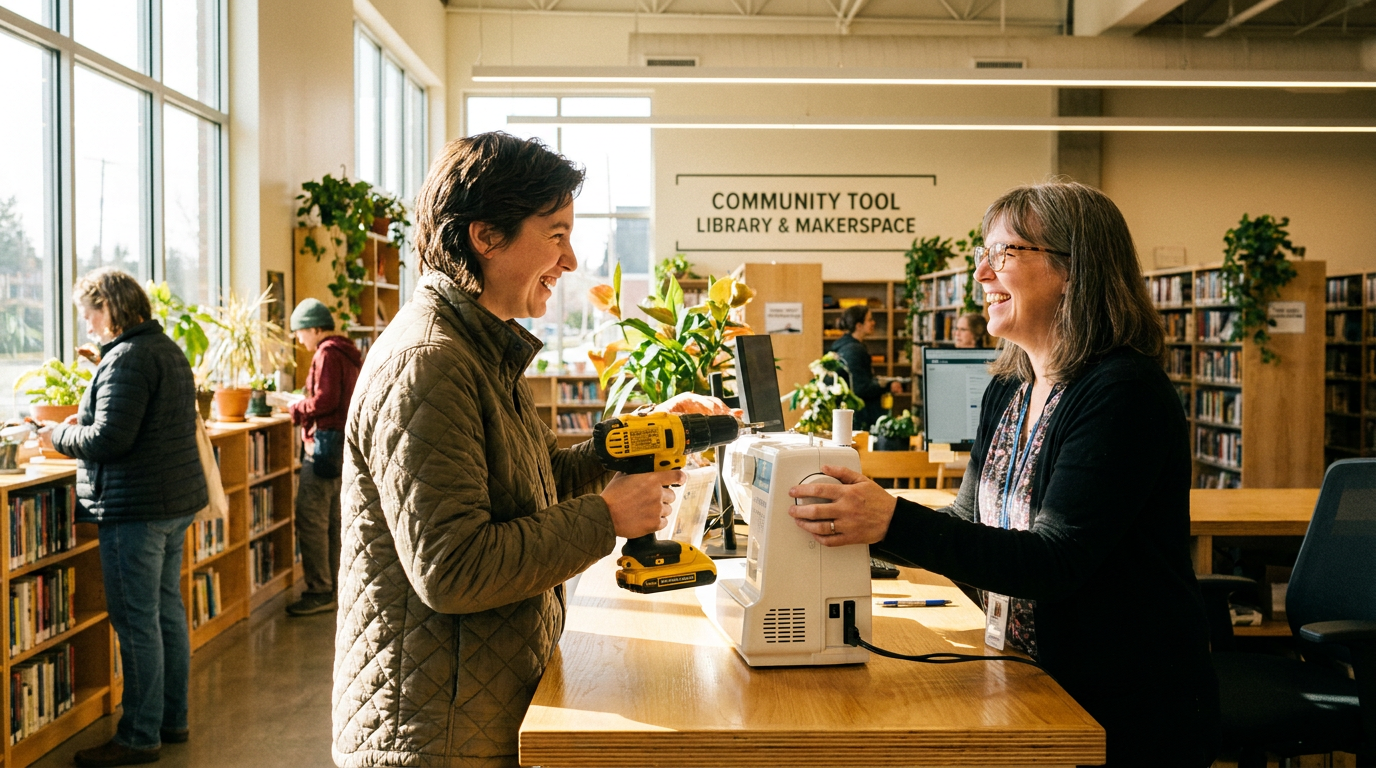
Enter the 'Library of Things' (LoT), a rapidly expanding movement that fundamentally challenges the necessity of individual ownership. Instead of buying a heavy-duty carpet cleaner, a sewing machine, or a six-person camping tent for a single weekend, community members can simply borrow them from a shared local inventory. By applying the traditional, trusted public library model to everyday household goods, these hubs are saving residents substantial amounts of money, drastically reducing environmental waste, and fostering deeper local connections. The concept is taking root globally, moving from niche grassroots experiments into mainstream civic infrastructure, and transforming the way communities think about the resources they share and the public spaces they inhabit.[1][2][3]
The concept is straightforward but transformative in its execution. A Library of Things functions as a centralized repository of useful, occasionally needed items. While some operate as standalone non-profits or community cooperatives, an increasing number are being integrated directly into existing public library systems. Patrons browse a catalog—often hosted online—reserve their desired item, and pick it up for a set borrowing period. The inventory is entirely driven by community needs, meaning a library in a dense urban center might stock high-end power tools for apartment renovations, while a suburban branch might focus on gardening equipment and outdoor recreational gear.[3]
The financial logic driving the movement is undeniable. Research into modern consumption habits indicates that roughly 7 percent of all household items are used less than once a month. For families navigating a high cost of living, purchasing a pressure washer, a specialized baking pan, or a tile saw for a one-off project is a difficult expense to justify. The Library of Things model eliminates this financial barrier, democratizing access to high-quality tools that would otherwise be restricted to those with ample disposable income and ample storage space.[1]

By providing affordable access, these libraries generate massive collective savings for their communities. In the United Kingdom, the pioneering Library of Things platform estimates that its service has saved its members over £6 million since its inception. Borrowing an item typically costs just a fraction—often around 5 percent—of its retail price. Furthermore, in public library settings, the service is frequently entirely free, requiring nothing more than a standard library card. This economic relief is particularly vital during periods of inflation, allowing households to maintain their homes and pursue hobbies without incurring debt.[1][2][3]
Beyond personal finance, the environmental stakes of the movement are massive. The global economy produces millions of tons of electronic and plastic waste annually, much of it stemming from discarded appliances, cheap tools, and novelty items that break after minimal use. The LoT model directly combats this crisis by extending the lifecycle of manufactured goods. Instead of fifty households buying fifty drills that will eventually end up in a landfill, one high-quality drill serves the entire neighborhood, drastically reducing the carbon footprint associated with manufacturing, packaging, and shipping.[6]
The environmental impact of this shared model scales quickly. A single network of lending hubs in London successfully diverted an estimated 50 tonnes of waste from local landfills simply by replacing individual purchases with shared community assets. This shift is a cornerstone of the 'circular economy,' an economic framework that prioritizes the reuse, repair, and sharing of existing materials over the continuous extraction of new natural resources. By keeping items in circulation for as long as possible, these libraries act as practical, hyper-local engines for global sustainability goals.[1][8]
The environmental impact of this shared model scales quickly.
The operational mechanics of these libraries are evolving rapidly to meet surging demand. Early iterations relied heavily on volunteer labor and operated out of cramped storefronts, church basements, or retrofitted shipping containers. Today, the infrastructure is becoming increasingly sophisticated and user-friendly. Some networks have developed custom software integrated with self-service smart lockers, allowing patrons to pick up and drop off items seamlessly at community centers, co-working spaces, and even shopping malls. This technological leap reduces the administrative burden on staff and makes borrowing as convenient as retrieving an online delivery.[1][2][5]

For traditional public libraries, the movement represents a natural evolution of their historic mandate. Libraries have long served as community anchors and equalizers, and expanding their collections to include physical objects helps them meet modern, practical needs. According to industry surveys, nearly a quarter of public libraries now offer some form of non-traditional lending. These collections go far beyond basic tools, encompassing everything from badminton sets and fishing poles to comprehensive bicycle checkout programs that promote physical health and alternative transportation.[3][4]
Some institutions are tailoring their collections to address highly specific demographic challenges within their communities. For example, libraries have introduced 'VITALITY kits' designed specifically for senior citizens. These kits contain assistive tools and instructional resources for stroke recovery, fall prevention, grief support, and Alzheimer's care. Other branches focus on food security and local biodiversity by hosting seed libraries, where patrons borrow seeds to plant in their gardens and later return seeds harvested from their mature crops, creating a self-sustaining agricultural loop.[3][4]
The Library of Things is part of a broader cultural shift toward hyper-local sharing and community reliance. Running parallel to lending libraries is the explosive growth of the 'Buy Nothing' movement. Operating primarily through social media networks and dedicated apps, Buy Nothing groups facilitate a hyper-local gift economy where neighbors give away items they no longer need and request items they do, entirely free of charge. These groups have ballooned in size, offering a direct alternative to the traditional retail frenzy of holiday shopping and seasonal sales.[7]
While the Buy Nothing project focuses on the permanent transfer of goods and household decluttering, the Library of Things focuses on temporary access to durable goods. Together, they represent a comprehensive, community-driven alternative to the traditional retail ecosystem. Both models share a core underlying philosophy: true wealth is found in community connections rather than material accumulation. By participating in these alternative economies, residents are actively choosing to step off the consumer hamster wheel and engage with their immediate surroundings.[7][8]

This resulting social cohesion is a measurable, highly valued outcome of the movement. In surveys of LoT users, 65 percent reported that participating in the sharing economy made them feel prouder of and better connected to their neighborhoods. The physical spaces where items are exchanged—whether a dedicated tool library or a corner of a public library branch—often become vibrant community hubs. They spark organic conversations between neighbors who might otherwise never interact, bridging generational and socioeconomic divides over a shared interest in a DIY project or a new hobby.[2][3]
Despite its widespread success, the movement faces significant structural challenges as it scales. Maintaining a fleet of power tools, kitchen appliances, and electronics requires dedicated repair skills, storage space, and consistent funding. Grassroots tool libraries often struggle with capacity, finding themselves bursting at the seams and overly reliant on the goodwill of a few dedicated volunteers. Transitioning from a scrappy neighborhood project to a sustainable operational model with paid staff, dedicated maintenance budgets, and larger facilities is a critical hurdle for growing organizations.[5]
To address the inevitable maintenance gap, many lending libraries are forming symbiotic partnerships with 'Repair Cafes'—community events where skilled volunteers help residents fix broken items rather than throwing them away. Additionally, some corporate manufacturers are beginning to see the strategic value in the sharing model. Brands like Bosch and Kärcher have provided tools to lending libraries at low or no cost. In exchange, they use the high-turnover environment to gather valuable, real-world data on product durability, maintenance needs, and usage patterns.[1][6]
The future of the movement looks highly collaborative and deeply integrated into civic life. More than 400 municipal councils and local groups in the UK alone have expressed interest in establishing their own sharing hubs, recognizing them as vital activators for empty storefronts and community centers. By treating household tools and recreational gear as public infrastructure rather than private property, communities are proving that access is ultimately more valuable than ownership. As the movement grows, it promises to reshape not just how we consume, but how we connect.[1][8]
How we got here
2013
The 'Buy Nothing' project is founded in Washington state, popularizing the hyper-local gift economy.
2014
Early Library of Things pilots launch in London and Toronto, testing community appetite for borrowing non-traditional items.
2016
Grassroots tool libraries begin experimenting with shipping containers and self-service kiosks to expand access.
2019
The Library of Things incorporates as a mission-locked company in the UK, developing scalable software for community hubs.
2024
Public libraries increasingly adopt the model, with nearly a quarter offering non-traditional items like health kits and bicycles.
Viewpoints in depth
Circular Economy Advocates
Focus on reducing waste and extending product lifecycles.
Environmental advocates view the Library of Things as a critical intervention against hyper-consumerism. By maximizing the utility of a single manufactured item—such as a power drill shared among fifty households rather than sitting idle in fifty separate garages—the model drastically reduces the carbon footprint associated with production, packaging, and shipping. They emphasize that transitioning away from individual ownership is essential for meeting global waste-reduction targets and keeping toxic e-waste out of landfills.
Community Builders
Focus on social cohesion and revitalizing public spaces.
For civic leaders and library directors, the primary value of lending libraries lies in human connection. These hubs transform passive consumption into active community engagement. When neighbors share resources, they inevitably share knowledge, whether it's a tip on how to use a carpet cleaner or advice on a DIY home repair. Proponents argue that integrating these services into traditional public libraries revitalizes civic infrastructure, driving foot traffic and proving that public spaces can adapt to modern, practical needs.
Pragmatic Consumers
Focus on the financial benefits and practical convenience.
From a purely economic standpoint, users are drawn to the sharing economy because it makes financial sense. In an era of high inflation and rising living costs, the ability to borrow an expensive piece of equipment for a fraction of its retail price provides immediate household relief. Pragmatists also value the spatial benefits—borrowing eliminates the need to store bulky, rarely used items in small apartments or crowded garages, offering a practical solution to modern clutter.
What we don't know
- How traditional retailers and tool manufacturers will adapt their business models if community borrowing reaches mainstream scale.
- Whether public funding and municipal grants can sustainably replace the heavy reliance on volunteer labor that currently powers many independent lending libraries.
Key terms
- Library of Things (LoT)
- A community-based service that lends out non-traditional items like tools, appliances, and recreational gear.
- Circular Economy
- An economic system aimed at eliminating waste and the continual use of resources by sharing, leasing, reusing, repairing, and recycling existing materials.
- Hyper-local Gift Economy
- A network, often neighborhood-based, where goods and services are given freely without expectation of monetary payment or direct barter.
- Repair Cafe
- A community gathering place where people with repair skills help others fix broken household items for free.
Frequently asked
How much does it cost to borrow from a Library of Things?
Many public library programs are completely free with a standard library card. Independent organizations may charge a small sliding-scale membership fee or a nominal rental cost (often 5% of the item's retail price).
What happens if an item breaks while I am using it?
Most libraries expect normal wear and tear and have maintenance teams or 'Repair Cafes' to fix items. Borrowers are usually only penalized for intentional damage, negligence, or loss.
How is this different from a traditional rental business?
Libraries of Things are typically non-profits, cooperatives, or public services focused on community access, equity, and sustainability, rather than maximizing profit margins.
What are the most common items available to borrow?
Collections vary by community needs, but popular categories include DIY power tools, gardening equipment, camping gear, specialized kitchen appliances, and board games.
Sources
Source coverage
8 outlets
3 viewpoints surfaced








[1]Positive NewsCircular Economy Advocates
The Library of Things: coming to a town near you
Read on Positive News →[2]Doughnut Economics Action LabPragmatic Consumers
Library of Things: Making borrowing better than buying
Read on Doughnut Economics Action Lab →[3]WebJunctionCommunity Builders
Everybody loves a Library of Things
Read on WebJunction →[4]EBSCOCommunity Builders
The Library of Things Movement is Taking Hold in Libraries
Read on EBSCO →[5]The Tool LibraryCommunity Builders
Strategic Planning For A Shared Future
Read on The Tool Library →[6]ResearchGateCircular Economy Advocates
Library of Things A Movement Towards Unused Resources
Read on ResearchGate →[7]MarketplacePragmatic Consumers
Buy Nothing groups are a way around holiday shopping
Read on Marketplace →[8]Factlen Editorial TeamPragmatic Consumers
Synthesis by Factlen editorial team
Read on Factlen Editorial Team →
Every angle. Every day.
Get community stories with full source coverage and perspective breakdowns delivered to your inbox.