
How Olympic Flag Football Will Work at the LA28 Games
Flag football makes its Olympic debut in 2028 with a fast-paced 5-on-5 format and unprecedented backing from the NFL. Here is how the rules, the rosters, and the global qualification path will work.
By Factlen Editorial Team
- NFL & Commercial Optimists
- Viewing flag football as the ultimate vehicle for global expansion.
- Global Competitors
- Seeing the Olympics as a chance to legitimize international programs.
- Grassroots Advocates
- Focusing on the sport's accessibility and the explosion of the women's game.
What's not represented
- · Traditional Olympic purists who argue that American football lacks the global universality required for the Games.
- · Current NFL head coaches concerned about injury risks to their franchise players during the Olympic tournament.
Why this matters
The inclusion of flag football in the Olympics is a massive cultural export for American sports, opening up a new global pathway for athletes—particularly women—while giving NFL stars a rare chance to compete on the world's biggest stage.
Key points
- Flag football will debut at the 2028 Los Angeles Olympics with a fast-paced, 5-on-5 format.
- The tournament will feature six men's teams and six women's teams, with 10 players per roster.
- NFL owners have officially voted to allow players to compete, capping participation at one player per NFL franchise.
- The game eliminates kicking entirely, requiring teams to pass or run for extra points after a touchdown.
- The United States receives an automatic bid, while international teams will compete for the remaining five spots starting in 2026.
When the Olympic cauldron is lit in Los Angeles in July 2028, the Games will feature a sport that is simultaneously America's most popular pastime and an entirely new global experiment. Flag football is making its Olympic debut, bringing the speed and strategy of the gridiron to the world's biggest sporting stage. [3][3]
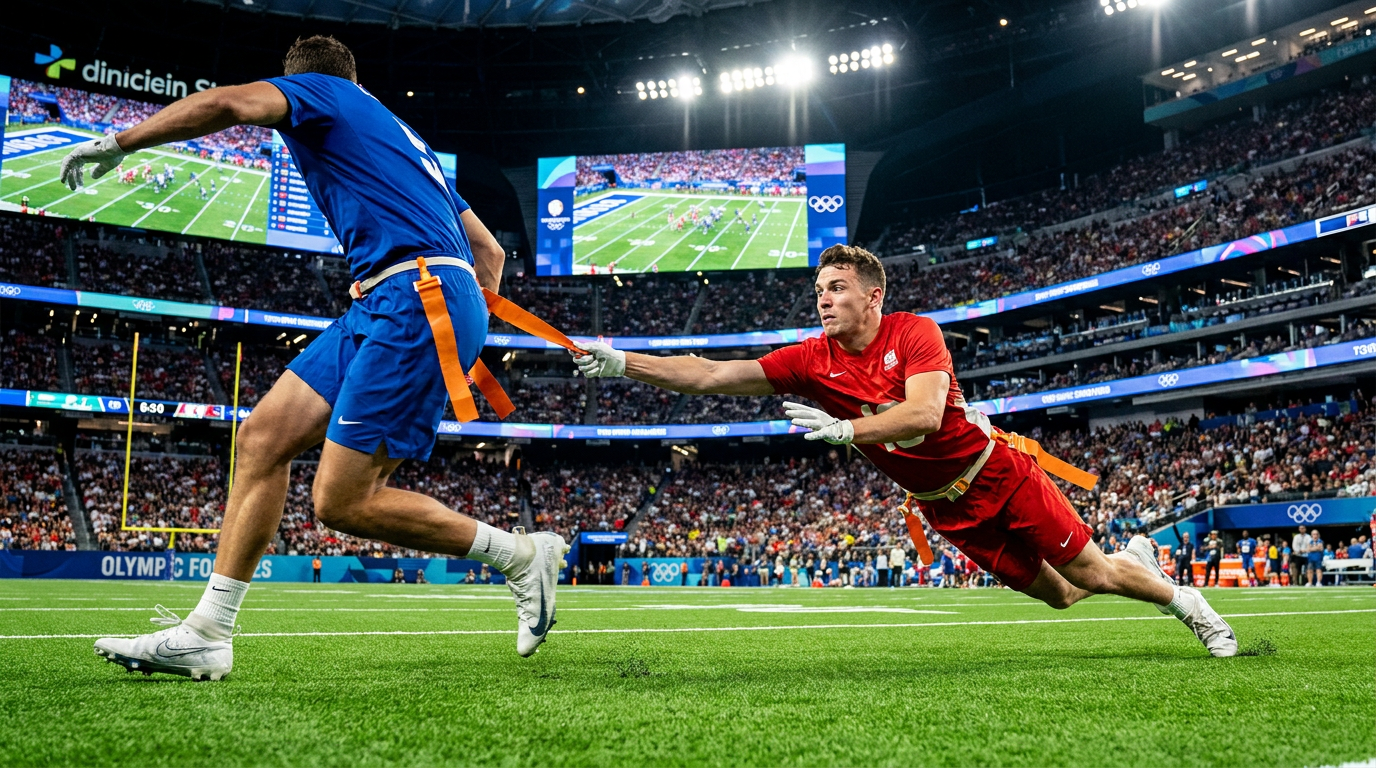
Unlike traditional American football, this variant strips away the helmets, the heavy shoulder pads, and the bone-jarring collisions. Instead, it relies on blinding speed, sharp reflexes, and precision passing. Play stops the moment a defender pulls one of the two fabric flags attached to the ball-carrier's waist. [1][1]
The push to include the sport was heavily backed by the National Football League, which views the Olympics as the ultimate vehicle to export American football to an international audience. [2] For decades, the NFL's global ambitions were bottlenecked by the sheer cost and logistical complexity of tackle football. Flag football solves that problem by requiring little more than a ball, a field, and a set of belts. [7][2][7]
The Olympic format will look vastly different from a Sunday NFL broadcast. The LA28 tournament will feature a fast-paced, five-on-five format, with each nation fielding a compact 10-person roster. [1][3][1][3]
The playing surface is significantly smaller than a standard gridiron. An Olympic flag football field measures 50 yards in length and 25 yards in width, flanked by two 10-yard end zones—making the total playing area 70 yards long. [1][1]

The mechanics of a drive are designed for constant action. An offense starts at its own five-yard line and has four attempts—known as downs—to cross midfield. If they succeed, they earn a fresh set of four downs to reach the end zone and score. [1][1]
Kicking is entirely absent from the Olympic rulebook. There are no punts and no field goals. A touchdown is worth the standard six points, but the subsequent extra-point attempt must be an offensive play: teams can choose to go for one point from the five-yard line, or risk a two-point attempt from the 10-yard line. [1][1]
The inclusion of the sport immediately sparked speculation about a potential American "Dream Team" composed of NFL superstars. In May 2025, NFL team owners officially voted to permit their players to compete in the 2028 Games, clearing the final bureaucratic hurdle. [2][2]
The inclusion of the sport immediately sparked speculation about a potential American "Dream Team" composed of NFL superstars.
However, to maintain competitive balance and limit the disruption to NFL training camps, the league instituted a strict quota: only one player per NFL franchise is permitted to join the United States national team. [2][2]
The resolution also allows designated international NFL players to suit up for their respective home countries, ensuring that elite talent is distributed across the tournament rather than concentrated solely on the American sideline. [2][2]
Getting to Los Angeles will be an exclusive gauntlet. The Olympic tournament is capped at just six men's teams and six women's teams, making it one of the hardest brackets to qualify for in the entire Games. [4][4]
As the host nation, the United States receives an automatic bid for both its men's and women's squads. The rest of the globe must battle for the remaining five spots through a multi-year qualification cycle overseen by the International Federation of American Football (IFAF). [4][4]

The first major tickets to LA28 will be punched at the IFAF World Championships in Düsseldorf, Germany, in August 2026. The top two finishers in both the men's and women's brackets—excluding the already-qualified Americans—will secure direct entry to the Olympics. [4][4]
The remaining three spots will be decided through a high-stakes Olympic Qualifier Series in the spring of 2028, giving emerging programs from Europe, Asia, and the Americas a final chance to reach the Olympic stage. [4][4]
While the prospect of NFL stars draws the headlines, the Olympic push is equally focused on the women's game, which is currently experiencing explosive grassroots growth. [5][5]

In the United States alone, over 230,000 girls participated in flag football recently, and 14 states have officially sanctioned it as a high school varsity sport. The Olympic platform is expected to pour gasoline on that momentum, offering young female athletes a clear pathway to the pinnacle of global sport. [5][5]
Commercially, the addition of flag football is a massive victory for LA28 organizers. It introduces a highly lucrative, NFL-adjacent audience to the Olympic ecosystem, opening up new avenues for sponsorships and broadcast engagement. [6][6]
How we got here
Oct 2023
The International Olympic Committee officially adds flag football to the LA28 program.
May 2025
NFL owners vote to allow player participation in the 2028 Games.
Aug 2026
The IFAF World Championships in Düsseldorf award the first two international Olympic bids.
Spring 2028
A final Olympic Qualifier Series determines the last three spots in the tournament.
July 2028
The LA28 Olympic Games begin in Los Angeles.
Viewpoints in depth
NFL & Commercial Optimists
Viewing flag football as the ultimate vehicle for global expansion.
For the National Football League and Olympic organizers, flag football represents a massive commercial and cultural opportunity. Traditional tackle football has historically struggled to gain a global foothold due to the immense cost of equipment, the need for large rosters, and the physical toll of the game. Flag football removes these barriers to entry. By placing the sport on the Olympic stage, the NFL hopes to cultivate a new generation of international fans and players, while LA28 organizers benefit from tapping into the NFL's massive, brand-loyal audience.
Global Competitors
Seeing the Olympics as a chance to legitimize international programs.
While the United States is the heavy favorite, international federations view LA28 as a critical legitimizing moment. Countries like Mexico, Japan, and Austria have spent years developing highly competitive flag football programs outside the shadow of the NFL. For these nations, the Olympic tournament is not just an exhibition of American talent, but a rare opportunity to prove that gridiron tactics and athleticism have successfully taken root overseas. The strict six-team limit ensures that only the absolute best international squads will take the field.
Grassroots Advocates
Focusing on the sport's accessibility and the explosion of the women's game.
At the youth and high school levels, advocates celebrate flag football for its inclusivity and low cost. The Olympic spotlight is particularly transformative for female athletes, who have historically been excluded from the highest levels of American football. With 14 U.S. states now sanctioning girls' flag football as a varsity sport and universities beginning to offer scholarships, the LA28 Games provide a visible, aspirational pinnacle that validates the sport's rapid grassroots expansion.
What we don't know
- Which specific NFL superstars will ultimately be selected for the heavily restricted Team USA roster.
- How NFL teams will handle insurance and injury liability for their franchise players competing in the Games.
- Whether the sport will remain on the Olympic program for the 2032 Brisbane Games, or if it will be a one-time showcase.
Key terms
- Downs
- Attempts to advance the ball. A team gets four downs to cross midfield, and if successful, four more downs to score a touchdown.
- IFAF
- The International Federation of American Football, the global governing body overseeing the sport's Olympic qualification.
- Extra Point
- A scoring attempt following a touchdown where a team can run a play from the 5-yard line for one point, or the 10-yard line for two points.
- Turnover on Downs
- When an offense fails to reach midfield or the end zone within their allotted four plays, resulting in the opposing team taking possession.
Frequently asked
Will NFL quarterbacks like Patrick Mahomes play in the Olympics?
NFL players are officially eligible to compete, but the league has capped participation at one player per NFL franchise for Team USA to maintain competitive balance.
Is there any kicking or punting in Olympic flag football?
No. The Olympic format eliminates all kicking. Teams must go for a one-point or two-point conversion via a pass or run after scoring a touchdown.
How do countries qualify for the LA28 tournament?
The United States qualifies automatically as the host. The remaining five spots will be decided at the 2026 World Championships in Germany and a final Olympic Qualifier Series in 2028.
How long is a flag football game?
International flag football matches typically consist of two 20-minute halves, played with a running clock until the final minutes.
Sources
Source coverage
7 outlets
3 viewpoints surfaced







[1]Olympics.comGlobal Competitors
What are the rules of Flag Football at LA28?
Read on Olympics.com →[2]NFL.comNFL & Commercial Optimists
NFL Clubs Approve Participation of NFL Players in the 2028 Olympic Games
Read on NFL.com →[3]LA28Grassroots Advocates
Flag Football at the LA28 Olympic Games
Read on LA28 →[4]IFAFGlobal Competitors
Olympic Qualification System for Flag Football confirmed
Read on IFAF →[5]Inside The GamesGrassroots Advocates
Flag football's Olympic debut sparks global growth
Read on Inside The Games →[6]Elev8NFL & Commercial Optimists
The Commercial Direction of the LA 2028 Olympics
Read on Elev8 →[7]Factlen Editorial TeamGrassroots Advocates
Synthesis by Factlen editorial team
Read on Factlen Editorial Team →

More in sports
See all 6 stories →Stuttgart Open
Ben Shelton Captures First Grass-Court Title With Thrilling Win Over Taylor Fritz in Stuttgart
6 sources

Standings
Sinner and Andreeva Lead Tennis Standings as Tours Pivot to Crucial Grass-Court Swing
9 sources

2026 Regulations
How Formula 1's 2026 Regulations Will Radically Change the Sport
6 sources

Injury
Virat Kohli's Rapid Hamstring Recovery Puts Him on Track for England ODI Series
7 sources

Every angle. Every day.
Get sports stories with full source coverage and perspective breakdowns delivered to your inbox.