
The Evidence on Office-to-Residential Conversions: What the Data Shows in 2026
The pipeline of empty office buildings being transformed into apartments has surged to record highs, fundamentally reshaping downtowns. However, structural constraints and high costs mean adaptive reuse is a targeted urban tool rather than a cure-all for the housing crisis.
By Factlen Editorial Team
- Urban Planners & Policymakers
- Focusing on downtown revitalization, zoning reform, and the creation of mixed-use neighborhoods.
- Real Estate Developers
- Focusing on the strict financial feasibility, construction costs, and market demand required to make a conversion profitable.
- Environmental Economists
- Highlighting the massive carbon savings of repurposing existing concrete and steel rather than building new structures.
- Housing Advocates
- Focusing on the sheer scale of the housing crisis and the need for affordable, rather than exclusively luxury, units.
What's not represented
- · Existing commercial tenants facing eviction from buildings slated for conversion
- · Construction labor unions negotiating the specialized work of retrofitting high-rises
Why this matters
As remote work permanently alters the American downtown, the shift from office to residential real estate is the most significant urban transformation of the decade. Understanding the true scale and limitations of this trend reveals whether your city's empty towers will become vibrant neighborhoods or remain vacant liabilities.
Key points
- The U.S. office-to-residential conversion pipeline reached a record 90,300 units in early 2026.
- Only about 11% of existing office buildings are physically suitable for conversion due to floorplate and plumbing constraints.
- For the first time since 1988, more office space is being removed from the market than is being built.
- Converting older offices into apartments produces 50% to 75% fewer carbon emissions than new construction.
- Conversions require heavy municipal tax incentives to remain financially viable outside of ultra-high-rent markets.
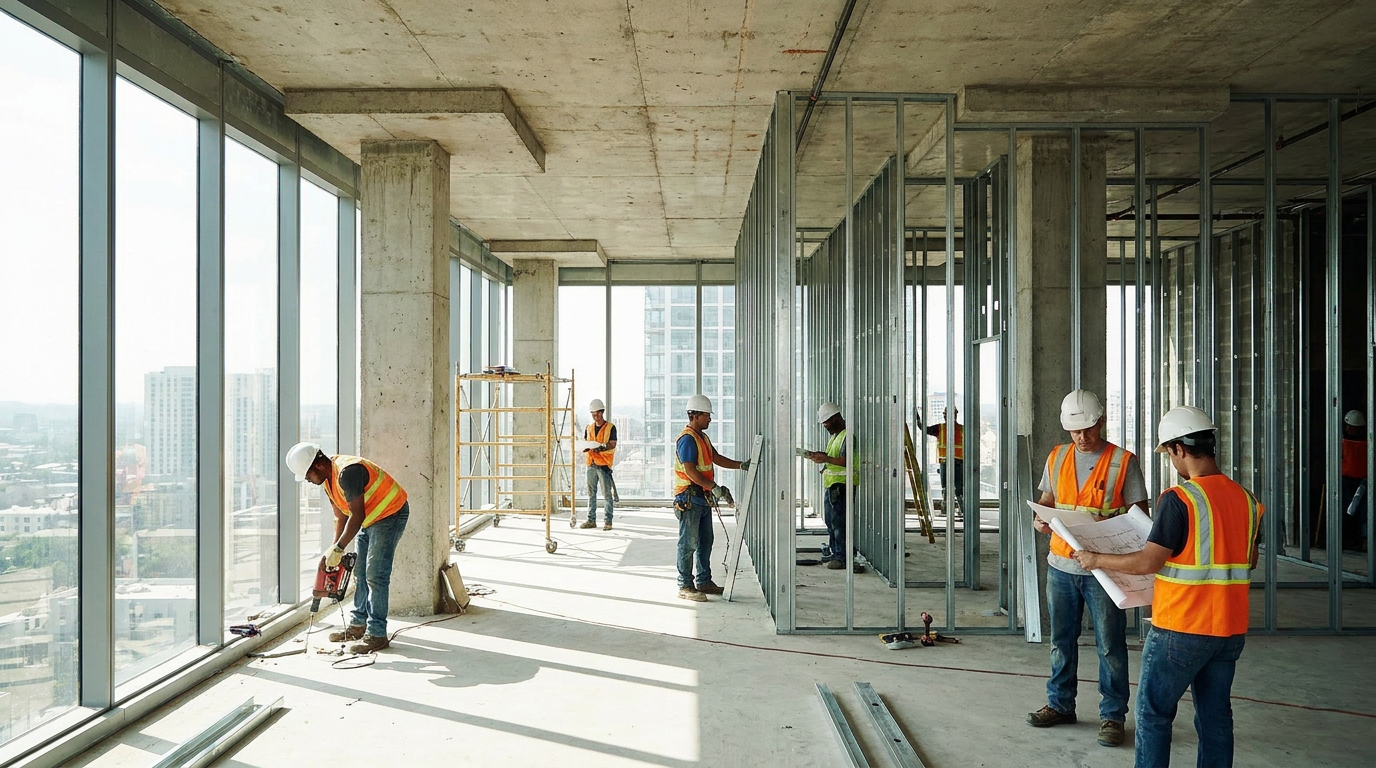
The visual contradiction of the post-pandemic American city is stark and undeniable: millions of square feet of commercial office space sit vacant while a historic, nationwide housing shortage drives up residential rents. For years, the proposed solution—converting empty cubicles and boardrooms into apartments—was largely dismissed by institutional developers as a niche architectural exercise that was too expensive to scale. But in 2026, the empirical data tells a vastly different story. Adaptive reuse has rapidly scaled from a theoretical talking point into a mainstream, multi-billion-dollar development strategy, fundamentally altering the real estate pipeline in major metropolitan areas across the country.[1][5]
The evidence for this acceleration is highly visible in the sheer volume of residential units currently underway. According to early 2026 data compiled by Yardi Matrix and RentCafe, there are now 90,300 apartments in the active office-to-residential conversion pipeline across the United States. This represents a staggering 28% year-over-year increase and is nearly four times the volume recorded in 2022, when only 23,100 units were planned. Office conversions now account for 47% of all future adaptive reuse projects nationwide, decisively eclipsing factory, hotel, and warehouse redevelopments as the dominant form of building recycling.[1][6]
New York City leads the nation by a wide margin, boasting over 16,300 units in development, followed closely by Washington, D.C., and Los Angeles. However, the trend is no longer confined to coastal gateway cities with notoriously high rents. Markets like Dallas, Denver, and Cleveland have seen their conversion pipelines double over the past year. The momentum is driven by a powerful, unavoidable alignment of economic incentives: office vacancy rates hovering near 20%, plummeting commercial property valuations, and municipalities desperate to inject life back into hollowed-out central business districts.[1][5]

Yet, the popular narrative that every empty office tower can seamlessly become a residential high-rise is directly contradicted by structural realities. The primary constraint limiting this trend is physical feasibility. A comprehensive study published by the National Bureau of Economic Research (NBER) evaluated the commercial districts of the 105 largest U.S. cities and found that only about 11% of existing office buildings are physically suitable for residential conversion. The limiting factors are deeply embedded in the architecture of modern workspaces, presenting severe engineering challenges.[2]
The most significant architectural hurdle is the 'floorplate'—the total square footage and layout of a single floor. Buildings constructed between the 1960s and 1990s often feature massive, deep floorplates designed to pack workers into interior cubicles under artificial fluorescent lights. Residential building codes, however, strictly require bedrooms to have operable windows and natural light. Converting a deep-floorplate office into apartments often leaves a massive, unusable dark core in the center of the building, destroying the project's economic viability unless developers undertake the costly process of carving out a central open-air atrium.[2][8]
Plumbing and HVAC infrastructure present another layer of immense complexity. Commercial buildings are typically designed with centralized utility cores, usually featuring just one set of communal bathrooms per floor. Residential buildings, by contrast, require decentralized plumbing, with individual kitchens and bathrooms for dozens of separate units on every level. Core-drilling through thick, post-tensioned concrete slabs to install new water and sewer lines is highly labor-intensive and expensive, often pushing total construction costs to levels that rival or exceed ground-up new development.[8]
Because of these severe structural constraints, the NBER researchers concluded that the ideal candidates for conversion are older, Class B and C office buildings. These older structures, often built before the advent of deep-floorplate designs, feature narrower profiles, more perimeter windows, and significantly lower acquisition costs. If all physically viable Class B and C buildings across the country were successfully converted, the researchers estimate it would add approximately 400,000 new apartments to the existing national housing stock, providing a meaningful boost to urban density.[2]

Because of these severe structural constraints, the NBER researchers concluded that the ideal candidates for conversion are older, Class B and C office buildings.
While 400,000 units is a substantial figure, it highlights the transparent uncertainty surrounding the ultimate scale of the solution. The United States currently faces a severe housing deficit estimated at over 4 million units. Urban planners and researchers at the Brookings Institution caution that while office-to-residential conversions are a highly visible and beneficial strategy, they remain a niche production tool. They cannot single-handedly solve the national housing crisis, but they can play a critical, targeted role in localized neighborhood revitalization and desegregation efforts.[4]
The financial evidence further complicates the picture, revealing that conversions are highly sensitive to local market conditions. Without government intervention, the math of adaptive reuse only pencils out in high-rent markets like Manhattan or San Francisco, where developers can charge premium leasing rates to offset the massive capital expenditures. In most mid-tier markets, the gap between the cost of acquisition plus renovation and the final residential value is simply too wide to attract institutional capital, leaving many physically viable buildings financially stranded.[2][7]
To bridge this financial gap, municipalities are increasingly deploying aggressive policy levers and tax incentives. In Los Angeles, the expansion of the Citywide Adaptive Reuse Ordinance has stripped away layers of zoning bureaucracy, making it legally permissible to convert commercial buildings that are at least 15 years old. In New York, developers can access tax exemptions of up to 90% if they designate at least 25% of the newly created units as affordable housing. Washington, D.C., has introduced a 20-year tax abatement program specifically targeted at downtown commercial-to-residential transformations.[1][5][7]
These policy shifts are beginning to yield undeniable macroeconomic results. According to a 2026 market report by CBRE, the commercial real estate sector has crossed a historic threshold: for the first time since the firm began tracking the data in 1988, more office space is being removed from the U.S. market than is being added. By the end of the year, an estimated 23.3 million square feet of office space is slated for demolition or conversion, compared to just 12.7 million square feet of new construction completions.[3]

This net reduction in supply is a crucial mechanism for stabilizing the distressed commercial real estate market. By removing obsolete, 'zombie' office buildings from the active inventory, cities can help lower the overall vacancy rate and concentrate remaining commercial demand into higher-quality, modern buildings. This culling process is undoubtedly painful for legacy property owners facing loan maturities, but economists view it as a necessary correction for the long-term health and efficiency of urban ecosystems. It allows the market to find a new equilibrium in the era of hybrid work.[3]
Beyond housing creation and market stabilization, the evidence points to a third, often-overlooked benefit: environmental impact. The construction industry is a massive contributor to global carbon emissions, largely due to the embodied carbon found in concrete and steel. The NBER analysis found that converting 'brown'—or energy-inefficient—office buildings into 'green' apartments produces 50% to 75% fewer carbon emissions than demolishing the site and building a new residential tower from scratch, making it a highly sustainable development pathway. This preservation of existing superstructures is a vital tool for sustainable urban growth.[2]
Upgrading these older structures with modern, energy-efficient HVAC systems, better insulation, and electrified appliances can decrease a building's operational greenhouse gas emissions by up to 80%. For cities striving to meet aggressive climate targets, such as New York's Local Law 97, adaptive reuse offers a rare, synergistic opportunity. It allows municipalities to simultaneously address the housing shortage and the climate crisis without pouring thousands of tons of new concrete, effectively hitting two major policy goals with a single intervention. The environmental math makes these projects highly attractive for green financing and federal grants.[2]

The transformation of the American downtown is no longer a speculative concept; it is actively under construction. While the evidence clearly shows that office-to-residential conversions are not a panacea for the nationwide housing deficit, they represent a highly effective, ecologically sound intervention for specific urban environments. As zoning laws adapt, financial models mature, and construction techniques improve, the hollowed-out commercial cores of the early 2020s are steadily being rewritten into the vibrant, mixed-use, residential neighborhoods of the 2030s. This evolution proves that cities can successfully adapt their built environments to meet the changing needs of their citizens.[1][3][4]
How we got here
1999
Los Angeles passes its original Adaptive Reuse Ordinance, pioneering the modern framework for converting historic downtown commercial buildings into lofts.
March 2020
The onset of the COVID-19 pandemic triggers a mass shift to remote work, emptying downtown office towers nationwide.
2022
The U.S. office-to-residential conversion pipeline sits at a modest 23,100 units as developers begin testing the viability of post-pandemic adaptive reuse.
August 2023
The NBER publishes a landmark study identifying that roughly 11% of U.S. office buildings are physically suitable for green residential conversion.
Early 2026
The conversion pipeline hits a record 90,300 units, and office space removals officially outpace new construction completions for the first time in decades.
Viewpoints in depth
Real Estate Developers
Focusing on the strict financial and architectural math required to make a conversion profitable.
For developers, the narrative of 'easy' conversions is a myth. They point to the immense capital expenditures required to core-drill concrete floors for new plumbing, upgrade electrical grids for residential loads, and carve out light wells in deep-floorplate buildings. Without significant tax abatements or historic preservation credits, developers argue that the math only works in ultra-high-rent districts where luxury leasing can offset the massive renovation costs.
Urban Planners
Viewing conversions as a tool to rescue downtown tax bases and create 24/7 neighborhoods.
City planners are less concerned with the national housing deficit and more focused on localized urban triage. With office vacancies threatening municipal property tax revenues, planners see adaptive reuse as a way to replace monoculture commercial districts with vibrant, mixed-use neighborhoods. They advocate for sweeping zoning reforms, like Los Angeles' Adaptive Reuse Ordinance, to remove the bureaucratic friction that kills these projects in the planning phase.
Environmental Economists
Highlighting the massive carbon savings of repurposing existing concrete and steel.
Climate researchers emphasize the 'embodied carbon' argument. Demolishing a high-rise and building a new one releases thousands of tons of CO2. By preserving the superstructure of a Class B office building and upgrading its facade and HVAC systems, economists argue that cities can achieve up to an 80% reduction in greenhouse gas emissions compared to new construction, making adaptive reuse a critical pillar of urban climate strategy.
What we don't know
- Whether the current pace of conversions will be sustained if commercial property values begin to recover.
- How many of the 90,300 units currently in the pipeline will actually reach completion amid high interest rates.
- The long-term impact of these luxury-leaning conversions on broader neighborhood affordability.
Key terms
- Adaptive Reuse
- The process of repurposing an existing building for a use other than what it was originally designed for, such as turning an office into apartments.
- Floorplate
- The total leasable square footage and physical layout of a single floor within a commercial building.
- Embodied Carbon
- The total greenhouse gas emissions generated during the manufacturing, transportation, and assembly of building materials like concrete and steel.
- Class B and C Office Space
- Older, less modern commercial buildings with fewer amenities, which are currently seeing the highest vacancy rates but are often the best candidates for residential conversion.
Frequently asked
Why can't all empty office buildings be turned into apartments?
Most modern office buildings have massive, deep floorplates. Because residential codes require bedrooms to have windows, converting these buildings leaves a large, dark, unusable core in the center, making the project economically unviable.
Will office conversions solve the housing shortage?
No. While conversions are expected to add tens of thousands of units annually, the U.S. faces a housing deficit of several million homes. Conversions are a helpful niche strategy, but not a total solution.
Are these new apartments affordable?
Generally, no. Because the construction costs of retrofitting plumbing and HVAC systems are so high, developers typically must charge luxury market rates to turn a profit, unless the project receives heavy government subsidies.
Which cities are converting the most offices?
New York City leads the nation with over 16,000 units in the pipeline, followed by Washington, D.C., and Los Angeles. However, midwestern and southern cities like Dallas and Cleveland are rapidly accelerating their conversion pipelines.
Sources
Source coverage
8 outlets
4 viewpoints surfaced








[1]Multifamily ExecutiveReal Estate Developers
Office-to-Apartment Conversions Surge as Pipeline Nears 100,000 Units
Read on Multifamily Executive →[2]NBEREnvironmental Economists
Converting Brown Offices to Green Apartments
Read on NBER →[3]CBREReal Estate Developers
U.S. Real Estate Market Outlook 2026: Office
Read on CBRE →[4]Brookings InstitutionUrban Planners & Policymakers
Simulating the impacts of office-to-residential conversion on neighborhood racial demographics
Read on Brookings Institution →[5]ConstructConnectReal Estate Developers
Office-to-Residential Conversions Accelerate as Adaptive Reuse Reshapes the Rental Pipeline
Read on ConstructConnect →[6]ResiClubHousing Advocates
The pipeline for converting office spaces into apartments has surged by 484% in just 4 years
Read on ResiClub →[7]JPMorganUrban Planners & Policymakers
What to know about office-to-residential conversion
Read on JPMorgan →[8]Old Money CapitalHousing Advocates
A Trend Taking Off — But How Big Is It Really?
Read on Old Money Capital →
Every angle. Every day.
Get real estate stories with full source coverage and perspective breakdowns delivered to your inbox.