
AI Breakthrough Decodes Sperm Whale 'Phonetic Alphabet,' Paving Way for Interspecies Communication
Researchers using advanced artificial intelligence have successfully decoded the complex vocal patterns of sperm whales, discovering a structured phonetic alphabet. The breakthrough brings humanity closer to interactive communication with marine life and could radically reshape environmental conservation laws.
By Factlen Editorial Team
- Marine Biologists & Linguists
- Focus on the structural complexity of animal language and cognitive biology.
- AI & Tech Innovators
- Emphasize building universal translation models that map the underlying shapes of language.
- Conservation & Legal Advocates
- Argue that decoding animal communication must lead to stronger environmental protections and legal rights.
What's not represented
- · Indigenous communities with traditional ecological knowledge of marine mammals
- · Commercial shipping and fishing industries facing potential new regulations
Why this matters
Decoding animal communication bridges the ultimate language barrier, fundamentally altering humanity's relationship with the natural world. Beyond the profound scientific achievement, this AI breakthrough could provide direct evidence of how human activity impacts marine life, potentially forcing a rewrite of global environmental laws and animal rights.
Key points
- Project CETI researchers used generative adversarial networks (GANs) to analyze decades of sperm whale acoustic data.
- The AI identified 156 distinct vocal patterns, revealing that whale clicks function similarly to human vowels and diphthongs.
- Earth Species Project and Google are building foundational AI models to translate multiple animal languages without a Rosetta Stone.
- Legal scholars argue this breakthrough could lead to stricter environmental protections and new legal rights for cetaceans.
For decades, the concept of communicating with non-human species was relegated to the realm of science fiction and speculative biology. However, by mid-2026, a powerful convergence of marine biology, cryptography, and advanced artificial intelligence has brought humanity to the precipice of genuine interspecies communication. Researchers have successfully decoded what they describe as the "phonetic alphabet" of sperm whales, fundamentally altering our understanding of animal cognition. This milestone is the culmination of years of intensive data collection and machine learning analysis, proving that the intricate clicks and codas exchanged by these massive marine mammals contain structured, intentional linguistic properties. The breakthrough not only bridges a massive gap in biological sciences but also sets the stage for a profound shift in how humans relate to the natural world.[1][2]
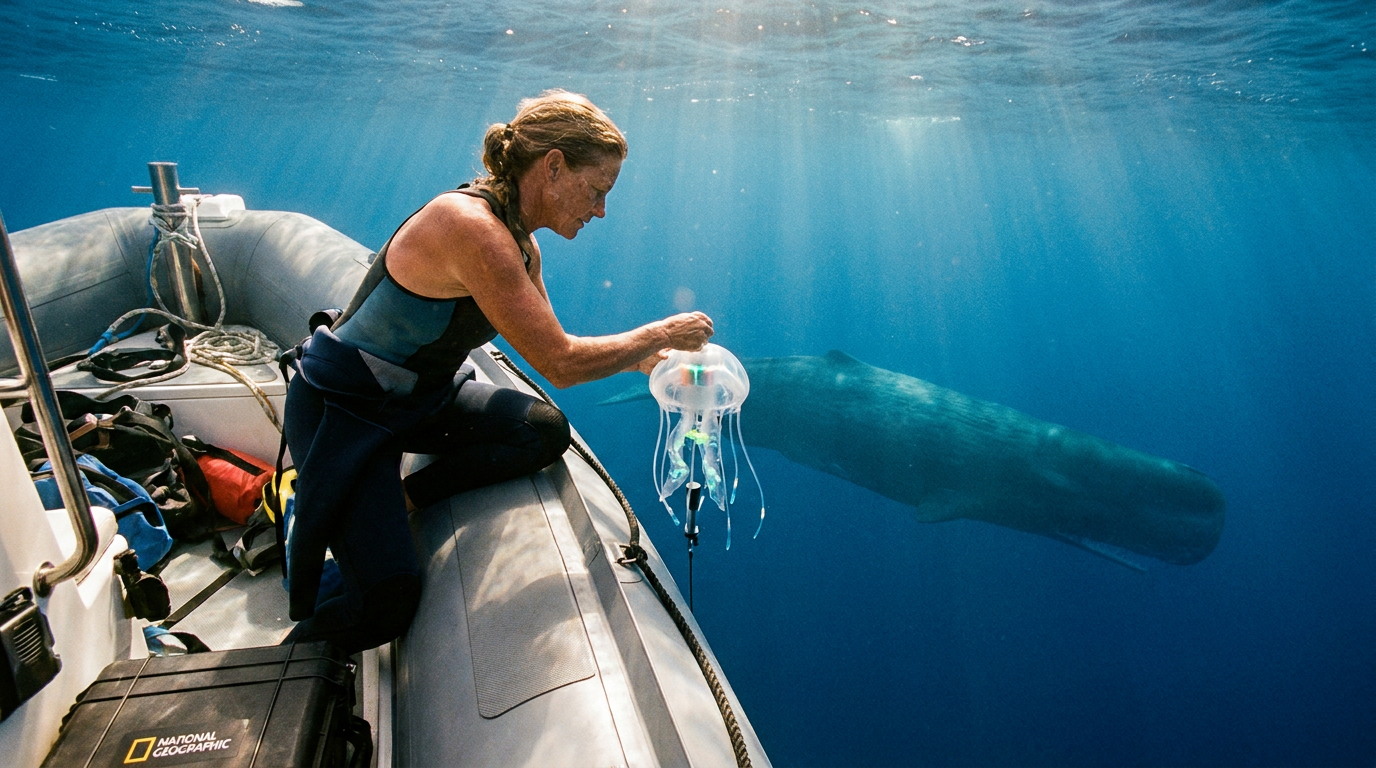
The foundation of this discovery stems from Project CETI (the Cetacean Translation Initiative), a massive interdisciplinary effort that united AI wizards, marine roboticists, and linguists. To capture the necessary data, the team deployed an unprecedented array of underwater listening stations, hydrophone-equipped aerial drones, and soft robotic fish designed to swim silently among sperm whale pods off the coast of Dominica. This hardware gathered the largest and most comprehensive animal behavior dataset ever recorded. By feeding decades of this acoustic data into generative adversarial networks (GANs)—the same sophisticated AI architecture used to model human language and generate synthetic media—scientists were able to isolate patterns that human ears and traditional software had previously missed. They discovered that sperm whale clicks are not just simple echolocation codes, but complex structures that closely resemble human vowels and diphthongs.[1][5]
Through this rigorous AI analysis, researchers identified 156 distinct vocal patterns that sperm whales combine using varying rhythms, tempos, and durations. Much like humans combining individual letters and syllables to form complex words and sentences, these marine mammals utilize an alphabet-like system to dynamically alter the meaning of their calls. Linguists involved in the project noted that the whales exchange these specific "vowels" in intentional, conversational dialogues, adjusting their vocal tract pulses in ways that mirror human speech production. This level of communicative complexity—where elements are combined differently to generate entirely new meanings—was previously thought to be exceedingly rare in nature, largely restricted to humans, certain primates, and a handful of bird species. The revelation that sperm whales possess such a structured language system suggests a depth of culture and intelligence that science is only just beginning to map.[1][2][4]

The sperm whale discovery is part of a much wider, rapidly accelerating race to decode the languages of the natural world using artificial intelligence. At the SXSW 2026 conference, Aza Raskin, co-founder of the Earth Species Project, detailed how modern deep learning models are mapping the underlying "shapes" of language without needing a traditional Rosetta Stone. By identifying hidden structural relationships and geometric patterns in massive acoustic datasets, AI can translate across entirely different modalities. This universal representation allows algorithms to process animal vocalizations the same way they process human languages, paving the way for foundational AI models that can generalize translation capabilities across multiple species simultaneously, rather than requiring bespoke software for every single animal.[3][7]
This universal, AI-driven approach to translation is already yielding remarkable results across a variety of species beyond sperm whales. Google's DolphinGemma project, for instance, has successfully trained large language models on nearly two decades of dolphin recordings, uncovering new layers of social complexity in their whistles and clicks. Meanwhile, other research teams are applying similar machine learning techniques to decode the highly contextual vocalizations of elephants, the vast and largely unknown vocabularies of crows, and the sophisticated alarm calls of prairie dogs. As the AI models ingest more data, they are revealing that many species use unique "names" for their young and possess complex forms of identity and social memory that were previously assumed to be uniquely human traits.[2][3][4]
This universal, AI-driven approach to translation is already yielding remarkable results across a variety of species beyond sperm whales.
For the scientists and technologists driving these initiatives, the ultimate goal is not merely to build a novelty chatbot for animals, but to fundamentally "throw open the doors of perception," as Raskin articulated. Human understanding of the world has historically been limited by our biological inability to perceive certain frequencies, decode rapid vibrations, or process massive acoustic datasets in real-time. By utilizing AI as an acoustic lens, researchers hope to understand the inner worlds, cultures, and lived experiences of non-human species. This deeper understanding is expected to foster a radical shift in human empathy, encouraging societies to view ecosystems not as resources to be managed, but as complex communities of intelligent beings with their own rich, communicative lives.[1][3]
This newfound ability to understand animal communication is poised to upend environmental law and conservation policy. A comprehensive legal analysis published by researchers from the New York University School of Law and Project CETI explored exactly how AI-assisted communication could reshape the legal frameworks governing marine life and natural habitats. Historically, laws like the Endangered Species Act and the Marine Mammal Protection Act have relied on limited, observational scientific understanding of what animals need to survive. If AI can provide direct, translatable evidence of how shipping noise, industrial pollution, or climate change negatively impacts marine animals, regulatory bodies could be forced to enforce much stricter, highly specific protections based on the animals' own communicated distress.[4][6]

The legal implications extend far beyond habitat protection, potentially catalyzing a movement for new legal rights for cetaceans and other highly intelligent species. If science can definitively prove that sperm whales possess a complex language, cultural transmission, and individual identities, legal scholars argue it becomes increasingly difficult to deny them basic rights under existing frameworks. The research challenges the long-standing moral and legal distinctions that separate humans from animals, suggesting that as our dictionary of animal signals improves, the legal system will have to adapt to accommodate the voices of non-human stakeholders in environmental disputes and corporate liability cases. By questioning these entrenched beliefs, the integration of AI and biology is laying the groundwork for a future where animals are no longer treated merely as property or passive subjects of conservation, but as active participants with legally recognizable interests.[1][4][6]
The timeline for achieving interactive "first contact" with these species is moving with breathtaking speed, outpacing even the most optimistic predictions from a decade ago. Project CETI researchers are currently in the process of building sophisticated sperm whale chatbots designed to test the accuracy of their language models. By feeding the AI a specific whale's conversation history, social context, and behavioral data, the system attempts to predict exactly what the whale might say next. These predictive models are crucial for validating the AI's understanding of the phonetic alphabet and ensuring that the translated codas accurately reflect the whales' intended meanings rather than human projection. The success of these chatbots relies heavily on the massive compute power now available to researchers, allowing them to process the nuanced spectral patterns of whale codas in real-time.[5]

Looking ahead, the next phase of this groundbreaking research involves taking the AI out of the laboratory and back into the ocean. Within the next few years, scientists plan to conduct interactive playback experiments—attempting to speak back and forth with the whales in their native tongue using underwater speakers and hydrophones. If these experiments succeed, it will mark the first time humanity has engaged in a two-way, intelligent dialogue with another species. As artificial intelligence continues to bridge the ultimate language barrier, humanity is stepping into a profound new era where nature can finally speak for itself, fundamentally transforming our relationship with the planet we share. The ability to exchange ideas and experiences with creatures that have inhabited the oceans for millions of years offers an unprecedented opportunity to learn from systems that have successfully navigated the infinite game of life. As this technology matures, it promises to unlock biological wisdom that could guide our own species toward more sustainable and regenerative ways of living.[3][5]
How we got here
2019
Project CETI is founded by an interdisciplinary team of marine biologists, AI researchers, and linguists at Harvard.
2022
Researchers deploy advanced underwater listening stations and soft robotic fish to gather massive acoustic datasets off the coast of Dominica.
2024
Google's DolphinGemma and Earth Species Project begin training large language models on decades of marine mammal recordings.
Late 2025
Scientists discover that sperm whale codas contain vowel-like and diphthong-like spectral patterns, revealing a complex phonetic alphabet.
Mid 2026
Project CETI begins testing AI-driven 'whale chatbots' to predict whale responses, preparing for interactive playback experiments.
Viewpoints in depth
Marine Biologists & Linguists
Focus on the structural complexity of animal language and cognitive biology.
This camp argues that discovering vowels and diphthongs in whale codas bridges a massive gap between human and animal cognition. By proving that whales intentionally alter their vocal tract pulses to change the meaning of their calls, biologists believe we must fundamentally rethink the exclusivity of human language. They emphasize that these findings validate decades of observational research into the rich, culturally transmitted social structures of cetaceans.
AI & Tech Innovators
Emphasize building universal translation models that map the underlying shapes of language.
Technologists view animal communication as the ultimate test for foundational AI models. They argue that deep learning can map the geometric 'shapes' of language without needing a Rosetta Stone, creating universal translation tools that work across multiple species simultaneously. For this group, the breakthrough proves that AI's pattern-recognition capabilities can solve biological mysteries that have eluded human scientists for centuries.
Conservation & Legal Advocates
Argue that decoding animal communication must lead to stronger environmental protections and legal rights.
Legal scholars and environmentalists focus on the policy implications of interspecies communication. They argue that if AI can provide direct, translatable evidence of an animal's distress or habitat preferences, regulatory bodies will be legally obligated to enforce stricter protections. Some advocates go further, suggesting that demonstrating complex language and culture in whales provides the necessary legal grounding to grant cetaceans recognized personhood and rights in environmental courts.
What we don't know
- The exact semantic meaning of specific whale codas and how their vocabulary translates to human concepts.
- Whether interactive playback experiments will result in genuine, two-way comprehension between humans and whales.
- How international courts and regulatory bodies will practically apply AI-translated animal communication in environmental lawsuits.
Key terms
- Generative Adversarial Networks (GANs)
- A class of machine learning frameworks where two neural networks contest with each other to generate new, synthetic instances of data that can pass for real data.
- Coda
- A patterned series of acoustic clicks used by sperm whales to communicate with one another across vast ocean distances.
- Diphthong
- A sound formed by the combination of two vowels in a single syllable, in which the sound begins as one vowel and moves toward another.
- Hydrophone
- A specialized underwater microphone designed to record or listen to acoustic signals and marine life vocalizations beneath the surface.
- Foundational AI Model
- A large-scale artificial intelligence model trained on a vast quantity of unlabeled data that can be adapted to a wide range of downstream tasks, such as translating multiple species' languages.
Frequently asked
How does AI translate animal languages without a dictionary?
AI models map the 'shapes' of language by identifying hidden structural relationships in massive acoustic datasets, allowing them to translate across modalities without needing a direct human-to-animal dictionary.
What did scientists discover about sperm whale clicks?
Researchers found that sperm whales use a phonetic alphabet with 156 distinct vocal patterns, including variations in rhythm and tempo that function similarly to human vowels and diphthongs.
Will humans be able to talk to whales?
Scientists are currently building AI 'chatbots' to predict whale responses and plan to conduct interactive playback experiments to test back-and-forth communication in the near future.
How could this impact environmental laws?
Direct translation of animal communication could provide concrete evidence of how human activity harms marine life, potentially forcing stricter enforcement of the Endangered Species Act and inspiring new legal rights for cetaceans.
Sources
Source coverage
7 outlets
3 viewpoints surfaced







[1]UC Berkeley NewsMarine Biologists & Linguists
AI helps researchers discover vowel-like sounds in sperm whale communication
Read on UC Berkeley News →[2]WHYYMarine Biologists & Linguists
How artificial intelligence is helping scientists understand animal communication
Read on WHYY →[3]VMLAI & Tech Innovators
AI is breaking the ultimate language barrier: between humans and nature
Read on VML →[4]Maritime InnovationsConservation & Legal Advocates
The Legal Impact of AI-Assisted Animal Communication
Read on Maritime Innovations →[5]The GuardianConservation & Legal Advocates
How to speak whale: the scientists trying to communicate with animals
Read on The Guardian →[6]NYU School of LawConservation & Legal Advocates
What If We Understood What Animals Are Saying? The Legal Impact Of AI-assisted Studies
Read on NYU School of Law →[7]Earth Species ProjectAI & Tech Innovators
Decoding animal language to transform our relationship with the rest of nature
Read on Earth Species Project →
Every angle. Every day.
Get ai stories with full source coverage and perspective breakdowns delivered to your inbox.