
The Science of Space: How Neuroaesthetics is Rewiring Interior Design for Mental Health
Emerging research at the intersection of neuroscience and architecture reveals that interior design is not just about aesthetics—it is a biological intervention. By applying the principles of neuroaesthetics, spaces can be optimized to measurably lower stress, improve focus, and actively support the human nervous system.
By Factlen Editorial Team
- Neuroscience Researchers
- Focus on the empirical, biological data linking spatial environments to human physiology.
- Design & Architecture Practitioners
- Focus on translating neurological data into practical, emotionally intelligent interior spaces.
- Public Health Advocates
- View intentional spatial design as a scalable, cost-effective intervention for community wellness.
- Editorial Synthesis
- Examines the holistic integration of biology and design to elevate everyday living spaces.
What's not represented
- · Low-Income Housing Developers
- · Neurodivergent Individuals
Why this matters
By understanding how the brain processes spatial environments, you can make simple, science-backed changes to your home that actively lower stress hormones, improve sleep, and boost daily focus.
Key points
- Neuroaesthetics is an emerging scientific field that measures how interior design and architecture physically alter brain chemistry and nervous system responses.
- Brain imaging shows that thoughtfully designed spaces can reduce stress hormones by up to 20 percent while lowering heart rates and boosting serotonin.
- The human brain has an evolutionary preference for curvilinear shapes, natural textures, and biophilic elements, which signal safety and reduce cognitive load.
- Institutions like Johns Hopkins University are reframing interior design as a biological intervention, pushing for its integration into hospitals, schools, and public infrastructure.
- Applying these principles at home involves low-tech adjustments like synchronizing lighting with circadian rhythms and layering textures to improve acoustics.
Have you ever walked into a room and instantly felt your shoulders drop, your breathing slow, and your mind clear? For decades, interior designers and homeowners alike attributed this phenomenon to good taste or a vague sense of "vibes." But modern science is revealing a far more mechanical reality. That immediate sense of calm—or, conversely, the sudden spike of anxiety upon entering a sterile, fluorescent-lit office—is not merely a subjective preference. It is a rapid, measurable biological response. Within milliseconds of crossing a threshold, the human nervous system processes spatial stimuli, altering hormone levels, heart rates, and brain waves before the conscious mind even registers the decor.[8]
This biological reality is the foundation of neuroaesthetics, an emerging scientific discipline that sits at the intersection of neuroscience, cognitive science, and architecture. While the term was coined in the late 1990s by researchers studying how the brain perceives visual art, the field has rapidly expanded into the built environment. Today, it offers a comprehensive, evidence-based understanding of how our surroundings can actively elevate or unnerve us. By translating the brain's innate preferences into spatial design, neuroaesthetics transforms interior decoration from a superficial luxury into a vital tool for emotional and physical well-being.[1][8]
The shift from intuitive design to empirical science has been driven largely by advancements in brain imaging technology. Using functional magnetic resonance imaging (fMRI) and PET scans, researchers can now document exactly what happens physiologically when humans encounter specific aesthetic environments. The data is striking. Studies consistently demonstrate that thoughtfully designed spaces can trigger a 15 to 20 percent reduction in stress hormones. Furthermore, these environments prompt a decrease in heart rate and blood pressure, alongside an elevation in serotonin and dopamine levels—the neurochemicals responsible for feelings of happiness and security.[5]

At the forefront of this movement is the International Arts + Mind Lab (IAM Lab) at Johns Hopkins University. Led by Susan Magsamen, the multidisciplinary initiative brings together brain scientists, architects, and public health experts to accelerate the study of "neuroarts." Magsamen and her team are pioneering a translational research approach designed to solve intractable problems in health and learning through aesthetic experiences. Their work fundamentally reframes interior design, viewing it not as a cultural afterthought, but as a direct biological intervention capable of modulating the human nervous system.[3][4]
To bridge the gap between laboratory research and real-world application, the IAM Lab recently published the "Intentional Space Roadmap." This comprehensive report calls for the establishment of a new, interdisciplinary sector termed "Neuroarchitecture." The roadmap provides an actionable framework for designers, unpacking exactly how variables like light, sound, texture, and form implicitly influence human cognition and connection. By drawing clear links between spatial design and measurable health outcomes, the initiative aims to make intentional, healing environments the standard rather than the exception.[2]
Understanding how the brain processes space requires looking at its evolutionary wiring. When humans enter a new environment, the sensory-motor system immediately scans for safety and resources. If a space is perceived as harsh, chaotic, or ugly, the amygdala—the brain's fear center—activates, prompting a subtle "fight or flight" response that elevates cortisol. Conversely, when a space features harmonious proportions and natural elements, the prefrontal and orbitofrontal cortices light up. These regions, linked to emotional regulation and pleasure, signal to the body that it is safe to relax, focus, and connect with others.[6][8]
Understanding how the brain processes space requires looking at its evolutionary wiring.
One of the most powerful neuromodulators in any interior space is light. Beyond merely illuminating a room, light is the primary director of the human circadian rhythm. Exposure to bright, blue-spectrum daylight in the morning suppresses melatonin and increases cortisol, promoting alertness and cognitive function. As the day progresses, transitioning to warmer, dimmer lighting allows the brain to naturally wind down and prepare for restorative sleep. Neuroaesthetic design leverages this biological clock, using dynamic lighting strategies to synchronize indoor environments with the natural solar cycle, thereby reducing the cognitive load of modern indoor living.[5][8]
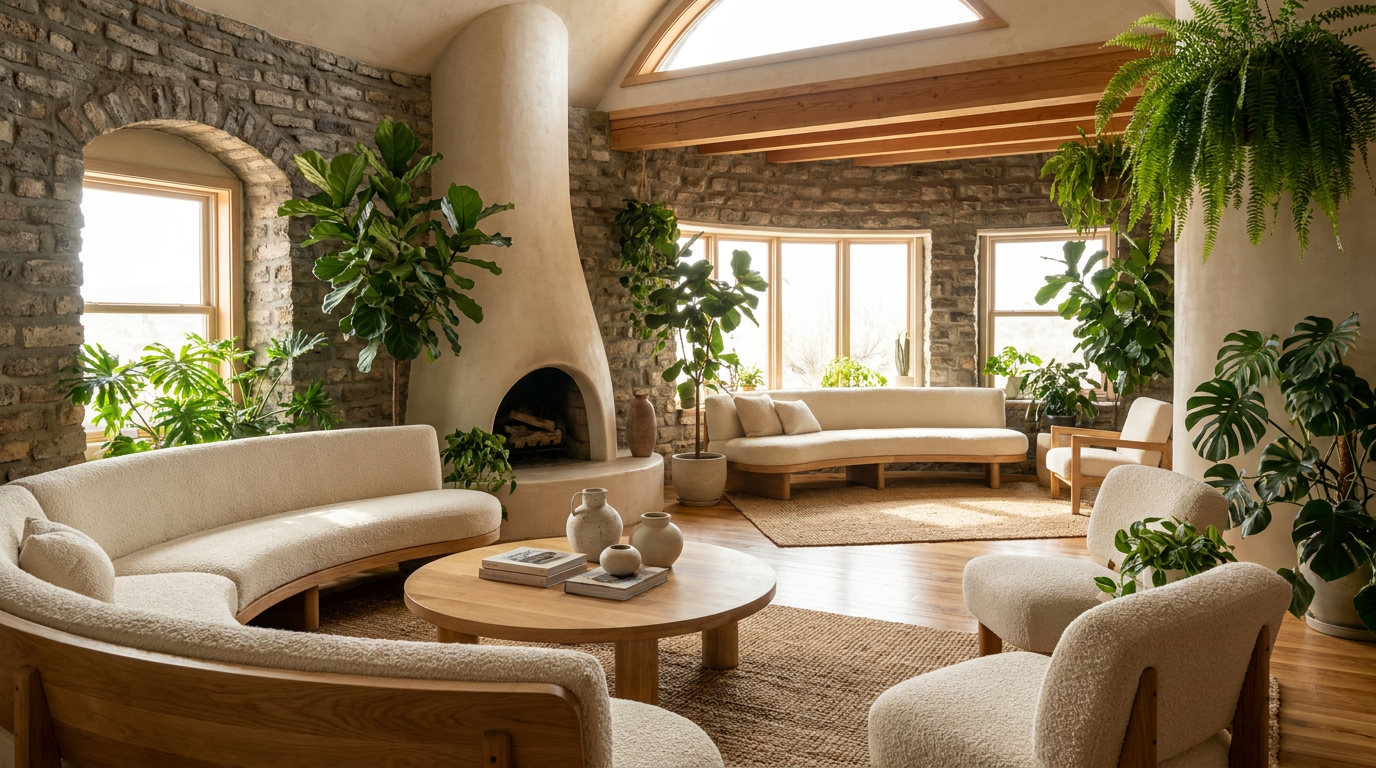
The physical shapes within a room also exert a profound influence on mental states. Neuroaesthetic research indicates a strong, universal human preference for curvilinear forms over sharp, angular lines. Smooth, flowing contours—whether in the arch of a doorway, the curve of a sofa, or the rounded edge of a table—are processed by the brain as safe and nurturing. Sharp angles, by contrast, can subconsciously trigger alertness or tension, as the primitive brain associates them with potential hazards. Integrating curves into a living space helps to soften the environment, fostering a baseline of psychological comfort.[1][8]

This preference for curves is closely tied to biophilia, the innate human desire to connect with nature. Because the human brain evolved outdoors, it is highly optimized to process natural stimuli. Incorporating biophilic elements—such as wood grains, stone textures, leafy plants, and natural fractal patterns—tricks the brain into a state of ease. Remarkably, the brain does not require these inputs to be entirely literal; even representations of nature, such as botanical wallpapers or earth-toned color palettes, can significantly lower heart rates and improve cognitive performance.[7][8]
Texture and acoustics play an equally critical, though often invisible, role in spatial perception. The brain interprets surface qualities instantly, associating plush, soft textures with warmth and safety, while sleek, hard surfaces signal utility and efficiency. Layering textiles like wool, velvet, and natural rugs does more than add visual depth; it fundamentally alters the acoustic profile of a room. Unpredictable, echoing noise is a primary driver of chronic stress in modern interiors. By absorbing sound, textured materials create a quiet, predictable acoustic environment that allows the nervous system to rest.[5][8]
The implications of neuroaesthetics extend far beyond residential living rooms. In commercial and public spaces, these principles are revolutionizing how environments are constructed. Hospitals that integrate natural light, biophilic views, and sound-dampening materials report accelerated patient recovery times and reduced clinical staff fatigue. Similarly, schools designed with neuroarchitectural principles—optimizing daylight and spatial harmony—demonstrate measurable improvements in student concentration, cognitive development, and knowledge retention.[6][7]

This systemic impact was a central focus at the recent Global Wellness Summit, where leaders from science, media, and public health converged to discuss the future of the built environment. The consensus was clear: wellness is no longer confined to healthcare settings or individual lifestyle choices. It is inextricably linked to the spaces people inhabit daily. By recognizing design as an ethical lever for public health, advocates are pushing for neuroaesthetic principles to become accessible, inclusive, and built into civic infrastructure by default.[3]
For the individual, applying neuroaesthetics does not require a complete architectural overhaul or an unlimited budget. It begins with a shift in perspective—decorating from the inside out. Rather than asking what looks impressive, the neuroaesthetic approach asks what feels restorative. It is about curating a sensory diet: adding a dimmable lamp for the evening, introducing a textured rug to quiet a room, or positioning a desk to face natural light. These low-friction adjustments build an interface between the home and the nervous system, turning the space into an active ally.[1][8]
As the modern world becomes increasingly overstimulating, the home must serve as a cognitive sanctuary. The integration of neuroscience and interior design offers a scientifically validated roadmap for achieving this balance. By moving beyond subjective trends and embracing the biological realities of human perception, neuroaesthetics provides a profound new toolkit. It empowers designers and individuals alike to craft environments that not only shelter the body but actively heal the mind.[8]
How we got here
Late 1990s
Neurobiologist Semir Zeki pioneers the field of neuroaesthetics, initially focusing on how the brain processes visual art.
2014
Studies begin demonstrating that aesthetically pleasing architectural spaces positively impact the orbitofrontal cortex, linking design to emotional regulation.
2019
Google, Muuto, and Johns Hopkins debut 'A Space for Being' at the Salone del Mobile, using wearable tech to prove interior design's real-time impact on physiology.
Early 2025
The Johns Hopkins IAM Lab publishes the 'Intentional Space Roadmap,' calling for a formalized 'Neuroarchitecture' sector.
Early 2026
The Global Wellness Summit highlights neuroaesthetics as a foundational, evidence-based pillar for the future of public health and preventive care.
Viewpoints in depth
Neuroscience Researchers
Focus on the empirical, biological data linking spatial environments to human physiology.
For neuroscientists, the conversation around design is entirely empirical. Using fMRI and biometric tracking, researchers view the built environment as a series of sensory inputs that either upregulate or downregulate the nervous system. They emphasize that aesthetic responses are not subjective cultural constructs, but hardwired evolutionary biology. By measuring cortisol, heart rate variability, and dopamine release, this camp argues that architecture should be treated as a measurable public health intervention rather than a purely artistic endeavor.
Design & Architecture Practitioners
Focus on translating neurological data into practical, emotionally intelligent interior spaces.
Architects and interior designers are tasked with turning clinical data into livable spaces. This camp values the scientific validation of their field, using neuroaesthetics to justify design choices that prioritize human comfort over stark minimalism or avant-garde trends. They focus on the practical application of biophilia, acoustic dampening, and circadian lighting, arguing that a room cannot be considered truly functional unless it actively supports the emotional and psychological well-being of its occupants.
Public Health Advocates
View intentional spatial design as a scalable, cost-effective intervention for community wellness.
Public health experts and wellness strategists look at neuroaesthetics through the lens of scale and equity. They argue that if environments shape health outcomes, then intentional design is an ethical imperative. This camp advocates for integrating neuroarchitectural principles into hospitals, schools, and urban planning to foster collective resilience. Their primary concern is ensuring that the biological benefits of good design are not restricted to luxury real estate, but are built into civic infrastructure by default.
What we don't know
- How individual neurological differences, such as neurodivergence, alter baseline responses to specific aesthetic stimuli.
- The long-term, compounding health metrics of living in a fully neuroaesthetic home over several decades.
- How to effectively mandate or subsidize neuroarchitectural principles in affordable public housing projects.
Key terms
- Neuroaesthetics
- The scientific study of how the brain perceives, processes, and responds to beauty, art, and spatial environments.
- Biophilic Design
- An architectural approach that connects building occupants more closely to nature by incorporating natural lighting, ventilation, landscape features, and organic materials.
- Cortisol
- A primary stress hormone produced by the adrenal glands; its levels can be measurably reduced by calming, well-designed environments.
- Circadian Lighting
- Artificial lighting systems designed to mimic the natural progression of daylight, supporting the body's internal clock and sleep-wake cycles.
- Amygdala
- The region of the brain responsible for processing emotions, particularly fear and threat detection, which can be triggered by chaotic or harsh spatial designs.
Frequently asked
What is the difference between interior design and neuroaesthetics?
Traditional interior design often focuses on visual trends and functional layouts. Neuroaesthetics applies neuroscience to understand how spatial elements like light, shape, and texture measurably affect brain chemistry and nervous system regulation.
How can I apply neuroaesthetics in my own home?
Start by optimizing your sensory environment. Maximize natural daylight, use warm and dimmable lighting in the evening, incorporate curved furniture, and add natural textures like wood and plants to lower cortisol levels.
Does neuroaesthetic design cost more?
Not necessarily. While major architectural changes can be expensive, the core principles—such as rearranging furniture to capture natural light, decluttering to reduce visual noise, and adding affordable houseplants—can be implemented on any budget.
Why does the brain prefer curved furniture?
Evolutionary biology suggests that the human brain associates sharp angles with potential threats or hazards. Curvilinear forms, which mimic the organic shapes found in nature, are processed by the brain as safe, nurturing, and calming.
Sources
Source coverage
8 outlets
4 viewpoints surfaced








[1]LivingetcDesign & Architecture Practitioners
Design can have a huge impact on your mood — here's why neuroaesthetics is the buzzword to know
Read on Livingetc →[2]Design MilkPublic Health Advocates
Johns Hopkins University's IAM Lab Publishes a Report Calling for the Development of a New Interdisciplinary Neuroarchitecture Sector
Read on Design Milk →[3]ArchiExpo e-MagazinePublic Health Advocates
Designing the Future of Wellness: Global Wellness Summit Highlights Neuroaesthetics
Read on ArchiExpo e-Magazine →[4]Johns Hopkins MedicineNeuroscience Researchers
International Arts + Mind Lab (IAM Lab) Center for Applied Neuroaesthetics
Read on Johns Hopkins Medicine →[5]Science in DesignNeuroscience Researchers
What is Neuroaesthetics? The Convergence of Neuroscience and Aesthetics
Read on Science in Design →[6]Pearl AcademyDesign & Architecture Practitioners
Neuroaesthetics in Interior Design: The Brain, Beauty, and Built Environments
Read on Pearl Academy →[7]ArchDailyDesign & Architecture Practitioners
Neuroaesthetics and Neuroarchitecture: Shaping Environments for Mental Health
Read on ArchDaily →[8]Factlen Editorial TeamEditorial Synthesis
Synthesis by Factlen editorial team
Read on Factlen Editorial Team →
Every angle. Every day.
Get home stories with full source coverage and perspective breakdowns delivered to your inbox.