
U.S. Releases Text of Iran Agreement Framework, Opening 60-Day Window on Nuclear Program
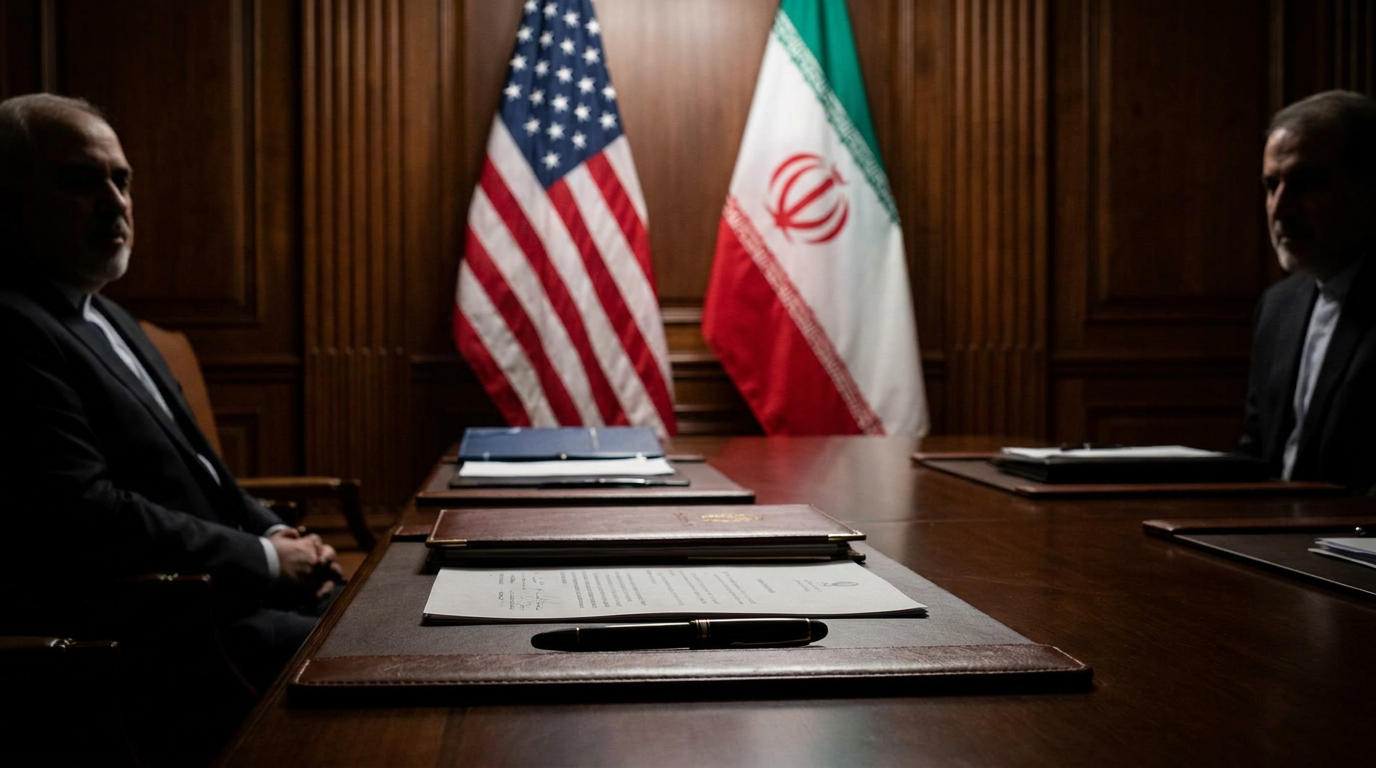
The United States and Iran have released the preliminary text of a new diplomatic framework, establishing a 60-day window to resolve outstanding disputes over Tehran's nuclear enrichment program.
By Factlen Editorial Team
- U.S. Administration
- Argues the framework is a pragmatic necessity to stabilize the Middle East and cap Iran's nuclear progress before it crosses the weapons threshold.
- Iranian State Media
- Frames the negotiations as a potential victory that could lift crippling economic sanctions, provided the U.S. respects Iranian sovereignty.
- Regional Skeptics
- Views any agreement that leaves Iran's nuclear infrastructure intact as a dangerous appeasement that threatens regional survival.
- Non-Proliferation Experts
- Focuses strictly on the technical viability of the agreement, emphasizing that without rigorous IAEA verification, the framework is meaningless.
What's not represented
- · Iranian civilian population affected by sanctions
- · Global shipping companies operating in the Strait of Hormuz
Why this matters
This 60-day window represents the most significant diplomatic pivot between Washington and Tehran in years, directly impacting global energy markets, Middle Eastern security, and the threshold of nuclear proliferation.
Key points
- The U.S. and Iran have released a preliminary diplomatic framework to de-escalate regional tensions.
- The text establishes a 60-day window to finalize limits on Iran's nuclear enrichment program.
- In exchange for nuclear caps, the U.S. proposes a phased lifting of economic sanctions.
- The breakthrough follows a recent U.S. acknowledgment of deadly airstrikes in Minab, Iran.
- Regional allies, particularly Israel, have expressed deep concern over leaving Iran's nuclear infrastructure intact.
The United States has officially released the text of a preliminary diplomatic agreement with Iran, marking a sudden and significant shift from military confrontation to high-stakes negotiation. The document, circulated among international stakeholders on Wednesday, outlines a broad framework for de-escalation in the Middle East while leaving the most contentious issues for a highly compressed period of future diplomacy.[1][4]
Rather than finalizing a comprehensive treaty, the newly released text establishes a formal 60-day window designed to resolve the most intractable dispute between the two nations: Iran's rapidly advancing nuclear enrichment program. During this two-month period, technical teams from both sides are expected to hammer out the specific limits on uranium stockpiles and the operational status of advanced centrifuges.[1][4][8]
The diplomatic momentum appears to be accelerating rapidly. Tehran has indicated that its leadership is actively reviewing the proposed framework, with Iranian officials openly discussing the unprecedented possibility of a direct signing ceremony between the U.S. and Iranian presidents if the nuclear details are successfully ironed out within the allotted timeframe.[2][6]
President Trump has publicly reinforced this accelerated timeline, stating that he expects the agreement to be signed "shortly." The administration has characterized the framework as a necessary and pragmatic step to stabilize the region, secure vital shipping lanes, and permanently prevent Tehran from acquiring a nuclear weapon.[2][3]

This diplomatic breakthrough arrives exactly 100 days after a severe military escalation that threatened to ignite a broader regional war. In March, U.S. airstrikes demolished an elementary school in the southern Iranian city of Minab, an event that triggered widespread international condemnation and brought bilateral relations to a historic low.[1][8]
Addressing the Minab incident recently, the president acknowledged the tragedy, stating that "mistakes are made" and confirming that the episode remains under active investigation by the U.S. military. This rare public concession regarding the deadly strike appears to have provided Tehran with enough political cover to re-engage in direct diplomatic talks without appearing to capitulate under military pressure.[1]
The core of the upcoming 60-day negotiation will focus intensely on uranium enrichment levels. Currently, international monitors estimate that Iran has enriched uranium to 60 percent purity at several heavily fortified facilities. This level of enrichment has no civilian justification and places Tehran a very short technical step away from the 90 percent threshold required for weapons-grade material.[4][8]

The core of the upcoming 60-day negotiation will focus intensely on uranium enrichment levels.
In exchange for capping enrichment and allowing enhanced, unannounced inspections by the International Atomic Energy Agency (IAEA), the draft text outlines a phased mechanism for lifting specific U.S. economic sanctions. These proposed relief measures primarily target Iran's heavily restricted oil export sector and its access to frozen international banking assets.[4][5]
Beyond the nuclear portfolio, the agreement includes preliminary commitments regarding maritime security in the Strait of Hormuz. This critical chokepoint, through which roughly a fifth of the world's daily oil consumption passes, has been the site of repeated seizures of commercial vessels and military standoffs over the past several years.[1][5]
Regional allies have reacted to the framework with intense skepticism. Israeli officials have expressed deep concern over the parameters of the draft, reiterating their long-standing demand that any agreement must completely dismantle Iran's nuclear infrastructure rather than merely capping its output or pausing its development.[7]
Conversely, several Gulf Arab states have cautiously welcomed the de-escalation. Having recently pursued their own diplomatic detente with Tehran to protect their vulnerable energy infrastructure, these nations view the 60-day window as a vital reprieve from the immediate threat of a catastrophic regional conflict.[5]

Within Washington, the framework faces immediate and intense bipartisan scrutiny. Lawmakers are demanding clarity from the administration on whether the final document will be submitted to Congress as a formal treaty—which would require a nearly impossible two-thirds Senate majority to ratify—or implemented unilaterally as an executive agreement.[3][5]
Non-proliferation experts emphasize that the ultimate success of the 60-day window hinges entirely on the strength of the verification protocols. Previous diplomatic arrangements have frequently collapsed over disputes regarding IAEA inspector access to undeclared military sites and the installation of continuous monitoring equipment.[8]
Inside Iran, the political calculations are equally fraught. The leadership is attempting to balance the desperate need for economic relief caused by years of crippling sanctions against powerful hardline factions, who view any compromise with the United States as a strategic surrender, particularly in the immediate aftermath of the Minab strikes.[6]

As the 60-day clock officially begins ticking, diplomats from both nations face a monumental task. They must convert a fragile, preliminary framework into a binding, verifiable mechanism that can survive both the inherent volatility of the Middle East and the turbulent domestic political environments in both Washington and Tehran.[4][5][8]
How we got here
2018
The United States formally withdraws from the Joint Comprehensive Plan of Action (JCPOA), reimposing heavy sanctions on Iran.
March 2026
U.S. airstrikes demolish an elementary school in Minab, Iran, bringing bilateral relations to the brink of war.
June 17, 2026
The U.S. and Iran release the text of a preliminary agreement, opening a 60-day window for nuclear negotiations.
August 2026
The deadline for the 60-day negotiation window to finalize enrichment limits and sanctions relief.
Viewpoints in depth
U.S. Administration's View
The administration views the framework as a necessary diplomatic lever to halt Iran's nuclear progress.
U.S. officials argue that the "maximum pressure" campaigns of the past have failed to stop Iran's centrifuges from spinning. By offering a structured 60-day window and the promise of phased sanctions relief, the administration believes it can secure binding, verifiable caps on uranium enrichment before Tehran crosses the nuclear threshold. They also view the agreement as a critical tool to stabilize the Strait of Hormuz and prevent a broader Middle Eastern war that could drag in U.S. forces.
Iranian Leadership's View
Tehran sees the negotiations as a pathway to economic survival, provided it does not appear to be surrendering.
For Iran's leadership, the primary objective is the removal of crippling U.S. sanctions that have devastated the national economy and fueled domestic unrest. However, the government must navigate intense internal pressure from hardline factions, particularly following the U.S. strikes in Minab. By keeping the nuclear infrastructure largely intact and framing the 60-day window as a negotiation between equals, Tehran hopes to secure economic relief without compromising its core sovereignty or regional deterrence.
Israeli Government's View
Israel views any agreement that caps rather than dismantles Iran's nuclear program as an existential threat.
Israeli officials have consistently argued that diplomatic frameworks only serve to delay, rather than prevent, a nuclear-armed Iran. They express deep concern that the 60-day window will legitimize Iran's status as a threshold nuclear state. From Israel's perspective, allowing Tehran to retain its advanced centrifuges and enriched uranium stockpiles—even under IAEA monitoring—leaves the regime with the capability to sprint toward a weapon at a time of its choosing.
Non-Proliferation Experts' View
Experts emphasize that the agreement's success depends entirely on the technical rigor of its verification mechanisms.
Nuclear watchdogs and arms control analysts focus less on the political rhetoric and more on the technical realities of IAEA access. They point out that a 60-day window is an incredibly tight timeframe to negotiate the complex protocols required to monitor Iran's sprawling nuclear infrastructure. Experts warn that unless the final agreement includes unhindered, 24/7 access to both declared and undeclared sites, the framework will fail to provide the international community with genuine early-warning capabilities.
What we don't know
- Whether Iran will agree to dismantle its advanced centrifuges or merely unplug them.
- If the U.S. Congress will attempt to block the phased sanctions relief outlined in the framework.
- How regional proxy groups aligned with Iran will respond during the 60-day negotiation window.
Key terms
- Uranium Enrichment
- The process of increasing the concentration of the U-235 isotope in uranium, which can be used for civilian nuclear power at low levels or nuclear weapons at high levels.
- Weapons-Grade Uranium
- Uranium that has been enriched to 90 percent purity or higher, making it suitable for use in the core of a nuclear explosive device.
- IAEA
- The International Atomic Energy Agency, the United Nations watchdog responsible for monitoring and verifying national nuclear programs.
- Strait of Hormuz
- A narrow, strategically vital waterway between the Persian Gulf and the Gulf of Oman, through which a massive portion of the world's oil supply is transported.
- Sanctions Relief
- The removal or suspension of economic penalties—such as bans on oil exports or banking access—imposed by one country on another to force a change in policy.
Frequently asked
What happens if the 60 days expire without a deal?
If the window closes without an agreement on enrichment limits, the preliminary framework could collapse, likely resulting in a return to heavy sanctions and heightened military tensions.
Does this framework immediately lift sanctions on Iran?
No. The current text only outlines a proposed mechanism for future sanctions relief, which would be contingent on Iran meeting specific, verified nuclear benchmarks.
How close is Iran to a nuclear weapon?
International monitors estimate Iran has enriched uranium to 60 percent purity. While 90 percent is required for a weapon, the technical leap from 60 to 90 percent is relatively short.
What was the Minab strike?
In March 2026, U.S. airstrikes demolished an elementary school in Minab, Iran. The U.S. president recently acknowledged the incident, stating 'mistakes are made' and that it remains under investigation.
Sources
Source coverage
8 outlets
4 viewpoints surfaced








[1]NYTU.S. Administration
U.S. Official Releases Text of Agreement With Iran
Read on NYT →[2]Al JazeeraIranian State Media
Tehran says considering plan for Iran, US presidents to sign deal
Read on Al Jazeera →[3]Fox NewsU.S. Administration
Trump administration unveils framework for historic Iran pact
Read on Fox News →[4]ReutersNon-Proliferation Experts
US-Iran draft agreement leaves nuclear enrichment limits unresolved
Read on Reuters →[5]BBC NewsNon-Proliferation Experts
What the new US-Iran 60-day diplomatic window means for the Middle East
Read on BBC News →[6]Tehran TimesIranian State Media
Iran reviews proposed text as 60-day negotiation window opens
Read on Tehran Times →[7]The Times of IsraelRegional Skeptics
Israel expresses 'deep concern' over US-Iran framework, demands zero enrichment
Read on The Times of Israel →[8]Council on Foreign RelationsNon-Proliferation Experts
The Evolution of US-Iran Nuclear Diplomacy
Read on Council on Foreign Relations →
More in news politics
See all 5 stories →
Every angle. Every day.
Get news politics stories with full source coverage and perspective breakdowns delivered to your inbox.