
How Hall Effect Joysticks Are Finally Curing Controller Stick Drift
After decades of frustrating hardware failures, the gaming industry is rapidly adopting magnetic sensors that eliminate the friction behind stick drift. Here is how Hall Effect and TMR technologies are making disposable controllers a thing of the past.
By Factlen Editorial Team
- Hardware Enthusiasts
- Advocates for right-to-repair and long-lasting consumer electronics.
- Competitive Gamers
- Players focused on input precision, zero deadzones, and tournament reliability.
- Peripheral Manufacturers
- Third-party brands leveraging magnetic tech to capture market share.
Why this matters
Stick drift is the most common and frustrating hardware failure in modern gaming, forcing players to routinely replace expensive controllers. The industry-wide shift toward magnetic Hall Effect sensors permanently solves this issue, saving consumers money while delivering superior competitive precision.
For nearly two decades, the global gaming community has been haunted by a single, infuriating mechanical ghost: stick drift. Whether you are a casual weekend player exploring a massive open world or a professional esports athlete competing for millions, the phantom movement of an on-screen camera or crosshair is an almost inevitable failure of modern controller architecture. It is the moment your character slowly walks off a cliff without you touching the gamepad, or your sniper reticle drifts slightly to the left just as you pull the trigger. This hardware decay has plagued every major console generation, turning premium peripherals into ticking time bombs.[6]
The financial and environmental toll of this built-in obsolescence is staggering. Gamers routinely find themselves forced to replace $70 first-party controllers every six to twelve months simply because the internal sensors can no longer accurately read the neutral center position. Over the lifespan of a console, a single player might spend hundreds of dollars just replacing drifting gamepads. But in 2026, the peripheral industry has finally reached a tipping point. Driven by a widespread consumer revolt, class-action lawsuits over hardware durability, and the rapid democratization of magnetic sensing technology, the era of the disposable controller is coming to an end.[2][4][7]
To truly appreciate the solution, one must first understand the fundamental mechanical flaw that causes the problem. The vast majority of standard controllers produced over the last twenty years rely on a legacy technology called a potentiometer. Inside these traditional analog stick modules, a conductive metal wiper physically drags across a curved carbon resistive track to measure the joystick's precise X and Y coordinates. It is a contact-based measurement system that relies entirely on physical friction to translate your thumb's movement into a digital signal.[2][4]

Every single time a player pushes the stick forward to sprint in a shooter or cranks it sideways to steer a car, that metal wiper acts like a microscopic plow. The constant physical friction slowly but surely scrapes away the delicate carbon surface, leaving behind a trail of conductive dust and debris inside the enclosed module. Over hundreds of hours of intense gameplay, this wear and tear creates dead spots, uneven resistance, and electrical noise. Eventually, the sensor becomes so degraded and dirty that it confuses the controller, registering phantom voltage changes and causing the game to think the stick is moving when it is perfectly still.[2][6]
The definitive antidote to this friction-based decay is the Hall Effect, a principle of electromagnetism discovered back in 1879 by American physicist Edwin Hall. While the science is over a century old, its application to modern gaming peripherals is revolutionizing how player inputs are captured. Instead of relying on physical parts that grind against each other until they break, Hall Effect joysticks utilize the invisible power of magnetic fields to track movement with microscopic precision.[1][4]
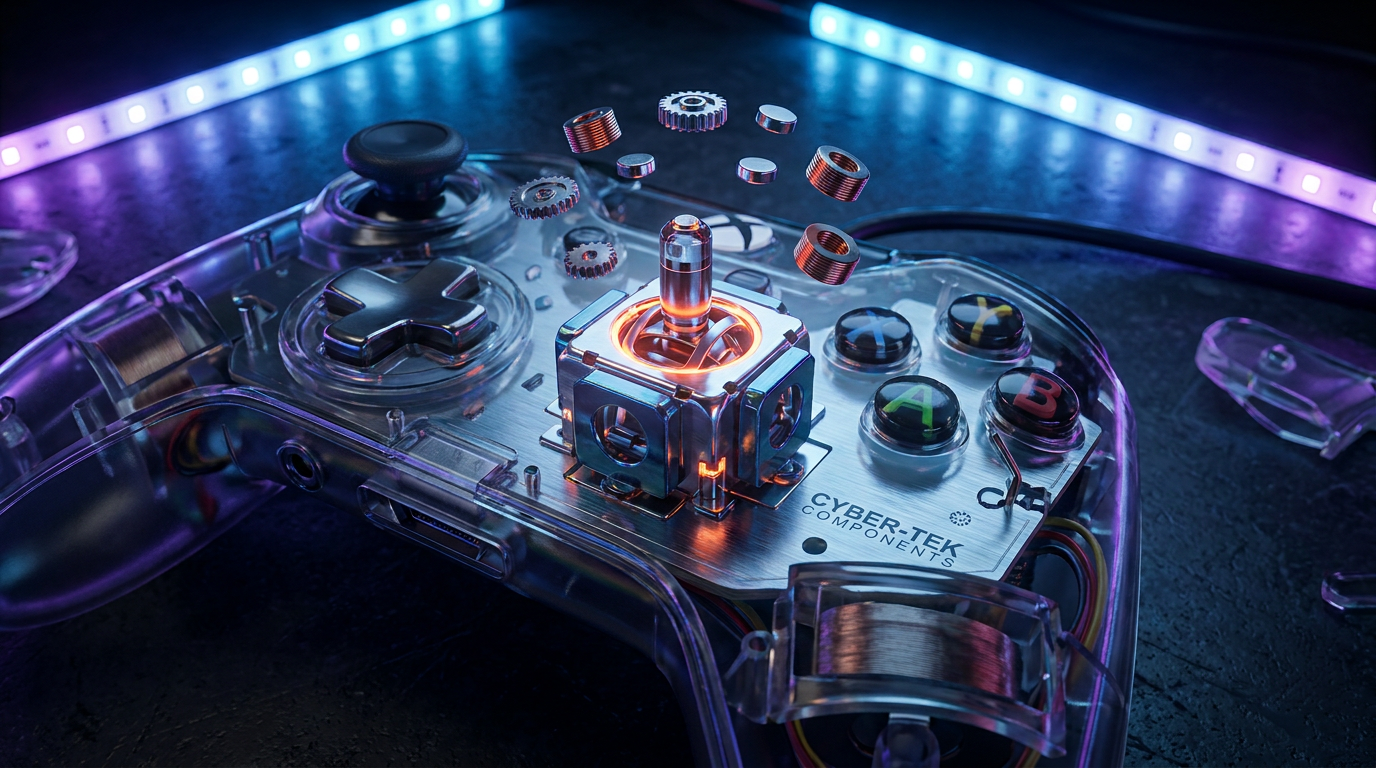
The internal architecture of a Hall Effect module is elegantly simple yet highly advanced. A permanent magnet is securely attached to the moving base of the joystick shaft. A stationary sensor sits nearby on the controller's circuit board, constantly measuring the strength, angle, and orientation of the magnetic field as the stick tilts in various directions. Because the sensor reads voltage changes caused by the shifting magnetic field through the air, there is absolutely no physical contact between the moving stick and the sensor itself.[1][6]
The primary and most celebrated benefit of this contactless design is its profound durability. By entirely eliminating the carbon track and the scraping metal wiper, the primary mechanical wear mechanism behind stick drift is eradicated at the source. While traditional potentiometers are nearly guaranteed to fail eventually—often rated for just a few hundred hours of heavy use—Hall Effect sticks are rated for five to ten million cycles. They can theoretically last the entire lifetime of the controller without ever losing their factory-calibrated center point.[1][2][7]

The primary and most celebrated benefit of this contactless design is its profound durability.
Beyond sheer longevity, magnetic sensors offer a distinct and measurable performance edge for high-level play. Without the electrical "noise" generated by a degrading carbon track, Hall Effect sticks provide incredibly clean, consistent, and linear inputs. Competitive players can confidently reduce their software deadzones—the artificial area at the center of the stick where movement is ignored to hide drift—to absolute zero. This allows for instantaneous, pixel-perfect micro-adjustments in high-stakes competitive shooters, ensuring that muscle memory translates flawlessly to the screen.[4][7]
While first-party console manufacturers have been notoriously slow to abandon their deeply entrenched, highly optimized potentiometer supply chains, third-party peripheral makers have aggressively filled the void. Brands like GuliKit, 8BitDo, Flydigi, GameSir, and Turtle Beach have seized the opportunity, making Hall Effect sensors the absolute gold standard for premium gamepads in 2026. By offering drift-free guarantees, these companies have successfully challenged the dominance of official controllers, forcing the entire industry to elevate its hardware standards.[3][4][6]
As the market embraces magnetic sensing, the technology itself is already evolving to the next level. The latest frontier in premium controller hardware is Tunnel Magnetoresistance, commonly referred to as TMR. While TMR operates on a similar contactless magnetic principle to standard Hall Effect sensors, it utilizes a different mechanism for detection. Instead of measuring changes in voltage as the magnetic field shifts, TMR sensors measure minute changes in electrical resistance, unlocking a new tier of hardware efficiency.[3][10]

This shift from voltage to resistance yields massive benefits for wireless peripherals. TMR sensors produce significantly stronger output signals with much less need for internal amplification. This translates to remarkable power efficiency; leading manufacturers note that their TMR joysticks consume roughly one-tenth the battery power of mainstream Hall Effect sensors. Furthermore, TMR boasts even higher resolution and polling stability, making it the new darling of the ultra-premium esports peripheral market where every millisecond and micro-movement counts.[3][10]
Ironically, magnetic joysticks are not a brand-new invention in the console space. Sega famously pioneered early versions of Hall Effect sticks in the beloved Dreamcast controller back in the late 1990s. Sony also utilized a similar magnetic sensing technology in the PlayStation 3's DualShock 3 controllers. However, as production scaled and cost-cutting measures took priority, the industry largely reverted to cheaper, mass-produced potentiometers, setting the stage for the stick drift epidemic that defined the PS4 and Switch eras.[5][7]
Despite the overwhelming advantages, it is important to maintain a realistic perspective: while Hall Effect and TMR sensors are heavily drift-resistant, they are not entirely indestructible. Controllers are complex mechanical devices, and they can still suffer from broken physical centering springs, degrading plastic housings, or firmware calibration glitches. A Hall Effect stick with a snapped tension spring will still fail to return to center, even if the magnetic sensor itself is reading perfectly.[2][7]

Furthermore, because these sensors rely on precise magnetic fields to determine their exact coordinates, they can theoretically be disrupted by powerful external magnets or extreme temperature fluctuations that alter magnetic properties. However, in standard living room or tournament gaming environments, these edge cases are incredibly rare and largely negligible. The core truth remains: the sensors themselves are entirely immune to the friction-based decay that inevitably kills standard gamepads, making them a vastly superior and more reliable investment for anyone who plays games on a regular basis.[2][4]
As the global gaming community becomes increasingly educated about hardware internals, component quality, and right-to-repair principles, the collective tolerance for disposable, rapidly degrading controllers has completely vanished. The widespread adoption of magnetic sensing in 2026 represents a rare, definitive victory for consumer hardware in an era often defined by planned obsolescence. It is a tangible technological leap that not only saves players significant money and reduces electronic waste, but fundamentally improves the precision, reliability, and overall enjoyment of the games they play every single day.[6][7]
Viewpoints in depth
Hardware Enthusiasts
Advocates for right-to-repair and long-lasting consumer electronics.
For the repair community and hardware purists, the shift to Hall Effect sensors is a long-overdue correction to an era of built-in obsolescence. They argue that first-party manufacturers have knowingly continued to use cheap potentiometer modules despite widespread failure rates, effectively taxing consumers who must replace their hardware annually. To this camp, magnetic sensing isn't just a performance upgrade; it is a fundamental consumer rights issue and a victory for sustainable electronics.
Competitive Gamers
Players focused on input precision, zero deadzones, and tournament reliability.
In the esports arena, durability is secondary to raw performance. Competitive players champion Hall Effect and TMR technologies because they eliminate the electrical noise that degrades aiming precision over time. By utilizing contactless sensors, these players can reduce their software deadzones to absolute zero, ensuring that the slightest micro-adjustment of the thumb translates instantly to on-screen movement without the risk of phantom drift ruining a critical match.
Peripheral Manufacturers
Third-party brands leveraging magnetic tech to capture market share.
For third-party controller manufacturers, Hall Effect and TMR sensors represent the ultimate wedge issue to break the dominance of first-party console gamepads. Brands like GuliKit, Flydigi, and Turtle Beach are aggressively marketing their drift-free architectures as premium, pro-level features. They view the transition to magnetic sensing as a key differentiator that justifies higher price points and builds intense brand loyalty among frustrated consumers.
What we don't know
- Whether first-party console makers will fully adopt Hall Effect sensors for their next-generation base controllers.
- How the long-term failure rates of newer TMR sensors will compare to standard Hall Effect modules after years of mass-market use.
Sources
Source coverage
7 outlets
3 viewpoints surfaced







[1]ELO GamingCompetitive Gamers
What Are Hall Effect Joysticks? The Complete Guide for Gamers
Read on ELO Gaming →[2]Turtle BeachPeripheral Manufacturers
Hall Effect Controllers Explained: The Stick Drift Solution
Read on Turtle Beach →[3]CNETPeripheral Manufacturers
TMR vs. Hall Effect Controllers: Battle of the Magnetic Sensing Tech
Read on CNET →[4]EveZoneCompetitive Gamers
Hall Effect Controller Tech: The Science of Anti-Drift
Read on EveZone →[5]RedditHardware Enthusiasts
ELI5: What is the 'hall effect' supposed to mean/be for videogame controller joysticks
Read on Reddit →[6]GadgetHyperPeripheral Manufacturers
Why Hall Effect is the Death of Stick Drift in 2026
Read on GadgetHyper →[7]Factlen Editorial TeamHardware Enthusiasts
Synthesis by Factlen editorial team
Read on Factlen Editorial Team →
Every angle. Every day.
Get gaming esports stories with full source coverage and perspective breakdowns delivered to your inbox.