
Open-Source AI Reaches a Tipping Point as June Releases Rival Proprietary Giants
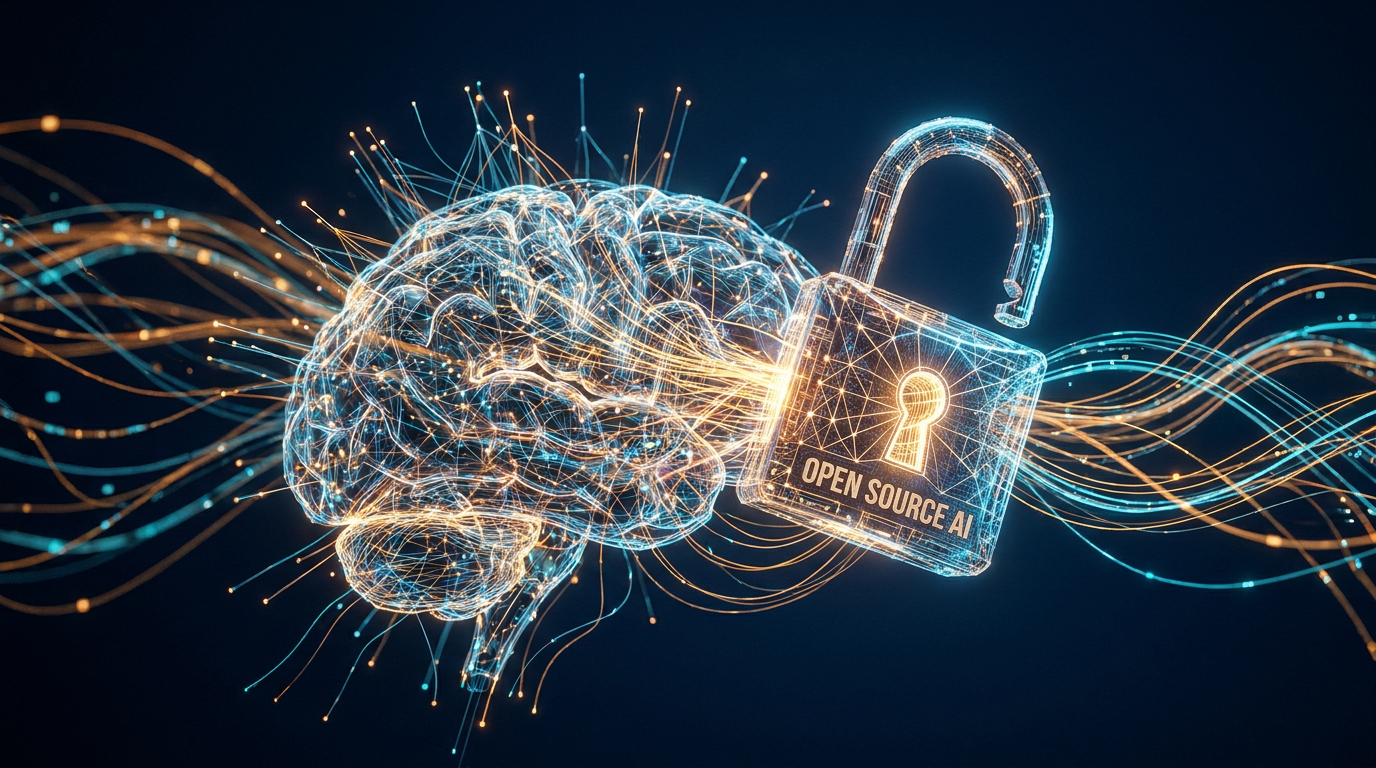
A rapid succession of open-weight AI models released in early June 2026 has successfully closed the capability gap with proprietary systems, offering frontier-level coding and reasoning to developers globally.
By Factlen Editorial Team
- Open-Source Developers
- Values the democratization of AI, emphasizing that open weights eliminate vendor lock-in, reduce inference costs, and allow for deep customization and self-hosting.
- Enterprise Adopters
- Focuses on the practical economics and data privacy benefits of running highly capable open models on private infrastructure rather than sending sensitive data to third-party APIs.
- Proprietary AI Labs
- Maintains that closed-source models still hold the absolute peak of general intelligence and offer better enterprise service-level agreements and safety guardrails.
What's not represented
- · Hardware Manufacturers
- · Cloud Infrastructure Providers
Why this matters
For the first time, developers and researchers globally can download and run AI models that match the reasoning and coding capabilities of the most expensive proprietary systems. This democratizes access to frontier-tier intelligence, drastically reduces compute costs, and eliminates vendor lock-in for enterprise and academic projects.
Key points
- A wave of open-weight AI models released in June 2026 has matched the capabilities of proprietary systems.
- MiniMax M3 achieved a 59.0% score on the SWE-Bench Pro coding test, beating GPT-5.5.
- NVIDIA released Nemotron 3 Ultra, a 550-billion-parameter model optimized for complex agentic workflows.
- Advances in Mixture-of-Experts (MoE) architecture allow these massive models to run efficiently on standard hardware.
- The availability of frontier-tier open models drastically reduces compute costs and eliminates vendor lock-in for developers.
The first two weeks of June 2026 have fundamentally reshaped the artificial intelligence landscape. In a flurry of rapid-fire releases, the open-source and open-weight AI community has deployed a new generation of models that successfully close the capability gap with proprietary giants like OpenAI, Anthropic, and Google.[1][4]
For years, the industry operated under a standard assumption: open-source models were excellent for lightweight tasks and budget-constrained projects, but complex reasoning, long-horizon agentic workflows, and deep software engineering required renting access to closed-source frontier models. That paradigm has now officially broken.[1][3]
The shift began on June 1 with the release of MiniMax M3, a flagship open-weight model from the Shanghai-based AI lab MiniMax. M3 arrived as the first open-weight system to combine three capabilities previously restricted to proprietary models: frontier-level coding performance, a massive one-million-token context window, and native multimodal understanding that processes text, images, and video simultaneously.[2][6][7]
The benchmark results immediately caught the attention of the global developer community. On SWE-Bench Pro, a rigorous test that measures a model's ability to solve real-world software engineering issues, MiniMax M3 scored 59.0%. This score edged past OpenAI's GPT-5.5 and Google's Gemini 3.1 Pro, placing an open-weight model firmly in the top tier of coding intelligence.[1][2][6]

Just three days later, on June 4, NVIDIA accelerated the momentum by unveiling Nemotron 3 Ultra. Announced at the Computex conference in Taipei, Nemotron 3 Ultra is a massive 550-billion-parameter model released under a fully permissive license. It was purpose-built for orchestrating complex, long-running agent workflows, such as multi-step coding agents and enterprise document research.[1][5]
Just three days later, on June 4, NVIDIA accelerated the momentum by unveiling Nemotron 3 Ultra.
NVIDIA's release highlighted a critical architectural evolution that is making these massive open models economically viable: the Mixture-of-Experts (MoE) design. While Nemotron 3 Ultra contains 550 billion total parameters, it only activates 55 billion parameters during any given computational pass. This active-to-total ratio means developers get the reasoning quality of a half-trillion-parameter model at the compute cost of a much smaller system.[5]
The wave of releases did not stop there. On June 12, Moonshot AI released Kimi K2.7 Code, a 1-trillion-parameter MoE model that drastically reduces computational overhead, requiring 30% fewer reasoning tokens than its predecessor to achieve higher coding benchmarks. The very next day, Z.ai launched GLM-5.2, featuring its own one-million-token context window and new advanced thinking-effort modes.[1][2]
This unprecedented density of releases—three major, frontier-class open models in less than two weeks—has fractured the concept of a single AI monopoly. Industry trackers note that there is no longer a single "best" model overall; instead, there is a top open-source coding model, a top reasoning model, and a top multimodal model, allowing developers to route specific tasks to the most efficient open system.[1][3]

The architectural breakthroughs enabling this shift go beyond MoE. Models like MiniMax M3 utilize new sparse attention mechanisms to handle their massive context windows without overwhelming GPU memory. Meanwhile, NVIDIA's Nemotron 3 Ultra leverages a hybrid Mamba-Transformer architecture and Multi-Teacher On-Policy Distillation (MOPD), a training method where the model learns from multiple specialized teacher models simultaneously.[5][6][7]
These technical optimizations translate directly into real-world cost savings. Independent analysis shows that running these new open-weight models costs roughly a tenth of what proprietary frontier APIs charge for equivalent work. For enterprise adopters, NVIDIA reported that Nemotron 3 Ultra lowers the cost of agentic tasks by up to 30% while achieving five times higher inference throughput compared to older open models.[5][8]

The proprietary labs are actively responding to this shifting landscape. In late May, OpenAI announced the retirement of older models like o3 and GPT-4.5 to focus compute resources on their newer, highly capable agentic models like GPT-5.3-Codex. The battleground has clearly moved away from simple chat interfaces and toward autonomous, long-horizon agents that can execute complex tasks over hours or days.[1][4]
For the broader technology ecosystem, the June 2026 open-source wave represents a massive democratization of capability. Startups, academic researchers, and developers in emerging markets no longer need to rely on expensive API subscriptions to build cutting-edge AI applications. By downloading models like MiniMax M3 or Nemotron 3 Ultra, they can self-host frontier-tier intelligence, ensuring data privacy and total control over their infrastructure.[2][3][7]
How we got here
Late May 2026
OpenAI announces the retirement of older models to focus on newer agentic systems like GPT-5.3-Codex.
June 1, 2026
MiniMax releases M3, featuring a 1-million-token context window and scoring 59.0% on SWE-Bench Pro.
June 4, 2026
NVIDIA unveils Nemotron 3 Ultra, a 550-billion-parameter open model optimized for agent orchestration.
June 12, 2026
Moonshot AI releases Kimi K2.7 Code, a highly efficient 1-trillion-parameter coding model.
June 13, 2026
Z.ai launches GLM-5.2, adding advanced thinking-effort modes to the open-source ecosystem.
Viewpoints in depth
Open-Source Developers
Advocates for the democratization of AI through accessible, open-weight models.
For the open-source community, the June 2026 releases represent the breaking of a monopoly. Developers argue that relying on proprietary APIs creates dangerous vendor lock-in, where a single corporate decision can break an entire application. By having access to frontier-tier models like MiniMax M3 and Nemotron 3 Ultra, developers can self-host their infrastructure, fine-tune models for highly specific niche use cases, and drastically reduce their operational costs. They view this shift as essential for ensuring that the next generation of software innovation is driven by a decentralized global community rather than a handful of massive tech conglomerates.
Enterprise Adopters
Focuses on the security and economic benefits of running capable models on private infrastructure.
Enterprise technology leaders view the new wave of open-weight models through the lens of data privacy and predictable economics. Many corporations have been hesitant to send proprietary codebases, legal documents, or sensitive customer data to third-party APIs. The ability to deploy a 550-billion-parameter model like Nemotron 3 Ultra on internal, air-gapped servers solves this massive compliance hurdle. Furthermore, the architectural efficiency of these new models—specifically the active-to-total parameter ratios in MoE designs—means that enterprises can achieve state-of-the-art reasoning without needing to purchase prohibitively expensive supercomputer clusters.
What we don't know
- How proprietary labs like OpenAI and Google will adjust their pricing models in response to highly capable, free open-weight alternatives.
- Whether the open-source community can sustain the massive compute costs required to train the next generation of trillion-parameter models.
- How quickly enterprise software vendors will integrate these new open models into their existing enterprise resource planning (ERP) systems.
Key terms
- Open-Weight Model
- An AI model whose pre-trained parameters are publicly released, allowing anyone to run it locally rather than accessing it exclusively through a paid API.
- Mixture-of-Experts (MoE)
- An AI architecture that divides a model into specialized sub-networks (experts) and only activates a small portion of them for any given task, drastically improving computational efficiency.
- Context Window
- The maximum amount of text, code, or data an AI model can hold in its active memory and process in a single prompt.
- SWE-Bench Pro
- A rigorous, industry-standard benchmark that tests an AI model's ability to autonomously resolve real-world software engineering issues.
- Agentic Workflow
- A process where an AI operates autonomously over multiple steps—such as writing code, testing it, and fixing errors—without needing constant human prompting.
Frequently asked
What is an open-weight AI model?
An open-weight model is an AI system where the underlying mathematical parameters (weights) are made publicly available, allowing developers to download, run, and modify the model on their own hardware.
How did MiniMax M3 perform on coding tests?
MiniMax M3 scored 59.0% on the SWE-Bench Pro software engineering benchmark, surpassing proprietary models like GPT-5.5 and Gemini 3.1 Pro.
What makes NVIDIA's Nemotron 3 Ultra efficient?
It uses a Mixture-of-Experts (MoE) architecture. While it has 550 billion total parameters, it only activates 55 billion per token, providing high reasoning quality at a lower computational cost.
Why is a 1-million-token context window important?
A massive context window allows the AI to process vast amounts of information at once, such as reading an entire software codebase or analyzing hundreds of research documents without losing track of earlier details.
Sources
Source coverage
8 outlets
3 viewpoints surfaced





[1]Build Fast with AIOpen-Source Developers
The June 2026 AI Model Leaderboard
Read on Build Fast with AI →[2]KiloOpen-Source Developers
Best Open-Source & Open-Weight AI Coding Models in 2026
Read on Kilo →[3]TechsyOpen-Source Developers
Best Open-Source LLM 2026: We Benchmarked 8
Read on Techsy →[4]LLM StatsOpen-Source Developers
Open Source LLM Updates
Read on LLM Stats →[5]NVIDIAEnterprise Adopters
Nemotron 3 Ultra Overview
Read on NVIDIA →[6]MiniMaxProprietary AI Labs
MiniMax M3: Frontier Coding, 1M Context, Native Multimodality
Read on MiniMax →[7]Fireworks AIEnterprise Adopters
MiniMax M3: A Capable New Open-Weight Contender
Read on Fireworks AI →[8]Artificial AnalysisEnterprise Adopters
MiniMax-M3 Intelligence, Performance & Price Analysis
Read on Artificial Analysis →

Every angle. Every day.
Get ai stories with full source coverage and perspective breakdowns delivered to your inbox.