
OLED vs. Mini-LED: The 2026 Premium Display Convergence
As Tandem OLEDs get brighter and Mini-LEDs achieve near-perfect black levels, the gap between the two premium display technologies is closing. Choosing the right panel in 2026 comes down to room lighting, screen size, and specific viewing habits.
By Factlen Editorial Team
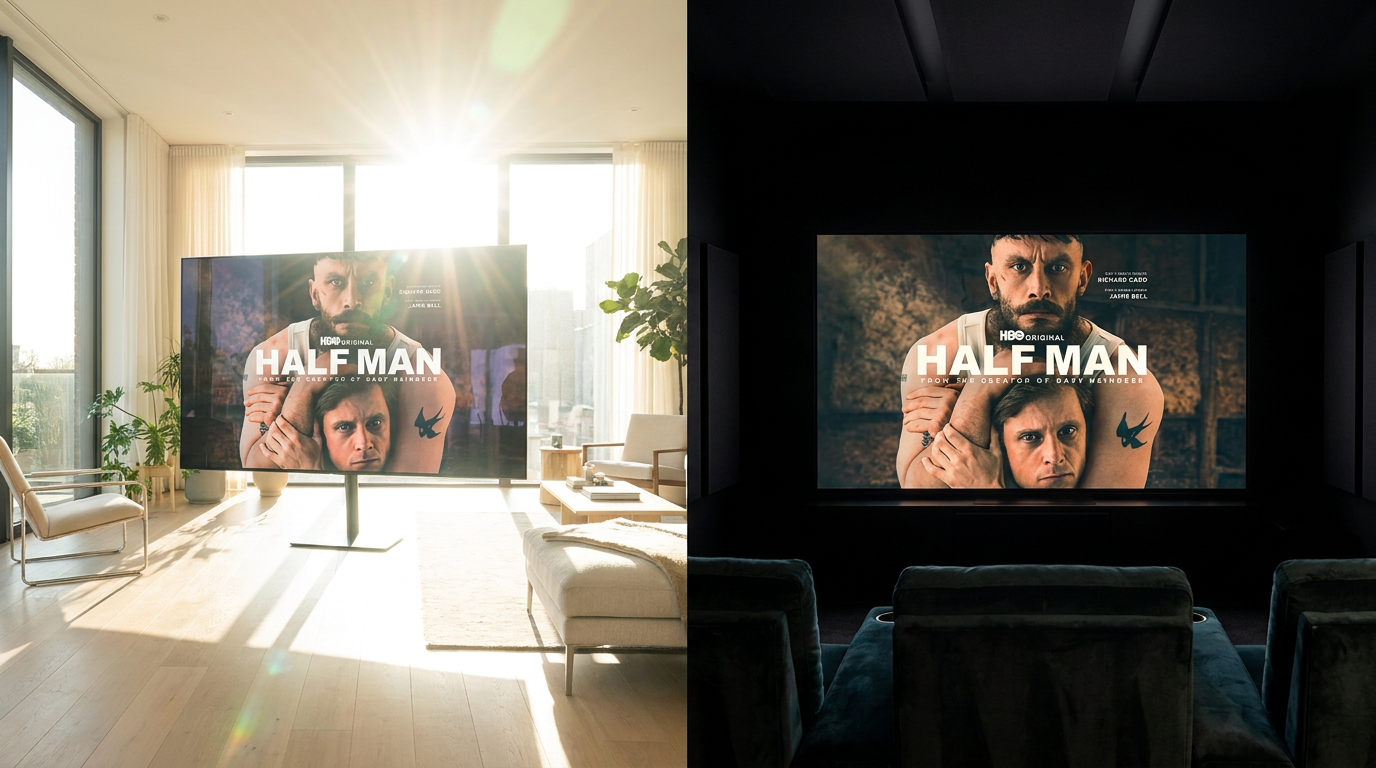
- Home Theater Purists
- Prioritize infinite contrast, perfect blacks, and pixel-level precision for cinematic viewing in dark rooms.
- Bright-Room Viewers
- Prioritize peak brightness, glare reduction, and zero burn-in risk for daytime viewing.
- Productivity & PC Users
- Emphasize text clarity, static image longevity, and subpixel layouts for coding and desktop work.
- Large-Format Value Buyers
- Focus on cost-per-inch, seeking massive 85-inch to 98-inch screens without the exponential price curve of premium panels.
What's not represented
- · Budget consumers shopping under $400, where neither premium technology is available.
- · Projector enthusiasts who prioritize massive 120+ inch cinematic scale over absolute panel brightness.
Why this matters
Choosing the wrong premium TV technology can lead to washed-out images in a sunlit room or distracting light-bleed in a dark home theater. Understanding the specific trade-offs between OLED and Mini-LED ensures buyers match the right panel to their lighting, habits, and budget.
Key points
- OLED delivers perfect blacks and infinite contrast by turning off individual pixels, making it the gold standard for dark rooms.
- Mini-LED achieves massive peak brightness over 3,000 nits, easily overpowering glare in sunlit living rooms.
- The 2026 'Great Convergence' sees Tandem OLEDs getting brighter and Mini-LEDs adding thousands of dimming zones to reduce blooming.
- Mini-LED offers significantly better value at massive screen sizes of 85 inches and above.
- OLED carries a slight risk of burn-in with static elements, while Mini-LED is immune, making it safer for heavy PC use.
The 2026 premium television and monitor market is defined by a single, high-stakes choice between OLED and Mini-LED technologies. While both display types have matured significantly, they solve fundamentally different problems for consumers. The landscape has shifted from a simple debate over quality versus price into a nuanced trade-off between absolute contrast and sheer luminance, requiring buyers to match the panel to their specific room lighting and viewing habits.[1][2]
The display industry is currently experiencing a "Great Convergence," where both technologies are aggressively invading each other's traditional territory. OLED manufacturers have introduced Tandem dual-stack panels, boosting peak brightness by up to 50 percent to combat daytime glare without accelerating panel degradation. Simultaneously, Mini-LED displays now feature RGB backlights devoid of traditional color filters, packing over 5,000 local dimming zones to nearly eliminate the halo effect that once plagued LCDs.[3][7]
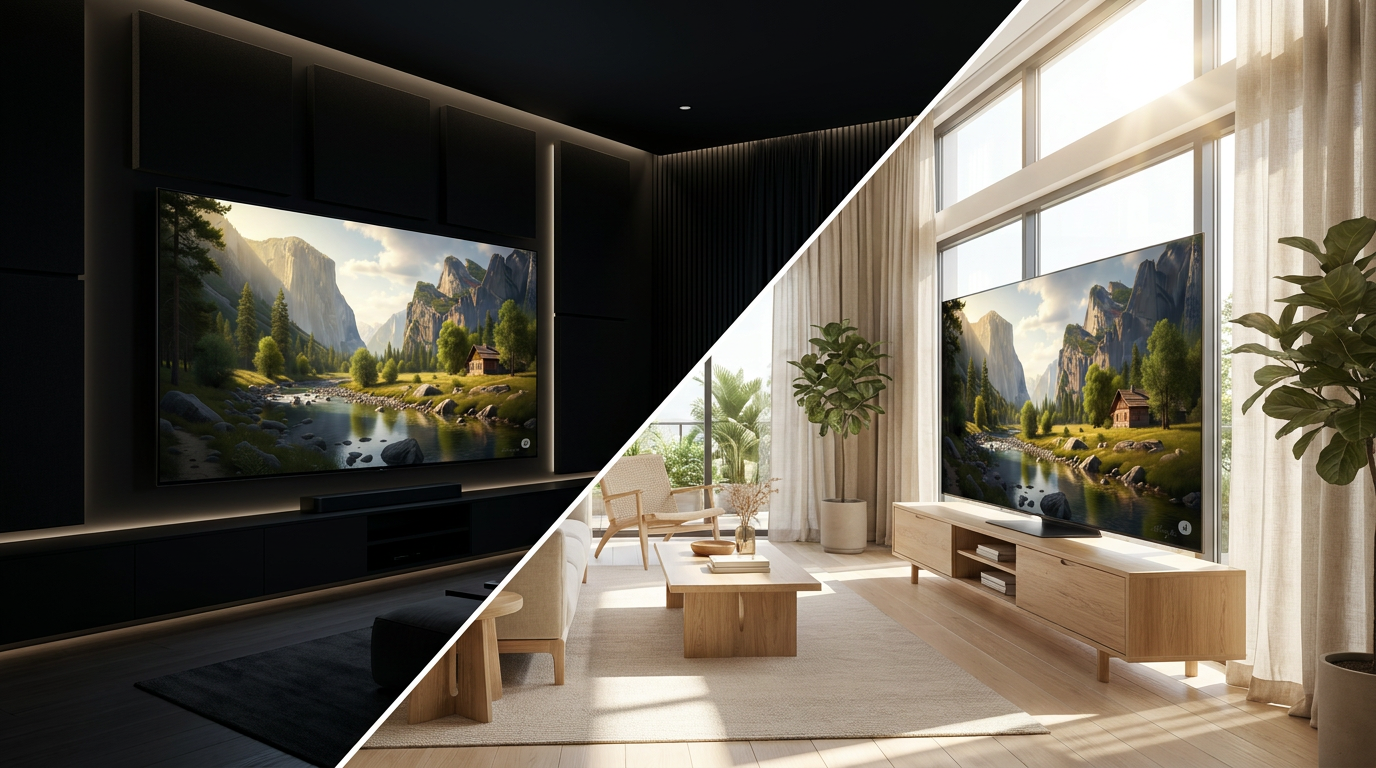
When evaluating contrast for dark rooms, OLED remains the undisputed performance king. Because each of its 8.3 million pixels generates its own light and can turn off completely independently, OLED achieves a mathematically infinite contrast ratio. The absolute black level measures at a perfect 0.000 nits, delivering flawless shadow detail and cinematic depth without any light bleeding into the letterbox bars of a movie.[1][4]

Mini-LED, despite massive improvements in local dimming algorithms, cannot entirely defeat the physics of a backlight. When a bright object, such as white subtitles or a glowing spaceship, sits against a pitch-black background, the dimming zones behind it must illuminate. Because these zones are larger than individual pixels, light inevitably spills into the surrounding dark areas, creating a faint glow known as blooming. While premium 2026 Mini-LEDs measure an impressive 0.002 nits for black levels, they still fall short of OLED's pixel-perfect precision in a pitch-black room.[1][2]
The dynamic flips entirely when evaluating brightness and glare in sunlit environments, where Mini-LED emerges as the clear winner. High-end 2026 models can sustain full-screen brightness levels that OLEDs simply cannot match, with peak highlights frequently exceeding 3,000 nits. This sheer volume of light output effortlessly punches through ambient daylight and window reflections, making HDR sports and vibrant video games look incredibly punchy even at high noon.[3][4]
OLED panels struggle to compete in these bright conditions due to their reliance on an Automatic Brightness Limiter. To prevent overheating and permanent panel degradation, the television will aggressively dim the overall image when a scene requires the entire screen to be bright, such as a hockey game or a snow-covered landscape. In a room with unshaded windows, an OLED panel can look washed out or overly reflective compared to the sheer horsepower of a Mini-LED.[1][2]

OLED panels struggle to compete in these bright conditions due to their reliance on an Automatic Brightness Limiter.
For modern gaming, both technologies offer spectacular performance with 4K resolution and 144Hz refresh rates, but they cater to different play styles. OLED holds a slight edge for competitive esports due to its sub-millisecond pixel response time, which virtually eliminates motion blur during fast camera pans. Conversely, Mini-LED is often preferred by gamers who play titles with static heads-up displays for hours on end, as the LCD foundation carries zero risk of permanent image retention.[1][4]
Productivity and PC use introduce another critical variable: text clarity. Mini-LED panels utilize standard RGB subpixel layouts that render static text, spreadsheets, and code perfectly crisp on Windows and macOS. Many OLED panels use non-standard subpixel structures, such as WOLED or QD-OLED, which can cause noticeable color fringing around small text. For users spending hours reading documents or writing code, Mini-LED serves as the much safer default.[5][6]
The pricing curve between the two technologies diverges sharply when shopping for massive screen sizes. While 55-inch and 65-inch OLEDs are highly competitive in price, scaling an organic panel to 83 inches or beyond remains astronomically expensive due to manufacturing yield rates. Mini-LED leverages highly efficient LCD production lines, allowing consumers to purchase massive 85-inch or 98-inch displays for a fraction of the cost of a comparable OLED, effectively winning the market war for sheer scale.[7]

Ultimately, OLED fits perfectly when the primary viewing environment is a light-controlled or dark room. It stands as the ideal choice for cinephiles prioritizing perfect black levels, wide seating arrangements where viewing angles matter, and gamers who demand instantaneous pixel response times for fast-paced action.[1][2]
However, OLED does not fit well when the room features heavy direct sunlight that cannot be controlled. It is also a risky choice if the user frequently watches content with static banners, like news networks, or if the budget requires a screen size larger than 77 inches without crossing into ultra-premium pricing tiers.[1][2]
Mini-LED fits exceptionally well when the display will live in a bright, open-concept living room with lots of natural light. It is the superior choice for daytime sports viewing, PC productivity requiring crisp static text, and buyers wanting the maximum screen size and HDR punch for their dollar.[3][4]
Conversely, Mini-LED does not fit well when the viewer is highly sensitive to blooming around subtitles in dark rooms. It also falls short for those who require perfect color accuracy from extreme off-axis seating positions, or who demand the absolute zero-blur motion clarity that only self-emissive pixels can provide.[1][4]
How we got here
2013
First commercial OLED TVs launch, introducing perfect blacks but struggling with low brightness.
2019
Mini-LED technology enters the consumer market, drastically increasing local dimming zones for LCDs.
2022
QD-OLED panels are introduced, blending quantum dots with OLED for better color volume.
2026
The 'Great Convergence' arrives as Tandem OLEDs boost brightness and Mini-LEDs eliminate color filters.
Viewpoints in depth
Home Theater Purists
Prioritize infinite contrast, perfect blacks, and pixel-level precision for cinematic viewing in dark rooms.
For cinephiles, the television is a window into the director's intent, and any light bleed ruins the illusion. This camp argues that because OLED pixels are self-emissive, they provide a level of depth and three-dimensionality that a backlit LCD simply cannot replicate. They point to the absolute 0.000 nits black level as the most important metric in display technology, arguing that infinite contrast makes colors appear richer and more saturated, even if the overall panel isn't as bright as a Mini-LED.
Bright-Room Viewers
Prioritize peak brightness, glare reduction, and zero burn-in risk for daytime viewing.
This perspective reflects the reality of modern open-concept homes, where controlling ambient light is often impossible. Advocates for this camp argue that OLED's perfect blacks are irrelevant if the screen is acting like a mirror during a Sunday afternoon football game. They value the sheer horsepower of Mini-LED, which can push past 3,000 nits to deliver punchy, vibrant HDR highlights that cut through window glare, ensuring the television remains highly watchable at all hours of the day.
PC & Productivity Users
Emphasize text clarity, static image longevity, and subpixel layouts for coding and desktop work.
Users who plug their displays into a computer have vastly different requirements than movie watchers. This camp highlights the structural differences in subpixel layouts, noting that standard RGB Mini-LEDs render small text and spreadsheet grids perfectly. They are highly critical of the color fringing often seen on WOLED and QD-OLED panels when displaying static text. Furthermore, the peace of mind that comes with zero burn-in risk makes Mini-LED the undisputed champion for users who leave static windows open for eight hours a day.
What we don't know
- Whether MicroLED technology will become affordable enough to replace both OLED and Mini-LED before 2030.
- How long the new Tandem OLED panels will truly last under heavy, real-world static usage over a decade.
Key terms
- Blooming
- A visual artifact where light spills from a bright object into surrounding dark areas, common on backlit displays.
- Nits
- A unit of measurement for brightness; higher numbers indicate a screen can output more light.
- Tandem OLED
- A newer panel architecture that stacks multiple light-emitting layers to increase brightness and lifespan.
- Local Dimming Zones
- Specific areas of a Mini-LED backlight that can dim or turn off independently to improve contrast.
- Subpixel Layout
- The physical arrangement of red, green, and blue elements within a pixel, which heavily impacts text clarity on PC monitors.
Frequently asked
Does OLED still have a burn-in problem in 2026?
While modern mitigation features and Tandem panels have drastically reduced the risk, OLED can still experience image retention if static elements like news tickers or game HUDs are displayed constantly over years.
Is Mini-LED just a regular LED TV?
Mini-LED is a massive evolution of standard LED/LCD technology. It uses thousands of microscopic LEDs grouped into dimming zones to provide vastly superior contrast and brightness control compared to older models.
Which technology is better for gaming?
Both are excellent, but OLED holds a slight edge for competitive gaming due to near-instantaneous response times, while Mini-LED is safer for long sessions with static interface elements.
Sources
Source coverage
7 outlets
4 viewpoints surfaced







[1]RTINGSHome Theater Purists
OLED vs Mini LED: Which is better?
Read on RTINGS →[2]Tom's GuideHome Theater Purists
OLED vs Mini-LED: The biggest battle in TV world
Read on Tom's Guide →[3]CNETBright-Room Viewers
OLED vs Mini-LED in 2026
Read on CNET →[4]What Hi-Fi?Bright-Room Viewers
OLED vs Mini LED TVs
Read on What Hi-Fi? →[5]KTCPlayProductivity & PC Users
Text Clarity Comparison OLED vs Mini-LED
Read on KTCPlay →[6]AsusProductivity & PC Users
Mini LED vs OLED: Which Display Technology is Better?
Read on Asus →[7]Alibaba B2B InsightsLarge-Format Value Buyers
OLED vs. Mini LED: 2026 Market Trends & Product Insights
Read on Alibaba B2B Insights →
More in shopping
See all 5 stories →

Every angle. Every day.
Get shopping stories with full source coverage and perspective breakdowns delivered to your inbox.