
The Year Quantum Computing Fixed Its Error Problem: Inside the 2026 Logical Qubit Breakthroughs
A series of breakthroughs in quantum error correction has drastically reduced the hardware required for fault-tolerant computing, moving the industry out of the noisy experimental phase and into the era of reliable logical qubits.
By Factlen Editorial Team
- Quantum Hardware Developers
- Focused on scaling physical qubit counts and demonstrating exponential error suppression to reach commercial viability.
- Academic & Theoretical Researchers
- Emphasize algorithmic efficiency, such as qLDPC codes that drastically reduce the physical-to-logical qubit ratio.
- Factlen Editorial Team
- Synthesizing the industry-wide shift from theoretical physics to applied engineering.
What's not represented
- · Cybersecurity experts concerned about the accelerated timeline for quantum computers breaking traditional encryption.
- · Classical supercomputing manufacturers adapting to the rise of hybrid quantum-classical data centers.
Why this matters
Quantum computers have long promised to revolutionize medicine, materials science, and cryptography, but their extreme fragility kept them confined to the lab. By successfully demonstrating reliable 'logical qubits,' engineers have retired the biggest physics risk in the field, drastically accelerating the timeline for when these machines will begin solving real-world commercial problems.
Key points
- Quantum computers have historically been too fragile for commercial use due to high error rates.
- Engineers use 'logical qubits' to group physical qubits together, creating a highly reliable virtual unit.
- Microsoft and Quantinuum successfully reduced logical error rates by 800 times compared to physical qubits.
- QuEra and Harvard achieved a 2:1 physical-to-logical qubit ratio, drastically reducing hardware requirements.
- Google demonstrated exponential error suppression, proving that adding qubits reduces noise.
- The breakthroughs transition the industry from the noisy experimental phase to the fault-tolerant era.
For the past decade, the quantum computing industry has been trapped in what physicists call the "NISQ" era—Noisy Intermediate-Scale Quantum. The machines are undeniably powerful, capable of performing calculations that would choke the world's fastest classical supercomputers. But they are also exquisitely fragile. A stray photon, a microscopic temperature fluctuation, or even a faint electromagnetic whisper from a neighboring component is enough to collapse a quantum state, destroying the calculation. This fragility has kept quantum computers confined to research laboratories, functioning more as brilliant physics experiments than practical commercial tools.[1]
In 2026, that paradigm has fundamentally shifted. Across multiple hardware platforms and research institutions, the industry has crossed a critical threshold: the transition from the noisy era to the "Fault-Tolerant Foundation Era." For the first time, engineers are proving that they can reliably detect and correct quantum errors faster than the environment can cause them. This breakthrough transforms quantum computing from a theoretical physics challenge into a scalable engineering discipline, dramatically accelerating the timeline for commercially useful quantum applications.[1][5]
To understand the magnitude of this shift, one must look at how classical computers handle errors. When a standard silicon chip processes information, it can easily copy bits of data to create backups. If a bit flips from a 1 to a 0 due to interference, the system checks the backup and corrects the error. Quantum mechanics, however, strictly forbids this. The "no-cloning theorem" dictates that it is physically impossible to perfectly copy an unknown quantum state. If you cannot copy the data, you cannot back it up.[4]
The solution to this quantum conundrum is a concept known as the "logical qubit." Instead of relying on a single, fragile physical qubit—whether that is a superconducting circuit or a trapped atom—engineers spread the quantum information across a large group of physical qubits. This collective group acts as a single, highly reliable virtual qubit. If one physical component in the group fails, the system can use the entangled state of the surrounding qubits to deduce what went wrong and repair the damage without ever directly measuring, and thus destroying, the core quantum information.[5][6]

Historically, the math behind logical qubits presented a seemingly insurmountable scaling problem. Early theoretical models suggested that to create just one reliable logical qubit, engineers would need to bundle together thousands of physical qubits. To build a machine capable of breaking modern encryption or simulating complex molecules, a quantum computer would need millions of physical qubits—a scale that remains decades away. The breakthroughs of 2026 have shattered those daunting ratios.[6]
The first major milestone arrived via a collaboration between Microsoft and Quantinuum. By applying Microsoft's advanced qubit-virtualization software to Quantinuum's trapped-ion hardware, the teams successfully created 12 highly reliable logical qubits. More importantly, they demonstrated an error rate that was 800 times better than the underlying physical qubits. They successfully ran over 14,000 independent instances of a quantum circuit without a single recorded error, proving that active syndrome extraction—the process of identifying errors on the fly—is viable today.[3][7]
Shortly after, Google's Quantum AI division published results from its new "Willow" processor, a chip featuring 105 superconducting qubits. Google demonstrated a phenomenon known as "below-threshold error correction." In simple terms, they proved that as they increased the number of physical qubits dedicated to error correction, the overall logical error rate decreased exponentially. This was the first definitive hardware-scale proof that adding more qubits suppresses noise rather than amplifying it, validating decades of theoretical physics.[5][6]
Shortly after, Google's Quantum AI division published results from its new "Willow" processor, a chip featuring 105 superconducting qubits.
But perhaps the most shocking advancement has come from the realm of neutral-atom quantum computing. A joint research effort between QuEra Computing, Harvard University, and MIT unveiled a new family of quantum error-correcting codes known as qLDPC (Low-Density Parity-Check). By co-designing the software with reconfigurable hardware—where lasers physically move atoms around in a vacuum to change their connections mid-computation—the team achieved a staggering physical-to-logical qubit ratio of approximately 2:1.[2][4]

This 2:1 ratio fundamentally rewrites the roadmap for the entire industry. Instead of needing thousands of physical qubits to encode a single logical one, the QuEra and Harvard team demonstrated that they could encode 580 logical qubits into just 1,152 physical qubits. This efficiency brings the prospect of large-scale, fault-tolerant quantum computing significantly closer, drastically reducing the physical footprint and cooling requirements needed to build a commercially viable machine.[2]
The performance of these new codes pushes the hardware into what researchers call the "Teraquop" regime. This metric corresponds to a system capable of executing one trillion logical operations before experiencing a single error. Hitting the Teraquop threshold is widely considered the holy grail for quantum computing, as it is the baseline reliability required to run complex, world-changing algorithms, such as simulating the exact chemical behavior of new pharmaceutical drugs or designing perfectly efficient battery materials.[2][4]
The rapid progress is not limited to hardware. The software layer is evolving just as quickly. IBM Research recently detailed an approach using large language models and artificial intelligence to discover entirely new quantum error correction codes. Their AI-driven system, OpenEvolve, identified hundreds of new candidate codes that human researchers had overlooked. While these AI-generated codes still require rigorous physical testing, they highlight how classical artificial intelligence is now accelerating the development of quantum architecture.[7]
Another critical advancement is the implementation of "transversal operations" and "correlated decoding." In older error correction models, the system had to pause and run a slow diagnostic check after every single logical step, creating a massive bottleneck that made quantum computers impractically slow. The new frameworks allow logical gates to be applied in parallel across the qubits, preventing errors from cascading while a joint decoder digests the pattern of all measurements simultaneously. This cuts the runtime overhead by a factor of 30 or more.[2]

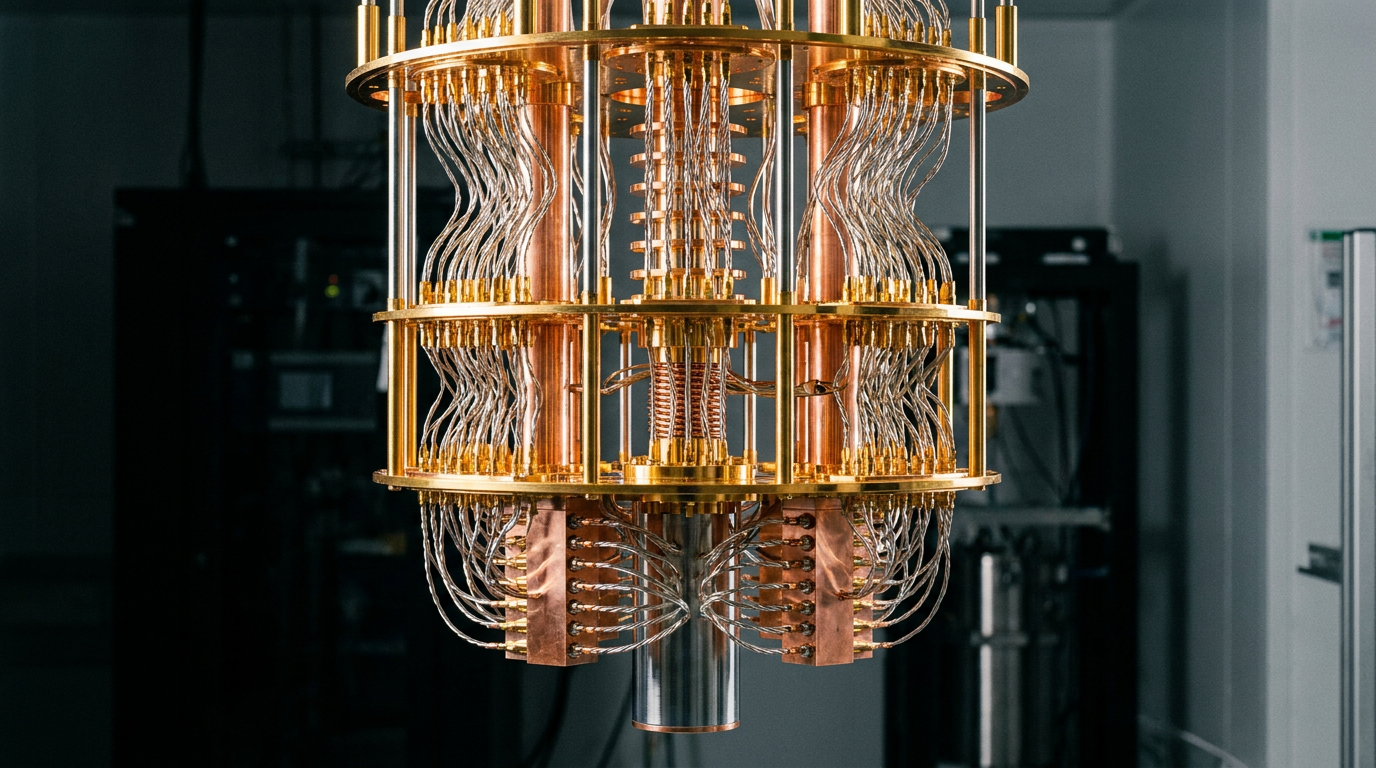
The competition between different hardware architectures is also driving the field forward. Superconducting qubits, favored by Google and IBM, offer incredibly fast operation speeds but require massive, energy-intensive cryogenic cooling systems. Neutral-atom platforms, championed by QuEra and Atom Computing, operate at room temperature (though the atoms themselves are laser-cooled) and offer unparalleled flexibility in how qubits connect to one another. Both approaches are now proving capable of robust error correction.[5][6]
Microsoft is pursuing yet another path, investing heavily in "topological qubits" with its Majorana 1 chip. This exotic approach aims to build error resistance directly into the hardware level by utilizing quasiparticles that are inherently immune to most environmental noise. If successful, topological qubits could bypass the need for complex software-based error correction entirely, though the technology remains further out on the horizon than superconducting or neutral-atom systems.[5]
What does this mean for the broader technology landscape? Entering 2026, most enterprise chief information officers viewed quantum computing as a speculative bet for the late 2030s. The demonstration of scalable logical qubits has compressed that timeline. Companies are now preparing for a reality where hybrid quantum-classical systems begin tackling specialized, high-value problems—like supply chain optimization and advanced cryptography—before the end of the decade.[1][5]

The shift from physical to logical qubits is the quantum equivalent of moving from fragile vacuum tubes to the reliable silicon transistor. It is the foundational step that makes everything else possible. While there are still immense engineering challenges ahead—particularly in wiring, control systems, and scaling the physical hardware to the tens of thousands—the fundamental physics risk has been retired. The era of quantum error correction has officially arrived, and the race to build the first truly useful quantum supercomputer is now a sprint.[1][6]
How we got here
Pre-2024
The quantum industry operates in the NISQ (Noisy Intermediate-Scale Quantum) era, characterized by fragile, error-prone processors.
April 2024
Microsoft and Quantinuum announce the creation of four highly reliable logical qubits with an 800-fold improvement in error rates.
Late 2025
IBM introduces OpenEvolve, utilizing large language models to discover new potential quantum error correction codes.
Early 2026
Google's Willow processor demonstrates below-threshold error correction, proving that scaling physical qubits exponentially suppresses errors.
April 2026
QuEra, Harvard, and MIT publish research demonstrating a 2:1 physical-to-logical qubit ratio using novel qLDPC codes.
Viewpoints in depth
Quantum Hardware Developers
Focused on scaling physical qubit counts and demonstrating exponential error suppression.
For companies building the physical machines—like Google, IBM, and Quantinuum—the primary goal has been proving that error correction actually works at scale. Their perspective is rooted in engineering: by demonstrating 'below-threshold' error correction, they have proven that building larger quantum chips will result in exponentially more reliable calculations, validating billions of dollars in hardware investment and shifting the industry's focus toward manufacturing scale.
Academic & Theoretical Researchers
Emphasizing algorithmic efficiency and novel error-correcting codes to reduce hardware overhead.
Theoretical physicists and academic researchers, such as the teams at Harvard and MIT, view the hardware scaling problem as a mathematical challenge. Rather than simply building bigger cooling systems for millions of qubits, they focus on designing smarter software. By developing highly efficient frameworks like qLDPC codes, they argue that the industry can achieve fault tolerance with a fraction of the physical hardware previously thought necessary, fundamentally changing the economics of quantum computing.
Enterprise End-Users
Eager for practical applications but focused on the timeline for true commercial advantage.
For the pharmaceutical companies, logistics giants, and financial institutions waiting to deploy quantum algorithms, the physics milestones are only relevant if they compress the timeline to commercial utility. This camp views the 2026 breakthroughs as the signal to start heavily investing in quantum-ready software and workforce training, anticipating that hybrid quantum-classical systems will begin delivering tangible business value by the end of the decade.
What we don't know
- How quickly manufacturers can scale these error-corrected systems from dozens of logical qubits to the thousands required for commercial advantage.
- Which hardware architecture—superconducting circuits, neutral atoms, or topological qubits—will ultimately dominate the commercial market.
- Whether the AI-generated error correction codes discovered by systems like IBM's OpenEvolve will perform as expected in physical hardware testing.
Key terms
- Physical Qubit
- The actual hardware unit, such as a trapped atom or superconducting circuit, that stores quantum information and is highly susceptible to environmental noise.
- Logical Qubit
- A highly reliable 'virtual' qubit created by grouping multiple physical qubits together using error-correcting software.
- Quantum Error Correction (QEC)
- The process of detecting and fixing errors in quantum computers before they derail a calculation, essential for long computations.
- NISQ Era
- The Noisy Intermediate-Scale Quantum era; the period of quantum computing characterized by fragile, error-prone processors.
- Fault Tolerance
- The ability of a quantum computer to continue operating accurately even when individual physical components fail or experience noise.
- Teraquop Regime
- A performance threshold where a quantum computer can execute one trillion logical operations before experiencing a single error.
Frequently asked
Why can't quantum computers just copy data to prevent errors?
The laws of quantum mechanics, specifically the 'no-cloning theorem,' forbid perfectly copying an unknown quantum state. Instead, error correction must spread the information across multiple entangled physical qubits.
What is the difference between superconducting and neutral-atom qubits?
Superconducting qubits are fixed electrical circuits on a chip cooled to near absolute zero. Neutral-atom qubits use precisely calibrated lasers to trap and move individual atoms in a vacuum, allowing for flexible connections.
When will quantum computers be useful for everyday business?
While 2026 marks the transition to fault-tolerant hardware, experts predict practical, large-scale commercial applications—like drug discovery or advanced materials simulation—will mature between 2029 and the early 2030s.
Sources
Source coverage
7 outlets
3 viewpoints surfaced







[1]Factlen Editorial TeamFactlen Editorial Team
Synthesis by Factlen editorial team
Read on Factlen Editorial Team →[2]QuEra ComputingAcademic & Theoretical Researchers
Low-Overhead Transversal Fault Tolerance for Universal Quantum Computation
Read on QuEra Computing →[3]Microsoft QuantumQuantum Hardware Developers
Microsoft and Quantinuum create 12 logical qubits
Read on Microsoft Quantum →[4]Harvard UniversityAcademic & Theoretical Researchers
Harvard quantum computing platform's potential to solve quantum error correction
Read on Harvard University →[5]Spin QuantaQuantum Hardware Developers
2026 Qubit Breakthroughs: Quantum Computing Enters the Fault-Tolerant Foundation Era
Read on Spin Quanta →[6]BQP SimQuantum Hardware Developers
What is the biggest quantum computing breakthrough in 2026?
Read on BQP Sim →[7]ForkLogFactlen Editorial Team
Corporations advance in quantum error correction
Read on ForkLog →
Every angle. Every day.
Get technology stories with full source coverage and perspective breakdowns delivered to your inbox.