
The 2026 AI Policy Fracture: Evidence Pack on Global Regulation, Copyright, and Enforcement
As of mid-2026, the global consensus on AI regulation has collapsed into three distinct legal realities: a US federal pivot toward national security, an impending EU enforcement cliff, and a wave of new corporate copyright liabilities.
By Factlen Editorial Team
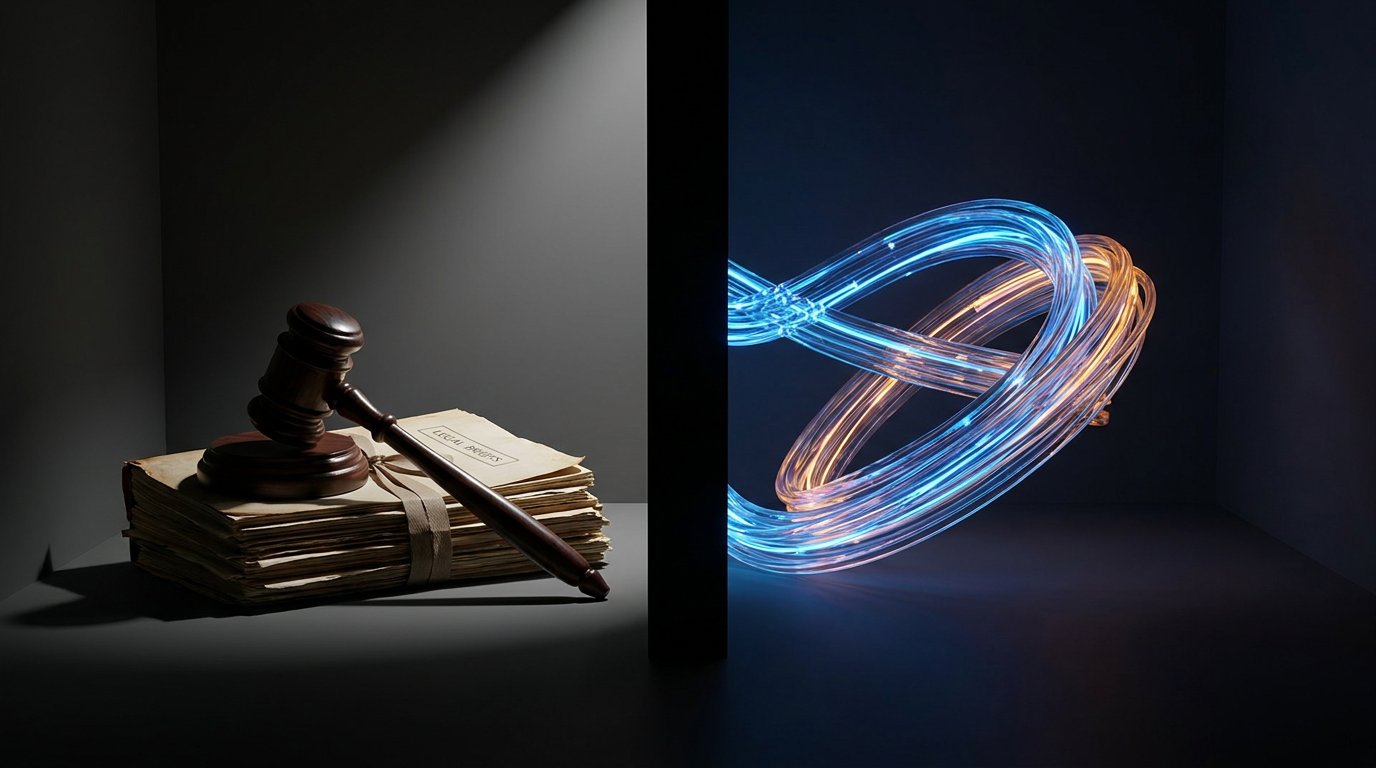
- Fundamental Rights Regulators
- Focus on consumer protection, algorithmic transparency, and preventing discrimination, driving the EU AI Act and US state laws.
- Enterprise AI Adopters
- Concerned primarily with navigating the fragmented compliance landscape, avoiding copyright liability, and maintaining operational efficiency.
- National Security Advocates
- Prioritize US geopolitical dominance, rapid innovation, and securing frontier models against cyber threats over consumer safety regulations.
What's not represented
- · Open-Source Developers
- · Independent Artists and Creators
Why this matters
The global consensus on AI regulation has collapsed. For businesses and developers, navigating the contradictory demands of US national security, EU fundamental rights, and new copyright liabilities is now a mandatory requirement for survival.
Key points
- The US federal government has shifted AI policy away from consumer safety toward national security and deregulation.
- US states have introduced over 1,500 AI bills in 2026 to fill the federal regulatory vacuum.
- The EU AI Act's stringent high-risk enforcement and transparency rules activate on August 2, 2026.
- The Supreme Court affirmed that purely AI-generated works cannot receive copyright protection.
- Businesses using AI tools are increasingly facing direct legal liability for copyright infringement.
The era of voluntary artificial intelligence commitments has officially ended. As of mid-2026, the theoretical debates that dominated the tech industry over the past three years have materialized into hard, fragmented legal realities. The global regulatory framework for AI is no longer a cohesive effort; it has fractured into distinct, often contradictory regimes.[1]
This Factlen Evidence Pack evaluates the primary source documentation driving this shift, focusing on three critical developments shaping the industry today. We examine the United States federal pivot toward national security, the European Union's impending enforcement cliff, and the quiet Supreme Court decision that transferred copyright liability directly to everyday businesses.[1][2]
The first major claim evaluated in this evidence pack is that the United States federal government has formally pivoted away from consumer AI safety, replacing it with a mandate focused on national security and deregulation. The documentary evidence for this shift culminated on June 2, 2026, when the White House issued an Executive Order titled "Promoting Advanced Artificial Intelligence Innovation and Security."[2]
Unlike previous frameworks that emphasized algorithmic bias and consumer protection, this directive mandates that national security agencies establish a classified benchmarking process for "covered frontier models" within sixty days. The language explicitly balances cybersecurity risks with the need to accelerate domestic innovation against geopolitical rivals, relying heavily on voluntary cooperation between the federal government and the private sector.[2]
This executive action follows a systematic dismantling of the previous administration's safety-focused infrastructure. In late May 2026, the National Institute of Standards and Technology officially renamed its prominent "AI Safety Institute Consortium" to the "NIST Artificial Intelligence Consortium." The agency explicitly stated that the renamed group would shift its mandate away from theoretical safety evaluations and concentrate instead on AI measurement, innovation, and rapid commercial adoption.[3]

This domestic pivot stands in stark contrast to the international consensus. While the United States reorients toward deregulation, allied nations are doubling down on dedicated safety infrastructure. Australia, for example, is currently launching its heavily funded AI Safety Institute to independently evaluate advanced systems before deployment, while Canada's equivalent body continues to coordinate global safety research. The US federal apparatus is increasingly isolating itself from this international network.[4][5]
While the documentary evidence for a federal deregulatory pivot is definitive, the practical impact on the market remains highly uncertain. The primary weakness in the federal strategy is the aggressive pushback from individual US states, which are rapidly filling the regulatory vacuum. According to legislative tracking data, state lawmakers introduced over 1,500 AI-related bills in the first quarter of 2026 alone, surpassing the entire volume of 2024.[6]
California's Transparency in Frontier AI Act and AI Training Data Transparency Act both took effect in January 2026, imposing the exact transparency mandates and whistleblower protections that the federal government abandoned. Meanwhile, Texas enacted the Responsible AI Governance Act, and Colorado recently overhauled its automated decision-making statutes. Consequently, developers face a deeply fragmented domestic market, despite federal attempts to establish an "AI Litigation Task Force" to challenge these state laws.[2][7]

Meanwhile, Texas enacted the Responsible AI Governance Act, and Colorado recently overhauled its automated decision-making statutes.
The second major claim is that the European Union's August 2026 enforcement deadline will force structural changes to global software engineering, regardless of US policy. According to the European Commission's official timeline, August 2, 2026, marks the activation of the EU AI Act's core enforcement mechanisms. This date triggers the stringent Annex III requirements for "high-risk" AI systems, alongside the Article 50 transparency rules.[8][9]
For engineering teams worldwide, this represents a hard compliance cliff that dictates how products must be built, documented, and deployed if they are to be sold in the European market. Legal analyses confirm that organizations deploying AI for employment decisions, critical infrastructure, or biometric categorization face immediate, heavy mandates. The law requires continuous risk management systems, tamper-evident logging retained for a minimum of six months, and guaranteed human oversight capabilities.[9][10]
Security teams are particularly focused on Article 15 of the Act, which mandates that high-risk AI systems must be resilient against adversarial attacks across their entire action layer. This means that the APIs and external tools that AI agents interact with are now legally in scope for cybersecurity compliance. The financial stakes are unprecedented for software regulation; penalties for high-risk system breaches can reach €35 million or up to seven percent of a company's global annual turnover.[10]
Furthermore, the transparency obligations taking effect in August require clear disclosures to end-users whenever they interact with an AI system or consume AI-generated content. However, the evidence regarding the strictness of day-one enforcement carries notable uncertainty. The EU provisionally agreed to material changes through the "Digital Omnibus on AI" in May 2026, which may delay certain compliance deadlines. Additionally, national regulatory authorities are still establishing their technical oversight capacities.[9]

The third and perhaps most immediately disruptive claim is that US businesses now bear direct, unshielded legal liability for AI-generated copyright infringement. The primary evidence stems from the US Supreme Court's March 2026 denial of certiorari in Thaler v. Perlmutter. By refusing to hear the case, the Court cemented the US Copyright Office's stance that works created exclusively by artificial intelligence cannot receive copyright protection.[11]
The judiciary has firmly established that human authorship remains a bedrock requirement for intellectual property rights in the United States. The downstream effects of this denial have materialized rapidly across the corporate sector. Because purely AI-generated outputs lack copyright protection, businesses cannot legally protect their AI-generated marketing materials, software code, or product designs from replication by competitors.[11][12]
More critically, the liability landscape has shifted. Recent class-action lawsuits demonstrate that plaintiffs are no longer exclusively suing the developers of foundational models for training on copyrighted data. They are increasingly targeting the enterprise users who deploy these tools to generate and publish infringing commercial content. A business utilizing an AI tool is now considered the responsible party for any resulting infringement.[12]

While the lack of copyright for purely AI-generated work is now settled law, the threshold for what constitutes "sufficient human involvement" remains a massive legal gray area. This is the primary uncertainty in the current copyright landscape. Courts have not yet defined exactly how much human prompting, editing, or curation is required to transform an uncopyrightable AI output into a protected, human-authored work.[13]
Synthesizing these three pillars reveals that the global AI ecosystem is no longer operating under a unified trajectory. Developers and enterprise leaders must now navigate a US federal apparatus focused on geopolitical dominance, a patchwork of US state laws focused on consumer transparency, an EU regime focused on fundamental rights, and a judicial system actively rewriting the boundaries of intellectual property. The concept of a single, global AI product release is becoming legally untenable.[1]
For enterprise leaders, compliance officers, and software engineers, the immediate priority across all three of these fractured regimes is rigorous documentation. Whether a company is attempting to prove human authorship to secure a copyright claim, demonstrating compliance with California's strict training data laws, or preparing for the European Union's August enforcement audits, the ability to trace an AI system's inputs, actions, and outputs is no longer a best practice. It is now a mandatory legal requirement for survival in the 2026 market.[1][10][13]
How we got here
Jan 2025
US federal government revokes previous safety-focused AI Executive Orders.
Dec 2025
US establishes an AI Litigation Task Force to challenge state-level AI regulations.
Jan 2026
California's strict AI transparency and training data laws officially take effect.
Mar 2026
US Supreme Court denies certiorari in Thaler v. Perlmutter, cementing AI copyright limits.
May 2026
NIST renames its AI Safety Institute Consortium to focus on innovation and adoption.
Jun 2026
White House issues new EO focusing AI policy on national security and cybersecurity.
Aug 2026
The EU AI Act's major enforcement provisions and penalties activate.
Viewpoints in depth
National Security Advocates
Prioritizing geopolitical dominance and cybersecurity over domestic consumer regulation.
This camp argues that the US cannot afford to slow down AI development with onerous safety testing while geopolitical rivals advance. They support the June 2026 Executive Order's focus on securing frontier models from cyber espionage and view state-level transparency laws as dangerous red tape that fragments the domestic market and hinders innovation.
Fundamental Rights Regulators
Demanding transparency, accountability, and strict oversight for high-risk AI systems.
Represented heavily by the European Union and individual US states like California, this viewpoint argues that AI poses immediate risks to civil rights, employment fairness, and truth. They cite the necessity of the EU AI Act's August 2026 enforcement and state-level mandates as critical guardrails, rejecting the US federal government's shift toward voluntary, security-focused frameworks.
Enterprise AI Adopters
Struggling to maintain compliance across contradictory global and local legal regimes.
Businesses and engineering teams are caught in the crossfire. They argue that the combination of the EU's €35 million penalty cliff, the US Supreme Court's refusal to grant copyright to AI-generated work, and the patchwork of 1,500 state laws makes product development legally perilous. Their primary focus is on building robust documentation and traceability tools to survive impending audits and class-action lawsuits.
What we don't know
- How much human involvement is legally required to transform an AI output into a copyrightable work.
- How strictly the EU will enforce the AI Act's high-risk provisions on day one in August 2026.
- Whether the US federal government's AI Litigation Task Force will successfully strike down state-level transparency laws.
Key terms
- Frontier Model
- Highly advanced, large-scale AI models that possess capabilities matching or exceeding the most advanced systems currently available.
- Annex III
- The section of the EU AI Act that classifies specific AI applications (like employment screening or critical infrastructure) as "high-risk," triggering strict compliance rules.
- Certiorari
- A formal request for the Supreme Court to review a decision of a lower court; denying it leaves the lower court's ruling in place.
- Action Layer
- The interface where an AI agent interacts with external tools, APIs, or databases to execute tasks, a key focus for cybersecurity compliance.
Frequently asked
When does the EU AI Act become fully enforceable?
The core enforcement mechanisms, including high-risk system requirements and transparency rules, activate on August 2, 2026.
Can I copyright an image generated by AI?
No. The US Supreme Court's March 2026 denial of certiorari affirmed that works created exclusively by AI lack the human authorship required for copyright protection.
What did the June 2026 US Executive Order change?
It shifted federal AI policy toward national security, mandating classified benchmarking for frontier models and relying on voluntary corporate cooperation rather than strict safety regulations.
Are businesses liable if their AI tools infringe copyrights?
Yes. Recent class-action lawsuits indicate that enterprise users who deploy AI to generate infringing commercial content can be held directly liable, not just the AI developers.
Sources
Source coverage
13 outlets
3 viewpoints surfaced













[1]Factlen Editorial TeamEnterprise AI Adopters
Synthesis by Factlen editorial team
Read on Factlen Editorial Team →[2]McDermott Will & EmeryNational Security Advocates
New executive order shifts US AI policy toward national security
Read on McDermott Will & Emery →[3]NISTNational Security Advocates
NIST Renames AI Safety Institute Consortium to NIST AI Consortium
Read on NIST →[4]SoftwareSeniFundamental Rights Regulators
Understanding Australia's AI Safety Institute
Read on SoftwareSeni →[5]Government of CanadaFundamental Rights Regulators
Canadian Artificial Intelligence Safety Institute
Read on Government of Canada →[6]MultiStateFundamental Rights Regulators
Tracking State AI Legislation Across All 50 States in 2026
Read on MultiState →[7]VerifyWiseFundamental Rights Regulators
State AI Laws Taking Effect in 2026
Read on VerifyWise →[8]European CommissionFundamental Rights Regulators
Timeline for the Implementation of the EU AI Act
Read on European Commission →[9]Travers SmithFundamental Rights Regulators
The EU AI Act: What you need to know
Read on Travers Smith →[10]Salt SecurityEnterprise AI Adopters
EU AI Act Enforcement August 2026
Read on Salt Security →[11]Morgan LewisEnterprise AI Adopters
Supreme Court Denies Certiorari in Thaler v. Perlmutter
Read on Morgan Lewis →[12]ForbesEnterprise AI Adopters
What The Supreme Court's AI Copyright Ruling Means For Your Business
Read on Forbes →[13]Baker DonelsonEnterprise AI Adopters
Supreme Court Denies Review in AI Authorship Case
Read on Baker Donelson →


Every angle. Every day.
Get ai stories with full source coverage and perspective breakdowns delivered to your inbox.