
Beyond Dystopia: How Solarpunk Philosophy is Weaponizing Radical Optimism
Emerging from science fiction, the Solarpunk movement has evolved into a practical philosophy that counters climate anxiety with actionable, community-driven hope. By combining renewable technology with mutual aid, it offers a blueprint for a sustainable and equitable future.
By Factlen Editorial Team
- Community Practitioners
- Advocates who believe the future is built through local mutual aid, DIY technology, and community gardens.
- Systemic Ecologists
- Theorists who argue that true sustainability requires dismantling corporate hierarchies and preventing greenwashing.
- Media & Culture Analysts
- Observers focusing on the evolution of the genre from science fiction to a tangible social movement.
What's not represented
- · Ecomodernists advocating for centralized, large-scale climate solutions
- · Traditional environmentalists focused purely on conservation rather than technological integration
Why this matters
As climate anxiety paralyzes millions and dystopian media dominates culture, Solarpunk offers a vital psychological and practical antidote. By providing a concrete blueprint for community resilience and sustainable technology, it transforms paralyzing fear into actionable hope.
Key points
- Solarpunk has evolved from a niche internet aesthetic into a comprehensive philosophy of radical optimism and climate action.
- The movement rejects the doomerism of dystopian media, insisting that a sustainable, equitable future is both imaginable and achievable.
- It embraces advanced renewable technology but demands it be decentralized and controlled by communities rather than corporations.
- Rooted in social ecology, the philosophy argues that environmental harmony requires the dismantling of human hierarchies and systemic inequalities.
- Practitioners focus on 'prefigurative politics,' building resilience today through mutual aid, repair cafes, and local democratic structures.
For decades, the cultural imagination has been held hostage by the apocalypse. From the irradiated wastelands of post-nuclear fiction to the neon-drenched, corporate-owned dystopias of the cyberpunk genre, popular media has relentlessly trained audiences to expect the absolute worst. This saturation of doom has fostered a pervasive sense of climate anxiety, eco-grief, and political paralysis, leaving many to wonder if a livable future is even possible. When the only futures we can vividly imagine are defined by collapse or hyper-capitalist exploitation, it becomes incredibly difficult to muster the political will required to change course.[7]
Enter Solarpunk. Originally emerging as a niche internet aesthetic, it has rapidly evolved into a comprehensive philosophy and social movement that asks a radically different question: What does a sustainable civilization actually look like, and how do we build it? Instead of wallowing in doomerism, Solarpunk provides a blueprint for a world where humanity has successfully navigated the climate crisis by harmonizing technology with nature. It operates on the premise that we already possess most of the tools needed to save ourselves—renewable energy, sustainable agriculture, and cooperative economics—and that the primary barrier is a lack of collective imagination and political organization.[6]
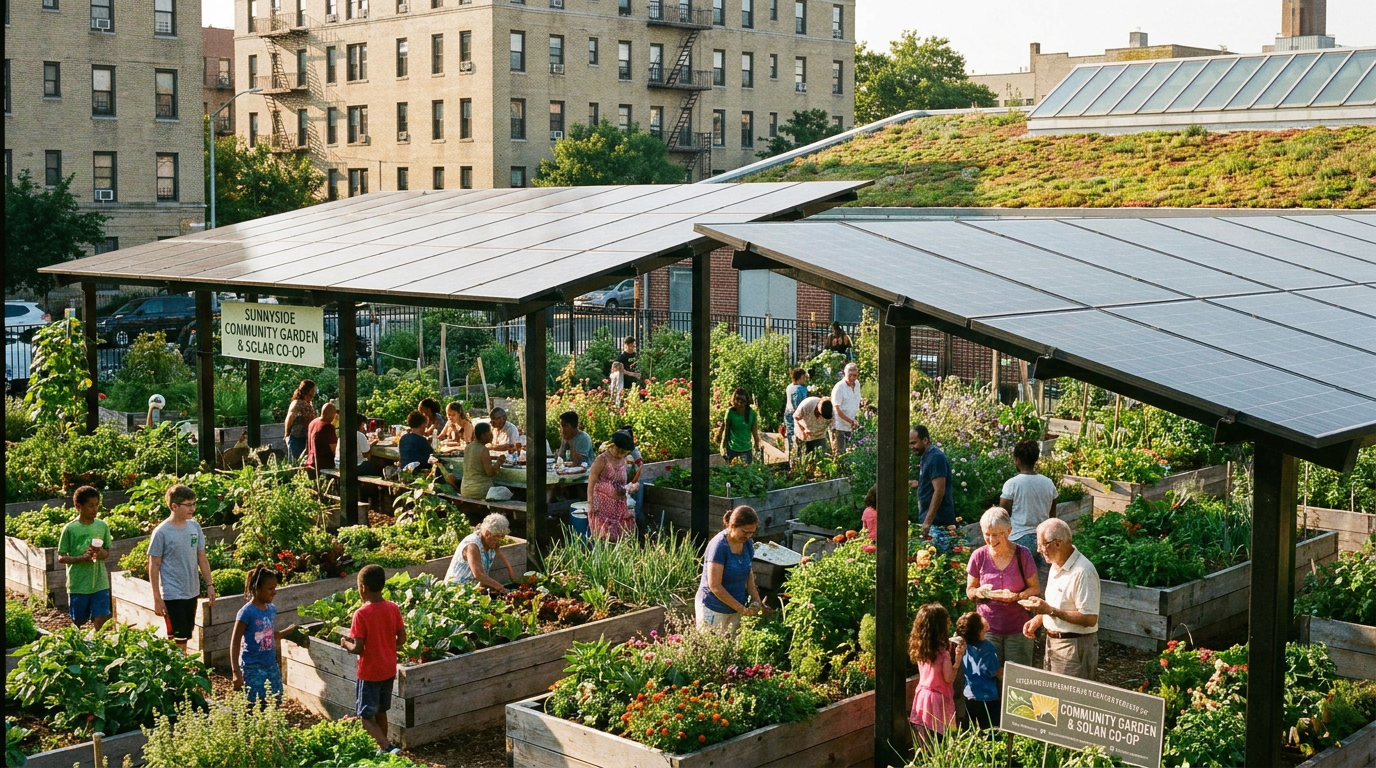
The movement's roots trace back to a 2012 Brazilian science fiction anthology titled 'Solarpunk: Histórias Ecológicas e Fantásticas em um Mundo Sustentável.' From there, it blossomed on visual platforms like Tumblr, characterized by Art Nouveau-inspired architecture, lush vertical gardens, and ubiquitous solar panels. Today, it has matured far beyond its visual origins, establishing itself as a rigorous framework for prefigurative politics and ecological action. It has transitioned from a speculative fiction subgenre into a lived practice, with adherents actively building the infrastructure of the future in their own backyards and neighborhoods.[6]
At the heart of Solarpunk philosophy is the concept of 'meaningful meliorism'—the belief that while the world is deeply flawed, thoughtful and sustained human effort can make it better. This is not the toxic positivity of ignoring systemic injustice, nor is it the naive hope that technology alone will act as a silver bullet. Rather, it is a militant refusal to surrender to despair, treating optimism as a necessary tool for survival and organizing. By expanding their psychological 'window of tolerance,' practitioners learn to process the grief of ecological loss without allowing it to curdle into apathy.[1]

The philosophy is best understood in direct contrast to its older sibling, cyberpunk. If cyberpunk is a warning about a future defined by 'high tech and low life'—where unchecked corporate power, extreme inequality, and artificial intelligence crush the human spirit—then Solarpunk serves as a compass. It envisions 'high tech and high harmony,' where communities wield technology to democratize energy, ensure equitable living standards, and actively restore the biosphere. Where cyberpunk protagonists are typically alienated loners fighting a losing battle against the system, solarpunk protagonists are community builders working collaboratively to heal their world.[7]
But why is it called a 'punk' movement? In a global economy predicated on fossil fuel extraction, artificial scarcity, and hyper-consumerism, choosing to prioritize sustainability and community care is an act of profound rebellion. Solarpunk insists on fundamental societal change from the roots up, rejecting the passive consumption of dystopian media in favor of active, localized resistance. Planting a community garden, repairing a broken appliance instead of buying a new one, or setting up a neighborhood solar microgrid are viewed not just as hobbies, but as direct challenges to the capitalist status quo.[3]
Crucially, Solarpunk does not advocate for primitivism or a romanticized retreat to the Stone Age. It enthusiastically embraces advanced technology, including renewable energy grids, biotechnology, advanced materials science, and open-source manufacturing. However, it demands that these technologies be decentralized and stripped of their capitalist imperatives. In this vision, technology serves as a catalyst for human and ecological flourishing rather than an instrument of wealth concentration. The goal is to deploy 'appropriate technology'—tools that are accessible, repairable, and scaled to the actual needs of the community rather than designed for planned obsolescence.[4]
Crucially, Solarpunk does not advocate for primitivism or a romanticized retreat to the Stone Age.
This technological vision is deeply intertwined with 'social ecology,' a theoretical framework heavily influenced by the late philosopher Murray Bookchin. Social ecology posits that the environmental crisis is fundamentally a social crisis. According to this framework, humanity cannot achieve a harmonious relationship with the natural world as long as it maintains systems of domination, hierarchy, and exploitation within its own societies. The exploitation of the earth is seen as a direct mirror of the exploitation of human beings, meaning that ecological salvation requires a radical restructuring of human social relations.[5]

Because of this foundational belief, true Solarpunk is inherently intersectional. It recognizes that marginalized communities—particularly BIPOC, queer, and disabled populations—have historically borne the brunt of industrial pollution, climate disasters, and systemic neglect. The movement envisions utopias that are actively led by these communities, ensuring that the transition to a green economy dismantles old prejudices rather than simply reinventing them with a coat of green paint. A sustainable future that leaves the vulnerable behind is entirely incompatible with the Solarpunk ethos.[2]
The philosophy also fiercely rejects the 'lone survivalist' trope so common in apocalyptic narratives. In the Solarpunk worldview, resilience is a collective endeavor, not an individual one. True security is found in mutual aid networks, tool libraries, cooperative housing, and community gardens. The movement operates on the understanding that no one survives alone, and that strong, diverse communities are the ultimate defense against systemic shocks. When a natural disaster strikes, it is not the individual with a bunker who thrives, but the neighborhood that knows how to share resources and care for its most vulnerable members.[2][3]
As the Solarpunk aesthetic has gained mainstream traction, it has inevitably faced the threat of corporate co-optation and greenwashing. A notable example occurred when a major international yogurt brand released a beautifully animated, Solarpunk-inspired commercial. While the visuals of floating wind turbines and lush green farms were stunning, critics quickly pointed out that using utopian imagery to sell mass-produced dairy products strips the movement of its anti-capitalist teeth. It transforms a radical demand for systemic change into a mere marketing aesthetic designed to soothe consumer guilt.[3]
To resist this dilution, Solarpunk theorists emphasize the absolute necessity of decommodified energy and the dismantling of private property logic. The sun and the wind are resources that naturally resist enclosure; harnessing them should empower local communities, not enrich distant utility monopolies. The philosophy demands that the 'commons'—shared resources belonging to the public—be restored and protected from corporate privatization. By keeping the focus on ownership and equity, the movement ensures that its vision cannot be easily repackaged and sold back to the public by the very entities driving the climate crisis.[5]

For those looking to practice Solarpunk in their daily lives, the movement offers a practical framework known as the 'Four Levels of Action.' At the individual level, it begins with emotional resilience—expanding one's psychological capacity to process eco-grief without shutting down. It also involves learning tangible, grounding skills like repairing broken electronics, mending clothes, or growing a small amount of food. These small acts of self-sufficiency serve to break the cycle of endless consumption and reconnect individuals with the material realities of their existence.[1]
The second level focuses on the close community. This is where individuals step out of isolation to build mutual aid networks, share resources with neighbors, and create local democratic structures. Whether it is starting a neighborhood composting initiative, organizing a childcare cooperative, or simply getting to know the people on your street, these actions weave the social fabric necessary for long-term resilience. It is the practical application of the belief that community is the most powerful technology we possess.[1]
The third and fourth levels scale up to broader community organizing and systemic change. This involves advocating for massive policy shifts, supporting degrowth economic models, and holding massive corporate polluters accountable. Solarpunks recognize that while individual recycling and local gardening are good, dismantling the fossil fuel industry and fundamentally restructuring the global economy is what will ultimately secure a livable planet. The local actions provide the foundation and the proof of concept, while the systemic actions aim to change the rules of the game entirely.[1][3]
Ultimately, Solarpunk is less a final destination than a practice of walking toward a receding horizon. It provides the language, the aesthetic, and the political vision necessary to imagine a world beyond our current intersecting crises. By choosing radical optimism and collective action over the easy comfort of despair, the movement proves that the future is not a dystopian inevitability. It is, instead, a landscape waiting to be cultivated by those brave enough to plant the seeds today.[3][7]

How we got here
2012
The term gains early traction with the publication of the Brazilian science fiction anthology 'Solarpunk: Histórias Ecológicas e Fantásticas em um Mundo Sustentável'.
2014
Visual artist Olivia Louise publishes foundational concept art on Tumblr, sparking the widespread development of the Solarpunk aesthetic.
2019
Researcher Adam Flynn and others publish 'A Solarpunk Manifesto,' formalizing the movement's transition from an art style to a political and social philosophy.
2024
Solarpunk is officially added to The Encyclopedia of Science Fiction, cementing its status as a major speculative genre.
Viewpoints in depth
Decentralized Practitioners
Advocates who believe the future is built through local mutual aid, DIY technology, and community gardens.
This camp argues that waiting for top-down policy changes is a losing battle. Instead, they focus on 'prefigurative politics'—building the utopian world they want to see right now, in their own neighborhoods. By establishing tool libraries, repair cafes, and local solar microgrids, they believe communities can decouple themselves from fragile, exploitative supply chains and foster genuine, localized resilience.
Social Ecologists
Theorists who argue that ecological harmony is impossible without dismantling human hierarchies.
Drawing heavily on the philosophy of Murray Bookchin, this viewpoint insists that the climate crisis is merely a symptom of a deeper social disease: capitalism and hierarchy. They warn against 'greenwashing,' where corporations adopt the lush, green aesthetic of Solarpunk without changing their extractive business models. For this camp, true sustainability requires the total abolition of private property logic and the democratization of all resources.
The Ecomodernist Critique
Techno-optimists who argue that decentralized, local action is insufficient for global climate challenges.
While sharing Solarpunk's optimism about technology, ecomodernists critique the movement's reliance on decentralized, anti-capitalist co-ops as naive. They argue that solving a planetary crisis requires massive economies of scale, state-backed nuclear power, and corporate innovation. From this perspective, the Solarpunk vision of neighborhood gardens and DIY solar panels is a beautiful aesthetic, but mathematically incapable of powering a modern, high-energy global civilization.
What we don't know
- Whether decentralized, community-led energy grids can scale rapidly enough to replace the massive baseload power currently provided by fossil fuels.
- How the movement will navigate the increasing attempts by multinational corporations to co-opt its aesthetic for greenwashing purposes.
- To what extent Solarpunk ideals can be implemented in regions currently devastated by war or extreme poverty, where basic survival supersedes long-term ecological planning.
Key terms
- Meaningful Meliorism
- The belief that human action and thoughtful effort can actively improve the world, rejecting both guaranteed utopia and inevitable doom.
- Social Ecology
- A philosophical theory positing that environmental crises are rooted in deep-seated social hierarchies and that ecological harmony requires human equality.
- Prefigurative Politics
- The practice of building the social structures and communities of the desired future within the present day, rather than waiting for systemic collapse.
- Mutual Aid
- A voluntary, reciprocal exchange of resources and services within a community, built on solidarity rather than charity.
- Greenwashing
- When a corporation uses deceptive marketing or aesthetic branding to appear environmentally friendly while maintaining extractive or polluting practices.
Frequently asked
What is the difference between Solarpunk and Cyberpunk?
Cyberpunk is a dystopian genre warning of a future dominated by unchecked corporate power and alienating technology. Solarpunk is an optimistic counter-movement envisioning a future where technology is used to democratize energy, protect the environment, and empower local communities.
Is Solarpunk just an art style?
While it began as a visual aesthetic featuring Art Nouveau architecture and green cities, it has evolved into a practical political philosophy. It now encompasses mutual aid, social ecology, and actionable climate resilience strategies.
Does Solarpunk reject modern technology?
No. Unlike primitivism, Solarpunk enthusiastically embraces advanced technology like renewable energy, biotechnology, and open-source networks. However, it demands that these tools serve humanity and the planet rather than corporate profit.
What is 'meaningful meliorism'?
It is the core psychological stance of Solarpunk: the belief that while the world faces severe crises, thoughtful and sustained human effort can genuinely improve conditions. It rejects both naive toxic positivity and paralyzing doomerism.
Sources
Source coverage
7 outlets
3 viewpoints surfaced







[1]Cooper Point JournalCommunity Practitioners
Solarpunk Survivalist's Guide: Thriving Through Resilience and Action
Read on Cooper Point Journal →[2]Solarpunk MagazineSystemic Ecologists
The Importance of Community in Solarpunk
Read on Solarpunk Magazine →[3]ResilienceSystemic Ecologists
Solarpunk: Radical Hope
Read on Resilience →[4]Solarpunk CitiesCommunity Practitioners
What is Solarpunk? A forward-thinking culture and design philosophy
Read on Solarpunk Cities →[5]The Brooklyn Institute for Social ResearchSystemic Ecologists
Solarpunk: Nature, Technology, and Radical Optimism
Read on The Brooklyn Institute for Social Research →[6]WikipediaMedia & Culture Analysts
Solarpunk
Read on Wikipedia →[7]Factlen Editorial TeamMedia & Culture Analysts
Synthesis by Factlen editorial team
Read on Factlen Editorial Team →

Every angle. Every day.
Get culture stories with full source coverage and perspective breakdowns delivered to your inbox.